
A very small chip or narrow gap
One or two tiny defects do not warrant fabricating ceramic.
Bonding vs Veneers
A small gap or chip in a front tooth can be handled by composite bonding or by a veneer. One is done within the day at a lower cost. The other takes weeks and costs more. It is less about which is better, and more about what you want to prioritise.
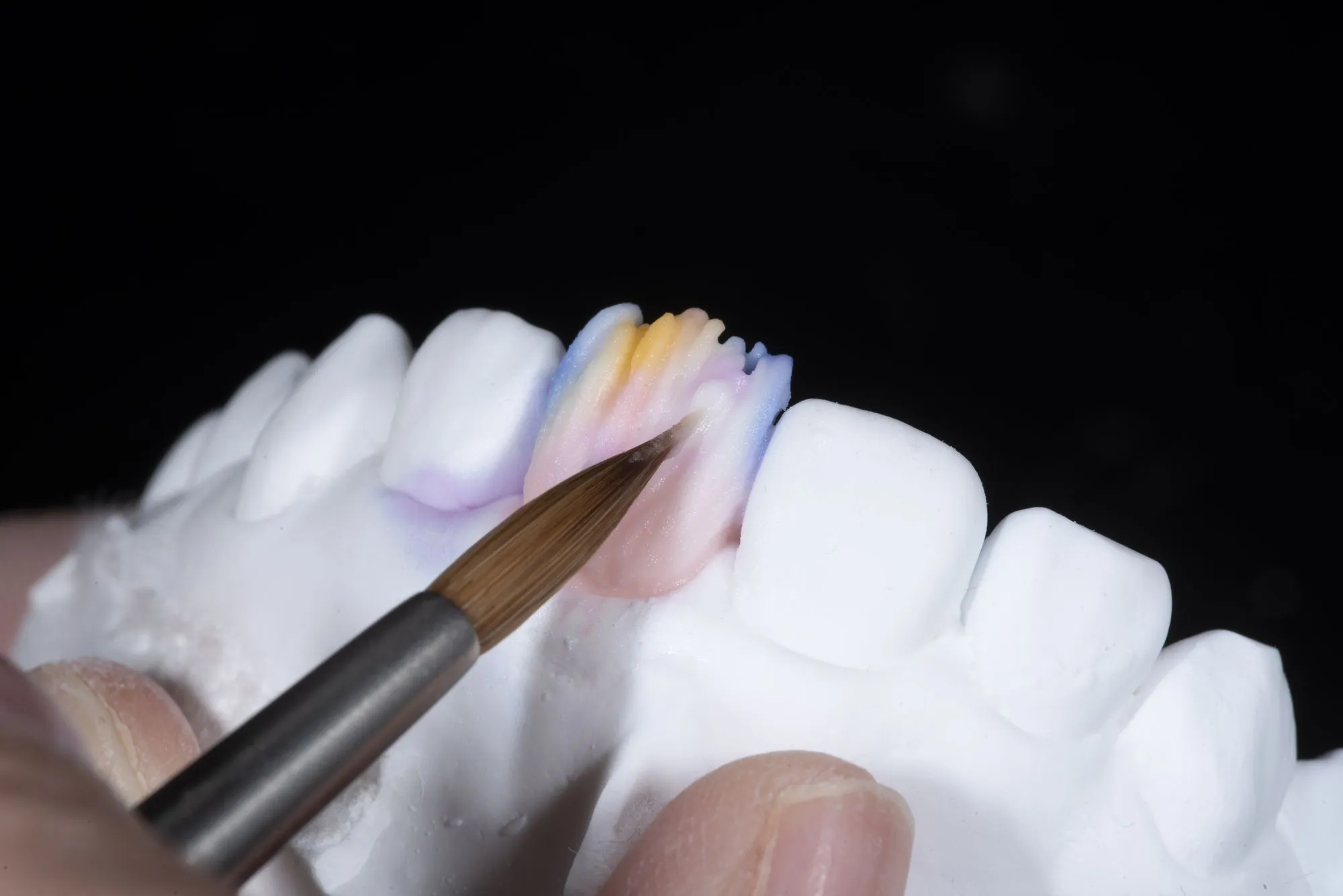 PORCELAIN VENEER
 The Difference
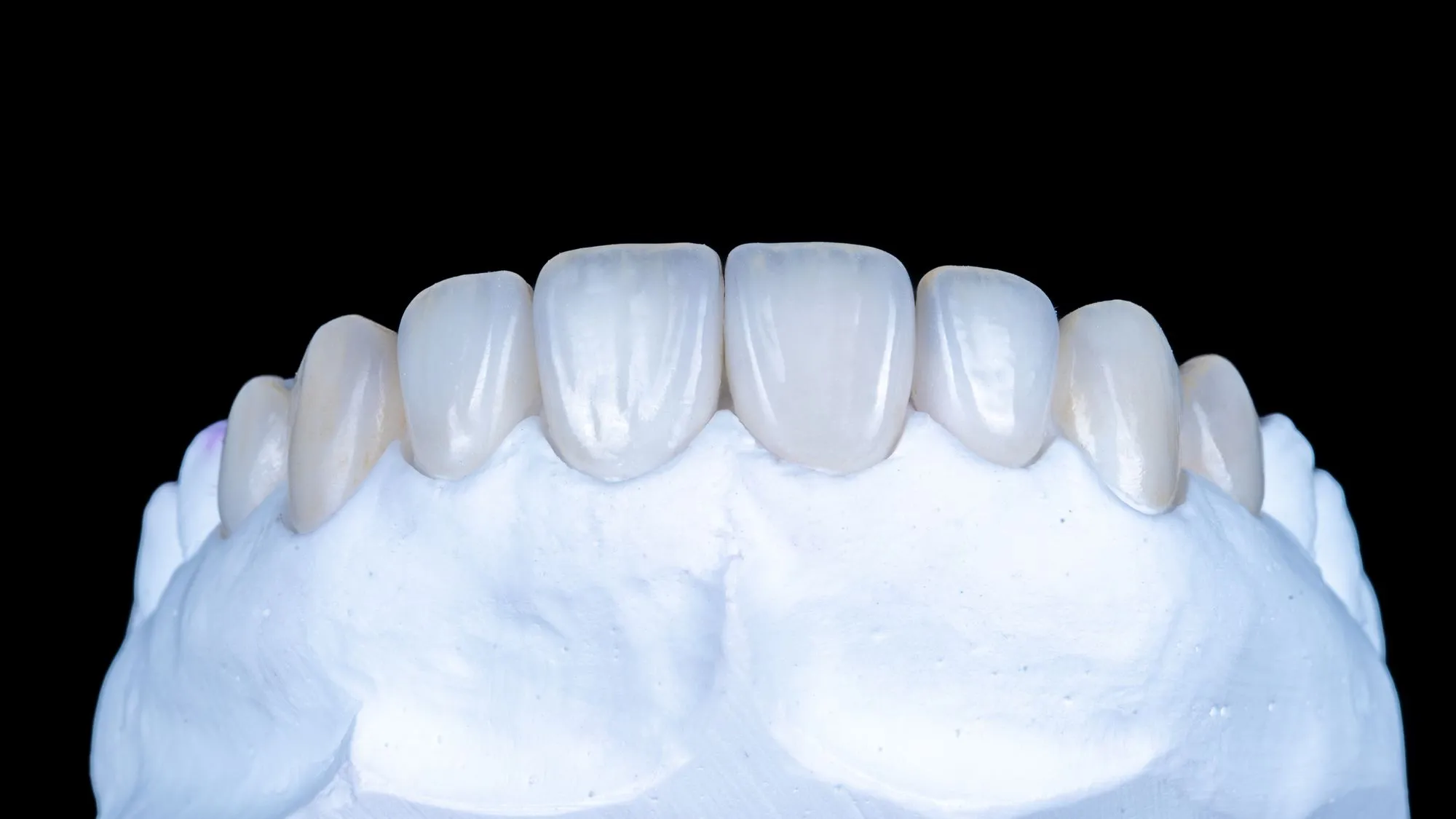
With bonding, the dentist builds the shape directly in your mouth and cures it with light. It is finished that day. A veneer is impressed, made in the laboratory, and bonded back. It takes longer, but the gloss and form can be completed outside the mouth and the material itself does not stain. That single difference — where it is made — produces every other difference.
Side by Side
The same front-tooth problem solved by each. Fees are our published rates, VAT excluded.
| Composite bonding | Veneer | |
|---|---|---|
| Where it is made | Directly in the mouth | In the laboratory, then bonded |
| Time | Usually one same-day visit | Usually 2–3 weeks (2–3 visits) |
| Staining | Margins discolour over time | The ceramic itself does not stain |
| Surface gloss | Gradually roughens | Gloss holds for far longer |
| Tooth reduction | Little to none | None to minimal |
| Repair | Easy to add to | Remade if it debonds |
| Fee (per unit) | KRW 250,000 (300,000 for closing a gap) | KRW 1,300,000 (VAT excl.) |
BEFORE / AFTER
Real veneer cases treated by Dr. Park Jonguk at Dream Dental Clinic, Gangnam. Tap a photo to compare before and after up close.
The before-and-after photos above are real clinical cases treated at Dream Dental Clinic, Gangnam (Dr. Park Jonguk). Results vary with each patient’s condition, and every procedure carries the possibility of individual variation and side effects.
Choose Bonding
Bonding is not a “temporary” option. In these situations it is the more sensible choice.
One or two tiny defects do not warrant fabricating ceramic.
When a front tooth has chipped and must be covered now, finishing the same day is the decisive advantage.
While the gum line and tooth position may still change, buying time with a reversible option is wiser.
Living with a shape built in composite, then transferring that shape to a veneer once you are happy with it, is a perfectly good sequence.

Choose Veneer
If these apply, going straight to ceramic ends up being less trouble than reworking composite repeatedly.
{ Bonding is the way to start cheaply; a veneer is the way to touch it less often. }
Evidence
The lifespan of composite varies so much by operator, site and habit that a single number would be misleading. The figures below are those reported for ceramic veneers.
Meta-analysis of 13 studies — 89% cumulative survival (median follow-up 9 years)
Glass-ceramic reached 94% and feldspathic porcelain 87%; complications were fracture/chipping 4%, debonding 2%, severe discoloration 2%, and secondary caries 1%.
Morimoto S, Albanesi RB, Sesma N, Agra CM, Braga MM. Main Clinical Outcomes of Feldspathic Porcelain and Glass-Ceramic Laminate Veneers: A Systematic Review and Meta-Analysis of Survival and Complication Rates. Int J Prosthodont. 2016;29(1):38-49. PMID 26757327
Estimated survival 82.9% at 20 years (94.4% at 5, 93.5% at 10)
318 veneers in 84 patients, mean follow-up 118 months. Ceramic fracture accounted for 44.8% of failures, and existing parafunction such as bruxism carried a 7.7-times greater risk of failure.
Beier US, Kapferer I, Burtscher D, Dumfahrt H. Clinical performance of porcelain laminate veneers for up to 20 years. Int J Prosthodont. 2012;25(1):79-85. PMID 22259802
Preparations confined to enamel survived at 99% — dentin exposure raised failure risk about tenfold
580 veneers followed for up to 12 years gave 86% overall survival, and 94% when only the margins remained in enamel — what mattered was where the preparation stopped, not merely how much was removed.
Gurel G, Sesma N, Calamita MA, Coachman C, Morimoto S. Influence of enamel preservation on failure rates of porcelain laminate veneers. Int J Periodontics Restorative Dent. 2013;33(1):31-9. PMID 23342345
These figures are general clinical outcomes reported in the academic literature. They are not our clinic’s own results and do not guarantee an individual outcome — your course depends on your teeth, bite, and habits.
A Practical Path
You do not have to decide between the two today. In consultation we often propose this order.
Define what actually bothers you
Colour, form or gaps — each points to a different material.
Small problem, finish in composite
One or two minor defects do not need to become ceramic.
Big change in form, simulate first
Seeing the design in advance makes it clear whether composite is enough.
You can trial the shape in composite
Live with it for a few days; if you like the form, transfer it to ceramic.
Aftercare differs once decided
Composite is about managing staining; veneers are about managing force — grinding and biting things open.
Quick Consult
Leave your number and we will call you back during clinic hours.
Request Received
We will contact you during clinic hours. For urgent matters, please call +82-2-3448-0028.
The available range depends on your condition. Feel free to ask us.
FAQ
It varies enormously with site, size and habits. On a front tooth, exposed to both load and staining, marginal discoloration or a small fracture that needs reworking is common. We cannot honestly reduce it to a single figure.
Yes. But each repetition means refreshing the bonding surface again, and matching the shade gets progressively harder. Once the repeats add up, it is time to consider ceramic.
Yes. We remove the old composite, check what tooth remains, and design from there. If decay was hiding underneath, the reduction may increase.
The material, the laboratory process and how long it holds all differ. Where the site will need frequent attention, ceramic ends up less troublesome; for a single small defect, bonding is the sensible answer.
A narrow gap, yes. But a wide one requires building material up thickly, which makes the shape look bulky and the margins stain more visibly.
Yes. Ceramic on the four most visible front teeth and composite on a small, less visible defect is a plan we use often.
This page is general information about the treatment. Diagnosis, treatment options, and duration vary by individual condition — an in-person examination is how we plan your actual care.
Articles
How the same topic is judged chairside, written up with real cases.
In many cases both are possible. We look at the tooth and tell you honestly which route means less trouble.