
Small
The tooth is small enough that adding a veneer will not make it look bulky
No-Prep Veneers
No-prep veneers place a thin ceramic shell over the tooth without drilling. For qualifying teeth, no anesthesia or reduction is required, so the natural tooth structure stays intact and the burden of preparation is reduced.
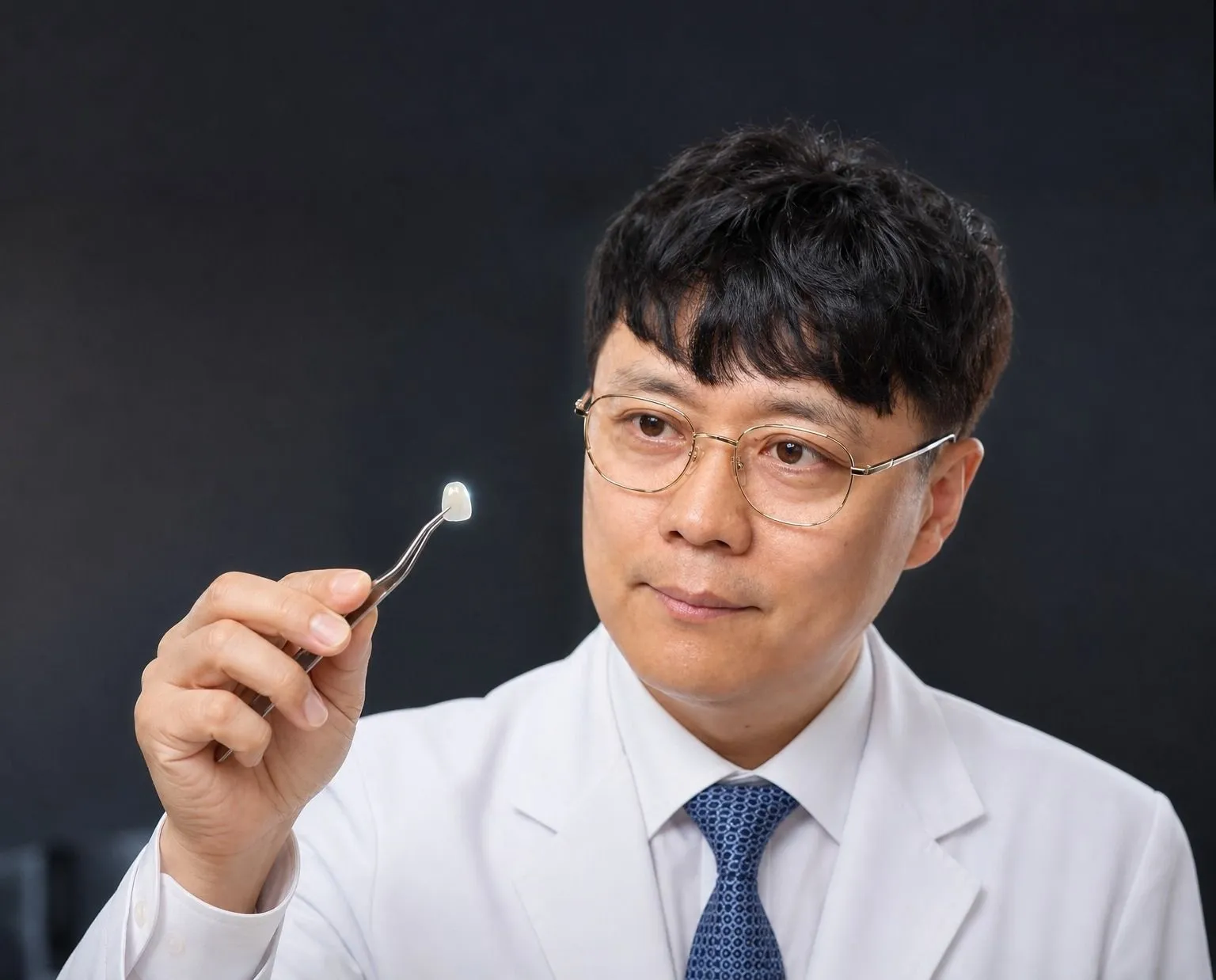 No-Prep Veneers
 Zero
Even without drilling, a thin ceramic layer placed over the tooth can create natural form and shade when the conditions are right.
Case Selection
Not every tooth qualifies. Three criteria are verified during diagnosis.
The tooth is small enough that adding a veneer will not make it look bulky
The arch is even and well-aligned, so no extra space needs to be created
The tooth does not protrude, leaving room for added thickness
S·A·F eligibility is determined with Park’s AES digital diagnosis. Park’s AES →
Three Tiers
When a tooth needs a bigger change of form, micro- and minimal-prep widen the design envelope. Which tier fits is a diagnostic decision.
| Criteria | No-prep | Micro-prep | Minimal-prep |
|---|---|---|---|
| Reduction | None | A trace amount, under the microscope | Only what the design requires |
| Anesthesia | Not needed | Not needed | Light anesthesia |
| Provisionals | Not needed | Not needed | Required |
The principle holds at every tier — we design only within what keeps the natural tooth safe.
Honest Limits
Promising no-prep to everyone would not be honest. In the cases below, micro- or minimal-prep — sometimes orthodontics — serves you better.
Eligibility is decided by data, not feel — Park’s AES shows numerically what can be achieved without reduction. Park’s AES →
Preservation
The most important question in aesthetic dentistry is “how much of my tooth survives?” The same concern leaves very different amounts behind.
| Criteria | No-prep veneer | Conventional veneer | Crown |
|---|---|---|---|
| Reduction | 0 mm — none | Partial enamel (calculated minimum) | Full-circumference reduction |
| Anesthesia | Not needed | Sometimes light | Required |
| Provisionals | Not needed | For minimal-prep cases | Required |
| Reversibility | No reduction — favorable for preserving tooth structure | Reduction is permanent | Permanent |
| Best for | Teeth meeting S·A·F | Teeth needing shape change | Heavily damaged teeth |
Bonding Science
A thin ceramic’s strength comes not from thickness but from bonding. The shell’s inner surface is acid-etched into micro-texture, the enamel is conditioned the same way, and resin cement flows into both before curing — mechanically interlocking shell and tooth into one body. Bonded this way, ceramic takes chewing force together with the tooth rather than alone, which is how paper-thin shells survive daily function. It is why we say bonding is half of veneer treatment — and where Dr. Park’s work in the Korean Academy of Adhesive Dentistry meets daily practice. During cementation a single drop of saliva can sharply weaken the bond, so isolation is kept strict and each tooth is bonded one at a time — with identical materials, the discipline of the protocol is what separates lifespans.
How
A paper-thin multilayer ceramic shell is bonded to the intact surface. On a qualifying tooth, the added thickness reads not as bulk but as restored proportion. And because nothing is trimmed, the enamel — where ceramic bonds strongest — remains whole, which favors bonding longevity too.
 Try-in
 Cases
No-prep veneer case





No-prep veneers — a natural smile completed without any reduction

No-prep veneers — treated without reducing the teeth

Process
No drilling means a simpler journey — most cases finish in two visits.
Diagnosis — the S·A·F call
Park’s AES digitally verifies whether no-prep is possible. If it is not, we explain why and what the alternative is.
Design
Shell form and shade are planned around your proportions and smile line, previewed with a wax-up.
Multilayer fabrication (several days)
Our in-house lab hand-layers the 0.1 mm-class shells. With no reduction, you live as usual — no provisionals.
Try-in & bonding
Shade and form are confirmed before bonding; precise cementation under isolation, then a bite check. Usually without anesthesia.
Check-up
We confirm the bond and comfort, and go over care routines.
Comfort
With no drilling, an injection is usually unnecessary in the first place.
Nothing is exposed, so you go about life as usual while the shells are made.
The enamel stays intact — the usual cause of post-reduction sensitivity never happens.
For those who postponed dentistry over needles and drill noise, no-prep is the gentlest way into aesthetic care.
Quick Consult
Leave your number and we will call you back during clinic hours.
Request Received
We will contact you during clinic hours. For urgent matters, please call +82-2-3448-0028.
The available range depends on your condition. Feel free to ask us.
FAQ
No. They suit teeth that are small (S), aligned (A), and flat rather than protruding (F). Outside those conditions we widen to micro- or minimal-prep, or recommend another treatment. Eligibility is a data decision made at diagnosis.
On qualifying teeth, a 0.1 mm-class shell reads as restored proportion, not bulk. We check the profile view together at try-in before bonding — a bulky result is never forced through.
Once firmly bonded, a thin shell takes force as one body with the tooth and resists fracture well. Habits like opening caps with your teeth must still be avoided, and grinders get a night guard planned alongside.
Because the tooth was never drilled, releasing the shell with the Er:YAG laser leaves the tooth as it originally was. That preserved reversibility is one of no-prep’s biggest advantages over reduction-based veneers.
When there is no reduction, proceeding without anesthesia is the norm, and bonding itself is not a painful step. Anesthesia can be added at any point if you want it.
No — the fee is the same: KRW 1,300,000 per tooth for multilayer build-up veneers (VAT excluded, as of 2026), regardless of reduction tier. The full fee table is disclosed on our pricing page.
Yes — partial shells covering only the gap side of a tooth are a classic no-prep case. Because the junction must be invisible, they demand even finer shade and contour design than full veneers.
With no trimming and no provisionals, both chair time and total visits tend to shrink. Most cases finish in two visits — one for diagnosis and design, one for try-in and bonding.
The conditions actually favor them: ceramic bonds strongest to enamel, and no-prep leaves the entire bonding surface as untouched enamel. Real-world lifespan still depends on bite, habits, and care — regular check-ups remain the foundation.
No-prep veneers are a front-teeth treatment, covering what shows when you smile. Canines are sometimes included depending on your smile line, but load-bearing molars call for crowns or inlays instead of thin shells.
The shell covers only the front surface — between the teeth and at the gum line, your natural tooth remains. That is why flossing and check-ups continue to matter. Early decay can often be treated without disturbing the shell, managed directly by our conservative-dentistry specialist.
Yes — a good combination. Orthodontics settles the alignment (the A criterion), which raises no-prep eligibility. Residual gaps, peg laterals, and shape concerns after braces are exactly what no-prep shells finish well.
The cement light-cures during the visit, but for the first 24 hours we advise avoiding very hard or chewy foods. After that, eat normally — just skip opening bottles or crunching ice with your front teeth.
Because the criteria can differ from clinic to clinic. We verify the three S·A·F conditions numerically with Park’s AES digital diagnosis and show you the data behind “yes” or “no.”
Lower incisors are small, which favors the S condition — the deciding factor is bite clearance against the uppers. With room to spare, no-prep proceeds; without it, we advise micro-prep or an alternative.
The disclosed fee is the same as any veneer — KRW 1,300,000 per tooth, so KRW 2,600,000 for two (VAT excluded, as of 2026). Two peg laterals are the classic no-prep case, often finished in two visits.
0.1–0.5mm, often compared to a contact lens. Margins are finished and polished along the gum line and tooth contours, aiming for a result where no eye can tell where shell ends and tooth begins.
Yes, identically. Shells are seated temporarily to confirm shade, form, and speech, and bonded only after your approval. Zero reduction never means skipping verification.
If the sensitivity comes from surface wear or enamel damage, covering the exposed area can be expected to help. Sensitivity from decay or gum recession needs its own treatment first — cause comes before shell.
No upper limit for adults — preserving enamel makes it gentle even on mature teeth. For adolescents still growing, tooth and gum positions are still shifting, so we advise waiting until growth completes.
The try-in stage effectively is that: finished shells are seated temporarily, shade and form reviewed, revised if wanted, and reviewed again. Permanent bonding happens only after your approval — decide after the experience, not before.
BEFORE / AFTER
Real veneer cases treated by Dr. Park Jonguk at Dream Dental Clinic, Gangnam. Tap a photo to compare before and after up close.
The before-and-after photos above are real clinical cases treated at Dream Dental Clinic, Gangnam (Dr. Park Jonguk). Results vary with each patient’s condition, and every procedure carries the possibility of individual variation and side effects.
Articles
How the same topic is judged chairside, written up with real cases.
Find out whether your teeth meet the no-prep criteria — through diagnosis.