
Resin vs. Veneers: 5 Things You Must Know Before Front-Tooth Treatment
Hello.
I'm Park Jonguk, director of Dream Dental Clinic, Apgujeong.
Resin (Composite Resin) is a treatment that shapes a tooth-colored restorative material directly onto the tooth,
while a veneer (Porcelain Laminate Veneer) is a treatment that bonds a thin ceramic shell, pre-fabricated in advance, onto the tooth surface.
There's a question that patients considering front-tooth treatment ask more than any other.
"What's the difference between resin and veneers?"
"Can't I just get resin done?"
"The price difference is large — is the result really that different?"
Both treatments are good treatments.
But there are clear differences in their range of application and results.
Today, drawing on 20 years of clinical experience with veneers, I'll give you a candid look at the differences between the two.
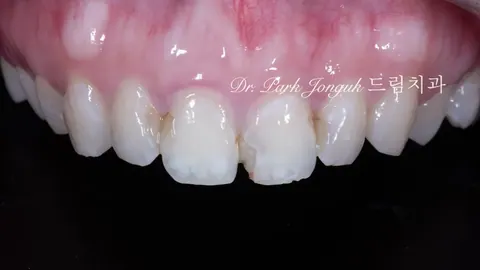
![[Photo 1] Before-and-after comparison photo of veneer treatment](/column-media/224254448890/01.webp)
1. The Difference in Materials: Resin vs. Veneer
Resin is a plastic-family material called composite resin.
It's built up directly on the tooth to form the shape.
Same-day treatment is possible, and the cost is relatively low.
A veneer is made of ceramic (porcelain).
It's precisely fabricated at a dental lab and then bonded onto the tooth.
It can reproduce translucency and texture nearly identical to a natural tooth.
The biggest difference shows up over time.
Resin discolors as time passes.
The surface roughens and the shine fades.
This usually becomes noticeable starting around 2 to 3 years in.
Because a veneer is ceramic, there's almost no discoloration.
The shine also holds up for a long time.
In many cases, the color stays the same as at the time of treatment even after 10 years.
That said, discoloration can occur at the cement that bonds the veneer to the tooth.
That's because the cement itself is a resin.
Good ongoing care is needed to keep it discoloration-free for a long time.
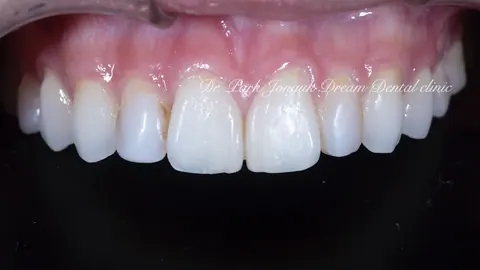
![[Photo 2] Long-term veneer maintenance case photo](/column-media/224254448890/02.webp)
2. Comparing Aesthetics: Resin vs. Veneer
With resin, the shape is formed directly by the practitioner's (the dentist's) hands.
It's effective for simple restorations.
It works very well for filling small cavities or chipped areas.
But when it comes to unifying the shape, color, and translucency across several teeth,
since everything has to be done inside the mouth,
the time the patient has to keep their mouth open during treatment ends up quite long.
A veneer is made by a dental technician in the lab, building up multiple layers of ceramic.
The enamel, dentin, and translucent layer of a natural tooth can each be reproduced individually.
Even the shade harmony with adjacent teeth and the translucency at the incisal edge are expressed in fine detail.
Given these limitations, resin can still be a good treatment when only one or two teeth are involved,
but veneers show their advantage to the fullest especially when treating 6 to 8 front teeth at once.
That's because all the teeth are designed together as a single, harmonious whole.
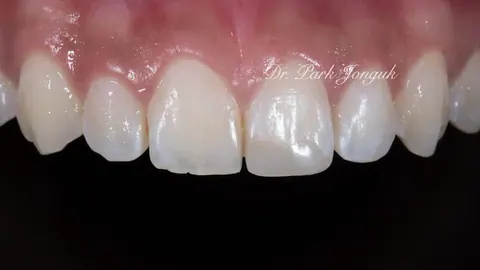
![[Photo 3] Photo of veneer treatment on 6 to 8 front teeth](/column-media/224254448890/03.webp)
3. Lifespan and Durability: Resin vs. Veneer
The average lifespan of resin is about 3 to 7 years.
Over time, discoloration, wear, and gaps at the margin develop.
It often needs to be touched up again on a regular basis.
The average lifespan of a veneer is 10 to 20 years or more.
Ceramic is a very stable material inside the mouth.
It resists both wear and staining well.
Of course, a veneer isn't permanent either.
But comparing the condition maintained over the same period, there's a clear difference.
▶ If you'd like to learn more about veneer lifespan, please refer to our earlier article.
→ [How Long Do Veneers Last? 20 Years of Experience Tells You]
4. When Resin Is the Better Fit
There are certainly cases where resin is the more suitable choice.
Small cavity restorations on 1 to 2 teeth
When a chip from trauma needs urgent restoration
Temporary restoration for children or adolescents whose growth is still ongoing
A temporary solution when there's a budget constraint
In cases like these, resin is an excellent choice.
A veneer isn't the right answer for every situation.
But if you want an overall aesthetic improvement of your front teeth,
if you want to change the color and shape of several teeth at once,
and if you want a result that lasts a long time,
a veneer is the more suitable choice.
![[Photo 4] A case where overall front-tooth aesthetics were completed with veneers](/column-media/224254448890/04.webp)
![[Photo 5] Photo of the veneer treatment process](/column-media/224254448890/05.webp)
Frequently Asked Questions
Q. I had resin done and it's badly discolored. Can I switch to veneers?
A. Yes, that's possible. Removing existing resin and replacing it with a veneer is a very common procedure. In fact, many patients end up coming to veneers after repeatedly having resin redone. Once the resin is cleanly removed and the tooth condition is evaluated, fabricating a veneer with minimal reduction can give you a much longer-lasting result.
▶ If you're torn between resin and veneers, the article below may also help.
→ [Treating Black Triangles: Resin vs. Veneer — Which Is Better?]
Q. Is a veneer still a good choice for treating just one or two front teeth?
A. Even when treating just one or two teeth, a veneer can give a good result. However, matching the color with the adjacent teeth becomes very important. A natural result only comes from a skilled technician precisely analyzing the shade of the neighboring teeth during fabrication. Treating just 1 to 2 teeth actually demands even higher technical skill.
▶ If you're curious about a case completed with just 2 front teeth, please refer to our earlier article.
→ [Just 2 Front-Tooth Veneers? The Secret of a Skilled Veneer Clinic]
Q. If the cost of veneers is a burden, can I get resin done first and switch later?
A. It's possible, but I wouldn't recommend this approach. Every time resin is redone, the tooth surface gets damaged a little more. By the time you switch to veneers later, the tooth condition has often already become less favorable. If cost is a concern, it's wiser to start with veneers on just the few teeth that need it most.
Dream Dental Clinic has been a clinic centered on veneer treatment for 20 years.
We diagnose accurately which cases call for resin and which call for veneers.
If you're considering front-tooth treatment, please feel free to consult with us anytime.
Thank you.
Park Jonguk, Director, Dream Dental Clinic, Apgujeong
Board-certified specialist in conservative dentistry
This article is a clinical note written by Dr. Park Jonguk of Dream Dental Clinic, Gangnam; the original was published on his blog. The photographs shown are real cases he treated. Results vary with each patient’s condition, and every procedure carries the possibility of individual variation and side effects.
Quick Consult
Request a Callback
Leave your number and we will call you back during clinic hours.
Request Received
We will contact you during clinic hours. For urgent matters, please call +82-2-3448-0028.