
Shade designed in person
The color and translucency observed chairside are carried directly into the layer design.
Multilayer Build-up Veneers
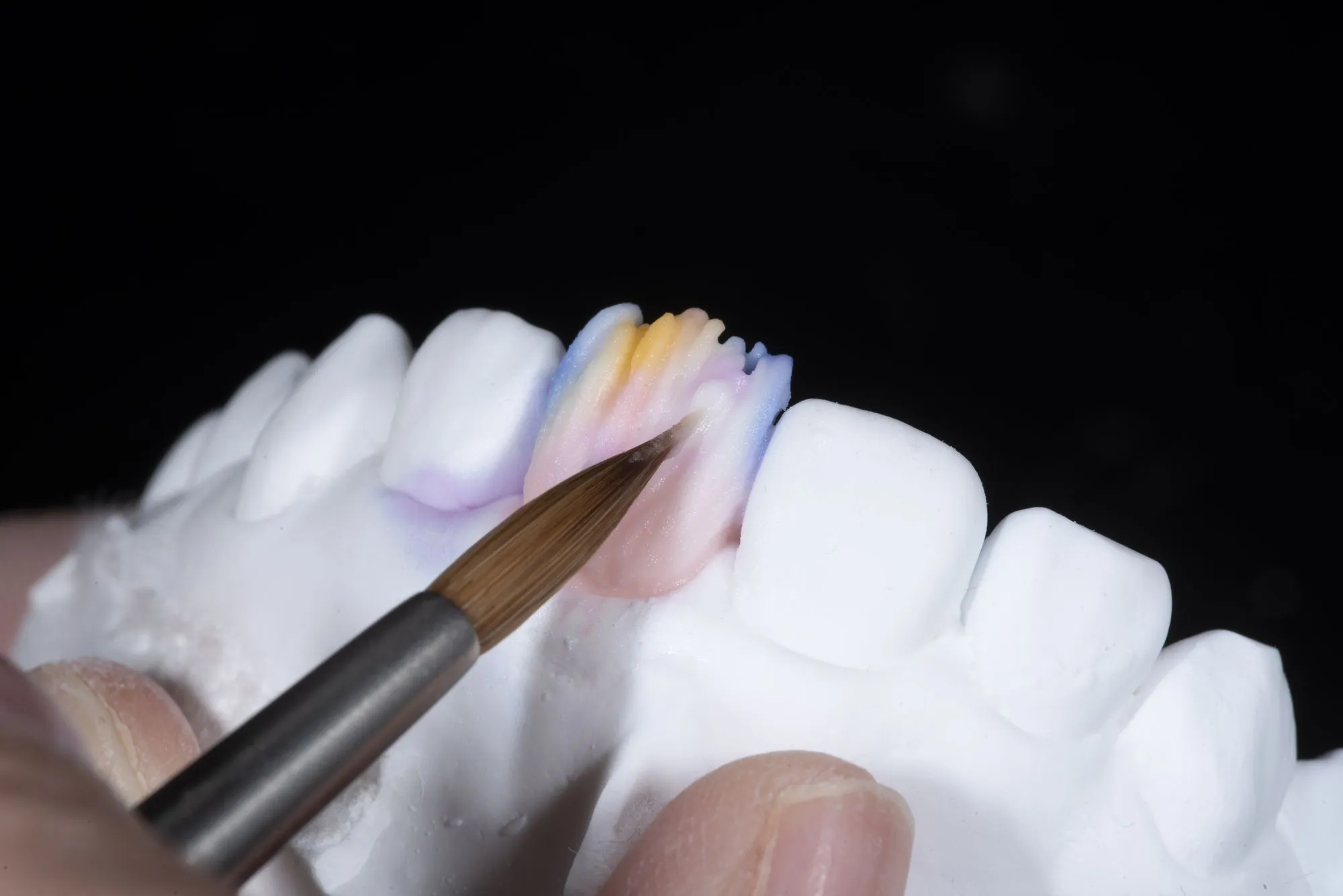
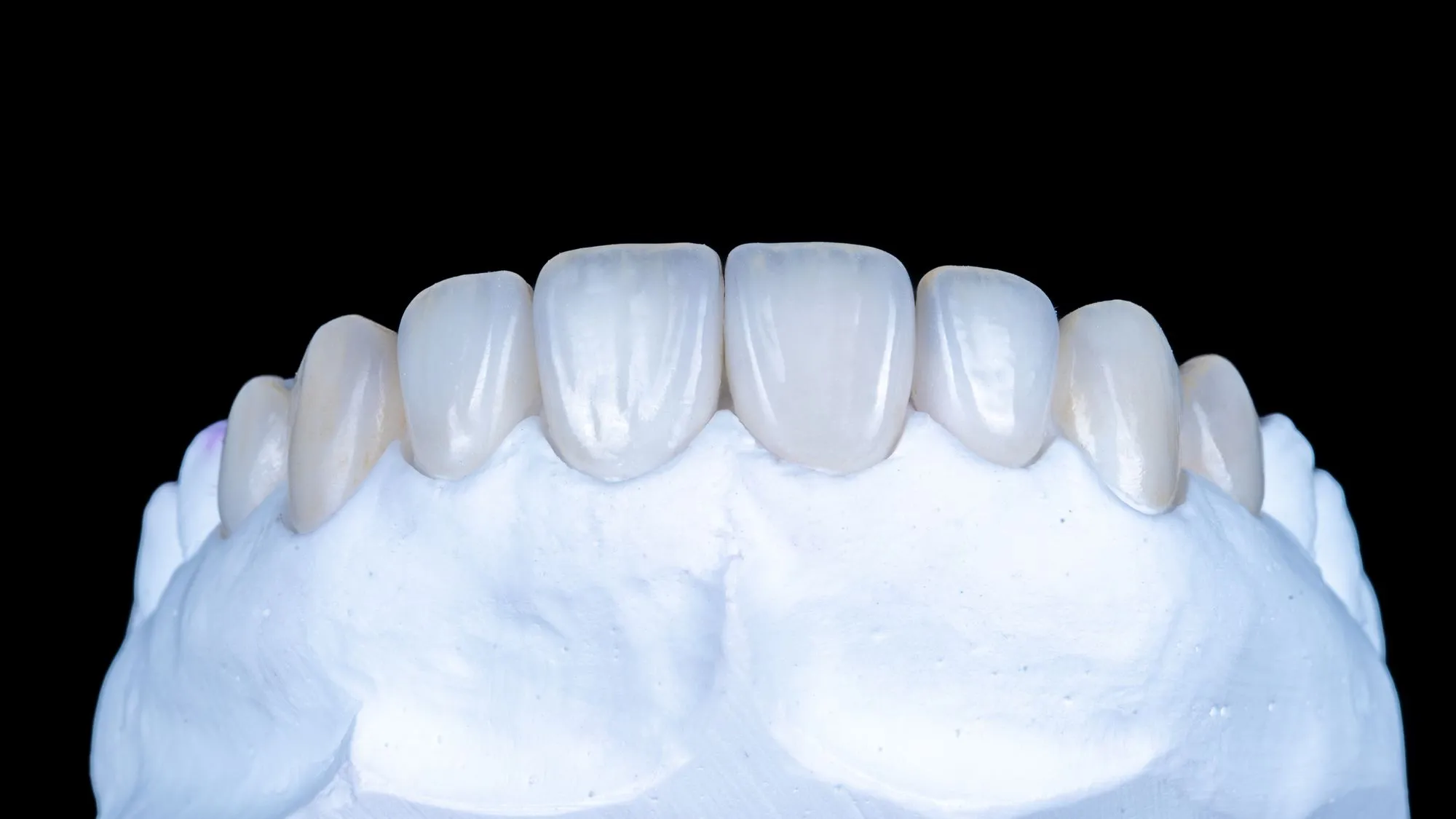
Four to five different ceramic powders are stacked in successive strata to recreate the translucency and color of natural teeth. Because each layer is built by hand, the result blends seamlessly with its neighbors.
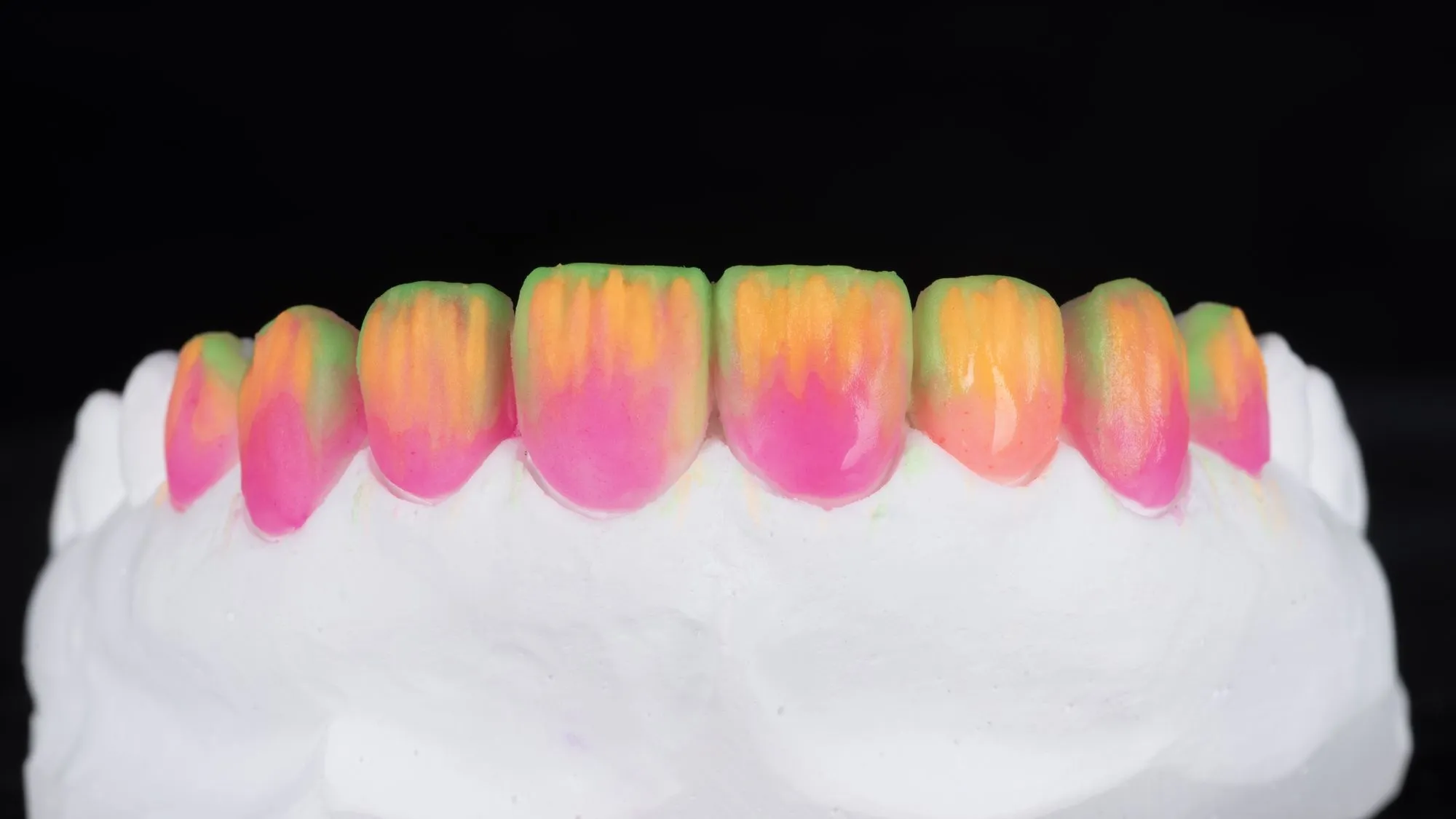 Multilayer Build-up
 Laminate Veneer
A treatment that bonds a thin layer of ceramic to the front surface of the tooth. It improves color, shape, and size — the maximum aesthetic effect through minimal invasion.
The Five Strata
The depth of a natural tooth does not come from one material. From the dentin that masks the substrate to the layer that carries incisal translucency, each ceramic is built up in order.
Opaque Dentin
Opaque Dentin
Masks discoloration and sets the base shade
Body Dentin
Body Dentin
Defines the dominant color of the tooth
Enamel
Enamel
Recreates surface texture and optical behavior
Translucent
Translucent
Incisal translucency — the key to naturalness
Glaze
Glaze
Luster and final surface finish
Why Layers
Because a natural tooth is itself layered. Yellowish dentin sits beneath semi-translucent enamel, and light passing through and reflecting between those strata is what creates the deep, living color of a real tooth. A shell milled from one ceramic lacks that optical structure — it can only imitate a surface color. Multilayer build-up stacks a dentin-role layer and an enamel-role layer in order, reproducing not a color but the structure of light.
Handmade
At Dream, the person who diagnoses also designs the shade. Only someone who has seen your teeth in person can reproduce their subtle color differences.
The color and translucency observed chairside are carried directly into the layer design.
Not milled from a pre-shaded block — built up individually for each tooth.
At try-in, shade and form are verified and refined stratum by stratum where needed.
Why Multilayer
| Criteria | One-day / single ceramic | Multilayer build-up (Dream) |
|---|---|---|
| Fabrication time | 20–30 minutes | Several days |
| Ceramics used | One | Four to five |
| Translucency | None | Identical to natural teeth |
| With only two veneers | Noticeable | Blends in unnoticed |
Best For
Not every veneer strictly needs layering — but in the cases below, the difference of strata shows directly in the result.
Six Steps of Making
This is where the several days go. Every step happens in our in-house lab, in the hands of the person who saw your teeth.
Shade observation & records
Chairside, the neighbors’ shade, translucency, and texture are observed and recorded with photographs and shade guides.
Design on the model
Shell form and thickness distribution are planned on the working model — including the layer recipe.
Layering
From opaque dentin to translucent, ceramics with different roles are brushed on stratum by stratum.
Firing
Each build is fired at high temperature to set strength and shade — repeated with every added layer.
Carving form & texture
Natural ridge lines and line angles are carved so light reflects as it does off a real tooth.
Glaze & polish
Luster is applied and the surface finished, ready for the final check at try-in.
Thickness
A veneer shell is usually 0.3–0.7mm thick in total. Every layer — from the masking base to the translucent tip — must share that space, leaving each stratum barely the width of a few hairs. A heavily discolored tooth gets more thickness assigned to opaque dentin for masking power; a tooth with good underlying color gets its thickness shifted to the enamel and translucent layers. The same five strata are budgeted differently for every tooth, and that budget is what determines how much — or how little — reduction is needed.
Discolored teeth
More thickness to the masking layer — blocking the base shade without letting the veneer turn grey.
Bright, youthful teeth
Thickness shifted to the translucent layers, preserving the glassy incisal edge so neighbors cannot tell.
Link to reduction
The layer budget comes first; only then is the minimum reduction decided. We never trim by a uniform default.
Process
Quick Consult
Leave your number and we will call you back during clinic hours.
Request Received
We will contact you during clinic hours. For urgent matters, please call +82-2-3448-0028.
The available range depends on your condition. Feel free to ask us.
FAQ
It depends on care and habits, but multilayer build-up veneers stay in good condition for a long time with proper care. We recommend regular check-ups.
No-prep is applicable when the teeth are small, the arch is even, and the teeth do not protrude. An exact assessment is provided after diagnosis.
One-day veneers are fabricated quickly from a single ceramic, while build-up veneers layer four to five ceramics to recreate the same translucency and shade as natural teeth.
The multilayer build-up method puts harmony with the neighboring natural teeth first. Even with only two veneers, nothing stands out — that is Dream Dental Clinic’s strength.
Yes. Enamel loss, discoloration, and wear caused by aging can be improved with veneers, restoring natural, healthy-looking teeth.
Revision is possible for existing veneers with discoloration, fracture, or unsatisfactory results. We examine their current state in detail and then guide you to the best approach.
At Dream Dental Clinic, veneers are KRW 1,300,000 per tooth (VAT excluded). Other non-covered fees — anterior all-ceramic crown KRW 1,300,000, ceramic crown KRW 700,000 — are listed in the fee guide on our website and may vary with tooth condition and treatment scope.
Every added layer must be fired at high temperature, and all six steps — shade records, layering, firing, carving, glazing — are done by hand. That time is exactly what produces the translucency and depth a single ceramic cannot.
A traditional porcelain known for optical behavior closest to natural enamel, suited to thin, hand-layered build-up. It is the material we use for multilayer veneers — unlike milled ceramic blocks, it allows shade expression layer by layer.
Porcelain strongly resists color change, and the glaze layer reduces staining — coffee and tea affect it less than natural enamel. The bonded margin can pick up slight staining over the years, which is managed with polishing at regular check-ups.
Only as much as the layer budget requires — typically within 0.3–0.7mm. Small or inward-set teeth may qualify for no-prep veneers with no reduction at all. Per-tooth thickness design comes before any trimming.
Usually one visit for diagnosis and shade records, then one or two for try-in and bonding. The fabrication days are in-house lab time — no visit needed — and if the try-in is not fully satisfying, the shade is corrected layer by layer before bonding.
Before bonding, the shells are seated temporarily so shade, form, length, and speech can be checked in your actual mouth — under daylight and room light together. Anything unsatisfying is corrected layer by layer first. We never rush past this stage.
Together, on the shade guide, compared against your neighboring teeth and skin tone. Photographic records and chairside observation drive the layer recipe — so the target is never just “white,” but a specific shade at a specific translucency.
Small chips are often recovered with polishing or repair; a larger fracture means remaking that tooth alone. Your shade records stay on file in our in-house lab, so a single remake still matches its neighbors.
Because the layered structure passes and reflects light the way enamel does, the goal is a veneer that never flares flat white under camera flash or dim lighting. We verify this under multiple light sources at try-in.
Hand-layering demands both the layering craft and an in-house lab, so it is offered at fewer places than milled one-day veneers. It is worth asking any clinic which fabrication method they actually use.
Yes — the micro-contours of natural enamel are what shape its light reflection. At the carving stage we observe your neighboring teeth’s texture, carve the same grain, and match the glaze level. A merely smooth surface is exactly what looks artificial.
Look for verifiable records rather than ad copy. Dr. Park Jonguk authored Korea’s first clinical veneer textbook (Daehan Narae Publishing, 2025), serves as education director of the Korea Academy of Adhesive Dentistry, and has taught 15 regular hands-on seminars for practicing dentists — credentials you can check against the academy’s board list and the Korean dental trade press. Then confirm the clinic shows you its diagnostic work-up (photos, models, reduction planning) before treatment, and that it handles revision cases too.
BEFORE / AFTER
Real veneer cases treated by Dr. Park Jonguk at Dream Dental Clinic, Gangnam. Tap a photo to compare before and after up close.
The before-and-after photos above are real clinical cases treated at Dream Dental Clinic, Gangnam (Dr. Park Jonguk). Results vary with each patient’s condition, and every procedure carries the possibility of individual variation and side effects.
Articles
How the same topic is judged chairside, written up with real cases.
Consultations for multilayer veneers — registration until 17:30 weekdays, 12:30 Saturdays.