
Gum disease dropped the gum and the bone
Where periodontitis has passed, the bone that supported the papilla is itself lower, so the gum does not return to its original height.
Black triangles
The tips of the teeth touch, but near the gum a triangular space stays open and reads as a shadow. Photographs make it especially obvious. It is a problem of the tooth and of the gum at the same time.
 PORCELAIN VENEER
 What It Is
Between two teeth, the gum normally fills a sharp triangle — the interdental papilla. When that papilla drops, a triangular space is left below the contact and reads as dark. However well the tooth is built, the only way to reduce that space is to widen the tooth’s form towards the gum. So this becomes a question of how much can be filled.
Why It Happens
Knowing the cause is how we judge whether filling it now will hold.
Where periodontitis has passed, the bone that supported the papilla is itself lower, so the gum does not return to its original height.
When overlapping teeth stand upright, the contact point moves higher, revealing a triangular space beneath it.
Teeth that narrow towards the root have a high contact point, so the space below was always open.
Repeatedly pushing an oversized tool through can compress and flatten the papilla.
BEFORE / AFTER
Real veneer cases treated by Dr. Park Jonguk at Dream Dental Clinic, Gangnam. Tap a photo to compare before and after up close.
The before-and-after photos above are real clinical cases treated at Dream Dental Clinic, Gangnam (Dr. Park Jonguk). Results vary with each patient’s condition, and every procedure carries the possibility of individual variation and side effects.
Options
The approach depends on the size of the space and its cause. No single method covers everything.
| Approach | Suits | Limits |
|---|---|---|
| Periodontal treatment first | Inflammation still present | Lost bone does not come back |
| Composite bonding | One or two small triangles | Marginal staining, redos |
| Veneers | Rebuilding form across several teeth | Hard to reverse |
| Orthodontic contact adjustment | When the tooth axis is the cause | Adds treatment time |

{ The gum usually does not come back. So this treatment is not about raising the gum — it is about bringing the tooth down to meet it. }
Honest Limits
Getting expectations exactly right matters more here than anywhere else.
How We Approach
We do not start with the tooth. Form comes only after the gum is stable.
Assess the gum first
We check inflammation and pocket depth, and treat periodontally first if needed.
Measure the space
The height of the contact and the width of the triangle tell us how much can be filled.
Decide where the contact should sit
Moving the contact point towards the gum is the core design decision here.
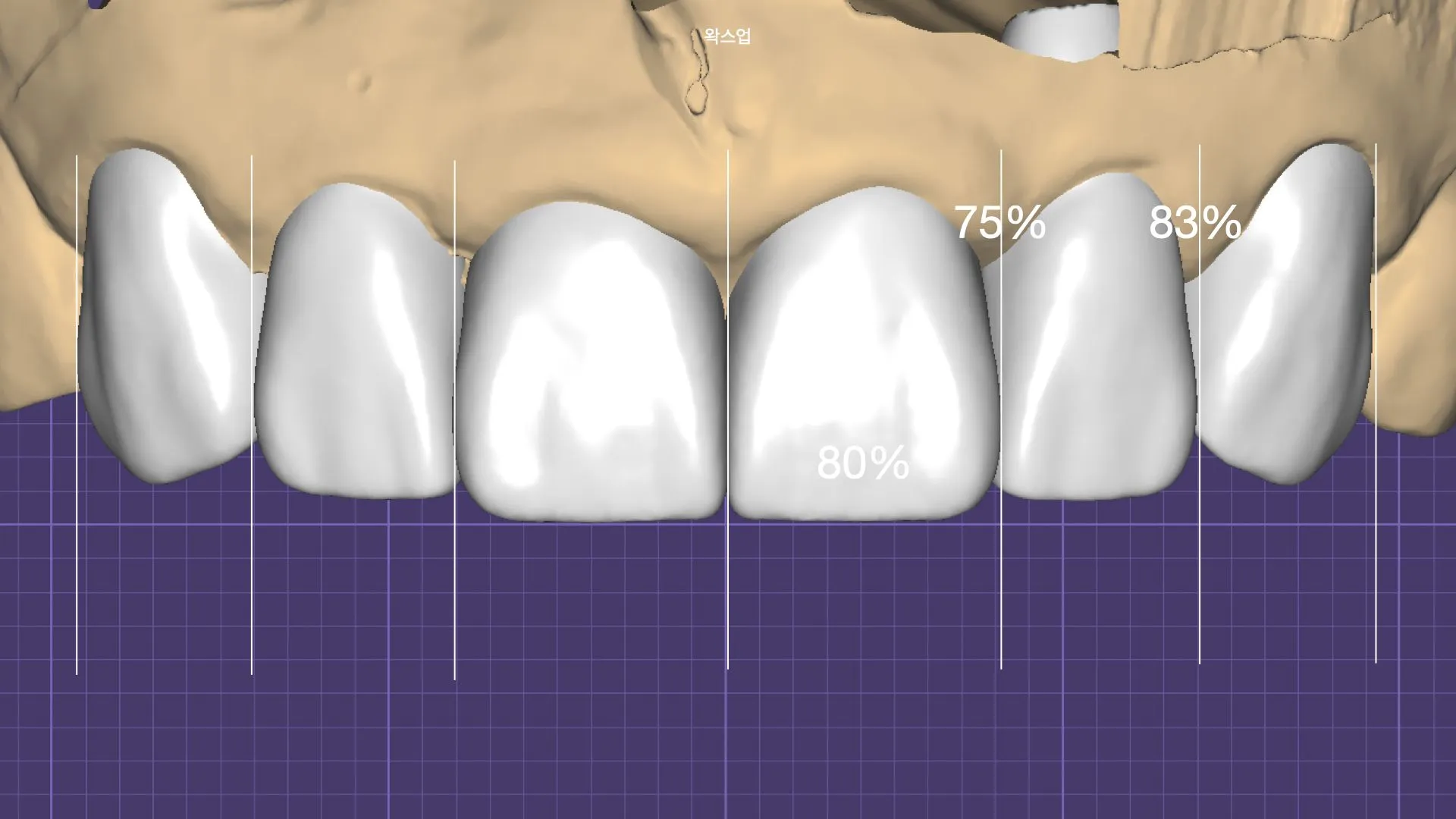
Confirm the form on simulation
We look together at whether the widened shape reads as bulky.
Finish in a cleanable form
Floss must pass through — a condition we place above appearance.

Evidence
There is little established data on regenerating the papilla itself. The figures below come from the restorative side.
Preparations confined to enamel survived at 99% — dentin exposure raised failure risk about tenfold
580 veneers followed for up to 12 years gave 86% overall survival, and 94% when only the margins remained in enamel — what mattered was where the preparation stopped, not merely how much was removed.
Gurel G, Sesma N, Calamita MA, Coachman C, Morimoto S. Influence of enamel preservation on failure rates of porcelain laminate veneers. Int J Periodontics Restorative Dent. 2013;33(1):31-9. PMID 23342345
Meta-analysis of 13 studies — 89% cumulative survival (median follow-up 9 years)
Glass-ceramic reached 94% and feldspathic porcelain 87%; complications were fracture/chipping 4%, debonding 2%, severe discoloration 2%, and secondary caries 1%.
Morimoto S, Albanesi RB, Sesma N, Agra CM, Braga MM. Main Clinical Outcomes of Feldspathic Porcelain and Glass-Ceramic Laminate Veneers: A Systematic Review and Meta-Analysis of Survival and Complication Rates. Int J Prosthodont. 2016;29(1):38-49. PMID 26757327
Estimated survival 82.9% at 20 years (94.4% at 5, 93.5% at 10)
318 veneers in 84 patients, mean follow-up 118 months. Ceramic fracture accounted for 44.8% of failures, and existing parafunction such as bruxism carried a 7.7-times greater risk of failure.
Beier US, Kapferer I, Burtscher D, Dumfahrt H. Clinical performance of porcelain laminate veneers for up to 20 years. Int J Prosthodont. 2012;25(1):79-85. PMID 22259802
These figures are general clinical outcomes reported in the academic literature. They are not our clinic’s own results and do not guarantee an individual outcome — your course depends on your teeth, bite, and habits.
Quick Consult
Leave your number and we will call you back during clinic hours.
Request Received
We will contact you during clinic hours. For urgent matters, please call +82-2-3448-0028.
The available range depends on your condition. Feel free to ask us.
FAQ
If the supporting bone is intact and only inflammation is at fault, some recovery is possible. Where the bone itself has receded, returning to the original height is generally not expected.
A small space can be made effectively invisible. With a large space, the realistic goal is to make it far less noticeable rather than to erase it.
It is not unusual. As overlapping teeth align, the contact point rises and the existing gum height is simply revealed. Restoring the form is often how it is improved.
A triangle sits between two teeth, so at least two are treated together. If the whole front line is affected, we design four or more as one.
We advise against it. Once cleaning becomes impossible, gum disease and decay start right there. We prioritise a form that floss can pass through.
That is a good approach. You experience the filled form in advance, and if you are happy with it, the same shape is transferred into ceramic.
This page is general information about the treatment. Diagnosis, treatment options, and duration vary by individual condition — an in-person examination is how we plan your actual care.
Articles
How the same topic is judged chairside, written up with real cases.
How much can be filled is set by the gum. After examining it we tell you honestly how far the result can go.