
Veneers in Your 60s: How to Naturally and Youthfully Fix Black Triangles and Chipped Teeth
Hello, this is Dream Dental Clinic in Apgujeong.
"As I've gotten older, gaps have opened between my teeth and the edges have chipped, so I look old."
"I have a young-looking face, but I hate that my teeth make me look older."
Just because you're in your 60s doesn't mean you have to settle for old-looking teeth.
Today I'm sharing the case of a patient who had lived with a chipped tooth for decades, and who had also developed black triangles as her gums receded —
a youthful-looking woman in her 60s — and the veneer treatment that made her teeth look younger.
The thing to be most careful about with veneers in your 60s, in particular, is making them too white and artificial-looking.
The one-day method or a single-material approach tends to come out excessively white, which ends up looking unnatural.
I'll show you how we made teeth that look naturally younger.
Before treatment: a concern in the 60s
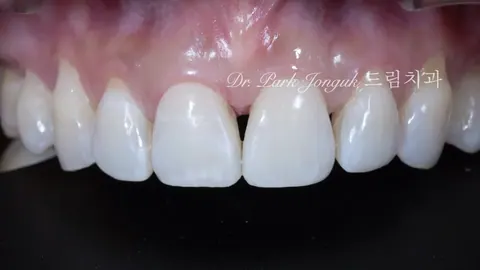
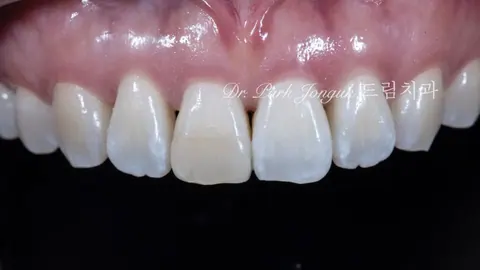
[Photo 1 – Before treatment]
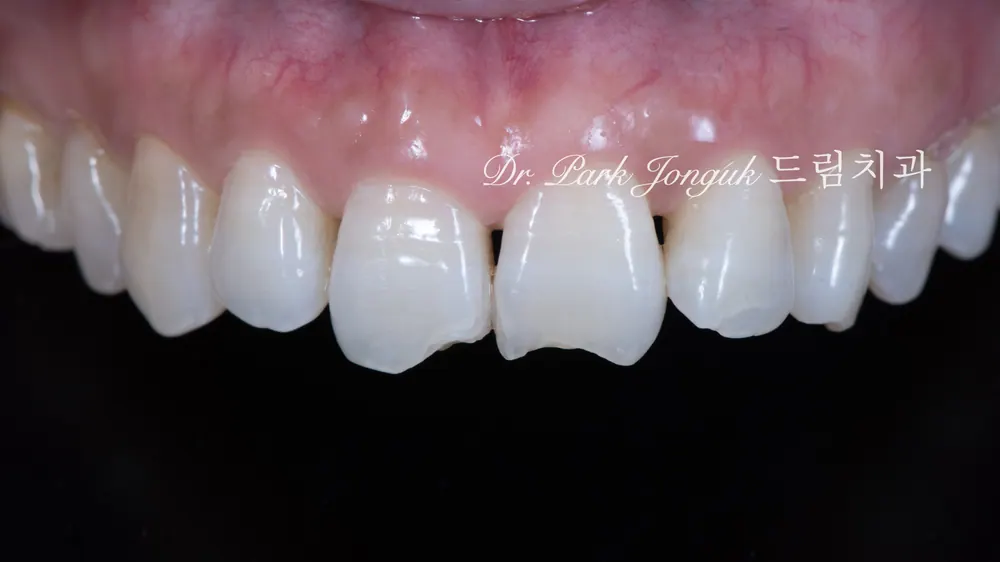
A woman in her 60s came in for treatment. Her appearance was genuinely youthful, but she had a lot of concerns because of her teeth.
Main issues:
❌ A chipped front tooth — she had lived with it just as it was ever since it chipped decades earlier
❌ Black triangles — as the gums receded, dark triangular gaps had formed between the front teeth
❌ Aged teeth — an overall yellowish, dull color
❌ A desire to look younger — she had a youthful face but hated that her teeth made her look older
The patient said, "I want to look younger, but I don't want it to be too obvious."
The trap of veneers in your 60s
The risk of making them excessively white
There's a very common mistake with veneers in your 60s: making them too white.
Problems with the one-day method:
Uses a single block of ceramic milled with CAD/CAM
Made all at once in a very bright, uniform shade
Translucency cannot be adjusted
Result: white, opaque teeth that look like "dentures"
Limitations of a single material:
Only a single shade is used
Can't express a natural tone appropriate to age
No sense of depth
Result: a flat, artificial feel
Why is this a problem?
Giving someone in their 60s teeth as bright white as a 20- or 30-something's actually looks unnatural and strange.
People around them immediately notice, "Oh, they've had dental work done."
Trying to look younger backfires, making them look artificial instead.
What does a natural veneer for someone in their 60s look like?
Core principles:
✓ Not too white, but a bright, clean tone ✓ Translucency is essential for naturalness ✓ Subtle color variation gives a sense of depth ✓ A slightly warm tone appropriate to age ✓ "Looking younger, but naturally"
A result like this is only possible with the handmade build-up method.
Precise diagnosis: a strategy that avoids enlarging the teeth
[Photo 2 – Size and proportion diagnosis]
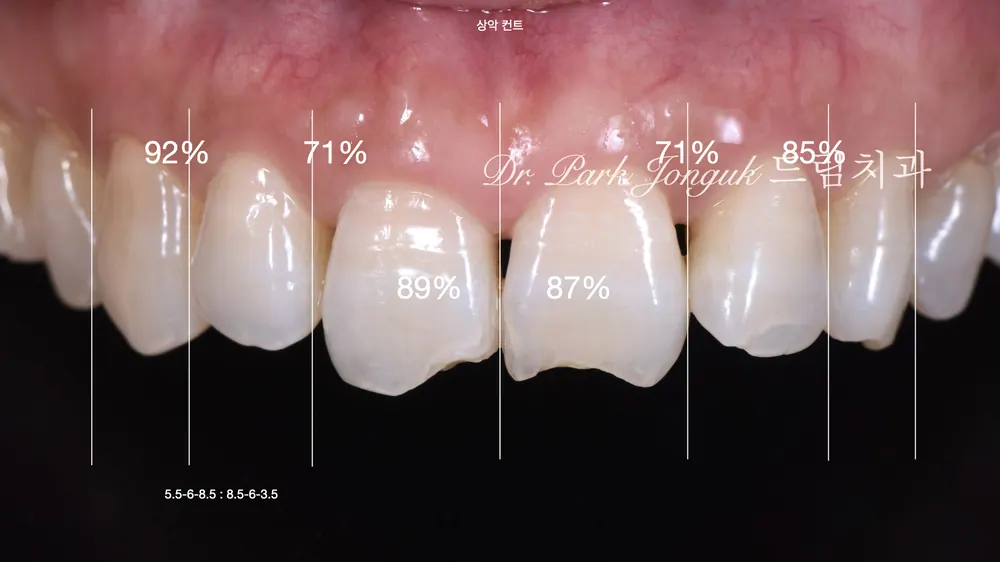
This was a case that required solving both a chipped-tooth veneer and a black-triangle veneer at the same time.
First, we precisely measured the tooth size and proportions.
Diagnostic findings:
The teeth were already fairly large
Making them any larger would look unnatural
But filling in the black triangles requires space
Restoring the chipped area requires length
The patient's request: "I'd like to avoid the teeth getting any bigger."
This was the core challenge of the case: filling the black triangles and restoring the chipped area, without making the teeth any larger.
[Photos 3, 4, 5 – Wax-up precision diagnosis]
To solve this complex challenge, a wax-up
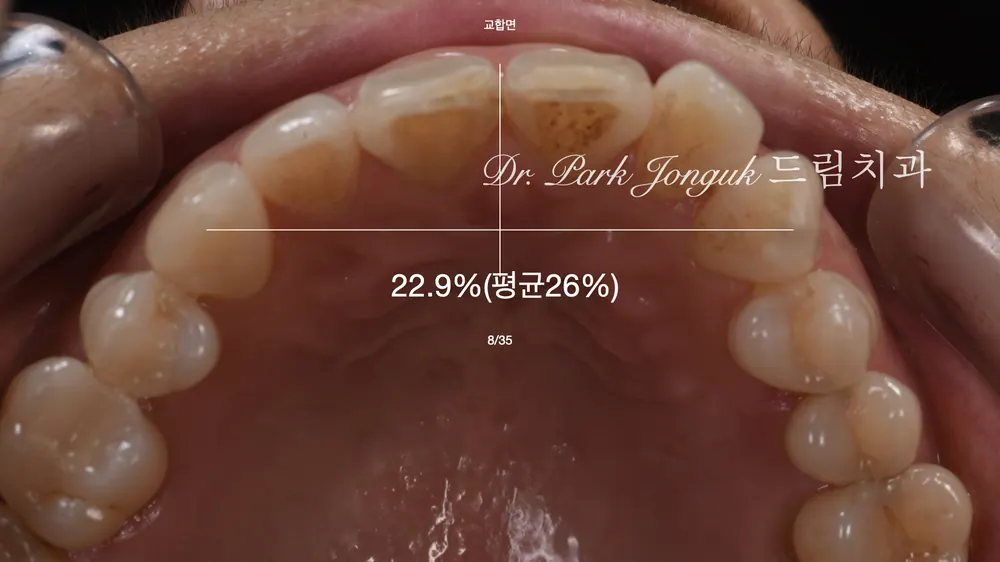
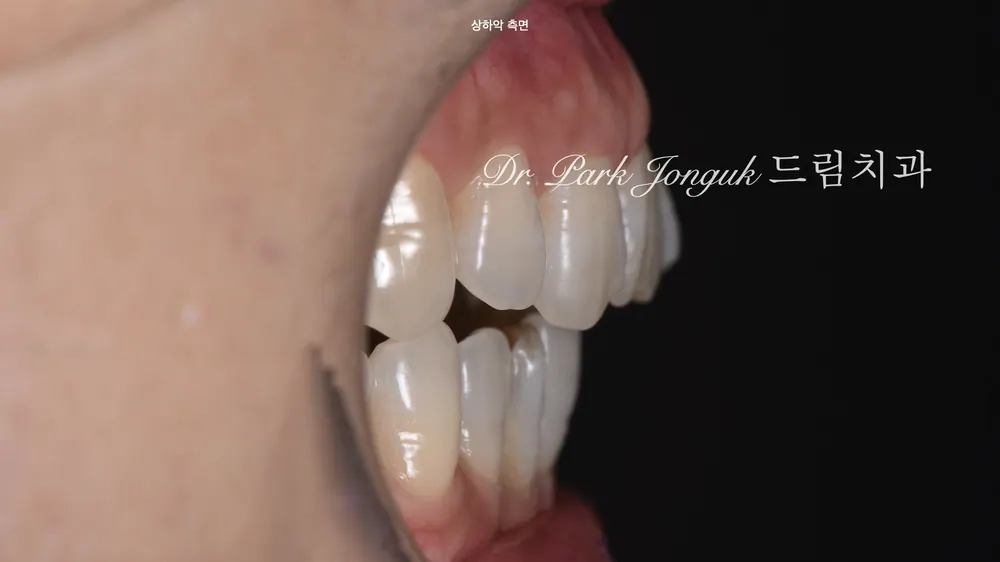
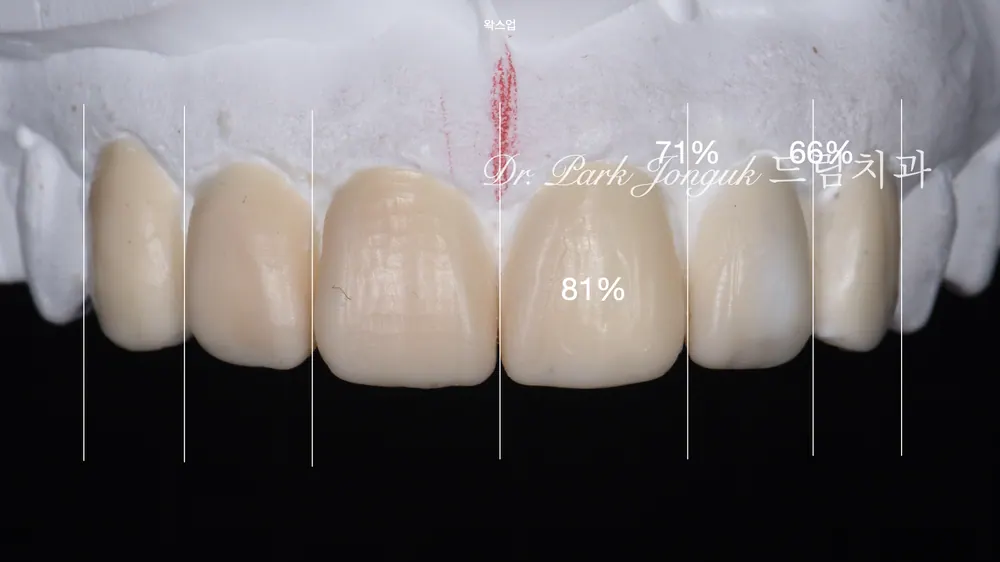
precision diagnosis was carried out.
Analysis items:
✓ Arch shape — the overall curve of the tooth arrangement
✓ Degree of protrusion — how far forward the teeth project
✓ Size of the black triangles — how much needed to be filled
✓ Length of the chipped area — how much needed to be restored
✓ Overall proportions — harmony with the face
Solution strategy: Filling the black triangles and restoring the chipped area naturally makes the teeth bigger.
But the patient didn't want them to get any bigger.
So the method we chose was to reduce the teeth by a certain amount to create space, and
within that space, achieve both the black-triangle fix and the length restoration at the same time.
As a result, the problems get solved while the final tooth size stays nearly the same.
Tooth reduction: securing space strategically
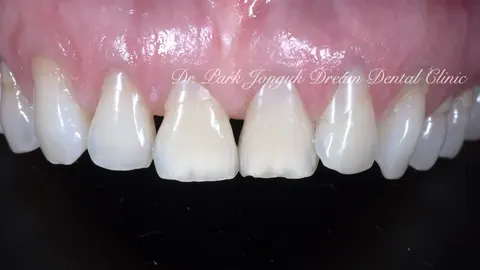
[Photo 6 – Tooth reduction completed]
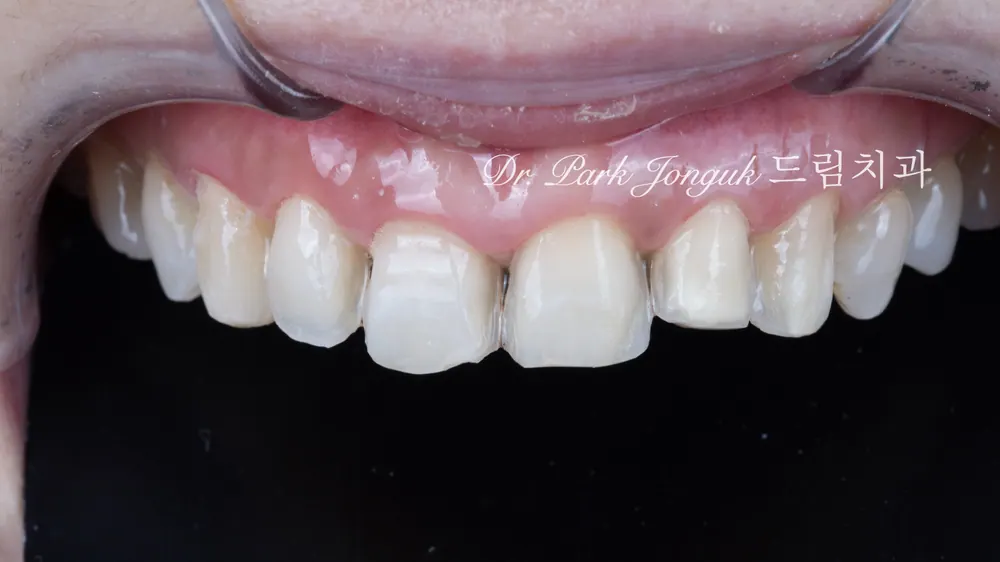
Since the patient wanted to avoid the teeth getting any bigger, we carried out tooth reduction strategically to match that goal.
Reduction plan:
Basic reduction while cleaning up the chipped area
Extra space secured in the black-triangle area
Overall standard veneer-level reduction
Restoration within the space created by the reduction
Result:
Space secured to fill in the black triangles
Length secured to restore the chipped area
But the final size stayed close to the original
This is the power of precise diagnosis. Without a wax-up, this kind of calculation isn't possible.
Veneer fabrication: naturalness suited to age
The difference the handmade build-up makes
The secret to making veneers look natural in your 60s is the multi-layer build-up.
Color design (tailored for the 60s):
Layer 1 – Inner core
A natural tone that isn't too bright
A slight hint of warm yellow included (a tone suited to the 60s)
Layer 2 – Transitional layer
Multiple shades blended
A slightly deeper tone near the gumline
A gradient that brightens toward the incisal edge
Layer 3 – Enamel layer
Translucency control
A moderate translucency at the incisal edge
Too much translucency actually looks off
Layer 4 – Characterization
Subtle color variation for depth
Natural texture expression
Core principle: "Not white like a 20-something's, but like the youthful teeth of a healthy person in their 60s"
Solving the black triangles
Along with the chipped-tooth veneer, we also resolved the black triangles.
Method:
The veneer naturally extends into the space between the teeth
Filling it in too much looks unnatural, so only a moderate amount
The gumline area is shaped naturally
Emphasis placed on harmony with the gums
Treatment complete: younger, but natural
[Photos 7, 8, 9 – After treatment]
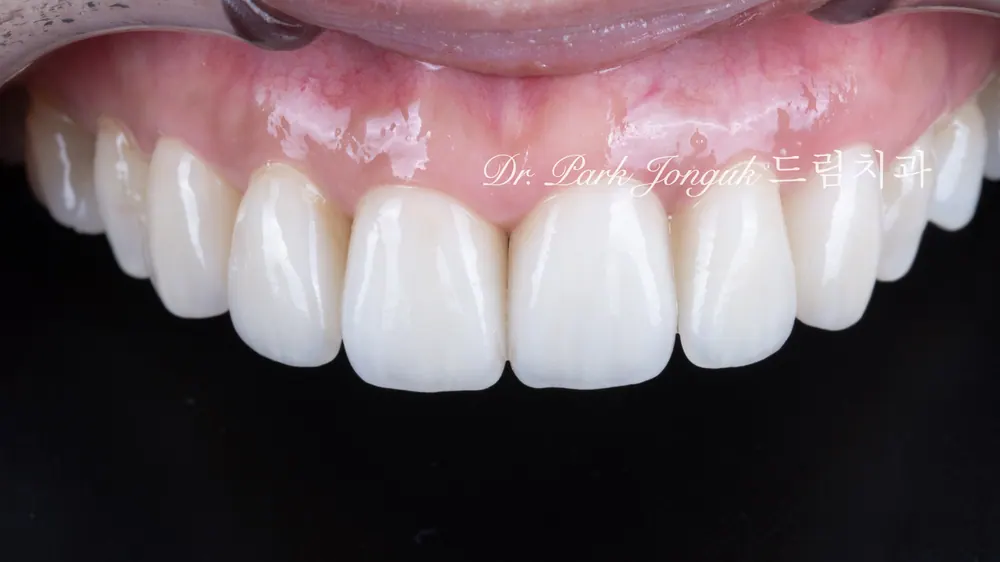
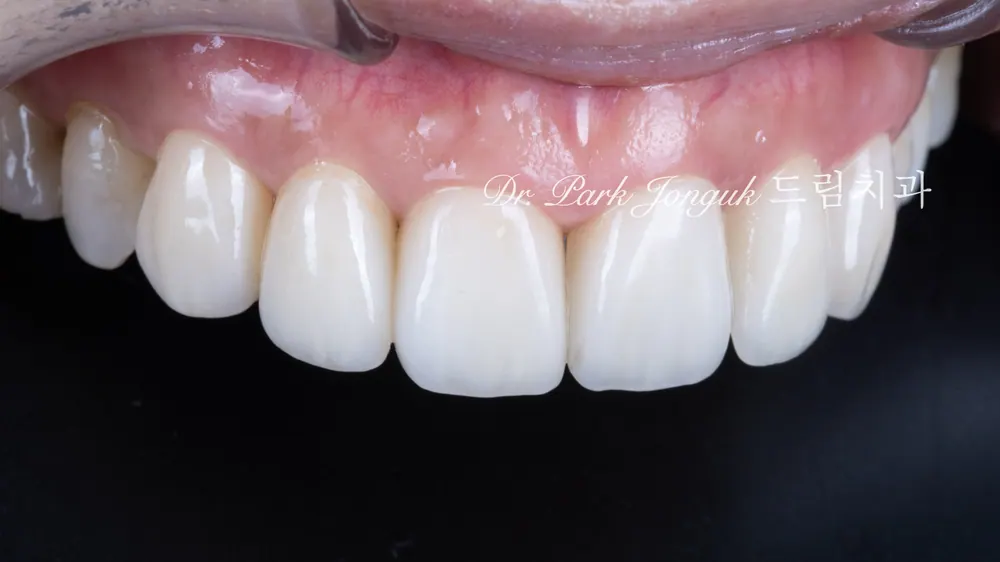
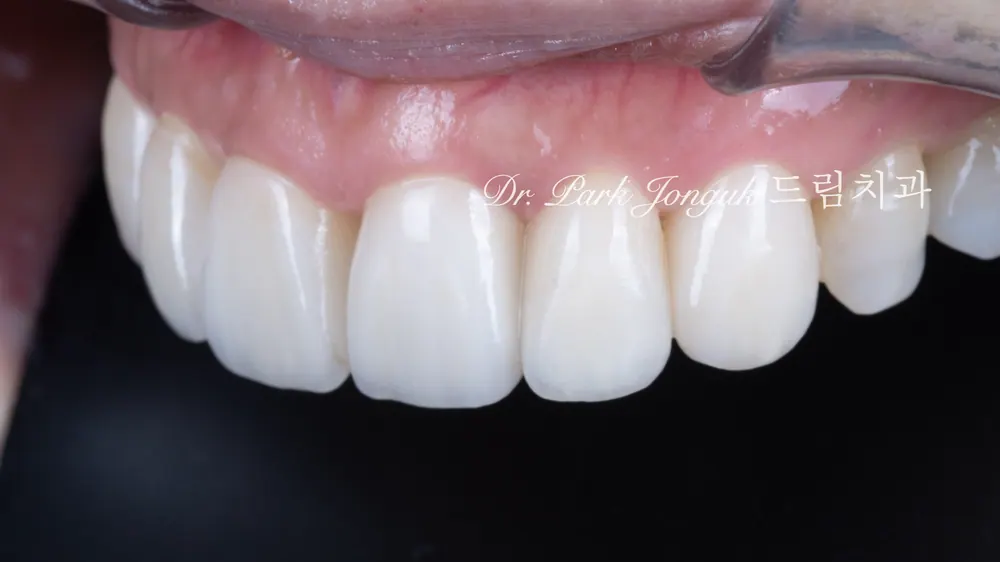
The veneer treatment that makes her look younger is finally complete!
Remarkable changes:
✅ Perfect restoration of the chipped tooth The front tooth that had been chipped for decades was restored to a smooth, beautiful shape.
✅ Black triangles resolved The dark triangular gaps that formed as the gums receded were naturally filled in.
✅ Looking much younger The dull, yellowish teeth changed to a bright, clean color. She clearly looks 20 years younger.
✅ Yet still natural This is the most important point. Not too white — a natural tone suited to her 60s. Not artificial-looking; she looks like "someone whose teeth were healthy to begin with."
✅ Size maintained Just as the patient wanted, the teeth didn't get any bigger. The black triangles were filled and the chipped area was restored, but the overall size stayed nearly the same.
✅ Not awkward-looking People around her don't say, "You've had dental work done" — instead they say things like, "You look younger," or "Have you been doing skin care?"
This is what real veneer treatment for the 60s looks like.
Conclusion: naturalness suited to age
The right answer for veneers in your 60s
The most important thing with veneers in your 60s is "looking younger, but naturally."
❌ The wrong approach:
Bright white, like someone in their 20s or 30s
Flat, in a single shade
Fast, done in one day
Result: artificial and unnatural
✅ The right approach:
A natural brightness suited to the 60s
Depth through a multi-layer build-up
Taking sufficient time, done precisely
Result: younger-looking, yet natural
Dream Dental Clinic's principles for veneers in the 60s
1. Precise diagnosis We take the face, age, and existing tooth size all into account. We plan to resolve the black triangles and chipped area without letting the teeth become excessively larger.
2. Age-matched color A natural tone around shade A2–A3. Translucency is also adjusted to match age — not too translucent, not too opaque.
3. Handmade fabrication A multi-layer build-up creates subtle color variation. This is the secret to naturalness.
4. Appropriate improvement, not perfection We don't try to make everything perfect. For naturally aged teeth in your 60s, perfect symmetry or perfectly white teeth would actually look strange.
After 20 years specializing exclusively in veneers, writing the textbook 『최소 삭제를 위한 라미네이트 임상』 (Veneer Clinical Practice for Minimal Tooth Reduction), and teaching dentists from across the country every month at Lamista Academy, there's something I've come to be convinced of.
"Age is just a number — natural beauty has no age."
Q&A: Common questions about veneers in your 60s
Q1. Is it possible to get veneers even in your 60s?
A. Of course. There's no age limit. If anything, the effect of veneers can be even more dramatic for people in their 60s and older.
As aged teeth look younger, the overall appearance can look about 10 years younger. What matters is doing it naturally, in a way that suits the person's age.
Q2. Can black triangles be solved too?
A. Yes. Veneers can naturally fill in the space between teeth.
But filling it in appropriately looks more natural than filling it in completely.
Overfilling it can actually end up looking unnatural.
Q3. Can a chipped tooth also be fixed with a veneer?
A. Yes. Even if you've lived with a chip for decades, like this patient did, it can be fully restored with a veneer.
The chipped area is smoothed out, and the veneer restores the length and shape.
Ceramic veneers are significantly better than resin in terms of color retention and durability.
Q4. I'm worried the teeth will end up bigger.
A. This can be controlled through precise diagnosis.
As with this patient, even while filling the black triangles and restoring the chipped area,
strategic tooth reduction can keep the final size nearly unchanged.
The size is decided through thorough consultation with the patient during the wax-up stage.
Q5. How is this different from one-day veneers?
A. The biggest difference is naturalness.
One-day veneers are milled from a single ceramic block, so only one shade is possible and translucency is hard to adjust.
A handmade build-up stacks multiple layers to create subtle color variation, achieving depth and naturalness.
This matters especially in your 60s, where an age-appropriate tone is important, which is why the handmade approach is essential.
Q6. Where's a good clinic in Gangnam for veneers in your 60s?
A. Check for the following: ✓ Experience with cases in the 60s (a different approach for different ages) ✓ Handmade build-up method (color adjustable) ✓ Precise diagnosis performed (wax-up) ✓ Experience resolving black triangles ✓ A portfolio of natural-looking results
I am the author of 『최소 삭제를 위한 라미네이트 임상』 (Veneer Clinical Practice for Minimal Tooth Reduction), and every month at Lamista Academy I teach veneer techniques tailored by age and case type. With 20 years of experience, I create natural-looking youthfulness for patients in their 60s.
This article is a clinical note written by Dr. Park Jonguk of Dream Dental Clinic, Gangnam; the original was published on his blog. The photographs shown are real cases he treated. Results vary with each patient’s condition, and every procedure carries the possibility of individual variation and side effects.
Quick Consult
Request a Callback
Leave your number and we will call you back during clinic hours.
Request Received
We will contact you during clinic hours. For urgent matters, please call +82-2-3448-0028.