
Contacts are shared, not concentrated
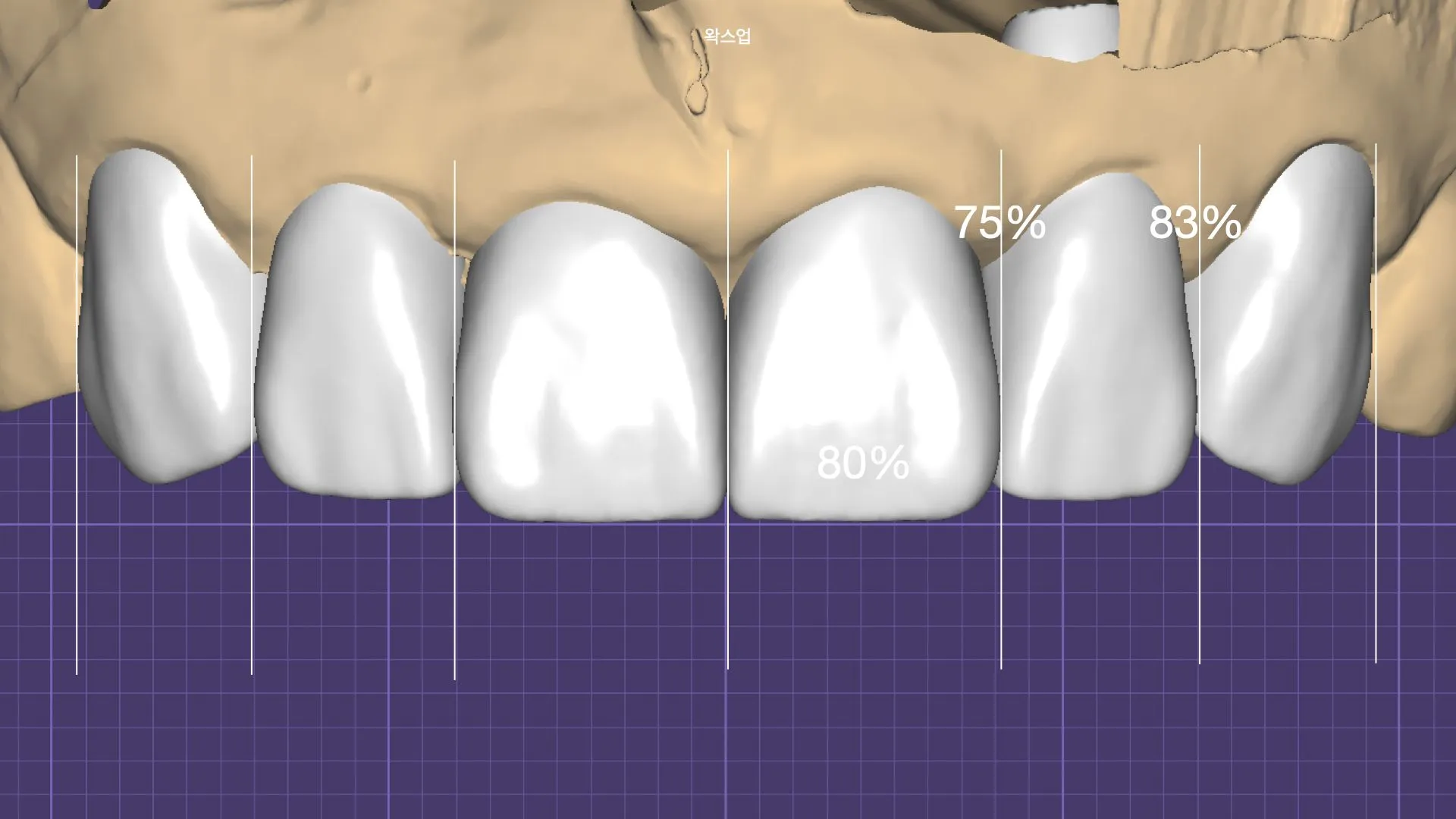
If one or two front teeth take all the load, those are the ones that break. We let the canines meet first in lateral movement so the incisors are loaded only momentarily.
Bruxism and Veneers
It comes up in almost every consultation. The answer is not yes or no — it is that the conditions change. Bruxism is a documented risk factor, but with a design that channels the force elsewhere and a guard worn at night, we usually can proceed.
 PORCELAIN VENEER
 The Risk
In a study following 318 veneers for nearly ten years on average, existing parafunction such as bruxism carried a 7.7-times greater risk of failure. Ceramic handles compression well but tolerates twisting forces poorly. Lateral load repeated all night loosens the bonded interface little by little, and it surfaces one day as a chip or a debond.
Self Check
Most people have no idea they do it. If two or more of these apply, it has to be verified at the diagnosis stage.
BEFORE / AFTER
Real veneer cases treated by Dr. Park Jonguk at Dream Dental Clinic, Gangnam. Tap a photo to compare before and after up close.
The before-and-after photos above are real clinical cases treated at Dream Dental Clinic, Gangnam (Dr. Park Jonguk). Results vary with each patient’s condition, and every procedure carries the possibility of individual variation and side effects.
Design Changes
The veneer is the same; the structure that carries the load is not. These four things change in a bruxism case.
If one or two front teeth take all the load, those are the ones that break. We let the canines meet first in lateral movement so the incisors are loaded only momentarily.
The more length we add, the longer the lever and the higher the fracture risk. We plan slightly shorter than the ideal, and confirm it after weeks in temporaries when needed.
Once preparation reaches dentin, adhesion drops sharply — in the literature, veneers bonded to dentin were roughly ten times more likely to fail. In a grinding case, minimal reduction is a safety margin.
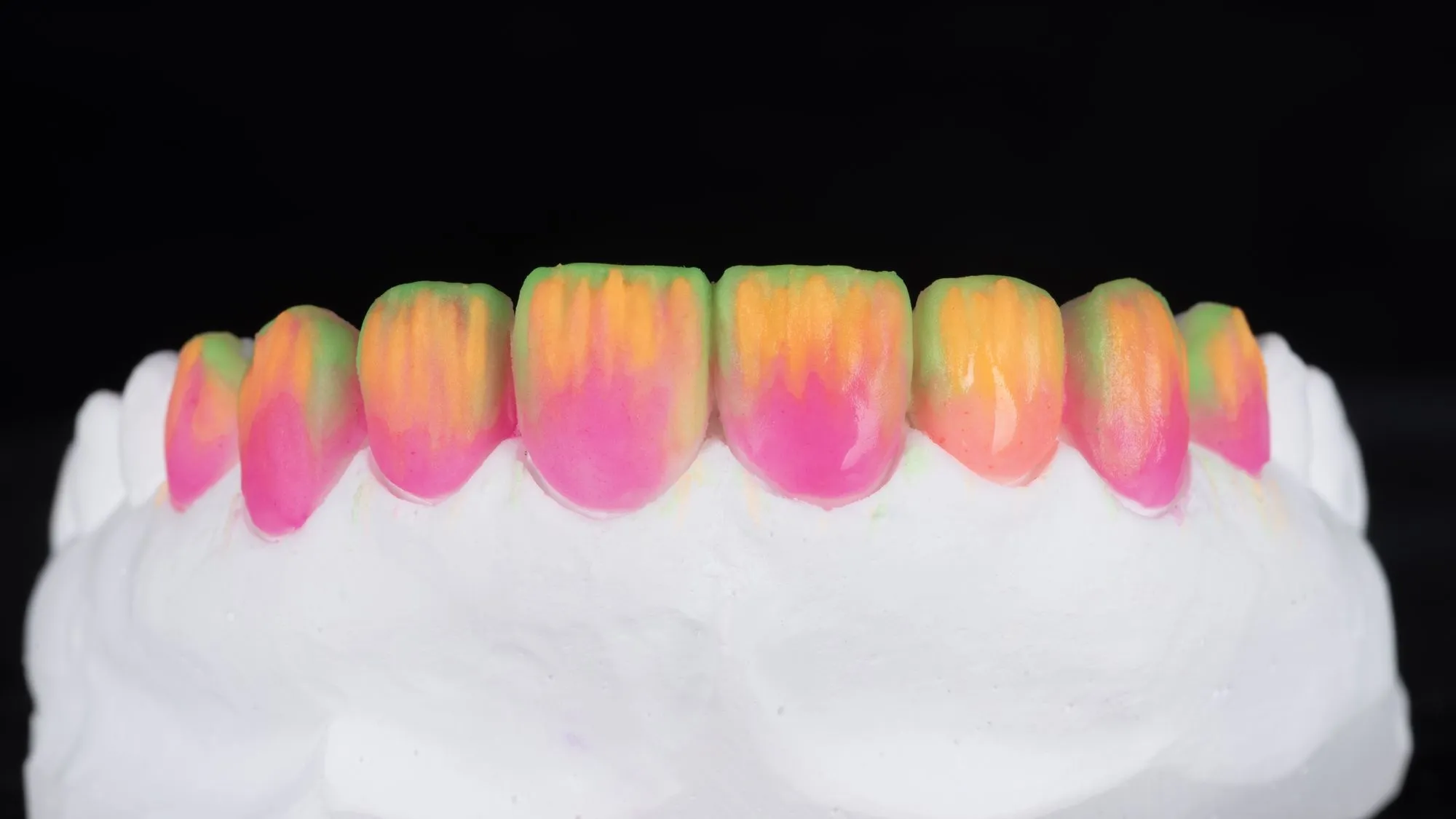
Thin, translucent feldspathic porcelain is the aesthetic favourite, but where heavy load is expected we secure thickness at the incisal edge or blend in a stronger material.

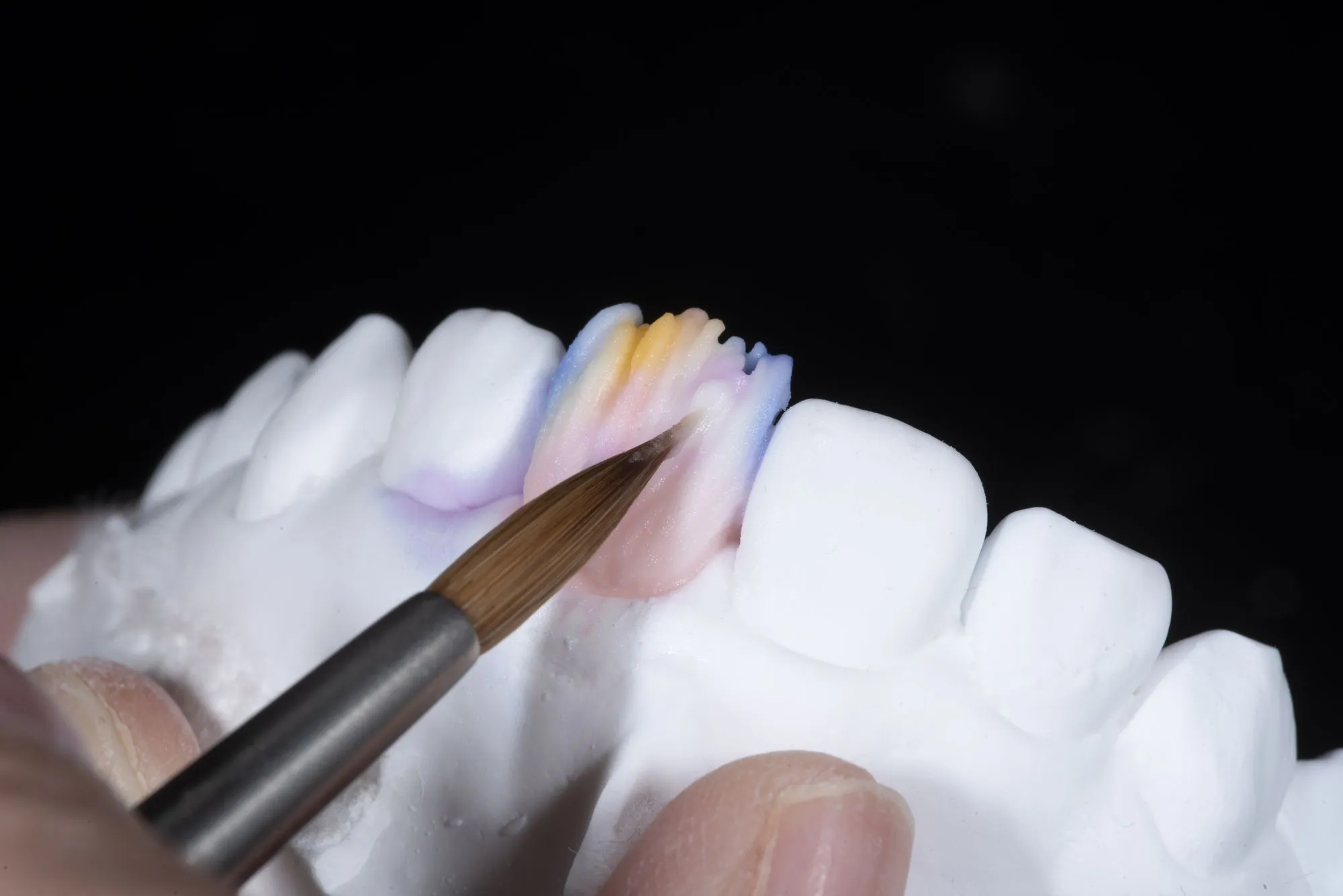
{ Placing veneers on a grinder means designing to redirect the force, not remove it. }
Decision
Bruxism is not one condition. Severity and what comes with it change the answer, and we set it together at the consultation.
| Condition | Judgement | Done alongside |
|---|---|---|
| Mild grinding, enamel intact | Usually can proceed | Night guard · six-month checks |
| Moderate grinding with worn incisors | Proceed with conditions | Load-sharing design · night guard required · longer temporary phase |
| Severe grinding, collapsed bite, heavy clenching | Veneers alone not advised | Stabilise the bite first; consider crowns or other options |
| With TMJ pain or limited opening | On hold | Re-evaluate after the joint symptoms settle |
Aftercare
In grinding cases, longevity is decided less on the day of treatment than in the months that follow.
Wear the night guard every night
It is the single most reliable protection. Worn for a few days and then left in a drawer, it does nothing.
Go easy for the first two weeks
The bond is settling. Avoid hard and chewy food during that period.
Stop tearing with the front teeth
Tearing bread, noodles or seaweed with the incisors sends lateral force straight into the veneer.
Have the bite rechecked every six months
Teeth drift. If contacts start concentrating on one side, a small adjustment prevents the rest.
Check in sooner during stressful periods
Grinding intensity varies with life. If your jaw aches, do not wait for the scheduled visit.
Evidence
The judgements above rest on the following long-term follow-up studies.
Estimated survival 82.9% at 20 years (94.4% at 5, 93.5% at 10)
318 veneers in 84 patients, mean follow-up 118 months. Ceramic fracture accounted for 44.8% of failures, and existing parafunction such as bruxism carried a 7.7-times greater risk of failure.
Beier US, Kapferer I, Burtscher D, Dumfahrt H. Clinical performance of porcelain laminate veneers for up to 20 years. Int J Prosthodont. 2012;25(1):79-85. PMID 22259802
Preparations confined to enamel survived at 99% — dentin exposure raised failure risk about tenfold
580 veneers followed for up to 12 years gave 86% overall survival, and 94% when only the margins remained in enamel — what mattered was where the preparation stopped, not merely how much was removed.
Gurel G, Sesma N, Calamita MA, Coachman C, Morimoto S. Influence of enamel preservation on failure rates of porcelain laminate veneers. Int J Periodontics Restorative Dent. 2013;33(1):31-9. PMID 23342345
Meta-analysis of 13 studies — 89% cumulative survival (median follow-up 9 years)
Glass-ceramic reached 94% and feldspathic porcelain 87%; complications were fracture/chipping 4%, debonding 2%, severe discoloration 2%, and secondary caries 1%.
Morimoto S, Albanesi RB, Sesma N, Agra CM, Braga MM. Main Clinical Outcomes of Feldspathic Porcelain and Glass-Ceramic Laminate Veneers: A Systematic Review and Meta-Analysis of Survival and Complication Rates. Int J Prosthodont. 2016;29(1):38-49. PMID 26757327
These figures are general clinical outcomes reported in the academic literature. They are not our clinic’s own results and do not guarantee an individual outcome — your course depends on your teeth, bite, and habits.
Quick Consult
Leave your number and we will call you back during clinic hours.
Request Received
We will contact you during clinic hours. For urgent matters, please call +82-2-3448-0028.
The available range depends on your condition. Feel free to ask us.
FAQ
Usually not — we proceed once the conditions are met: a design that distributes load, and a night guard worn consistently. Where the bite has collapsed or clenching is very heavy, we look at other options alongside.
Bruxism does not go away by itself, so we advise wearing it for as long as you have the veneers. Fractures after people stop wearing it are a familiar story in our practice.
They temporarily reduce muscle force and are sometimes used as an adjunct, but the effect is time-limited and it does not remove the habit. It is not a substitute for a night guard.
Restoring the lost length and shape is exactly what veneers do well. But unless the cause is addressed too, the same wear returns. Our worn-teeth page covers this in detail.
Leaving the enamel untouched is favourable for adhesion. However, no-prep adds thickness to the tooth, which does not suit every case — form and bite are assessed together.
Usually yes. But if the same spot keeps chipping, that is a signal to revisit the occlusal design rather than the tooth.
Related
This page is general information about the treatment. Diagnosis, treatment options, and duration vary by individual condition — an in-person examination is how we plan your actual care.
Articles
How the same topic is judged chairside, written up with real cases.
We start by assessing how severe the grinding is and what your bite is doing, then tell you whether it is possible now and what must go with it.