
Can You Get Veneers If You Grind Your Teeth Badly? 20 Years of Clinical Experience Answers
Hello, I am Park Jonguk, director of Dream Dental Clinic, Apgujeong.
Quite a few patients who come in for a veneer consultation ask this exact question.
"I hear I grind my teeth in my sleep. Is it okay for me to get veneers?" "I have a habit of clenching my teeth tightly during the day without realizing it. Won't my veneers come loose?"
Today I'll answer these two questions drawing on 20 years of clinical experience with veneers.
What's the difference between teeth grinding and teeth clenching?
Teeth grinding is the unconscious habit of sliding the upper and lower teeth side to side while asleep.
Teeth clenching is the habit of biting down on the teeth with strong force, whether awake or asleep.
Most people aren't well aware of either habit in themselves.
It's usually noticed when a family member mentions it, or through symptoms like a sore jaw in the morning or sensitive molars.
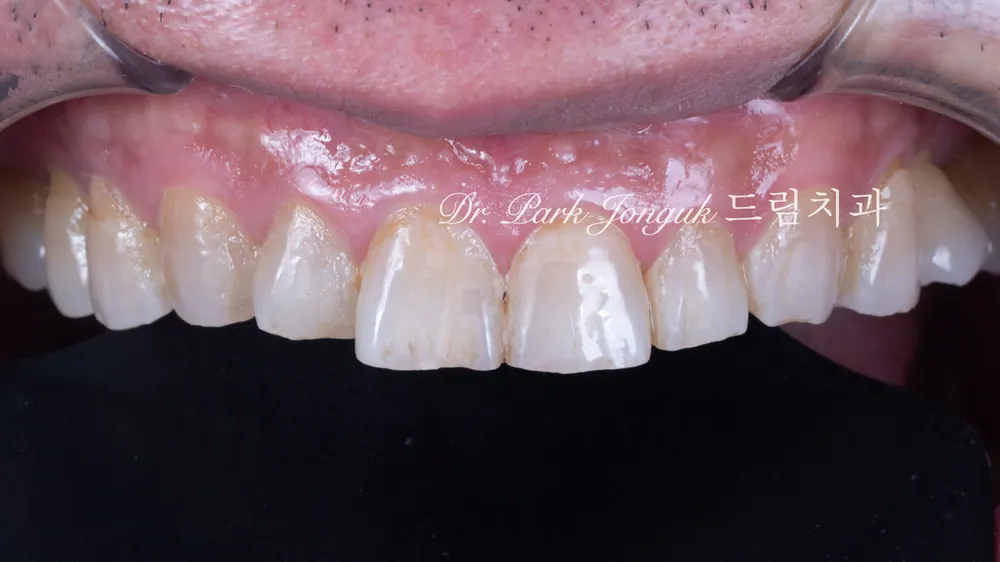
If your front teeth are worn flat or show small cracks, you should be even more suspicious of these habits.
Why is this a risk signal for veneers?
A veneer is a thin piece of ceramic, 0.3 to 0.5mm thick.
It's designed to easily withstand ordinary chewing pressure.
The problem is the force from grinding and clenching.
The force applied to the teeth during these habits is two to three times stronger than during normal eating.
When this force is applied repeatedly to the edge of a veneer, three things can happen.
First, fine cracks appear at the edge of the veneer.
Second, the bonded area weakens and the veneer comes loose.
Third, the opposing molars wear down as well, and the bite breaks down.
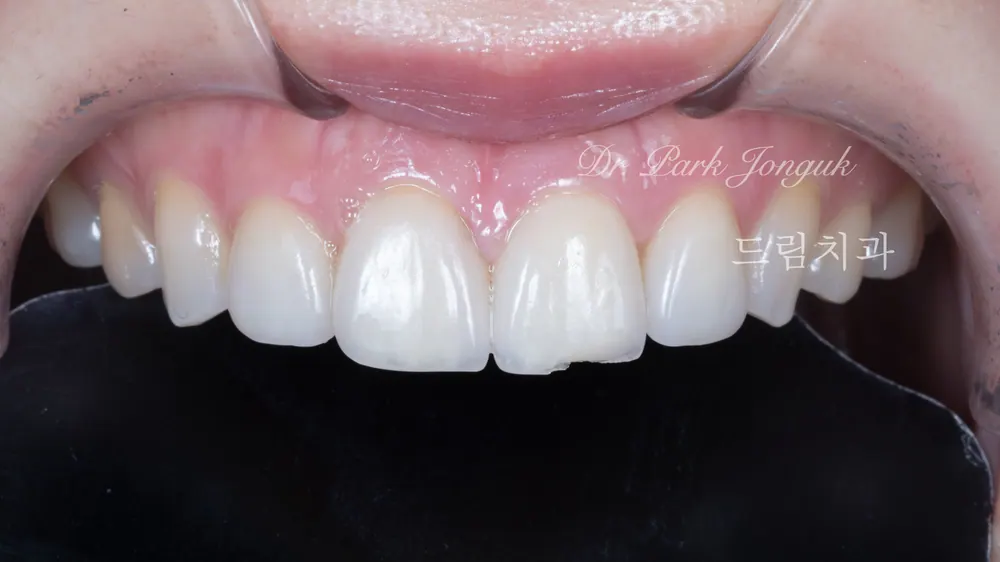
(As in Photo 1) I often see cases in clinical practice where one edge of a veneer has been ground away by teeth grinding.
Veneers are still possible, but with conditions
Having a grinding habit doesn't automatically make veneers impossible.
In fact, veneers are often exactly what's needed to restore front teeth that have become shortened from wear.
But to proceed safely, the following four principles need to be followed.
Principle 1. An accurate diagnosis comes first.
We thoroughly carry out a bite analysis, a jaw joint exam, and an assessment of how severe the nighttime grinding is.
Skipping this step leads to poor results.
At Dream Dental Clinic, we check the bite starting from the first consultation.
The way the teeth are reduced and the limits of the veneer design are set based on these bite-related issues.
Principle 2. Choosing the material carefully.
We choose a ceramic reinforced for extra strength compared to a standard veneer.
The thickness and type of material are adjusted to fit the patient's bite condition.
Even with the same veneer, the material choice alone can make a big difference in lifespan.
This is also closely tied to how the tooth is reduced. It has to be decided how to treat the area that contacts the lower teeth.
Principle 3. Design determines the outcome.
The veneer is designed so its edge doesn't take a direct hit from the bite.
The thickness and angle of the edge of the front tooth are made to fit each individual patient's bite.
This process determines how long the veneer will last.
Principle 4. A night guard must always be used together with it.
After veneer treatment, a clear device worn at night is used together with the veneers.
This one small device can extend the lifespan of a veneer by more than double.
It may feel a bit uncomfortable at first, but most patients adjust within one to two weeks.
What about aftercare?
After veneer treatment, patients get a regular checkup every six months.
If the bite shifts even slightly, it's adjusted immediately.
We recommend wearing the night guard almost every day.
During periods when stress makes the grinding worse, it's especially important to keep using it.
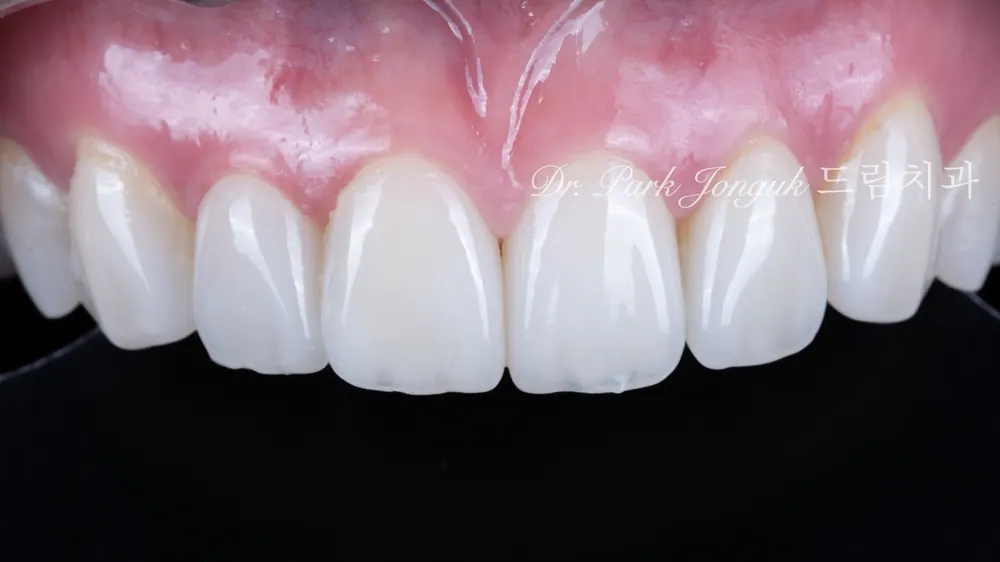
(As in Photo 2) the veneers of a patient who consistently used a night guard still look just as they did at the start, even after 8 years.
Frequently asked questions
Q1. How can I check whether I grind my teeth?
A. The most reliable way is hearing it from a family member or someone who sleeps next to you.
Besides that, if your jaw often feels stiff in the morning,
the tips of your molars are worn flat,
or you often notice tooth sensitivity, these can be reasons to suspect it.
An accurate diagnosis is confirmed through a bite exam at the clinic.
Q2. Won't a night guard be uncomfortable?
A. The first one to two weeks take some adjustment to the feeling of something in your mouth.
After that period, most patients adjust well, and many even notice their jaw feels more comfortable in the morning.
Because it's custom-made to fit your mouth exactly, it rarely feels thick or bulky.
Q3. What happens if I have severe grinding but don't use a night guard?
A. The chance of the veneer's edge chipping or the bond loosening and the veneer coming off goes up significantly.
It can cut the lifespan of a carefully made veneer by more than half.
For someone with a grinding habit, a night guard isn't optional, it's essential.
In closing
You don't have to give up on a beautiful smile just because you grind or clench your teeth.
Accurate diagnosis, careful material selection, a design customized to the patient, and a night guard.
If these four things are followed properly, you can have veneers safely and with confidence.
For a front-tooth veneer consultation, please contact Dream Dental Clinic, Apgujeong.
Director Park Jonguk personally diagnoses and performs the treatment.
Park Jonguk (D.D.S., M.S. / Chief Director, Dream Dental Clinic / 20 years of clinical experience with veneers)
This article is a clinical note written by Dr. Park Jonguk of Dream Dental Clinic, Gangnam; the original was published on his blog. The photographs shown are real cases he treated. Results vary with each patient’s condition, and every procedure carries the possibility of individual variation and side effects.
Quick Consult
Request a Callback
Leave your number and we will call you back during clinic hours.
Request Received
We will contact you during clinic hours. For urgent matters, please call +82-2-3448-0028.