
Why a Veneer That Only Shines Gives Itself Away — On Surface Texture and Gloss
Hello, I am Park Jonguk, director of Dream Dental Clinic.
In my last post, I talked about why mass-produced veneers tend to look unnatural. Natural teeth aren't a flat white slab — the color near the gum differs from the color at the tip, and there's a layered structure inside that gives them their characteristic depth and translucency. Having covered color, layers, and shape, it might seem like the story is finished, but there's actually one more piece left. Something that gives it away at the very last moment no matter how well you match the color and shape. Today I'd like to talk about that final piece: surface texture and gloss.
When I ask why veneers look fake, most people mention color. Too white, so it shows. That's true. But there are veneers where the color is matched well, and yet something still feels off. You can't quite put your finger on it, but there's a sense of something artificial. In most cases, that feeling comes down to the surface.
In my practice, I often see patients who come in wanting to redo veneers they had done elsewhere. When I listen to their concerns, most say they don't like the color, but when I actually examine the teeth, the surface is often the real problem, more than the color. They don't know the exact reason, but they know something feels off. After reading today's post, you'll be able to see the reason for that awkwardness.
A tooth's surface isn't smooth like glass
Hold a mirror close and take a careful look at your own front teeth. This time, look not at the color, but at the surface.
The surface of a natural tooth has gentle vertical undulations. Look closely at a single front tooth and you'll see three gentle vertical ridges running down it — traces left over from when the tooth formed as separate lobes that fused together. And running across those, in the horizontal direction, are extremely fine microgrooves. These are growth lines called perikymata, something like the growth rings of a tree left behind as enamel built up layer by layer.
This texture changes with age. Teeth in the teens and twenties have distinct texture. As you get older, chewing, brushing, and food passing over the teeth wear it down bit by bit, so by the 40s and 50s the surface becomes smoother. Just by observing the surface carefully, you can roughly tell a tooth's age. Just as skin has an age, so does the surface of a tooth.
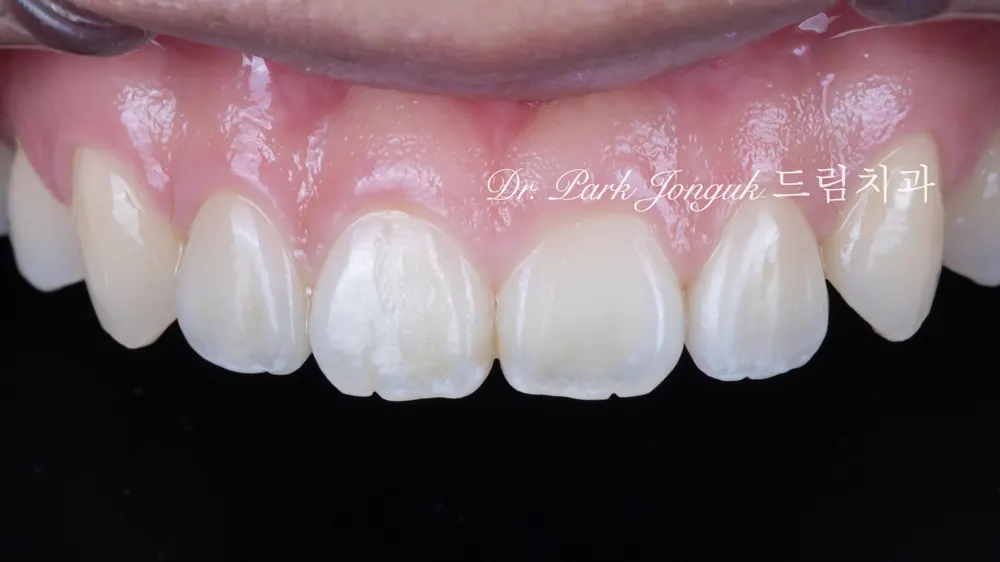
What's interesting is that almost none of the patients who come in for a veneer consultation have ever closely examined the surface of their own teeth. Even brushing every day, there's no real occasion to look at the surface. And yet our eyes have spent a lifetime looking at other people's tooth surfaces, so the moment we see a tooth without this texture, it immediately looks unfamiliar.
You can't consciously see each individual groove. Yet strangely enough, if it's missing, the eye notices right away. Why is that?
It's because of light.
The way light reflects is different
Shine light on a smooth sheet of glass and it flashes sharply at a single point. It reflects like a mirror. On a surface with fine texture, by contrast, the light is broken up into tiny pieces and spreads out softly. Think of a glass bead versus a pearl. A glass bead glints, while a pearl glows softly. Both have luster, but the quality of that luster is completely different. The luster of a natural tooth is on the pearl side.
Most veneers that are popular these days are finished on the surface with glaze alone. A machine mills a ceramic block into the shape of a tooth, glaze is applied to the surface, and it's fired all at once. It's exactly the same process as making a piece of pottery. It's fast, simple, and produces roughly the same result no matter who does it — a method that fits very well with the mass-production system I described in my last post.
The problem is that a surface made this way is as uniform as glass. Smile under a fluorescent light, and the fluorescent tube shows up reflected, unchanged, on all six veneers. The natural teeth next to them glow softly like pearls, while the veneers alone gleam like glass beads. No matter how well the color has been matched, this is the moment it gives itself away.
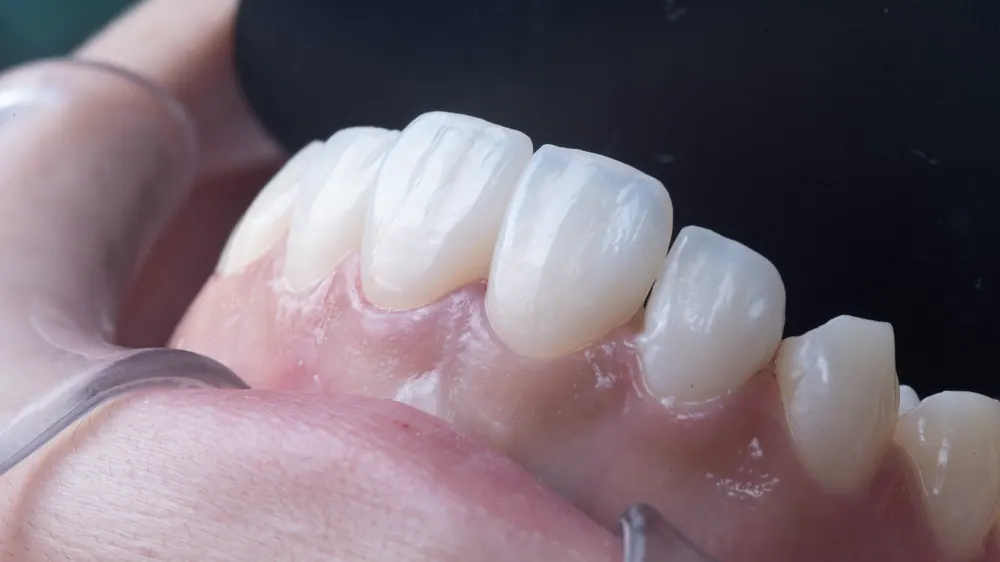
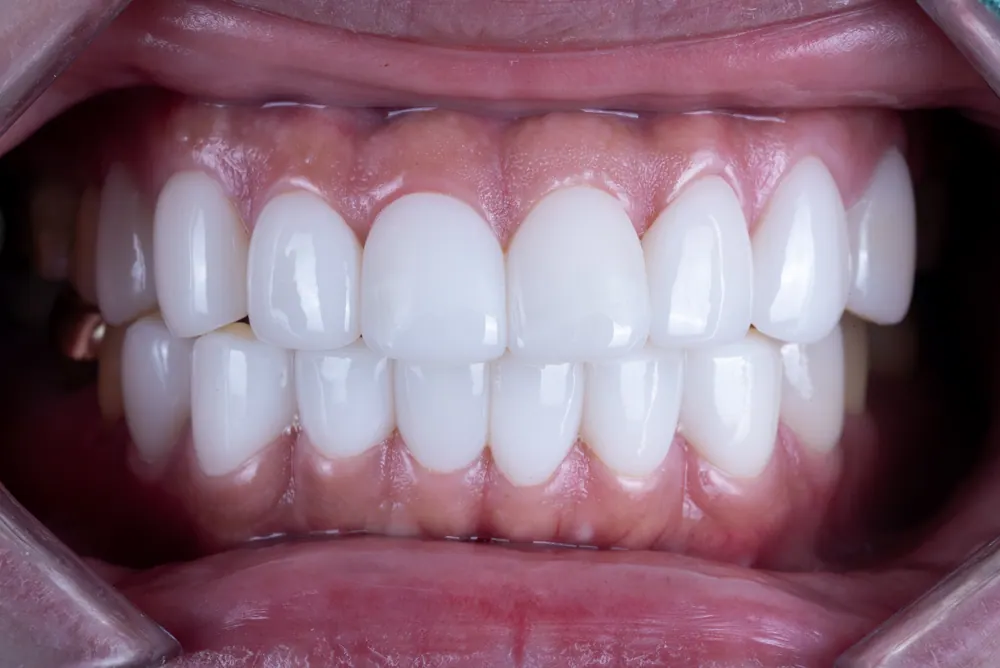
Why are there so many veneers like this? It connects directly to the story of mass production and the growth of large dental chains that I discussed in my last post. Finishing work that engraves texture and matches gloss takes hands-on effort, which lowers hourly output. For an advertisement promising same-day completion to be possible, these steps have no choice but to be skipped.
This is also why it stands out especially in photographs. The instant a flash fires, a smooth surface bounces that light straight back. That's why veneers that pass unnoticed under everyday lighting suddenly look chalky white only in ID photos or wedding photos. It's genuinely upsetting to have your teeth glowing like a light fixture in photos meant to last a lifetime.
It's easy to understand with a skin analogy. Why does a character's skin in video game graphics sometimes feel fake? It's not because the color is wrong. Modern graphics technology can render skin color so well it's almost indistinguishable from the real thing. Yet something doll-like still lingers. It's because the pores and fine texture — in other words, the surface texture — are missing. Teeth are exactly the same. Without texture, no matter how good the color is, you end up with doll teeth.
It's the same with leather goods. Genuine leather has its own natural grain, while synthetic leather has a uniform surface. They may look similar from a distance, but they differ up close. Teeth are something people see from a very close distance when talking with you. If they were only ever seen from far away, there would be no need to even bring this up.
So how is a natural-looking surface actually made?
1. Observation comes first
First, I look at the patient's remaining natural teeth. How much texture is left, how much gloss there is, and what shape the surface undulations take. As mentioned earlier, the surface of a tooth in your 20s and the surface of a tooth in your 50s are completely different. Engraving the sharp texture of a 20-year-old's tooth onto a patient in their 50s looks just as out of place, and giving a patient in their 20s a glass-smooth surface makes it look like a doll's tooth. It has to blend in, in the same mouth, with the neighboring teeth that weren't veneered. There's no single fixed correct answer — the correct answer lies inside that particular patient's mouth.
2. Engraving the texture, one groove at a time
The observed texture is engraved onto the ceramic surface one groove at a time using fine instruments. Vertical undulations are formed, horizontal grooves are added over them, and the direction and depth are matched to the neighboring teeth. A machine cannot do this work. A surface milled by computer is either perfectly smooth or has a uniform, repeating pattern — one or the other. Observing each person's unique texture and engraving it to match is possible only with a skilled hand. It naturally takes time. In a mass-production system that has to turn out dozens of pieces a day, this is a step that gets skipped from the very start.
3. Gloss — only as much as the neighboring teeth
Finally, during polishing, the level of gloss is matched to the neighboring teeth. Going from coarse to fine, switching abrasives step by step much like sanding wood, the shine is built up in stages — and knowing where to stop is the real skill. Not maximizing the gloss, but matching it to the neighboring teeth — that's the key. Gloss isn't something you maximize; it's something you match.
To be clear, glaze finishing itself isn't a bad thing. Even with glaze, the texture can be engraved beforehand and the gloss adjusted after firing. The problem is a method that skips that entire process and finishes with glaze alone. Given how much time and care go into engraving texture, it's probably true that the temptation to skip it is strong.
You can check this for yourself
Let me share a simple method. Stand by a window, hold up a hand mirror, and slowly move your head. As the reflected light from the window passes over your teeth, on a natural tooth the band of light spreads and moves softly. On a veneer finished with glaze alone, the shape of the window passes over it like a mirror, reflected as-is. Try it on your own teeth first, and you'll immediately understand what I mean.
Taking a photo with your smartphone flash turned on is another way. If a tooth stands out looking chalky white and glows like a light source in the flash photo, there's a good chance its surface is finished like glass.
You can use the same method on try-in day, when the veneers are placed temporarily. Under bright light, compare them side by side with the natural teeth next to them. Is the gloss soft like the neighboring tooth's, or does the veneer alone gleam on its own? Can you see texture, or is it smooth like a sheet of glass? You don't need any special knowledge to see this difference with your own eyes. Try-in is the last chance to check and correct these things before final bonding. If anything feels off on that day, you should be sure to say so.
What happens over time?
You might ask this question: won't hand-engraved texture wear away over time? Ceramic is a material more resistant to wear than natural tooth enamel. Everyday brushing or eating won't wear the texture away. If anything, the opposite concern is more relevant — habits that apply strong force to the teeth, such as grinding. This is something that needs to be checked in advance during the diagnostic stage.
I also occasionally get the question of whether texture makes staining worse. Fine texture at the level of perikymata isn't rough enough to cause staining. A well-polished ceramic surface is actually more resistant to staining than a natural tooth. Where staining does become a problem is not the surface, but the margin where the tooth meets the veneer — and that's a matter of precise fabrication and bonding, not surface texture. I think that's a topic I should cover separately another time.
There's no end to what could be said about surfaces, but this covers what came to mind today, so I'll wrap up here.
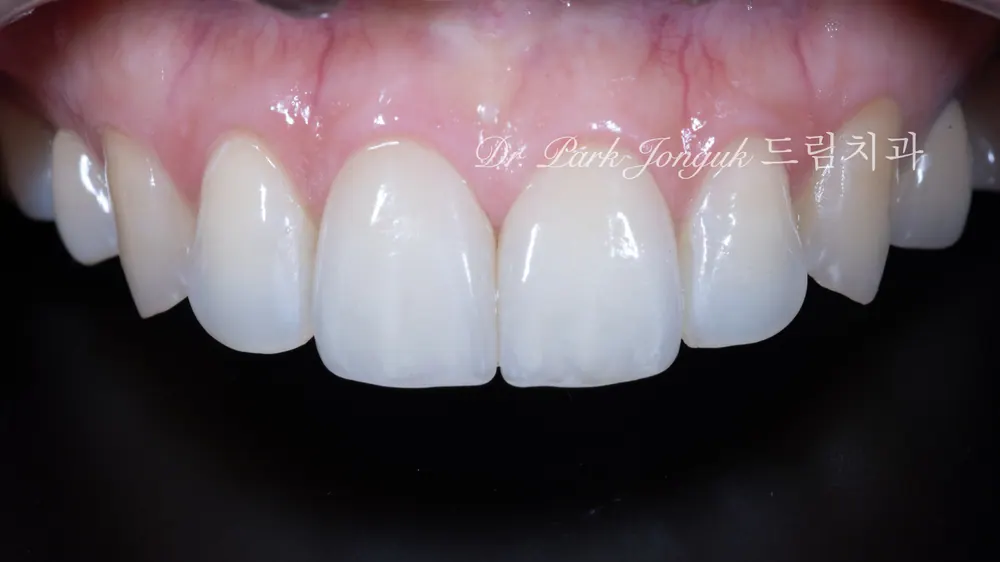
For a good veneer treatment
Don't be dazzled by a gleaming white shine, and
when you're at your consultation, try asking this question.
"How do you finish the surface texture and gloss? Do you just apply glaze and fire it, or do you look at the neighboring teeth and engrave the texture to match?"
Naturalness seen from a distance is decided by color, but naturalness when you're face to face in conversation is decided by the surface. What I've come to feel after more than 20 years of veneer treatment is that naturalness isn't ultimately built from one single big thing — it's built up from small things: color, translucency, shape, and even the texture of the surface. And taking care of those small things ultimately requires time and hands-on effort. Perhaps it's only natural that these small things end up missing from veneers made quickly and in large numbers.
This article is a clinical note written by Dr. Park Jonguk of Dream Dental Clinic, Gangnam; the original was published on his blog. The photographs shown are real cases he treated. Results vary with each patient’s condition, and every procedure carries the possibility of individual variation and side effects.
-
 Veneer Redo: Is It Possible Without Reducing the Tooth Again? From the Causes of Failure to Safe Removal
 -
 Five Ways to Identify a Clinic Skilled in Laminate Veneers: What Patients Should Check During Diagnosis
 -
 Why Veneer Retreatment Shouldn't Be Rushed: The Role of Temporary Teeth and the Importance of the Initial Diagnosis
Quick Consult
Request a Callback
Leave your number and we will call you back during clinic hours.
Request Received
We will contact you during clinic hours. For urgent matters, please call +82-2-3448-0028.