
Why Do All-White Veneers Look Unnatural? — The Story of Build-Up Veneers
Hello, I'm Park Jonguk, DDS, MS, director of Dream Dental Clinic.
In the last article, I talked about why mass-produced veneers are becoming more common. Today I'd like to go a bit deeper into that topic — why all-white veneers look unnatural, and how natural-looking veneers are actually made.
A Natural Tooth Isn't a White Slab
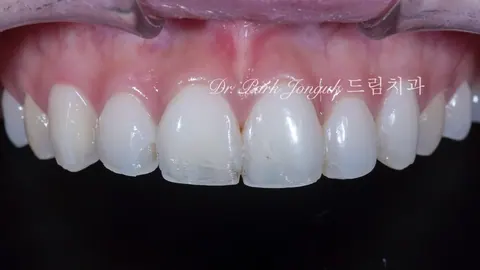
Take a moment to look closely at your own front teeth in the mirror. Is the tooth really just one single shade of white? It isn't. Near the gum, there's a yellowish tone, and it becomes clearer and more translucent toward the edge of the tooth. At the very tip, there's a glass-like translucent band, and inside that translucent band you can make out finger-shaped structures reaching downward — what's called a mamelon. It's most visible in younger teeth. The surface isn't a smooth sheet of glass either. There are gentle vertical contours and fine, subtle ridges, so light reflects off it softly.
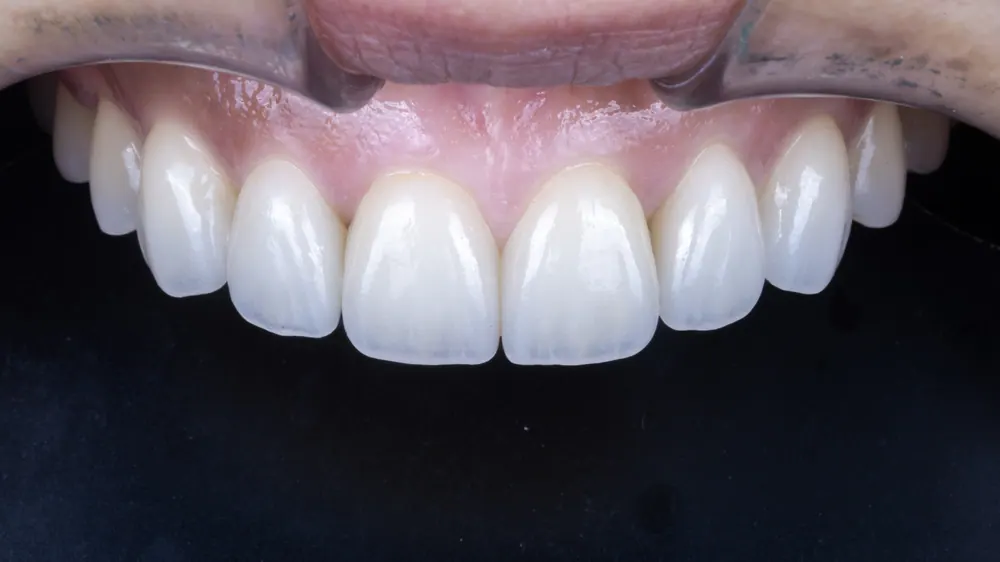
The same goes for shape. There are two central incisors, then a lateral incisor on either side, then a canine — and each of these teeth has its own distinct shape. A central incisor looks like a central incisor, a lateral incisor looks like a lateral incisor. Even the two central incisors aren't perfectly symmetrical left to right; they differ subtly. Some teeth have sharp, defined corners, while others are more rounded. These subtle differences, taken together, form a smile that's uniquely that person's own.
The field that studies these things is called tooth morphology. It's one of the first subjects taught in dental school. We don't consciously notice each of these structures when we look at someone else's teeth. But remarkably, when these structures are missing, we notice right away. Something feels off. Something feels fake. Even if we can't explain why, the feeling is accurate — because our eyes remember the shape of natural teeth we've seen our whole lives.
Veneers Carved from a Single Block
Most of today's trendy, all-white veneers are made using what's called the monolithic method. "Monolithic" means "a single block." It's a method where a machine mills a factory-made ceramic block of one uniform color and one uniform translucency into the shape of a tooth. Since the block itself is uniform, the finished veneer is the same color and the same translucency everywhere you look. There's no color gradation from the gum side to the tip of the tooth, no translucent band, and no mamelon. It ends up being a white slab that only looks like a tooth on the surface — which is why it looks dull and heavy.
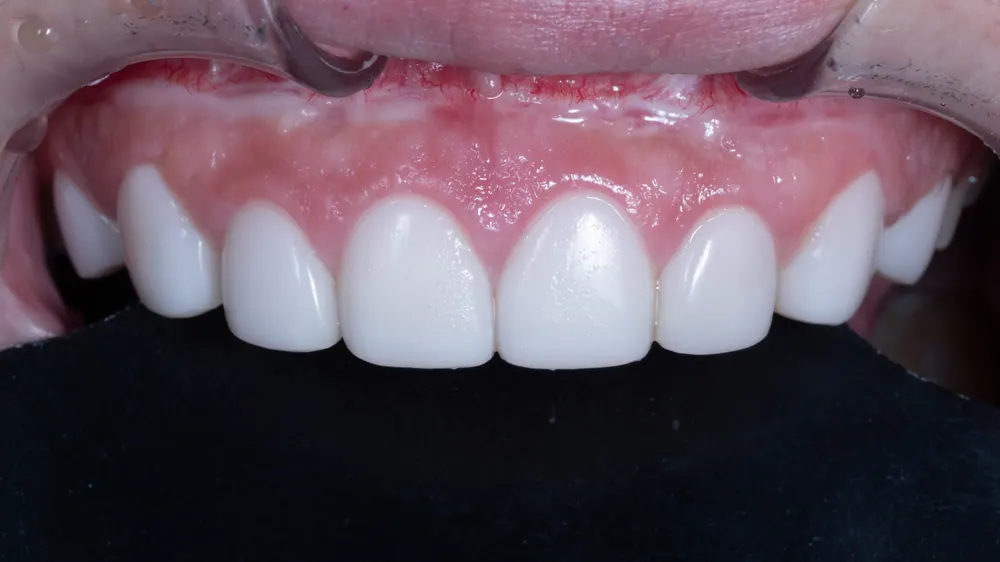
Because a machine mills it, it's fast. Because it's uniform, it suits mass production well. It can even be done in a single day. The catch is that this method gives up, from the very start, on all the countless subtle details a natural tooth has.
To Look Like a Natural Tooth, It Has to Be Made Like One
A natural tooth has a layered structure. Inside is the yellowish dentin, and over it is the semi-translucent enamel. It's because of this layered structure that light enters the tooth and comes back out, creating the depth and translucency unique to a natural tooth.
That's why natural-looking veneers are made using a build-up method. Rather than carving from a single block, it involves layering several ceramics with different properties on top of one another. Inside, a ceramic that reproduces dentin; over that, a semi-translucent ceramic like enamel; and at the tip, a ceramic that gives a sense of translucency. Even the mamelon is built in, one at a time, during this process. Ceramic powder is mixed and applied layer by layer with a fine brush,
then fired in a kiln, and once it cools, another layer is added and fired again. A machine can't do this. It can only be done by a skilled pair of human hands.
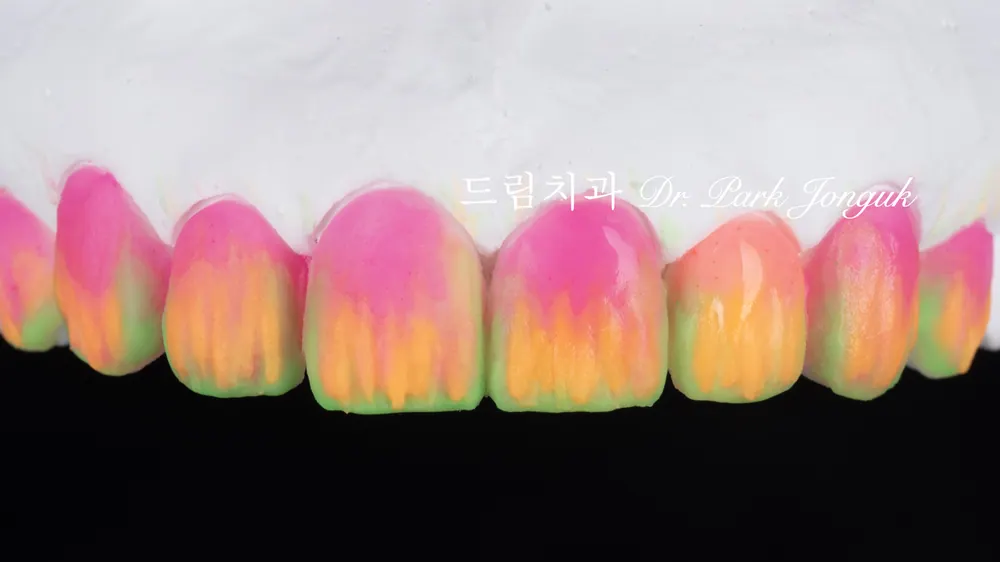
Build-up starts with observation, before it's ever about the skill of layering. We observe the patient's remaining natural teeth — what color the adjacent tooth is, where the translucent band starts, which direction the surface texture runs. We record this and keep it in photos, then reproduce it piece by piece in ceramic. Only then do the teeth with veneers and the teeth without blend naturally together in the same mouth. A factory-made block has no room for this kind of observation from the very start.
To use a painting as an analogy, it's like the difference between an image printed out all at once and an oil painting where an artist has layered paint many times over. From a distance, the two might look similar, but up close, the depth is completely different. Teeth are something people see from a very close distance, during conversation.
Taking a Long Time Isn't a Drawback
Because build-up veneers repeat the layering-and-firing process many times, fabrication takes several days. Each firing requires time in the kiln and time to cool, along with time to check the resulting color and decide how to build the next layer. Even after all the layers are built, there's still finishing work left — shaping the surface texture and adjusting the gloss. Naturally, none of this is possible in a single day. In an age where speed is treated as a virtue, taking several days might sound like a drawback. But consider this: these are teeth that will sit at the very center of your face for the rest of your life. Is waiting a few days for that level of detail really a loss?
Time is the price of expression. A veneer made quickly can only express as much detail as that speed allows.
In Closing
When you're getting a consultation for veneers, ask this rather than focusing on brand names or advertising slogans.
How are these veneers made? Are they carved from a single block, or built up from multiple ceramics? How long does fabrication take?
The method of fabrication determines the result. No matter how white or evenly aligned they are, veneers that don't reproduce the form of a natural tooth can never look natural.
After more than 20 years of doing veneer treatment, what I've come to feel is that what ultimately makes a good veneer isn't the name of the material or the size of the clinic. It's the observation, the time, and the human hand that went into that veneer that shape the result.
This article is a clinical note written by Dr. Park Jonguk of Dream Dental Clinic, Gangnam; the original was published on his blog. The photographs shown are real cases he treated. Results vary with each patient’s condition, and every procedure carries the possibility of individual variation and side effects.
Quick Consult
Request a Callback
Leave your number and we will call you back during clinic hours.
Request Received
We will contact you during clinic hours. For urgent matters, please call +82-2-3448-0028.