
Correcting Over-Retracted Teeth After Braces Naturally With No-Prep Veneers
Hello. This is Park Jonguk, director of Dream Dental Clinic in Apgujeong.
Today I'm introducing a case where over-retracted teeth after orthodontic treatment were resolved with no-prep veneers.
I'll explain why veneers are needed after braces and what makes veneers for over-retracted teeth special.
Over-retracted after braces, teeth barely showing
This patient had undergone orthodontic treatment.
But after the braces, she ended up with over-retracted teeth.
She came in for improvement, saying her teeth barely show when speaking or smiling.
The braces had made the alignment even, but because the teeth ended up too far inward, lip support was lacking.
Since the teeth barely showed when smiling, the smile looked closed off.
The three conditions for no-prep veneers
This patient was a perfect case for no-prep veneers.
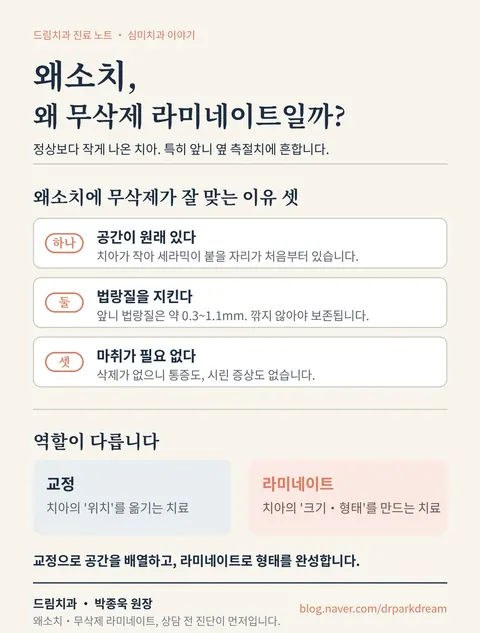
Three conditions are needed for no-prep veneers.
1. The teeth need to be small
This is a case where the teeth are small and need to be built up.
There's no need to reduce the tooth — in fact, it needs to be enlarged, which is what makes no-prep possible.
2. The alignment needs to be even
The arrangement of the teeth needs to be neat.
If they're crooked, reduction is needed to correct the position, but if they're even, reduction is unnecessary.
3. The teeth must not be protruding
The teeth must not be sticking out toward the front.
In fact, no-prep only works when the teeth are tilted inward (over-retracted).
Over-retraction after braces is an ideal case for no-prep veneers
This patient's case matched all three conditions extremely well.
The alignment was perfectly even, thanks to the orthodontic treatment.
The teeth were small and tilted inward (over-retracted).
They weren't protruding — if anything, they were tucked in.
So when over-retraction occurs after braces, no-prep veneer treatment is possible in a great many cases.
Over-retraction after braces is the most ideal indication for no-prep veneers.
Before treatment, the teeth barely show due to over-retraction
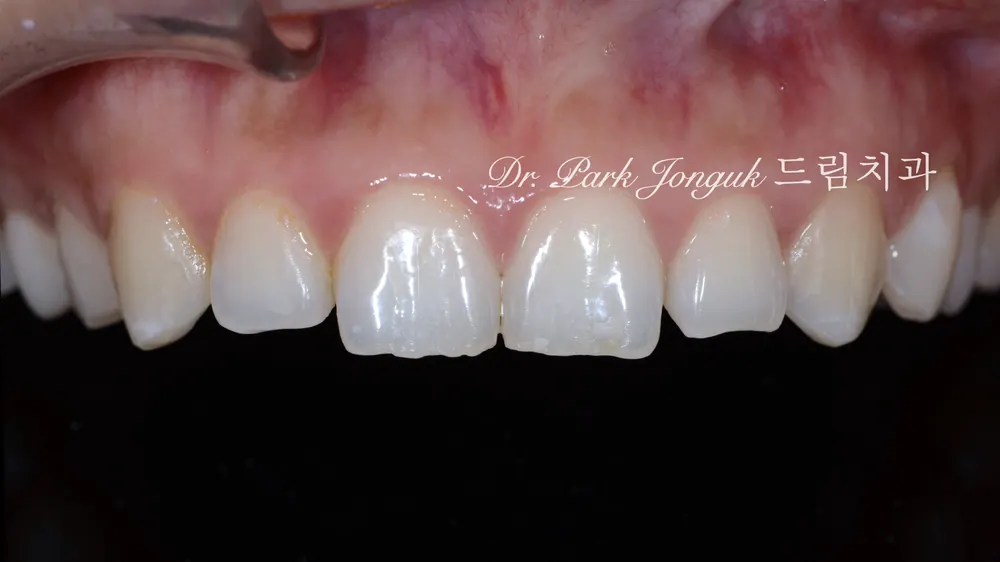
Photo 1 is the initial consultation photo.
The teeth are tilted inward.
They barely show at all when smiling.
With insufficient lip support, the mouth looks pulled inward.
The teeth are small and well-aligned, but the position is the problem.
The fabricated veneers — really thin, but rich in expression
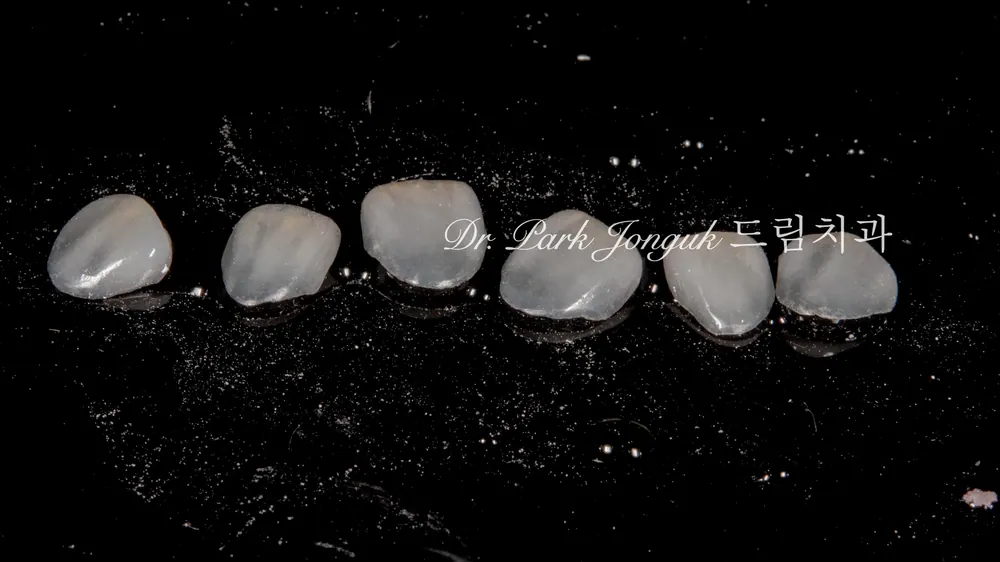
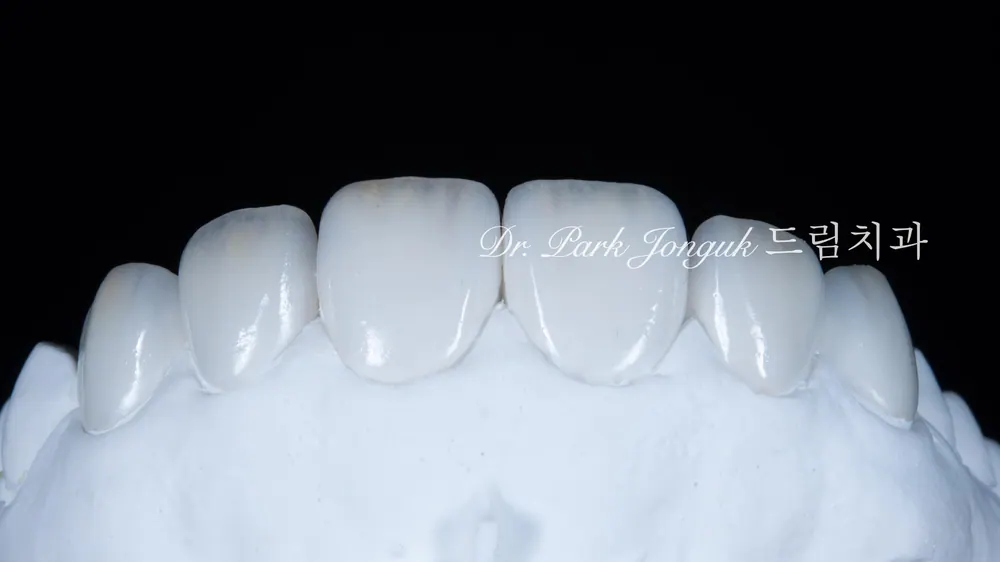
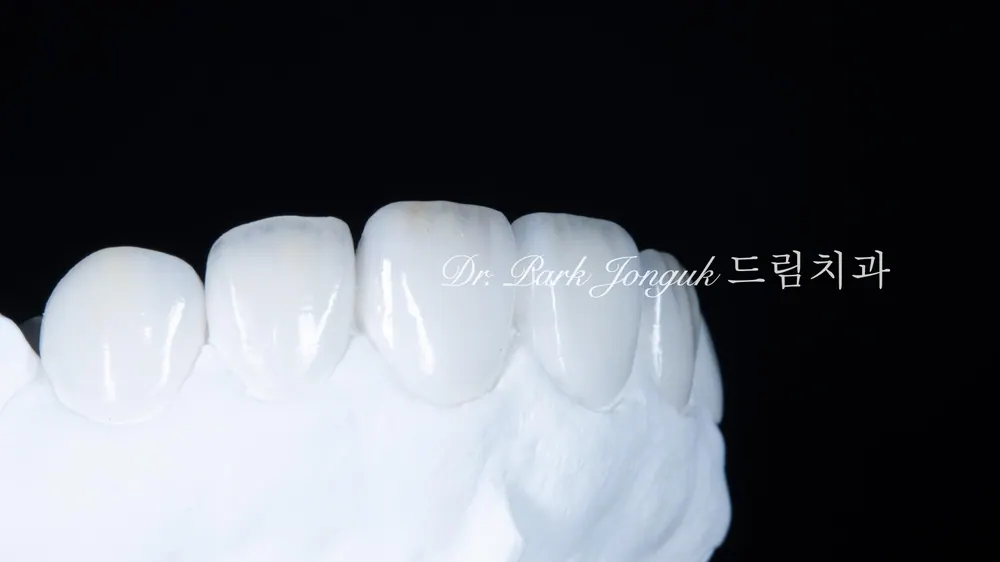
Photos 2, 3, and 4 show the fabricated veneers.
You can see something really remarkable.
They're really thin
Since these are no-prep veneers, they were made really thin.
It's an ultra-thin thickness of around 0.2-0.3mm.
It's thin enough that light can pass through it.
Yet all the variety of a natural tooth's expression is there
Despite being this thin, remarkably, every expression of a natural tooth is alive in it.
You can see the translucency at the edge of the tooth.
There's a subtle color variation across the tooth surface.
The developmental lobes, fine contours, and other three-dimensional shapes are reproduced.
This is exactly the advantage of a handmade veneer.
Single block vs. handmade build-up
Most veneers today: monolithic veneers
Most veneers these days are fabricated from just one single material.
This is called a monolithic veneer.
It's a method of milling a single ceramic block by computer.
It's fast and inexpensive, but it has its limits.
This tends to result in a veneer that's white, awkward, and artificial-looking.
With only a single color, there's no translucency and no color variation.
It looks flat and monotonous.
Our method: multilayer build-up
Our method is one that uses a variety of ceramics to fully bring out the feel of a natural tooth.
We stack multiple types of ceramic in layers.
On the inside, we build a core out of dentin-colored ceramic.
In the middle, we layer on translucent, enamel-colored ceramic.
At the tooth edge, we apply transparent ceramic.
On the surface, we express fine individual characterization.
Only by stacking these multiple layers can we create the translucency, color variation, and three-dimensional depth of a natural tooth.
It takes time and care, but the result is completely different.
The try-in process — a veneer that wraps around to the sides
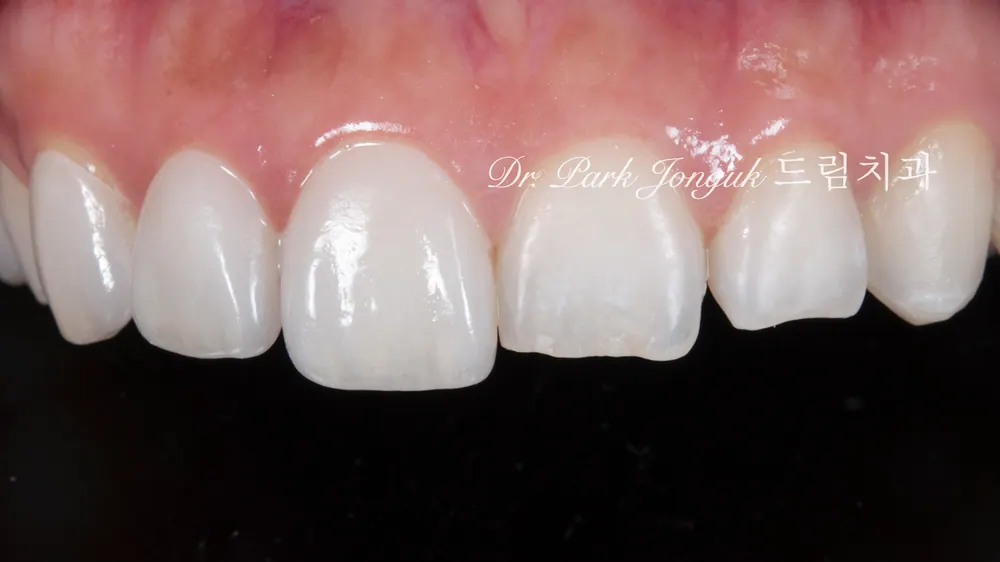
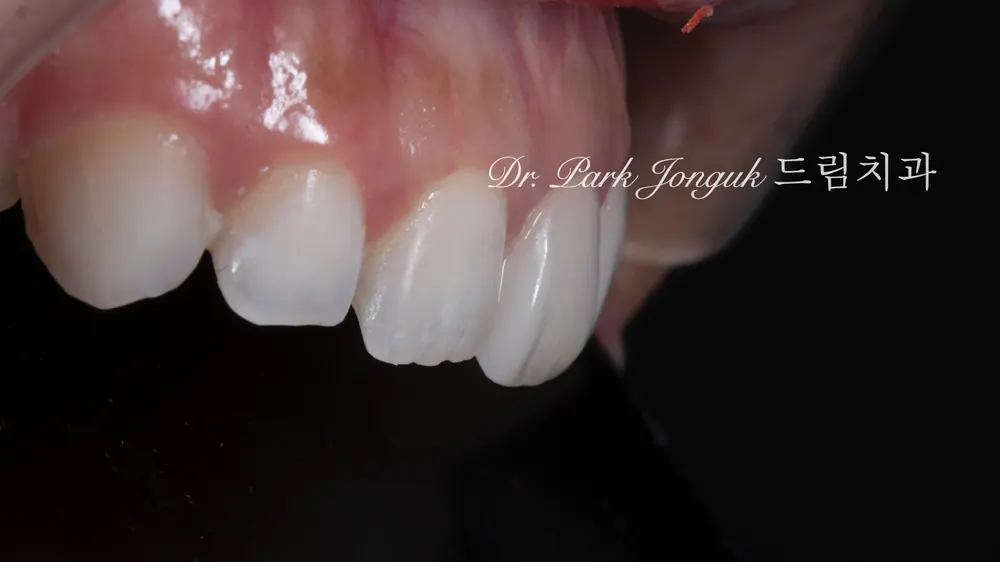
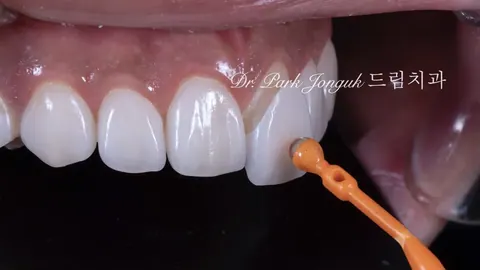
Photos 5 and 6 show the veneer placed on one side at a time.
The try-in process lets us compare left and right.
You can see it wraps around to the side of the tooth
Even though it's a no-prep veneer, it wraps around all the way to the side of the tooth.
Since over-retracted teeth are tilted inward, the veneer naturally extends not just over the front but around the side as well.
This is what allows the tooth to be brought forward.
The left-right comparison is clear
The left side has the veneer placed on, while the right side doesn't yet.
The left tooth shows coming forward, while the right tooth is still tilted inward.
The difference is really dramatic.
The final result — the feel of a natural tooth is alive
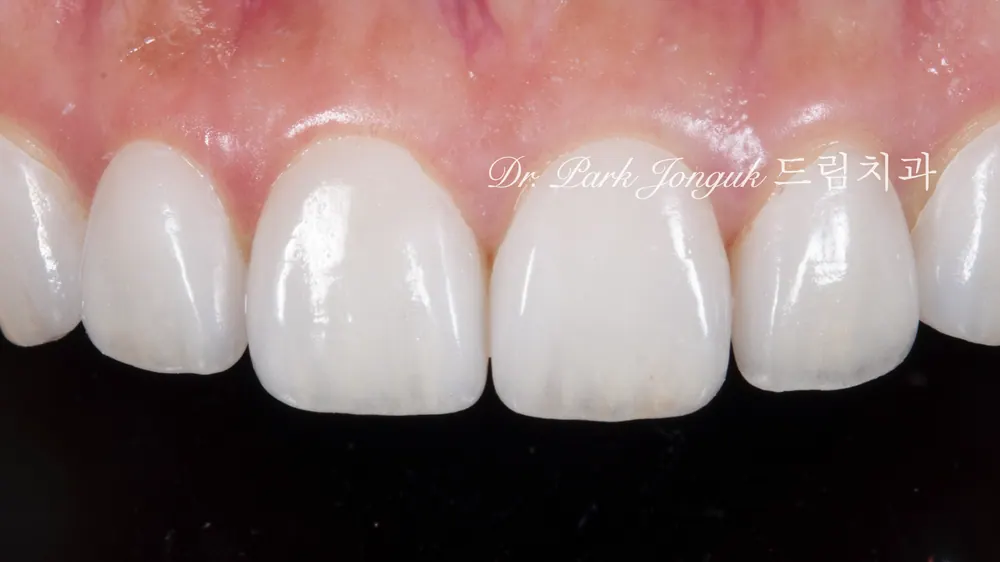
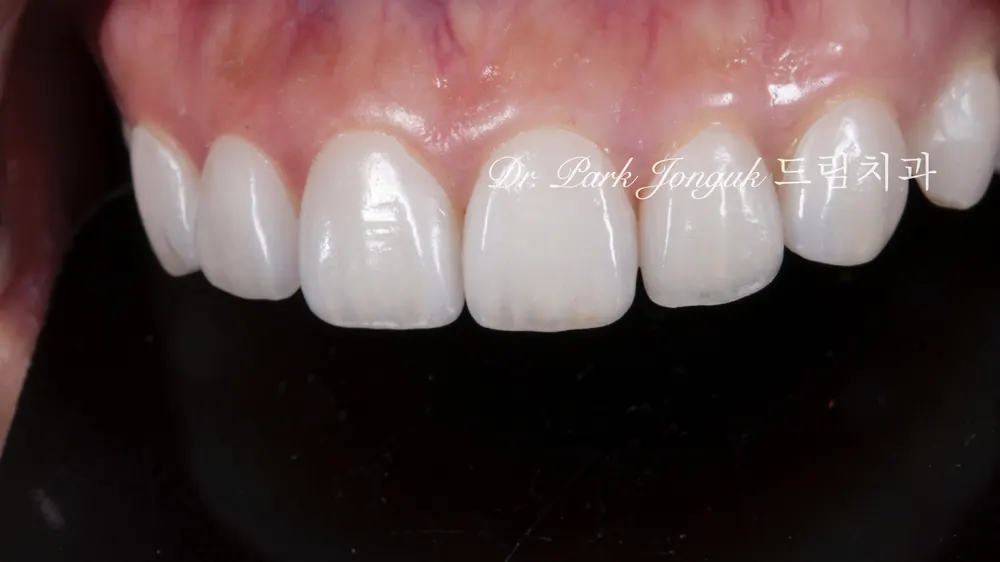
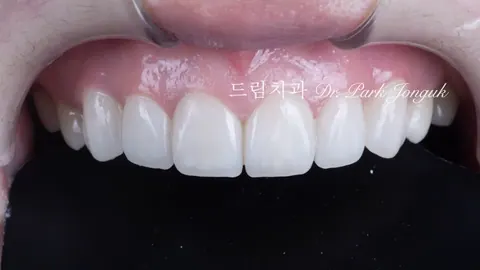
Photos 7 and 8 show the final result.
It's really beautiful and natural.
Look at the color of the veneer
The color is really natural.
It's not simply white.
Toward the root, it's a warm ivory color.
In the middle of the tooth, it's a bright tone.
At the tip of the tooth, it's translucent.
This kind of natural color variation is what makes it look like a real tooth.
Look at the expression at the tooth edge
The translucency at the tooth edge is perfect.
Light passes through and diffuses softly.
This is a hallmark of a young, healthy tooth.
Subtle contours and characteristics are also reproduced on the surface.
The feel of a natural tooth is fully alive
It's natural to the point that you can't tell veneers were even done.
It's indistinguishable from a real tooth.
The three-dimensional depth, translucency, and color variation are all exactly like a natural tooth.
Being white doesn't automatically mean it's good
Many people say, "Please make my veneers white when you do them."
But making them unconditionally white doesn't mean the result will be good.
Keeping a natural tone matters
If it's too white, it looks artificial.
It looks as unnatural as if a fluorescent light were turned on.
Maintaining a natural tone matters.
A natural tooth isn't pure white.
It has a subtle ivory tone, and the color varies slightly by area.
This kind of natural color variation is what creates beauty.
Translucency is the key
More important than brightness is translucency.
With translucency, a tooth looks bright and yet natural.
Without translucency, no matter how bright it is, it looks artificial.
Achieving both translucency and a natural tone together, as in this case, is what real skill looks like.
Here's what to do about veneers after braces
If you had orthodontic treatment and ended up over-retracted, here's what to do.
Check whether no-prep veneers are possible
Check the three conditions.
Are the teeth small? Is the alignment even? Are the teeth not protruding?
If all three apply, it's an ideal case for no-prep veneers.
Check whether it's the handmade build-up method
Ask whether it's the single-block (monolithic) method or the handmade build-up method.
Only the handmade build-up method can create natural translucency and color.
Ask for a natural tone
Don't ask for "white no matter what" — ask for "bright but natural."
Translucency and color variation are what make it truly beautiful.
Frequently asked questions (Q&A)
Q1. Do no-prep veneers come off easily?
A. When properly fabricated and bonded, they can be used for over 10 years, the same as regular veneers. Since they bond directly to enamel, the bond strength can actually be even stronger.
Q2. Can I get veneers right after finishing braces?
A. It's best to wait a retention period of at least 6 months after braces before getting veneers. The teeth need to be stable before the procedure for a long-term stable result.
Q3. Are no-prep veneers possible even without over-retraction?
A. It's possible as long as the three conditions are met (small teeth, even alignment, no protrusion). Whether no-prep is possible is determined through precise diagnosis.
This article is based on the actual clinical experience of Dr. Park Jonguk, director of Dream Dental Clinic in Apgujeong. He has practiced esthetic dentistry for 20 years and lectures monthly to fellow dentists on no-prep veneer techniques at Lamista Academy. He published Korea's first veneer textbook.
This article is a clinical note written by Dr. Park Jonguk of Dream Dental Clinic, Gangnam; the original was published on his blog. The photographs shown are real cases he treated. Results vary with each patient’s condition, and every procedure carries the possibility of individual variation and side effects.
Quick Consult
Request a Callback
Leave your number and we will call you back during clinic hours.
Request Received
We will contact you during clinic hours. For urgent matters, please call +82-2-3448-0028.