
[Front Tooth Veneers] The Power of "3-Tooth Aesthetics" Proven by Korea's Veneer Textbook Author: Do You Know the Real Reason Clinics Recommend 6?
Hello, I am Park Jonguk, chief director of Dream Dental Clinic, Apgujeong, and a board-certified specialist in conservative dentistry.
For 20 years I have focused solely on aesthetic restoration of the front teeth,
and I have written Korea's first veneer-focused textbook,
and I continue to educate other dentists through Lamista Academy.
At the foundation of all of these activities
is a philosophy of minimal invasion, never damaging a patient's teeth more than necessary.
The front-tooth veneer case I'll show you today
belongs to one of the hardest categories of aesthetic treatment,
a case of matching a single tooth, or the smallest possible number of teeth.
Through this case, I want to clearly show why so many clinics recommend treating six or more teeth,
and why we can achieve a fully harmonious aesthetic result with just three teeth, and what the technical difference behind that actually is.
1. An expert's view: the technical reason clinics recommend six or more
When many patients come in for an aesthetic consultation,
they're often advised to treat not just the problem tooth but also the healthy teeth on either side,
and end up being recommended veneers for six (or even eight) front teeth.
The hidden technical reality behind this recommendation:
The limits of a single block: the mechanical CAD/CAM method used by most clinics is carved from a single-color block of ceramic. A monochromatic block like this can never reproduce the complex color gradation and translucency of a natural tooth.
Choosing the easy way out: since it's impossible to match the color of a veneer to a natural tooth, the easiest and fastest option for a clinic is simply to reduce the surrounding healthy teeth as well and cover everything in "the same color." This amounts to a compromise in technical skill, and it leads to the ethical problem of unnecessarily reducing a patient's healthy teeth.
We at Dream Dental Clinic believe that only a hand-made build-up can solve this problem.
2. Case study: white spots and a small chip
in a patient in her 30s
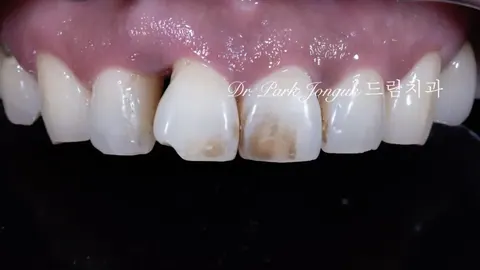
[Photos 1, 2] Before treatment and analysis of the problem
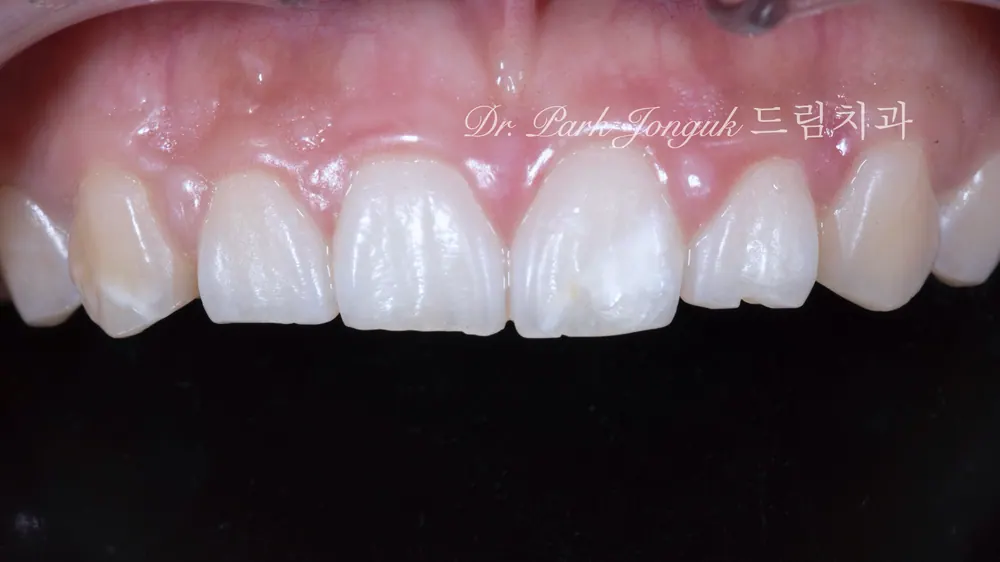
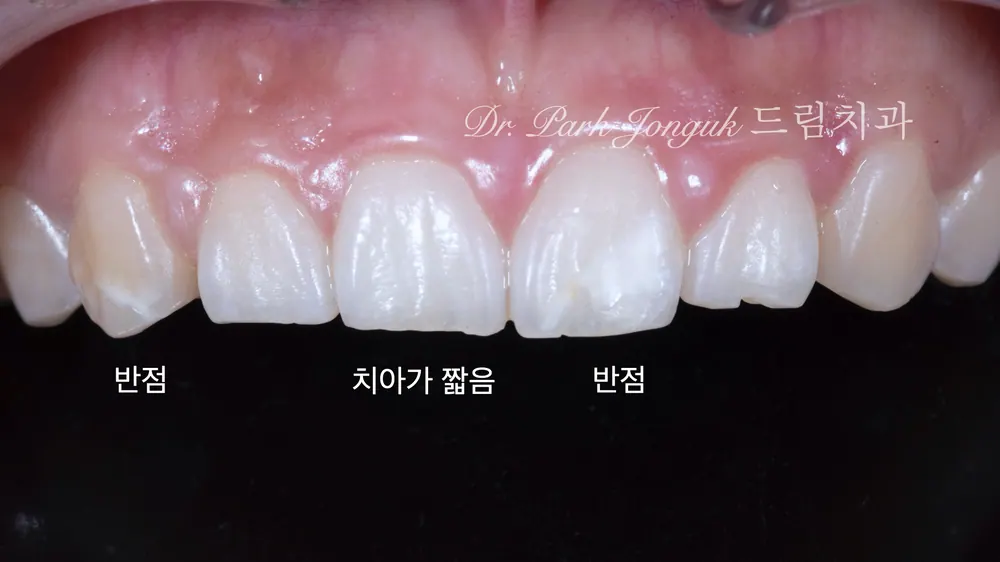
This patient's teeth were very well aligned,
but she had an aesthetic concern about a specific area every time she smiled.
White spots: strong, localized white spots were present on the right canine and the left front tooth (lateral incisor), disrupting the smile. These carry a high risk of recurrence if treated with resin.
Chipping: the tip of the right front tooth (central incisor) had a small chip, making it shorter, which threw off the overall left-right symmetry.
We decided to treat only these three teeth with front-tooth veneers to solve the problem, while fully preserving the rest of the healthy teeth.
3. The minimal-reduction principle: prioritizing enamel preservation above all
[Photo 3] After tooth reduction
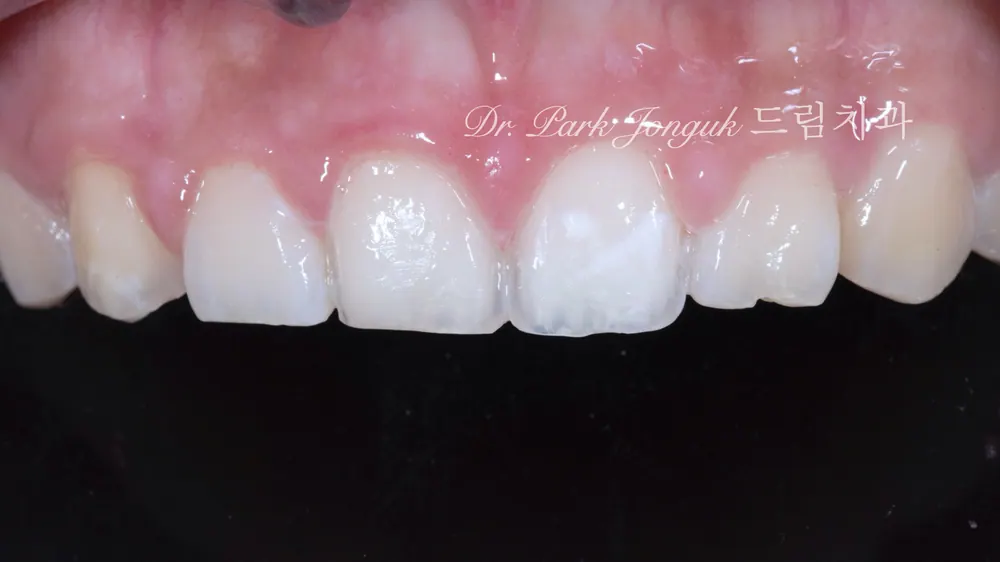
In front-tooth veneer treatment, what determines the lifespan of the tooth is the amount reduced.
Preserving enamel: our goal is to secure the bonding space for the veneer within the outer enamel layer alone, which has no nerve. This is key to preventing future sensitivity or other problems, and to maximizing the veneer's bond strength.
Achieving minimal reduction: with single-tooth matching, even a small excess in reduction can cause a major error in the final color, so this demands the refined, minute know-how and skill of a specialist in conservative dentistry.
4. The culmination of technical skill: hand-made build-up (Photo 4)
[Photo 4] Fabricating the veneer
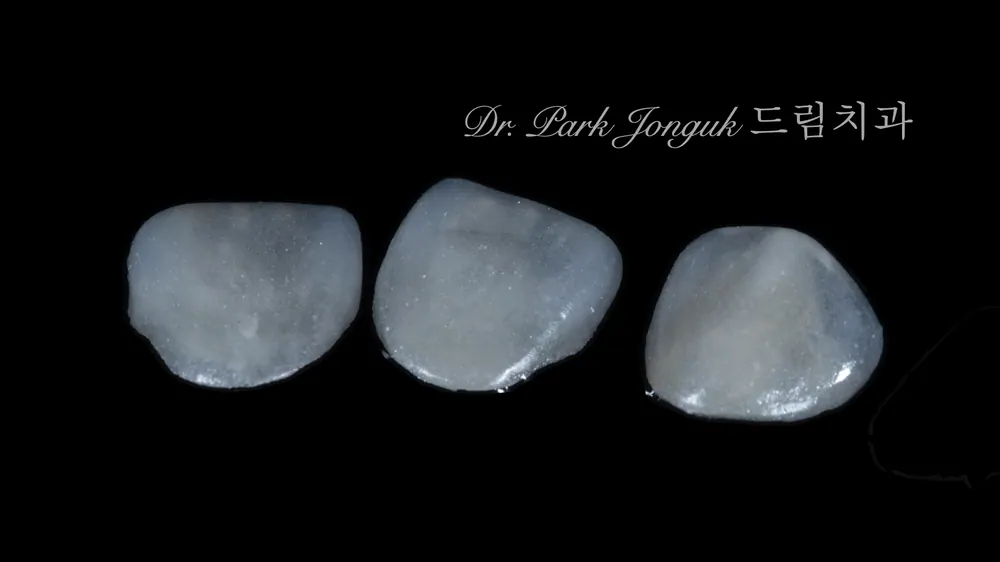
The finished veneer is truly thin and transparent, almost like a contact lens.
All of the aesthetic elements of a natural tooth are contained within this thin restoration.
Our hand-made build-up method creates color as follows.
Dentin layer: a base layer is built up to mimic the opaque yellow dentin inside the tooth, giving the tooth depth.
Color layering: powders in a range of colors, replicating the hue and chroma of the patient's surrounding teeth, are carefully layered on top of one another.
Translucency layer: a transparent layer is added at the tip of the tooth to let light pass through, completing a lifelike feel and a natural-looking edge.
Only this kind of hand-made process can make just three veneers blend perfectly with the many surrounding natural teeth.
5. Final result: an outcome indistinguishable from natural teeth (Photos 5, 6, 7)
[Photo 5] The setting process
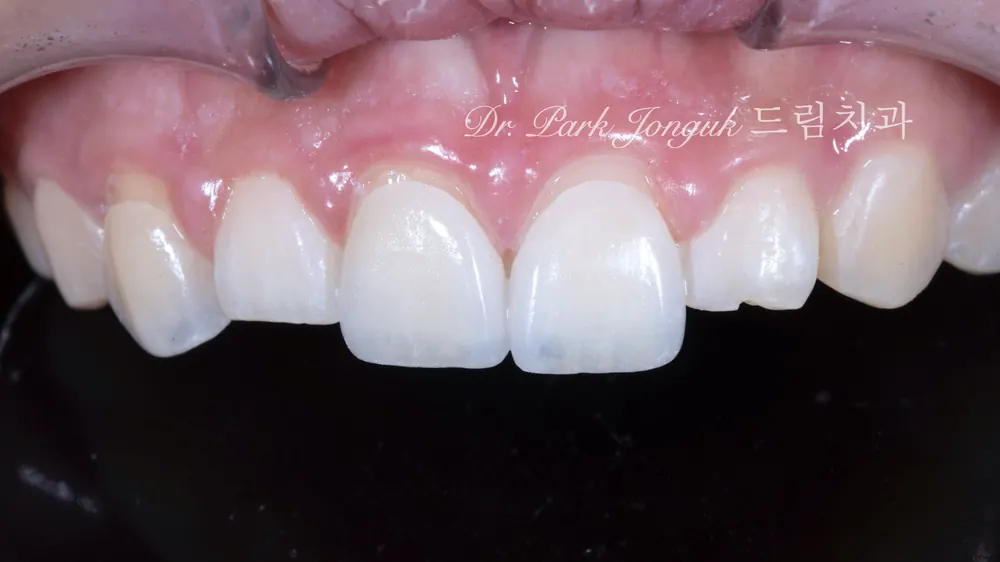
This is the process of precisely placing the veneers onto the teeth.
At this stage, success means the boundary with the surrounding teeth can't be seen with the naked eye.
[
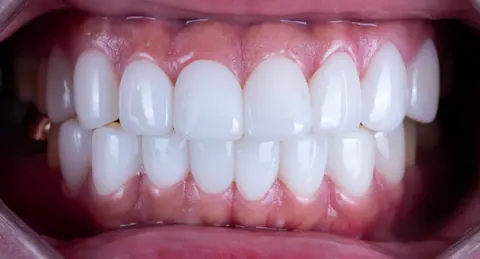
Photos 6, 7] The final look after treatment
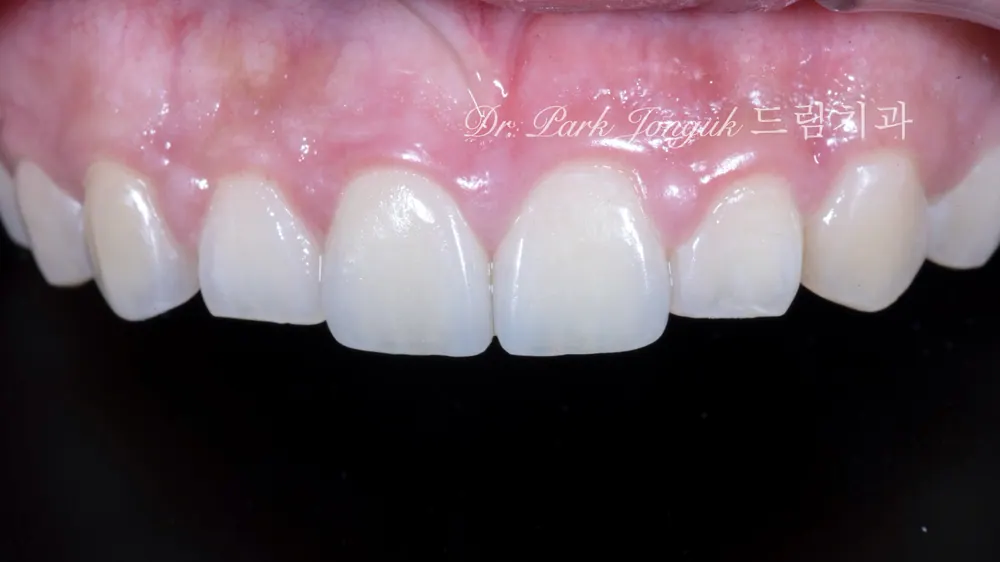
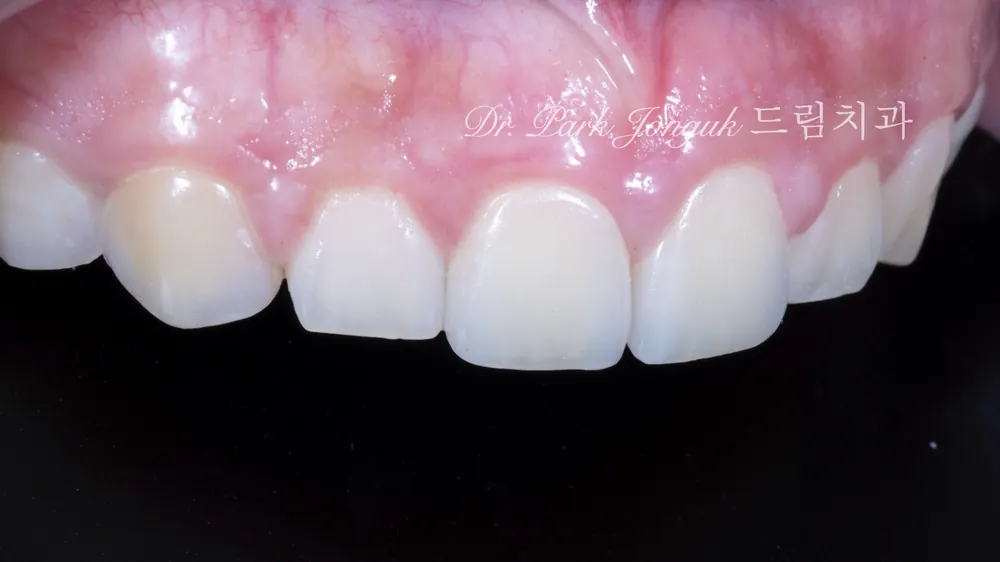
Treatment was completed successfully. The white spots, the chipped edge,
and the overall imbalance in tooth color are gone, and a fully harmonious smile has been achieved.
"I honestly can't tell which tooth is the veneer," in the patient's own words,
and that's the best proof of the minimally invasive, highest-quality aesthetic treatment we aim for.
Conclusion: the ethical choice in front-tooth veneers
Front-tooth veneers should never lead to unnecessary reduction beyond what a patient actually needs. If a beautiful enough result can be achieved with just three teeth, that is the ethical treatment that puts the patient's tooth health first.
Choosing a specialist in conservative dentistry with clear technical skill in both the minimal-reduction principle and hand-made build-up is the only way for patients to protect their precious teeth and get an aesthetic result they won't regret.
Front-Tooth Veneer Q&A: Top 5 Questions
Q1. Why is single-tooth veneer matching more expensive or difficult than treating six teeth?
A. Because the procedure is far more difficult technically. Treating six teeth is easier since they're all made in the same color, but a single tooth has to replicate the hundreds of subtle colors and translucency levels of the surrounding natural teeth, which takes far more time and skill from an experienced dental technician.
Q2. Is there a reason white spots should be treated with a veneer rather than resin?
A. It's about long-term stability. Resin is bound to discolor and wear over time, but a veneer's color and surface hardness are permanent, so it can permanently hide white spots and maintain the aesthetic result.
Q3. Even with minimal reduction, will the veneer stay bonded well and last a long time?
A. Yes, it's enough. With modern ceramics and a strong bonding protocol, a stable bond can be achieved while still preserving the tooth's enamel. Reducing the tooth excessively just to secure bond strength is an outdated approach.
Q4. What specific advantages does hand-made build-up offer?
A. The depth of naturalness is different. Because powders in various colors are layered on top of one another to reproduce color gradation and a translucent edge, the result blends perfectly with the natural teeth, unlike a machine-carved, single-color veneer.
Q5. Is regular maintenance important after front-tooth veneer treatment?
A. It's very important. The veneer itself won't discolor, but getting checkups and care from a specialist every six months to a year, to maintain the bonding margin and gum health, is how you extend the veneer's lifespan as much as possible.
This article is a clinical note written by Dr. Park Jonguk of Dream Dental Clinic, Gangnam; the original was published on his blog. The photographs shown are real cases he treated. Results vary with each patient’s condition, and every procedure carries the possibility of individual variation and side effects.
Quick Consult
Request a Callback
Leave your number and we will call you back during clinic hours.
Request Received
We will contact you during clinic hours. For urgent matters, please call +82-2-3448-0028.