
What Makes Teeth Beautiful?
People get eyelid surgery or rhinoplasty at plastic surgery clinics to make their eyes or nose more attractive.
Surgery meant to make you look better is called cosmetic surgery, and teeth can be treated the same way.
Treatment that makes teeth beautiful is called dental cosmetic treatment.
There are two main approaches to dental cosmetic treatment: one is the well-known veneer, and the other is the all-ceramic crown.
A veneer only removes a thin layer from the front surface of the tooth and covers it with thin ceramic, while a crown removes the tooth more broadly and covers it completely, like a cap. Both treatments have their own indications, and treatment should be chosen accordingly.
If you are going to "reshape" teeth, they need to end up beautiful. So what exactly makes teeth pretty, what makes them beautiful?
1. Tooth proportions
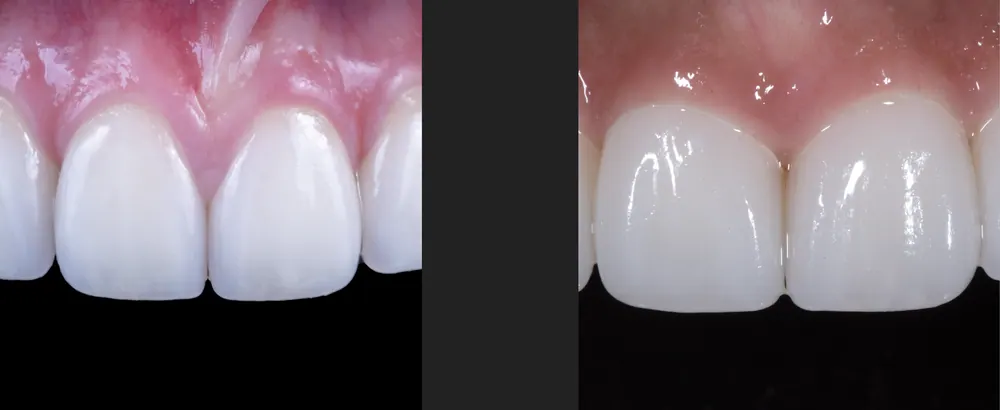
Every person's face shape is different. Some faces are long, others are round and full. But what if we ignored those face shapes entirely and made every tooth the same shape?
The width-to-length ratio of the teeth should follow the proportions of the face to some degree. It's the process of making the shape of the face and the teeth harmonize, and it's something like the starting point of tooth design.
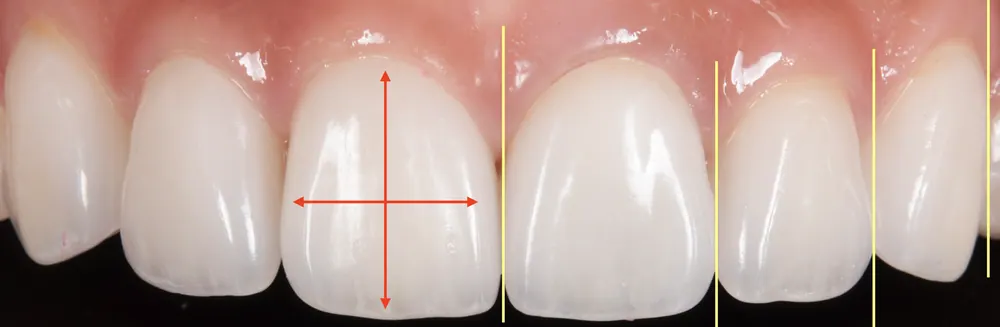
Once the proportion relative to the face is decided to some extent, the proportions between the teeth themselves are set.
This concerns the ratio of the teeth as seen from the front. Papers up through the early 2000s often said teeth should be fitted to the golden ratio, and many veneer textbooks published up to that point mention it. A ratio of roughly 1.6:1:0.6 is treated as the golden ratio, meaning the front tooth to the tooth beside it should be 1.6:1. But if you actually apply this ratio to real teeth, it looks genuinely unnatural.
More recent papers increasingly argue that fitting the ratio between teeth to the golden ratio is not the right approach. Based on my own 16 years of experience, the golden ratio is simply not achievable, and I'd say insisting on it is an outdated idea. I've found many better ratios and now work according to those instead. It's reassuring that the ratios I've been using turn out to match the ratios recent papers report as beautiful, so I suppose everyone's eye for this ends up fairly similar. ^^
2. Tooth detail
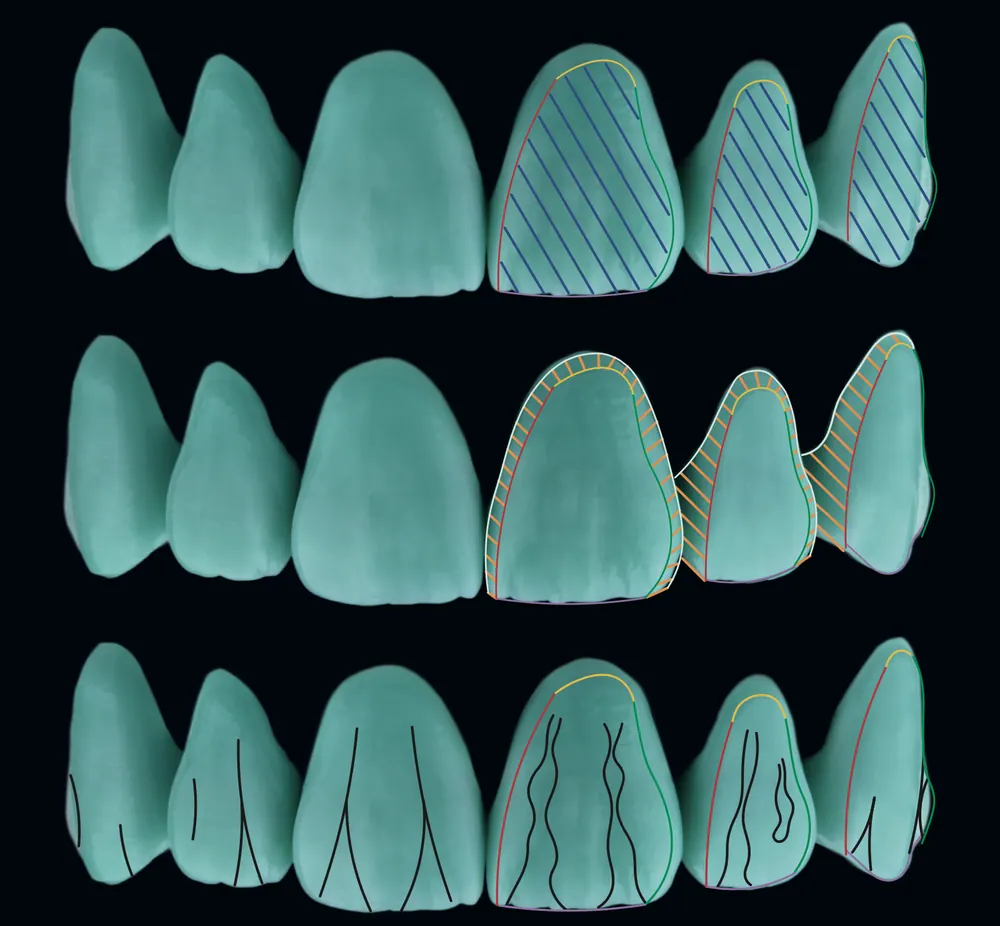
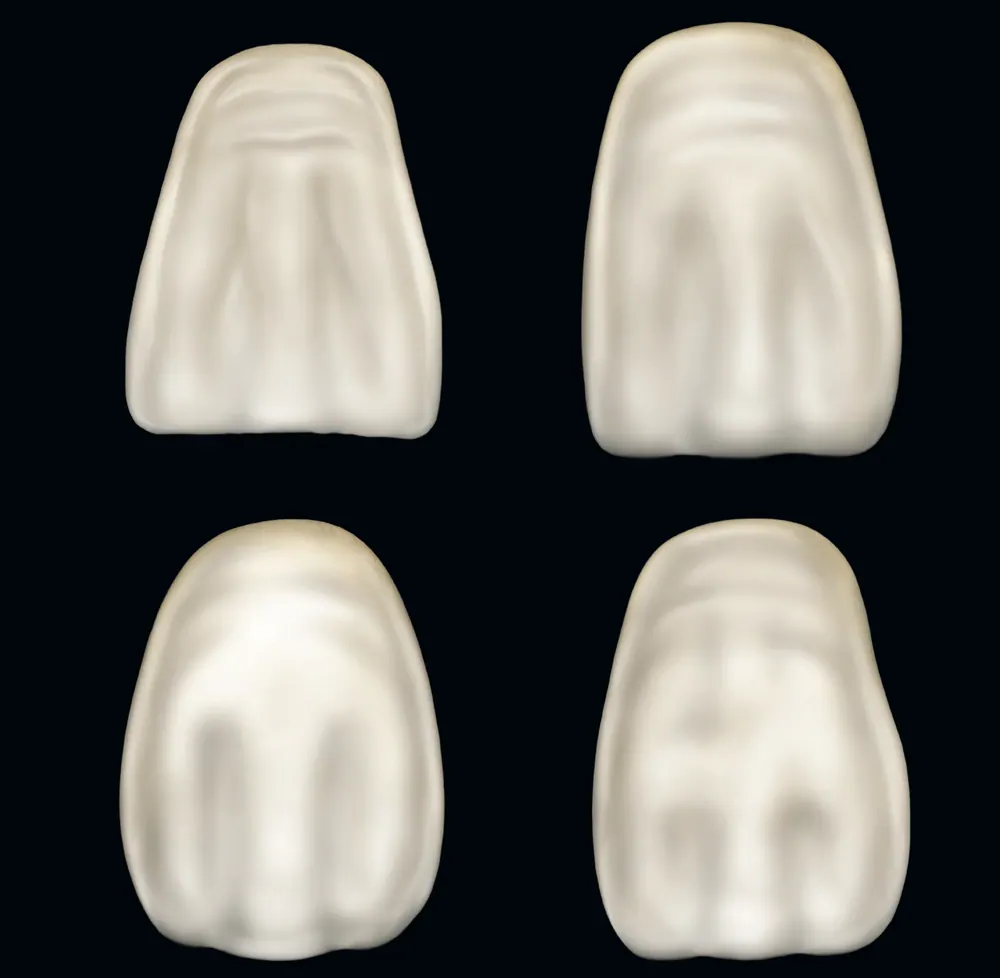
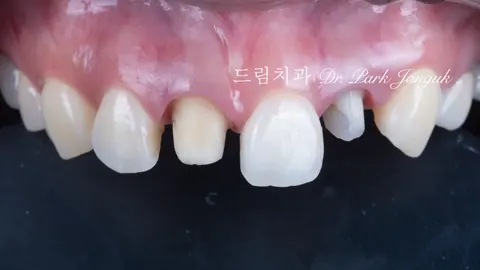
A tooth is very small, but it hides detail like an entire universe inside it. The shape, curvature, surface texture, and line angles all vary from tooth to tooth, and bringing out those details well is the basis of a beautiful tooth.
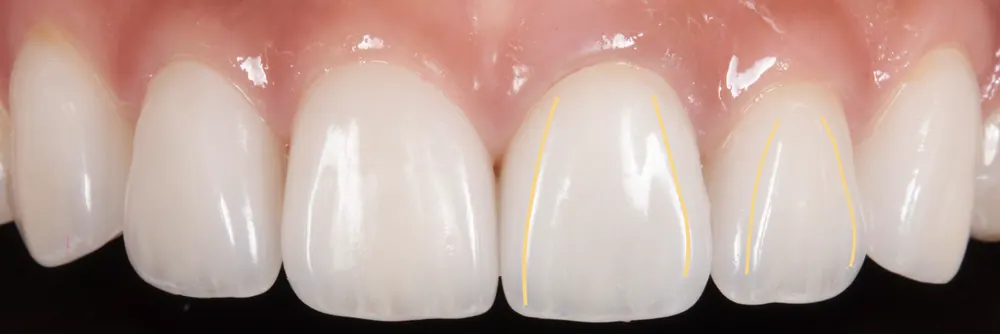
The line angles in particular, which create a tooth's sense of dimension, matter a great deal. How that dimension is expressed can make a tooth read as more masculine or more feminine, and can create a stronger or a softer impression.
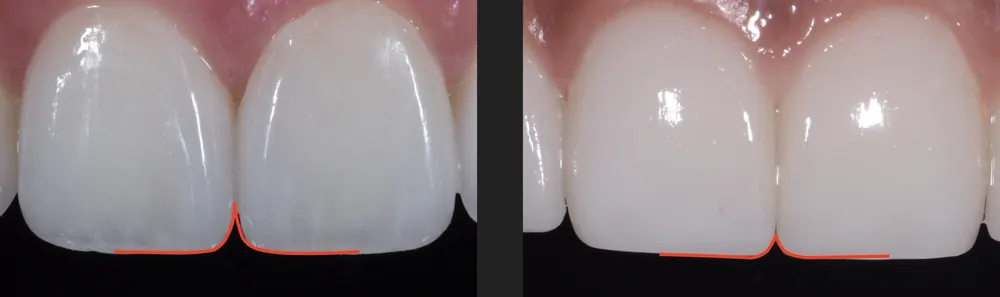
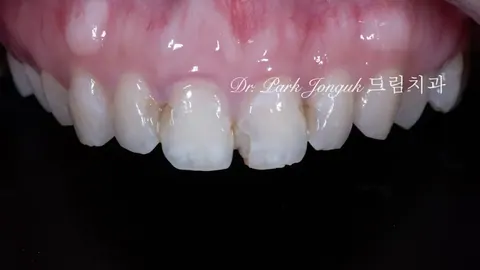
How the small gap at the tip of the teeth opens up also matters quite a bit. If it's shaped like the right side in the photo, it becomes what our textbooks call a "worn, aged tooth." Having it open naturally, like the left side, is quite important. If that space is completely closed off it tends to look like dentures, and because that shape is simpler for a dentist to make, many cosmetic cases these days end up looking that way. I don't favor that look, so I design toward a younger-looking tooth instead.
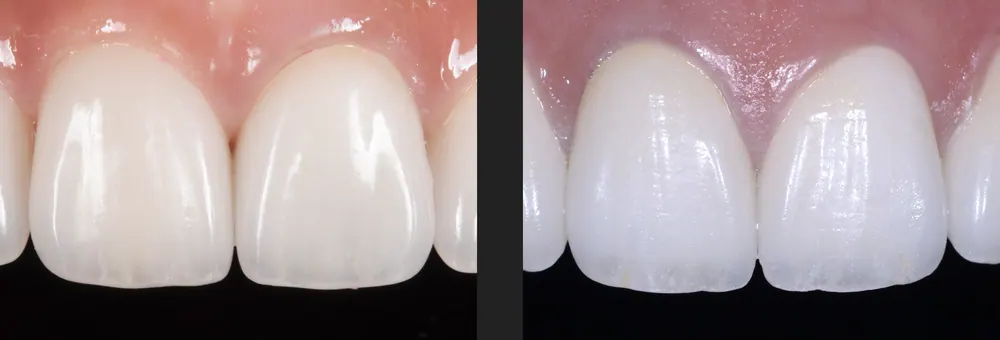
Surface texture is another basic element of a beautiful tooth. Because the handmade method can give teeth a natural texture, it can reproduce far more beautiful teeth than the one-day method.
Recent one-day veneer methods have started ignoring this kind of detail almost entirely. The biggest reason is that CAD/CAM still cannot fully capture this level of detail, and another reason is that producing many teeth for one patient in a single day makes it difficult to preserve all of that detail.
3. Translucency of the teeth
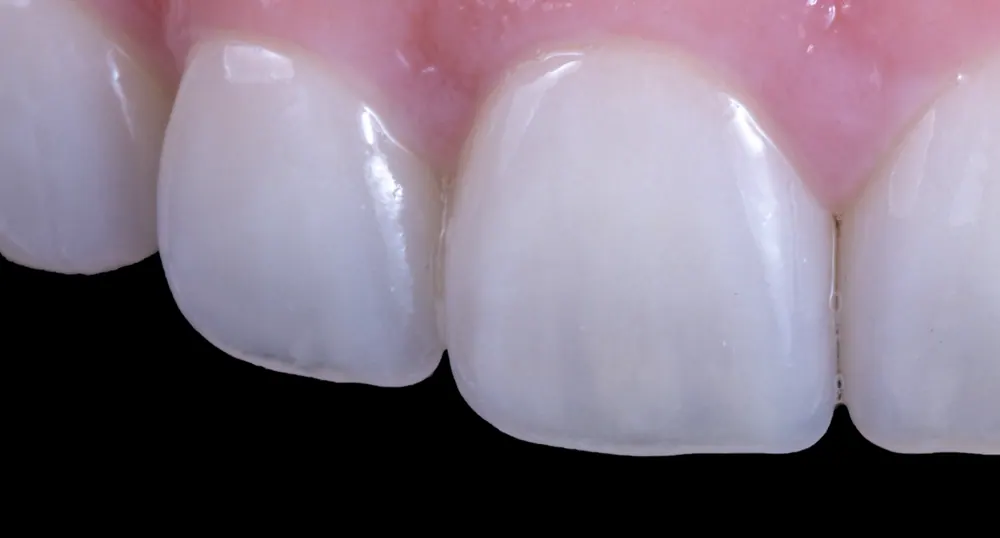
Another problem with the one-day veneer method is translucency.
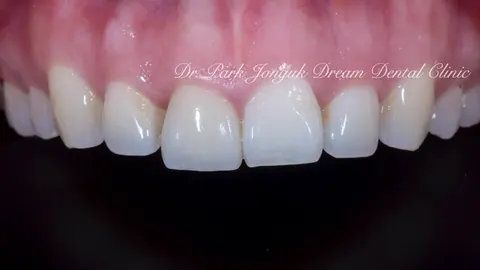
Younger teeth are characterized by a clear, translucent feel at the tip. As teeth are used over the years, the enamel layer wears down, the teeth turn yellowish, and that beautiful translucency is lost.
The goal of dental cosmetic treatment is beautiful teeth, and beautiful teeth can be described as young, bright, and translucent. Wherever possible, it's important to reproduce the shape, color, and translucency of younger teeth, and the handmade method is the only way to bring out that translucent feel.
This article is a clinical note written by Dr. Park Jonguk of Dream Dental Clinic, Gangnam; the original was published on his blog. The photographs shown are real cases he treated. Results vary with each patient’s condition, and every procedure carries the possibility of individual variation and side effects.
Quick Consult
Request a Callback
Leave your number and we will call you back during clinic hours.
Request Received
We will contact you during clinic hours. For urgent matters, please call +82-2-3448-0028.