
Buck-Teeth-Like Gapped Front Teeth and Peg Laterals, Resolved Together: A Veneer Treatment Case
Protruding buck teeth, gapped teeth, and peg lateral incisors
being present all at once make for a case that's very tricky to diagnose.
An accurate judgment is needed as to which treatment, orthodontics or veneers, is more suitable.
Today's case is one where a natural, harmonious front-tooth shape was achieved using veneers alone, without orthodontic treatment.
Introduction: Buck teeth + gapped teeth + peg laterals, how do you solve it when all three are present at once?
When the front teeth stick out slightly like buck teeth and there's a gap in the middle,
and on top of that, both lateral incisors are peg laterals in shape, it becomes an aesthetically very complex situation.
In cases like this, there are broadly two options.
Orthodontics to straighten the alignment, followed by veneers
Veneers alone
Doing orthodontics first can even out the alignment,
but the peg lateral problem still has to be resolved with veneers regardless.
In other words, since both stages have to be done, there's the added burden of a longer cost and timeline.
This patient, a man in his 30s, said, "It would be too much of a hassle to do orthodontics and then veneers on top of that,"
and chose veneers-only treatment.
Of course, veneers-only treatment isn't always possible,
so how much reduction is needed,
how natural a result can be achieved,
how much the tooth size and rotation angle can be adjusted, and so on,
all require a precise diagnosis beforehand.
The case I'm introducing today is exactly
a treatment where buck teeth, gapped teeth, and peg laterals were all naturally resolved at once with veneers.
Without a lot of experience in veneer diagnosis and fabrication, this is an extremely difficult case.
If you'd like to learn more about veneer treatment, please refer to the link below.
Main content
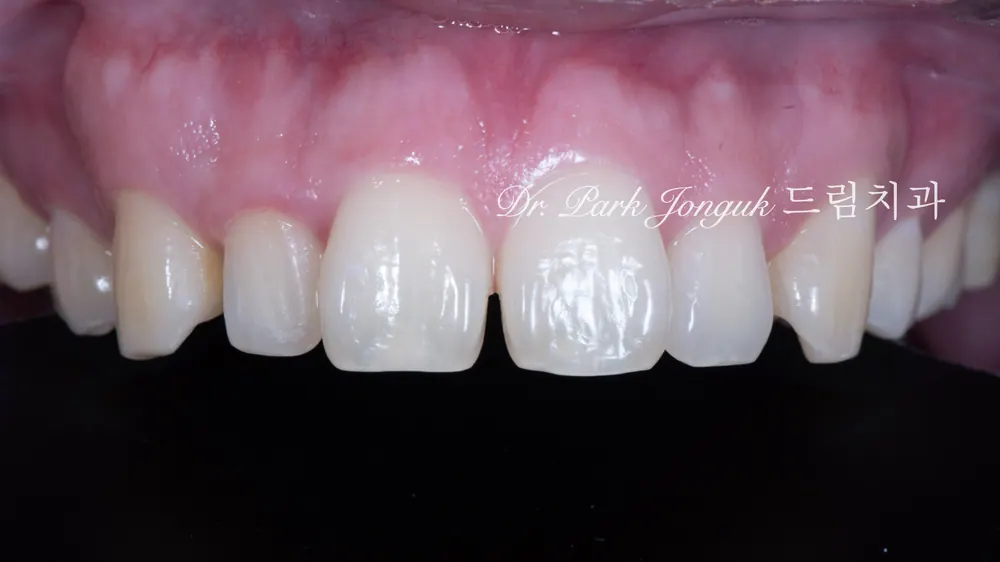
📸 Photo 1: Pre-treatment state
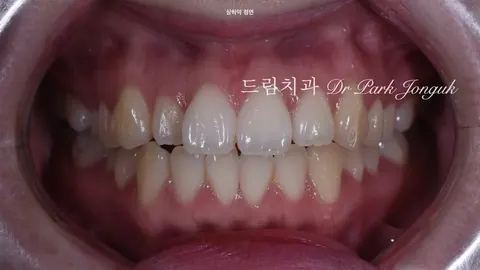
As you can see in the initial photo, the following characteristics were clear.
The two front teeth stuck out slightly forward, like buck teeth
There was a gap between the two central incisors, throwing off the center line when smiling
Both lateral incisors were congenitally small, short peg laterals
Overall, the proportions between teeth weren't good, giving the impression that "only the front teeth look excessively large"
It could be resolved with veneers, but the precondition is
how precisely "adjusting tooth size" and "reducing the protrusion" can be designed.
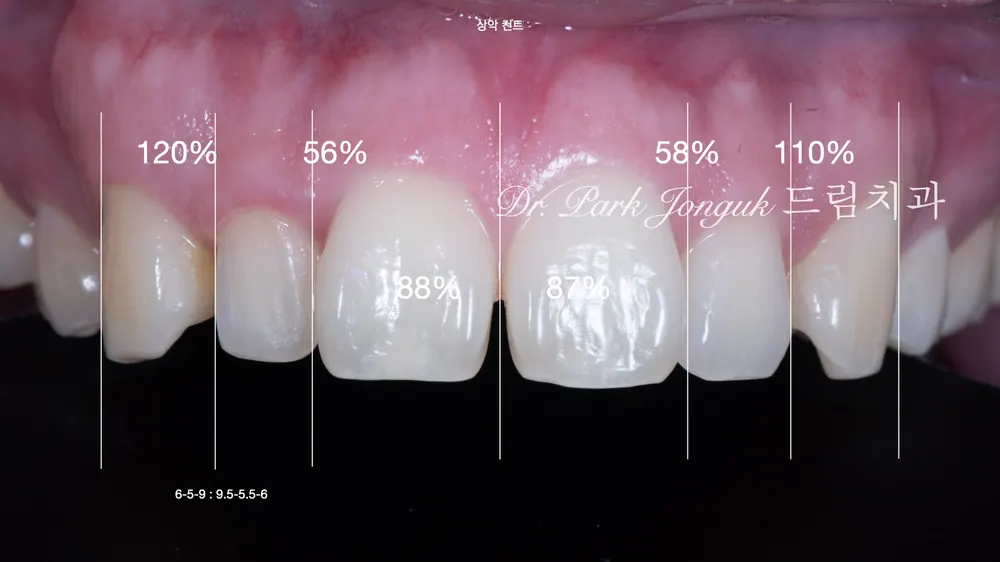
📸 Photo 2: Diagnostic analysis process
There were three points that mattered most at the diagnosis stage.
1. Whether the rotation and tilt of the protruding front teeth could be adjusted
A buck-tooth shape is almost impossible to fix with no-prep veneers.
But by adjusting the rotation angle of the teeth through minimal prep, a large part of the sense of protrusion can be resolved.
2. The ratio by which to enlarge the peg laterals
Since making the lateral incisors too large looks unnatural,
rather than a golden ratio relative to the central incisors, we applied "a ratio suited to the individual's face shape."
3. Naturally closing the gap between teeth
Simply filling the gap would make the front teeth look larger,
so it was essential to slightly reduce the central incisors while enlarging the lateral incisors as a proportion adjustment.
This process can only be designed accurately with a lot of diagnostic experience.
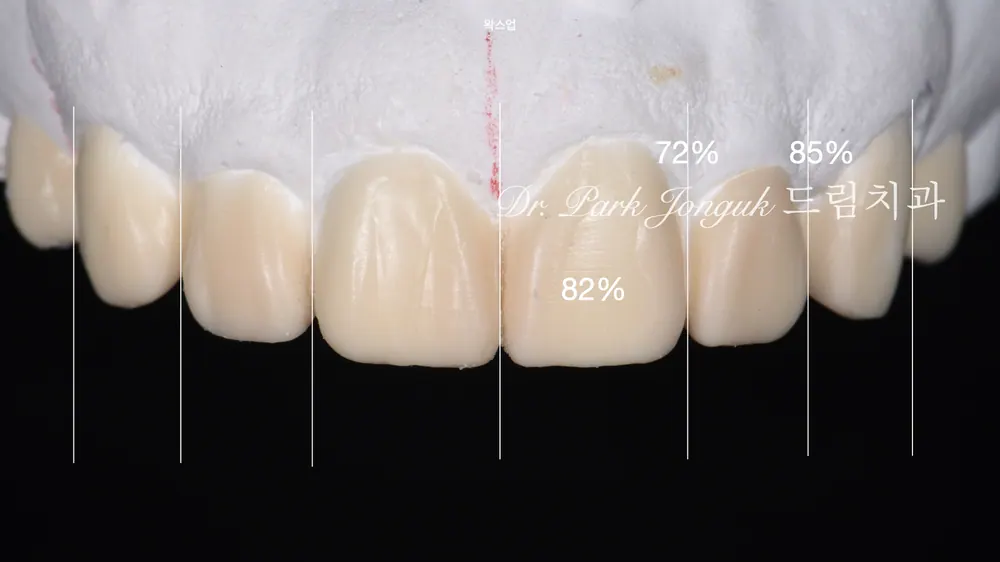
📸 Photo 3: Wax-up (model design)
The wax-up is the core process of veneer treatment,
the stage where you build in advance "what the final result will look like."
In this case, the following points mattered in particular.
Designing the tooth tips to rotate slightly inward to reduce the buck-tooth feel
Slightly reducing the width of the central incisors while enlarging the lateral incisors to naturally fill the gap
Adjusting the width of the peg laterals to about 70% of the central incisors
Considering the overall arch curve and how it harmonizes with the patient's face shape
The wax-up isn't just simple model work,
it's the most important stage where the proportion, curve, and tilt of the front teeth are all decided.
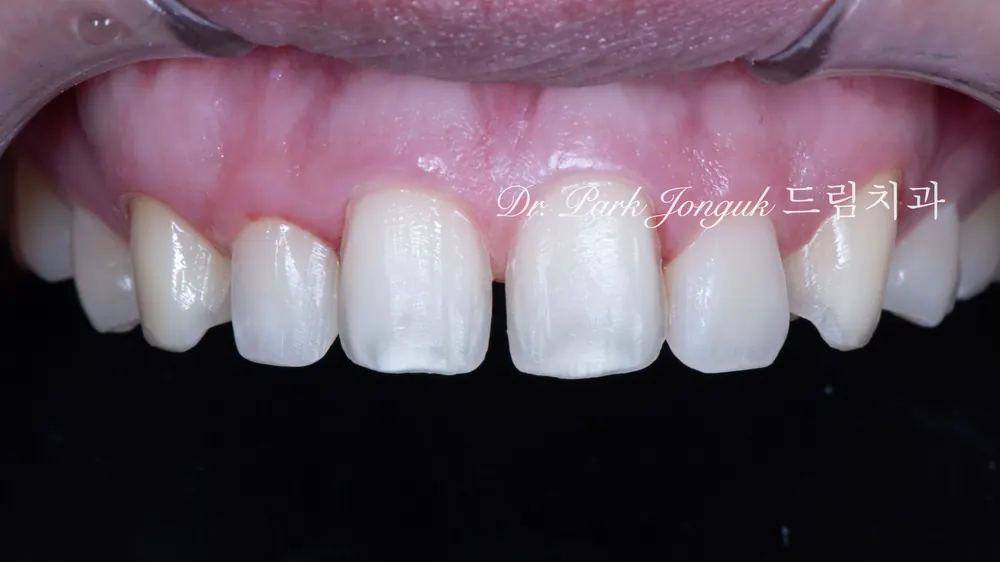
📸 Photo 4: Appearance after tooth reduction
Tooth reduction was carried out "as minimally as possible, but precisely to the extent needed."
Excessive reduction weakens the tooth,
while too little reduction fails to reduce the protrusion, and the resulting thicker veneer can actually make the teeth look even more prominent.
In this case,
✔ reducing the protrusion
✔ naturally closing the gap between teeth
✔ enlarging the peg laterals
for these three goals, precise minimal-prep reduction was carried out under a microscope.
The amount of reduction was so small
that "you'd believe it if someone told you this photo was taken before treatment."
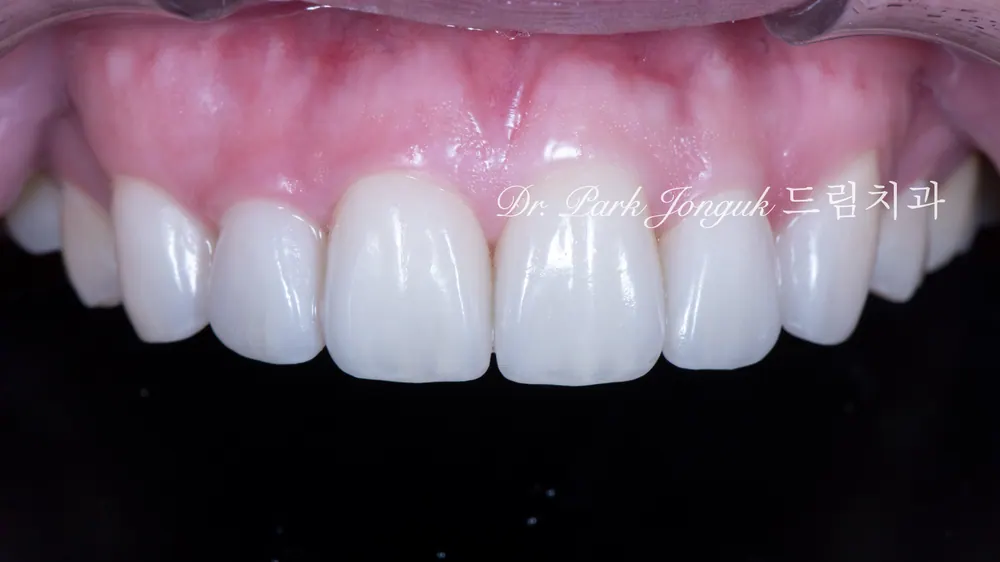
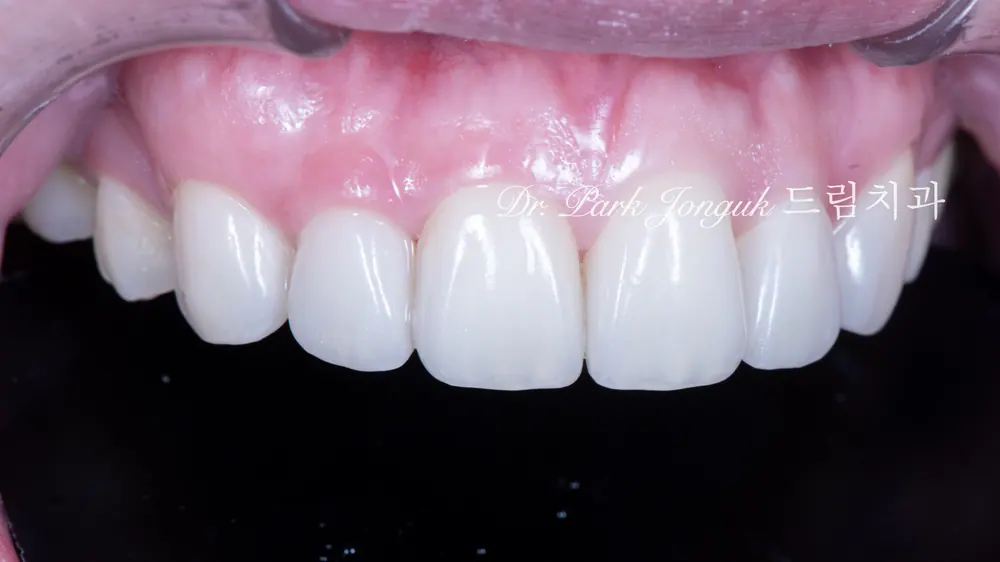
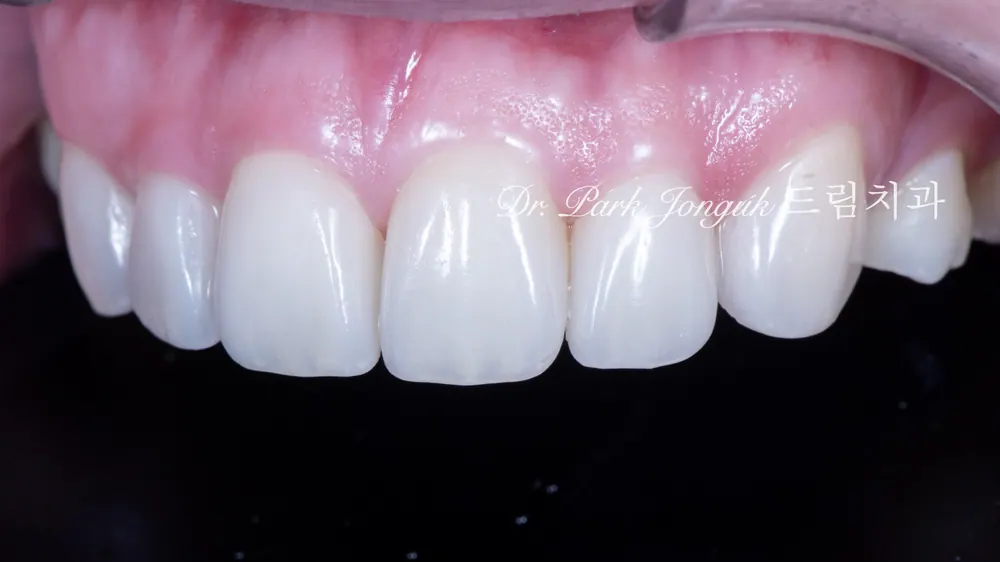
📸 Photos 5, 6, 7: After veneer treatment
The changes visible in the post-treatment photos are as follows.
1. The buck-tooth shape was fully corrected
As the angle and direction of the tooth tips were adjusted,
the sense of protrusion naturally disappeared.
2. Natural closing of the gap between teeth
The width of the central incisors was controlled so they wouldn't get larger,
and the previously peg-shaped lateral incisors were naturally enlarged, making the overall harmony much better.
3. A natural rebirth of the peg laterals
Rather than simply making them larger,
they were shaped to match the central incisors and canines,
with color, translucency, and three-dimensional feel all matched together.
4. Overall improvement of the smile line
After the veneers, the tooth alignment looks tidy when smiling,
and the harmony with the lips and face shape is much better.
The patient herself said,
"I'm so satisfied because this was resolved so much more naturally and quickly than orthodontics would have been,"
she told us.
Conclusion
A case with buck teeth, gapped teeth, and peg laterals all at once
is truly not an easy, complex aesthetic diagnostic case.
But when
an accurate diagnosis,
a detailed wax-up design,
precise minimal-prep reduction under a microscope,
and handmade build-up veneers
all come together in harmony,
it's possible to transform the front teeth into a natural, beautiful shape even without orthodontics.
Veneers aren't just "the technique of attaching something"; they're a combination of design, diagnosis, and fabrication.
That's why it's especially important to get a consultation at a clinic with real experience.
❓ Q&A
Q1. Can buck teeth be corrected with veneers alone, without orthodontics?
It's often possible, but not every case can be resolved this way.
The degree of protrusion, tooth size, and proportions need to be accurately analyzed.
Q2. Isn't it hard to make peg lateral veneers look natural?
That's right. Enlarging a peg lateral is a highly difficult task.
Only handmade build-up veneers can express the translucency of a natural tooth.
Q3. Do veneers for gapped teeth last a long time?
With accurate bonding and bite analysis, they can be used for a long time.
Veneers typically last 10 to 20 years, and sometimes longer with good care.
This article is a clinical note written by Dr. Park Jonguk of Dream Dental Clinic, Gangnam; the original was published on his blog. The photographs shown are real cases he treated. Results vary with each patient’s condition, and every procedure carries the possibility of individual variation and side effects.
![[Peg Lateral Veneers] From a Strong-Looking Impression to a Soft, Feminine Smile — The Esthetics of Front-Tooth Veneers](/column-media/224178565168/thumb.webp)
Quick Consult
Request a Callback
Leave your number and we will call you back during clinic hours.
Request Received
We will contact you during clinic hours. For urgent matters, please call +82-2-3448-0028.