
Buck-Tooth Veneers: A Fast, Natural Solution Without Braces — A Real Gangnam Veneer Case
Hello. I'm Park Jonguk, director of Dream Dental Clinic, who has practiced esthetic dentistry in Apgujeong for 20 years.
Today, I'd like to introduce a veneer case for buck teeth that troubles many people.
I hope this helps those searching for a clinic that's skilled with veneers.
Buck teeth: braces vs. veneers?
This patient came to us wanting to fix two protruding buck teeth,
after searching for a Gangnam veneer clinic and finding us.
She said her front teeth always looked like they were sticking out whenever she smiled, which had bothered her for a long time.
When the front teeth protrude like buck teeth, there are two treatment plans to consider.
The first is orthodontic treatment.
This is a method that improves the protrusion by moving the position of the teeth, without shaving them down.
The second is veneer treatment.
This is a method that reduces the teeth minimally and bonds veneers on, improving both the position and the shape at the same time.
Personally, I believe preserving healthy tooth structure is important,
so I tend to recommend orthodontics.
But depending on the patient's circumstances and requirements, veneers can be the better choice.
In this patient's case, there were two important requirements.
One was that treatment needed to be finished quickly,
and the other was that she also wanted the color and shape of her teeth improved.
Orthodontic treatment takes at least a year or more,
and orthodontics alone can't change the color or shape of the teeth.
Veneers, on the other hand, can be finished within 2-3 weeks,
and can improve not just the position but the color and shape as well.
After thoroughly consulting with the patient, we decided on veneer treatment.
We began treatment with the goal of minimizing the amount of tooth reduction.
Before treatment, several problems are visible
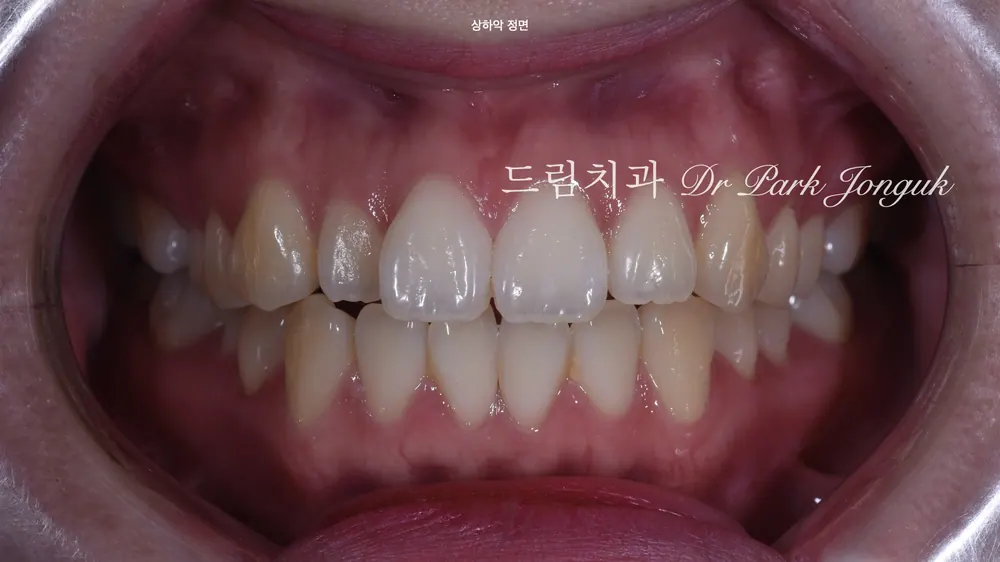
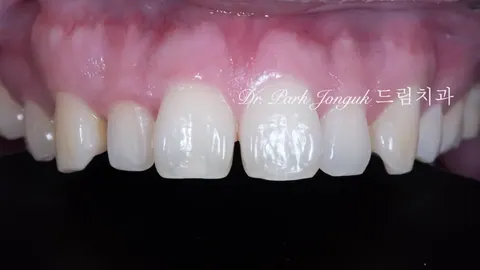
Photo 1 is the before-treatment photo.
Beyond the buck teeth, several other esthetic problems can be observed.
1. Buck teeth: the two central incisors protrude forward. This stands out especially when she smiles and gives a strong impression.
2. Large, jar-shaped central incisors: the central incisors aren't just protruding — they're also large in size,
with a shape that's as wide as a jar. This gives a masculine, unrefined feel.
3. Relatively small lateral incisors: because the central incisors are large, the lateral incisors beside them look relatively very small.
The proportions are out of balance.
4. Yellowed canines: the canines are yellow and dark in color.
This darkens the overall smile.
Fixing the buck teeth alone wouldn't be the end of it —
all of these problems needed to be improved together to create a truly beautiful smile.
The diagnostic process starts with the face
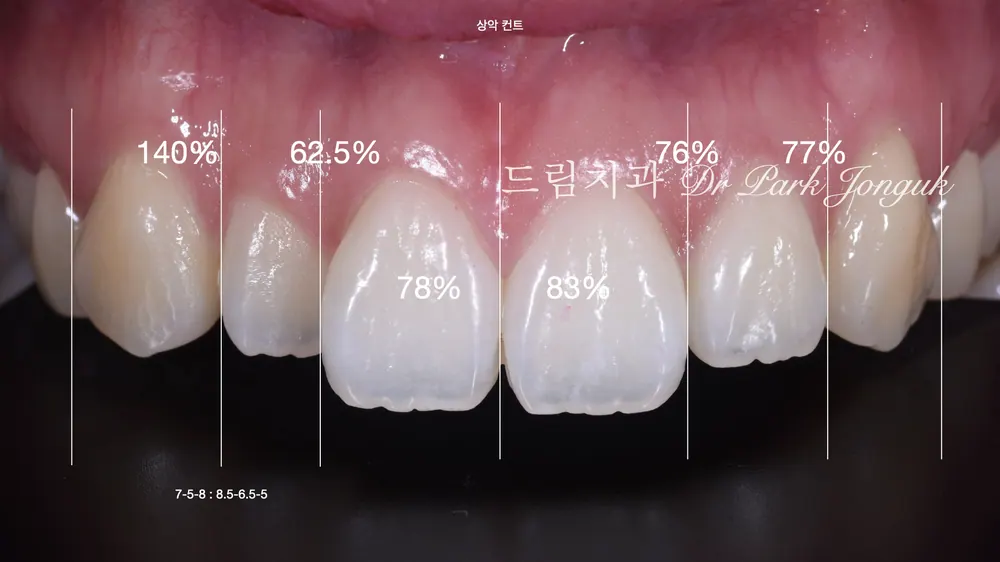
Photo 2 shows the diagnostic process. The biggest hallmark of a clinic skilled with veneers is precise diagnosis.
Facial diagnosis comes first
Building a treatment plan by looking only at the teeth is a recipe for failure.
Diagnosis has to start with the face.
We analyze the patient's facial shape, lip line, and smile curve.
We closely evaluate the relationship between the teeth and the face — how much of the teeth show when she smiles —
and whether the tooth midline lines up with the facial midline, among other details.
Tooth diagnosis
After the facial diagnosis, we do the tooth diagnosis.
As shown in the photo, we have to analyze the size, shape, and proportion of every tooth.
We measure the width and length of each tooth and evaluate the size relationship between the central incisors, lateral incisors, and canines.
We quantify everything, down to the tooth angles, the curve of the incisal edges, and the degree of protrusion.
Starting treatment with a "this should be about right" approach, without this kind of precise diagnosis,
leads to a result that looks awkward and unnatural.
It's no exaggeration to say diagnosis determines 80% of a treatment's success.
Precision wax-up diagnosis: previewing the result
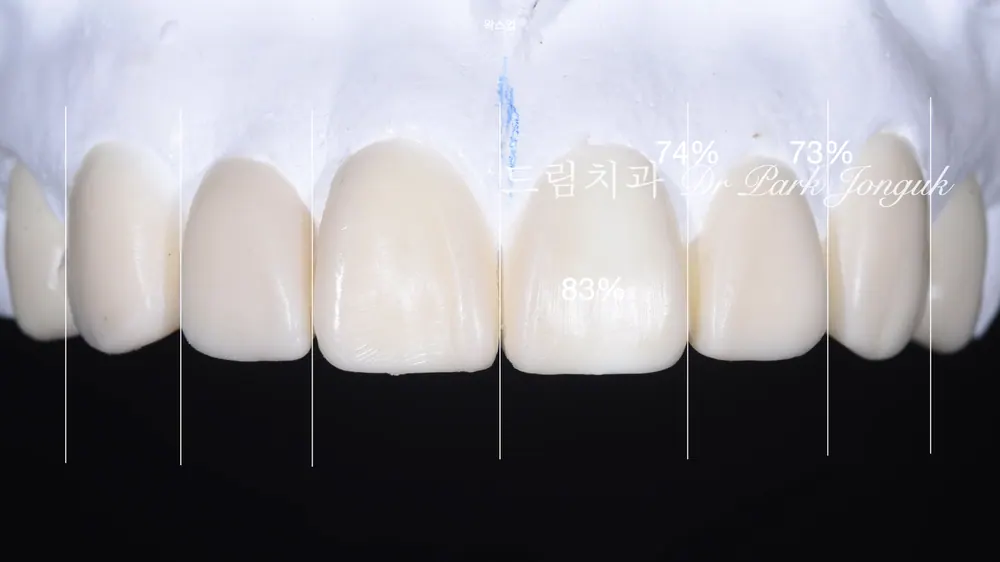
Photo 3 is the precision wax-up diagnosis result that came out of the analysis.
This is the process of building the final veneer shape in advance, based on the diagnostic data.
We set the central incisors, which had protruded like buck teeth, into a natural position.
We narrowed the width of the once jar-wide central incisors and gave them a more feminine, delicate shape.
The once-small lateral incisors were built up to an appropriate size.
We matched their proportion to harmonize with the central incisors, creating overall balance.
For the canines, we brightened the color and refined the shape naturally.
Seeing the wax-up model, the patient was delighted, saying, "I'm so excited that I can have teeth like this."
The wax-up is an important process for building trust by showing the patient the final result in advance.
Precision reduction using a microscope
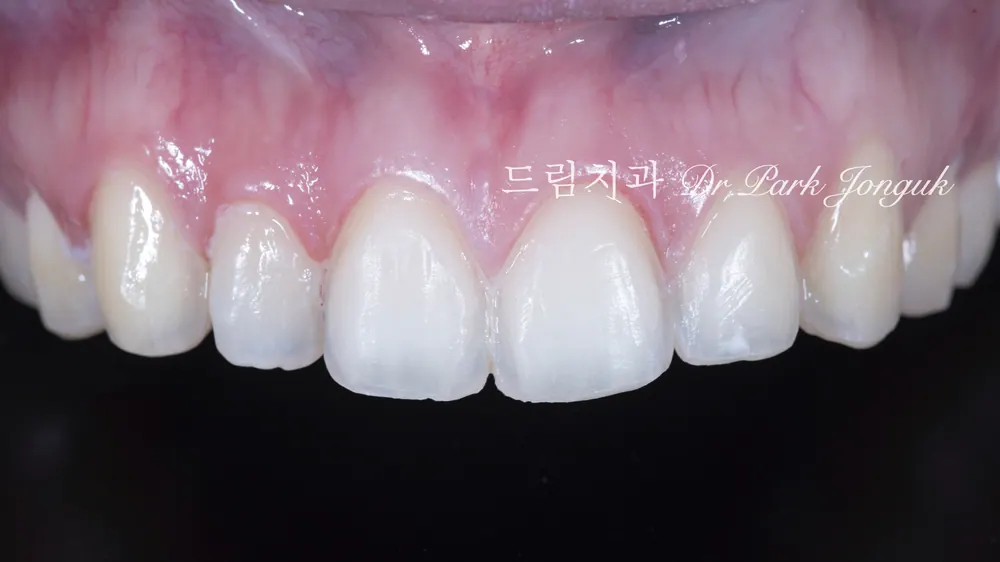
Photo 4 shows the tooth reduction being carried out as analyzed.
At this stage, our core principle is minimal reduction.
The importance of using a microscope
We use a microscope for tooth reduction.
With a microscope, the tooth can be magnified 10x or 20x, so only the exact area that needs it can be reduced precisely.
Reducing with the naked eye means cutting by rough estimation, a "this should be about right" approach.
But with a microscope, reduction can be done accurately down to 0.1mm increments.
The parts that protrude like buck teeth are reduced a bit more,
while the parts already in a normal position are reduced as little as possible.
This kind of differential reduction is impossible without a microscope.
Minimal reduction for the lateral incisors and canines
The lateral incisors were already small, so we barely reduced them at all.
If anything, since the direction is to make them larger, almost no reduction is needed.
For the canines too, since it was only a matter of improving color and slightly refining the shape, we did only minimal reduction.
The patient was glad, saying, "It's reassuring to know you're barely shaving down my teeth at all."
Since a tooth can never be un-reduced once it's cut, preserving as much of it as possible is always best in the long run.
Testing the final result with temporary teeth
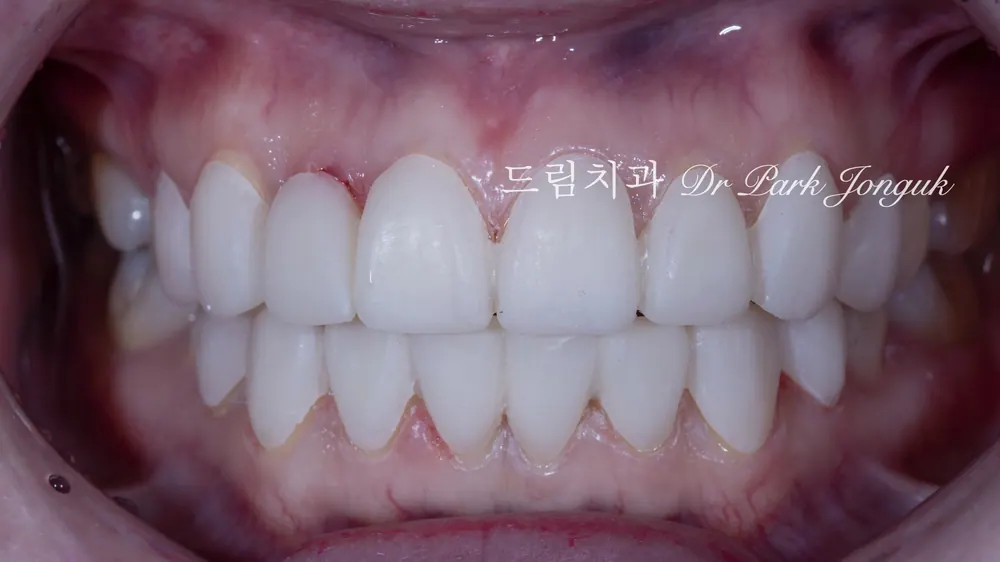
Based on the wax-up, we fabricated temporary veneers.
The patient wore the temporary teeth through her daily life to check for any discomfort,
and confirmed that she liked the shape and size.
Even at the temporary-tooth stage, she was satisfied, saying, "The buck teeth are gone and my teeth look natural."
After treatment: a complete transformation
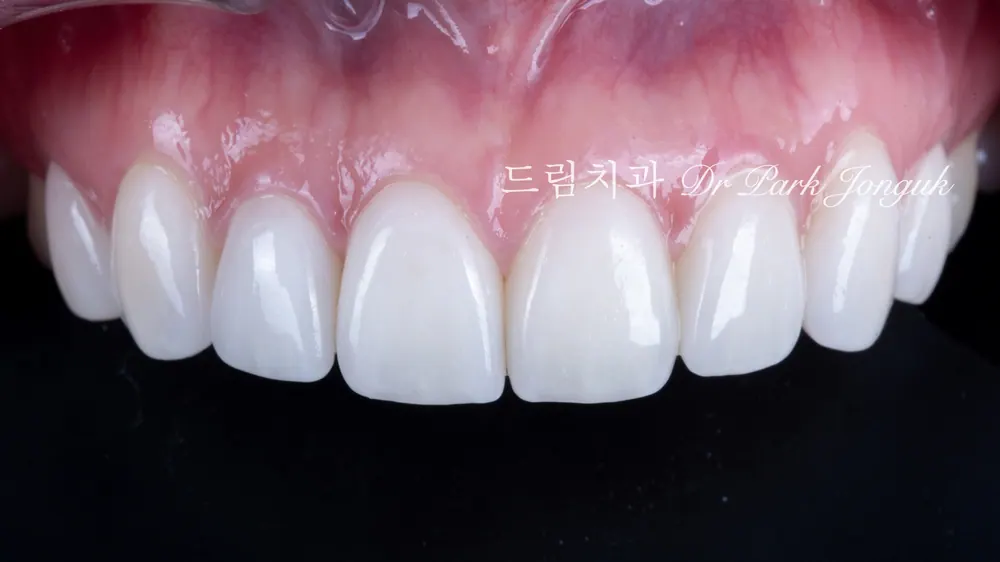
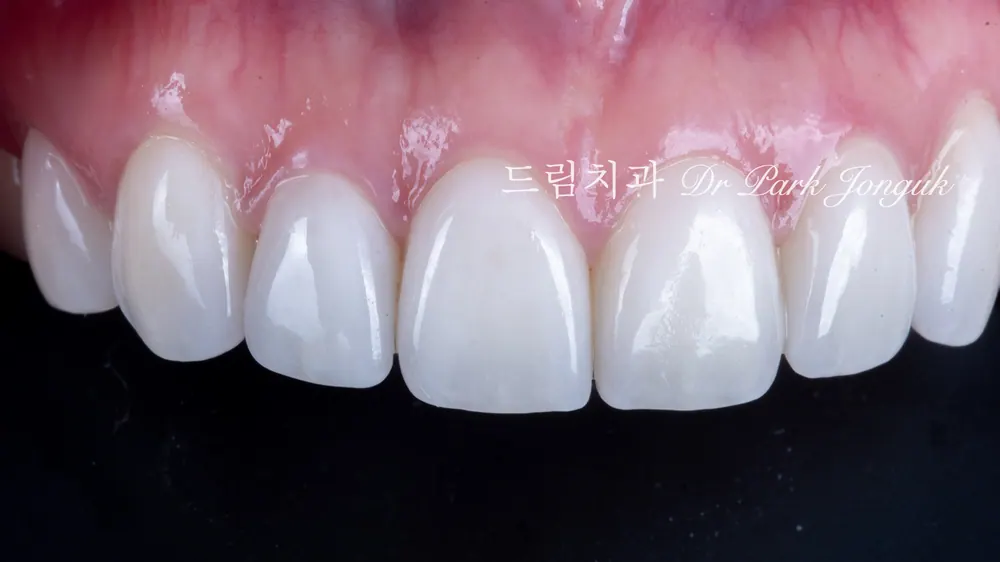
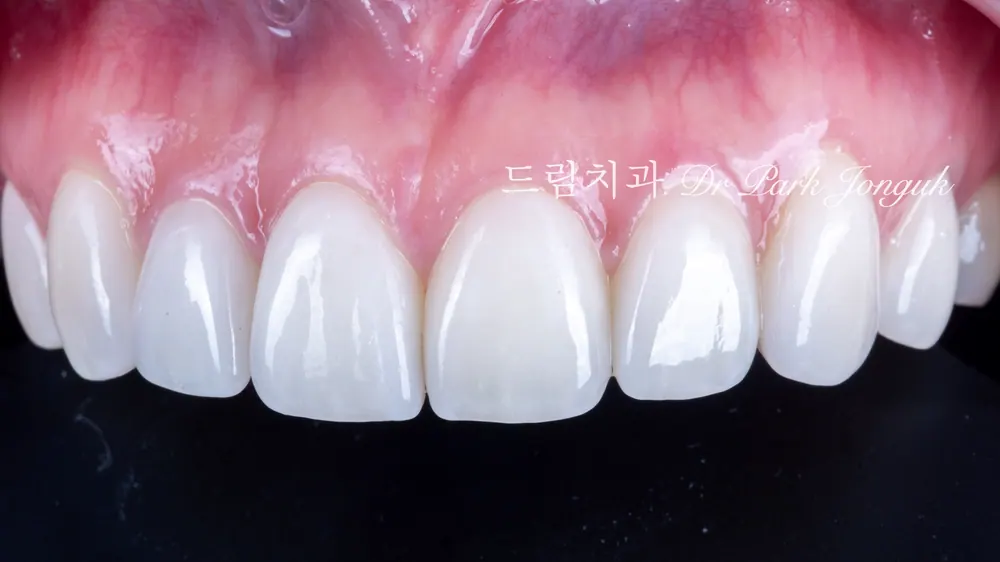
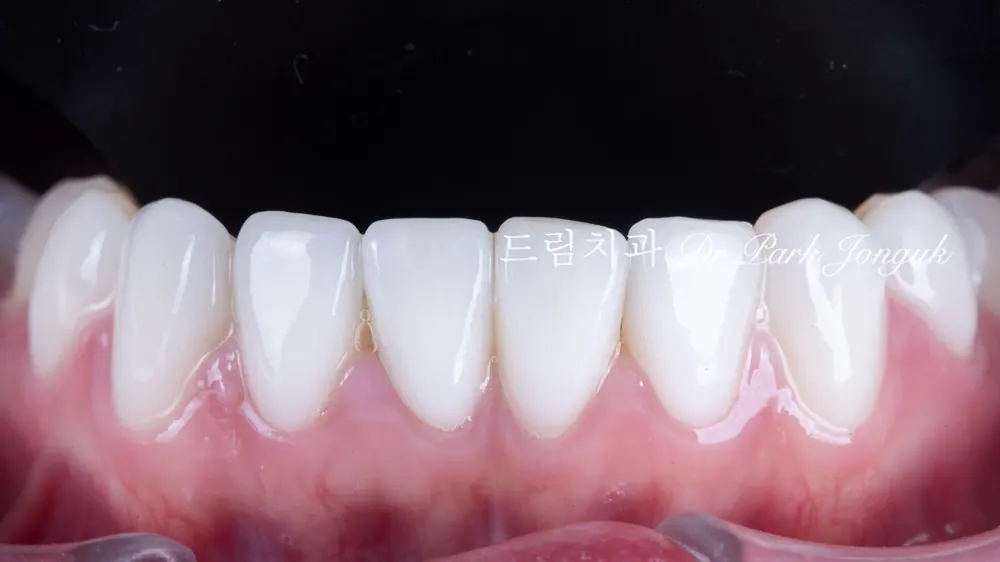
Photos 6, 7, 8, and 9 show the result after treatment.
The buck teeth are completely resolved
The central incisors, which had protruded forward, have moved into a natural position.
Now, when she smiles, the buck teeth aren't visible at all, and a soft, elegant smile has been completed.
The tooth shape has become beautiful
The once wide, unrefined, jar-shaped central incisors have changed into a delicate, feminine shape.
The lateral incisors are now an appropriate size as well, harmonizing with the central incisors.
The tooth color is bright and natural
Including the once-yellow canines, the overall color is now bright and radiant.
But it's not simply white — it has translucency and dimensionality, so it looks natural.
The translucency at the incisal edge, the subtle contours of the surface, and even the way the color shifts with the light — all of it is alive. This is exactly the natural look created by hand-built-up veneers.
Her whole face has brightened
With her teeth now beautiful, her whole face looks brighter and more youthful.
The patient was truly delighted, saying, "Now I can smile with confidence."
How to check whether a clinic is skilled with veneers
For those considering buck-tooth veneers, here's how to find a clinic that's skilled with veneers.
First, check whether they perform a precise diagnosis.
There should be a system that quantitatively analyzes tooth size, proportion, and shape, starting with facial analysis.
Second, check whether there's a wax-up process.
A wax-up diagnosis that builds and shows the final result in advance is essential.
Third, check whether they use a microscope. Precise reduction requires the use of a microscope.
Fourth, check whether it's a hand-built-up method.
Rather than a single block milled by computer,
it should be a build-up method that layers multiple sheets of ceramic to look natural.
Fifth, ask to see real cases.
Looking at before-and-after photos of similar buck-tooth cases lets you gauge that clinic's skill.
Gangnam veneers: experience matters
There are many Gangnam veneer clinics, but the difference in results can be large.
The single most important factor is experience.
Over 20 years, I've built up know-how from treating countless buck-tooth cases.
Knowing at what angle to reduce for maximum effect with minimal reduction,
and what shape to create so it looks natural while the buck teeth no longer show —
these fine techniques come from experience.
Collaboration with a skilled ceramist matters just as much.
Even if I diagnose and reduce with precision,
if the ceramist doesn't understand it accurately and fabricate it beautifully, the result can't turn out well.
We work with a trusted team of ceramists we've worked alongside for 20 years.
They're a team that fully understands my diagnostic intent and delivers the best possible result for the patient.
If you're torn between orthodontics and veneers for buck teeth
For those struggling with buck teeth, here's my advice:
both treatment methods have their pros and cons.
The advantage of orthodontics is that it preserves the teeth without shaving them down.
But it takes a long time (1-2 years), and it can't improve the color or shape of the teeth.
The advantage of veneers is that they're fast (2-3 weeks) and can improve not just the position but the color and shape as well.
But there's the burden of having to reduce the teeth.
I recommend orthodontics whenever possible. But if time is limited,
or if you also want the color and shape of your teeth improved,
or if there's a strong chance you'd want veneers even after orthodontics, veneers may be the better choice.
What matters most is consulting thoroughly with an experienced dentist
to find the best method for you personally.
Frequently Asked Questions (Q&A)
Q1. If I treat buck teeth with veneers, do a lot of teeth need to be shaved down?
A. The parts that protrude like buck teeth are reduced somewhat more, but with precise, microscope-guided reduction, it's kept to a minimum. The lateral incisors and canines are hardly reduced at all, or only minimally.
Q2. Can buck teeth protrude again after veneer treatment?
A. Veneers are bonded very strongly to the teeth, so they won't protrude again. With proper care, they stay stable for 10 years or more.
Q3. How long does veneer treatment take?
A. It generally takes about 2-3 weeks. It goes through stages such as diagnosis, wax-up, tooth reduction, temporary teeth, and final veneer fabrication and bonding. It's much faster than orthodontics (1-2 years).
Q4. How much do Gangnam veneers cost?
A. It varies depending on the number of teeth, the difficulty, and the materials used. Buck-tooth cases require precise diagnosis and planning, so the exact cost is provided after an examination.
Q5. How should I care for my teeth after buck-tooth veneer treatment?
A. It's the same as general oral care. Being careful with hard foods, getting regular checkups, and brushing properly is all the basic care you need.
This article is based on the actual clinical experience of a dentist who has practiced esthetic dentistry in Apgujeong for 20 years. He lectures dentists on veneer techniques every month at Lamista Academy and has published Korea's first veneer clinical textbook.
This article is a clinical note written by Dr. Park Jonguk of Dream Dental Clinic, Gangnam; the original was published on his blog. The photographs shown are real cases he treated. Results vary with each patient’s condition, and every procedure carries the possibility of individual variation and side effects.
![[Peg Lateral Veneers] From a Strong-Looking Impression to a Soft, Feminine Smile — The Esthetics of Front-Tooth Veneers](/column-media/224178565168/thumb.webp)
Quick Consult
Request a Callback
Leave your number and we will call you back during clinic hours.
Request Received
We will contact you during clinic hours. For urgent matters, please call +82-2-3448-0028.