
Veneer Redo: Turning Fluorescent-Light-White Teeth Natural
Hello, I'm Park Jonguk, director of Dream Dental Clinic, who has practiced esthetic dentistry in Apgujeong for 20 years.
Today I want to introduce a veneer redo case.
I hope this helps anyone struggling with veneers that look far too opaque and artificial.
Teeth as white as a fluorescent light — it just looked too awkward
This patient came to see me after receiving veneer treatment at another clinic.
Her veneers were far too opaque, white as if a fluorescent light had been switched on, and looked awkward and artificial.
She told me, "Right after treatment I thought they looked white and fine, but the longer it went on, the more artificial they looked, and it became really stressful."
She said she decided on a redo after repeatedly hearing from people around her that "it's so obvious you got veneers."
Before treatment, the problems are clear at a glance
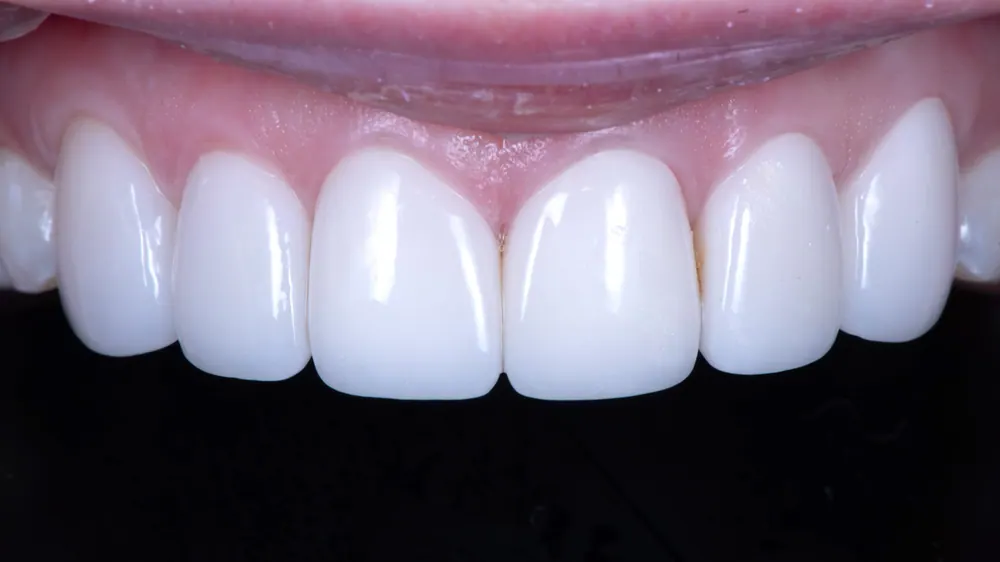
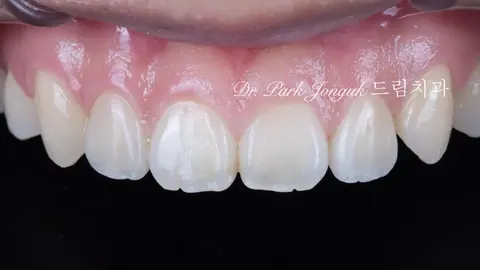
Photo 1 is from her initial visit.
Several problems with the veneer can be observed.
It's far too opaque
The biggest problem is that there's no translucency at all.
In a natural tooth, light passes through and diffuses softly, but this veneer blocks light entirely.
It's as opaque as if it had been coated in white paint.
It's just white, like a fluorescent light
It's simply white.
There's none of the subtle color variation found in a natural tooth.
The root area, the middle, and the tooth edge are all the exact same white.
It's excessively bright and flat, like a fluorescent light left on.
It looks far too awkward and artificial
It looks completely disconnected from the surrounding natural teeth.
It's very obvious that she got veneers.
The shape is also uniform and monotonous.
There's no sense of vitality at all.
This is the typical problem with a one-day, single-block veneer.
Removing the veneer — the tooth had already been reduced a great deal
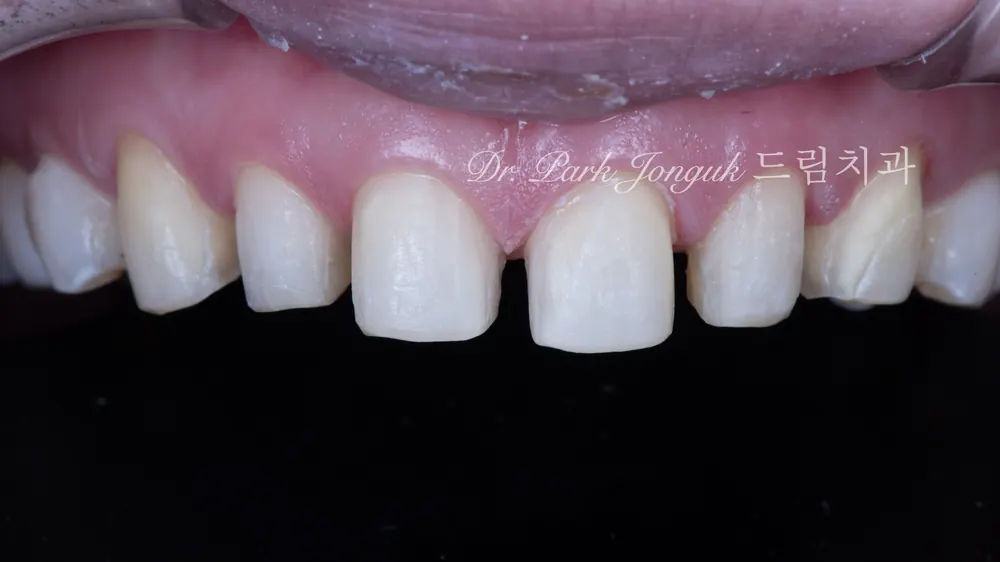
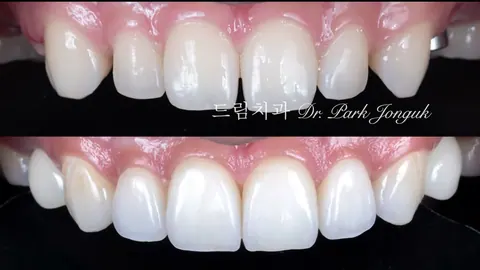
Photo 2 shows the result after the veneer was removed.
It was a shocking sight.
Excessive tooth reduction
Far too much of the tooth had already been reduced.
The appropriate amount of reduction for a veneer is 0.3-0.5mm, but this patient's tooth had been reduced far more than that.
The tooth had been reduced down to a sharp, needle-like point.
It had gone past the enamel and even exposed the dentin.
The problem with excessive reduction
Reducing a tooth too much causes several problems.
The tooth becomes very sensitive.
The tooth's structural strength weakens.
It narrows the options available for a future redo.
It was a truly unfortunate situation.
Safely removed with a laser
Fortunately, it was removed safely using a laser.
Using a laser allows only the bonding layer between the veneer and the tooth to be selectively removed.
Removing it with an ordinary drill risks further damaging a tooth that's already been heavily reduced, but a laser minimizes damage to the tooth.
The existing veneer was carefully and completely removed.
Precise diagnosis and hand-built layered fabrication
After removing the veneer, a precise diagnosis was carried out.
The patient's facial shape, lip line, and smile curve were analyzed.
The final shape was designed in advance with a wax-up.
This time, naturalness was set as the top priority.
Hand-built, multilayer construction
The new veneer was fabricated using a hand-built, multilayer method.
Several kinds of ceramic were layered one on top of another.
A dentin-colored core layer was built on the inside.
A semi-translucent, enamel-colored layer was built in the middle.
Translucent ceramic was applied at the tooth edge.
Fine characterization was expressed on the surface.
Only this approach can create the same translucency and dimensionality as a natural tooth.
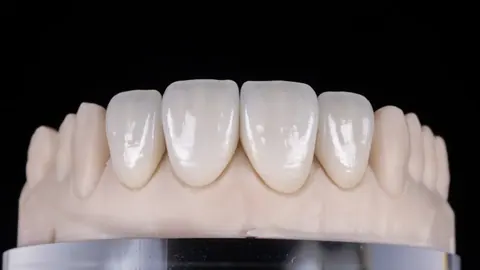
After treatment, it looked completely natural
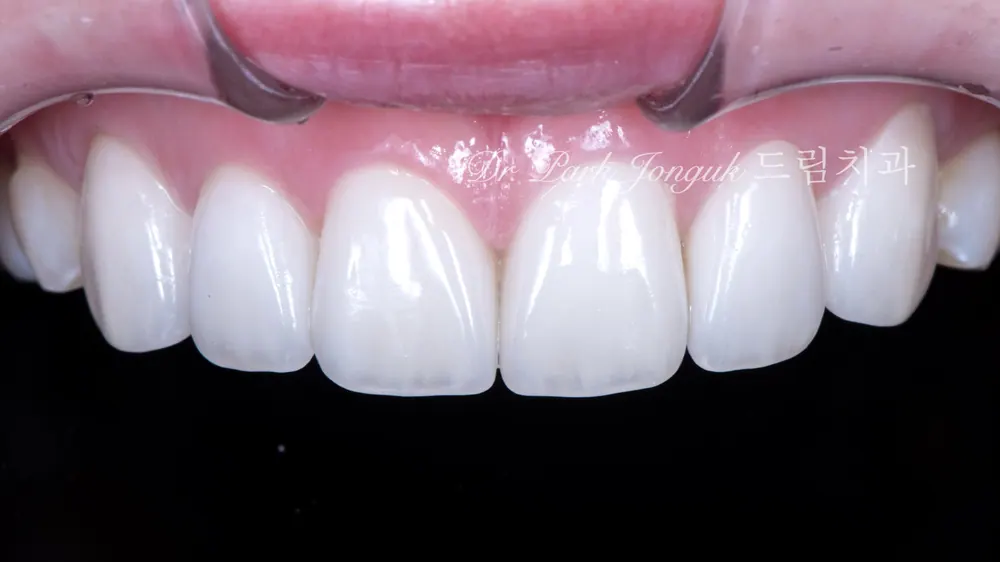
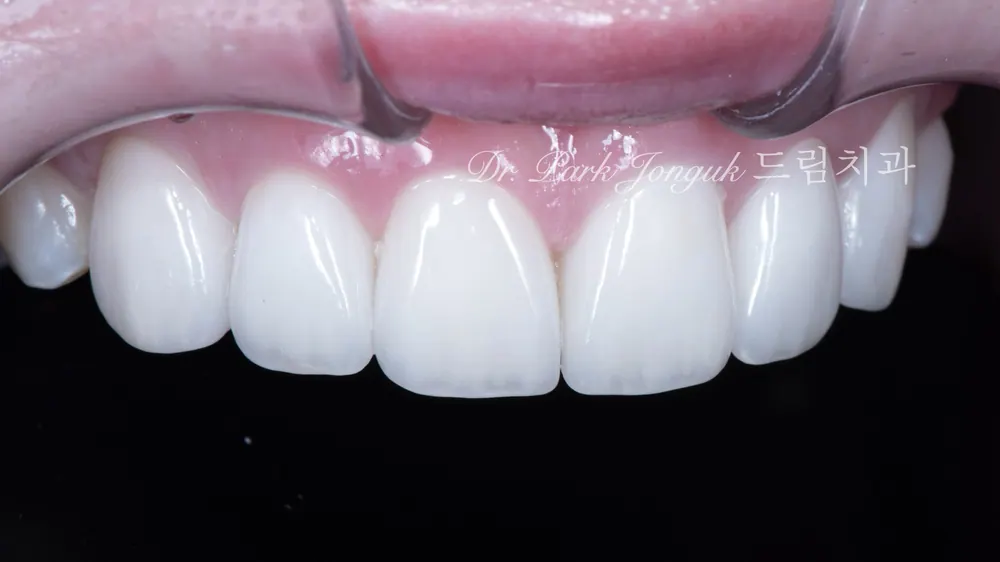
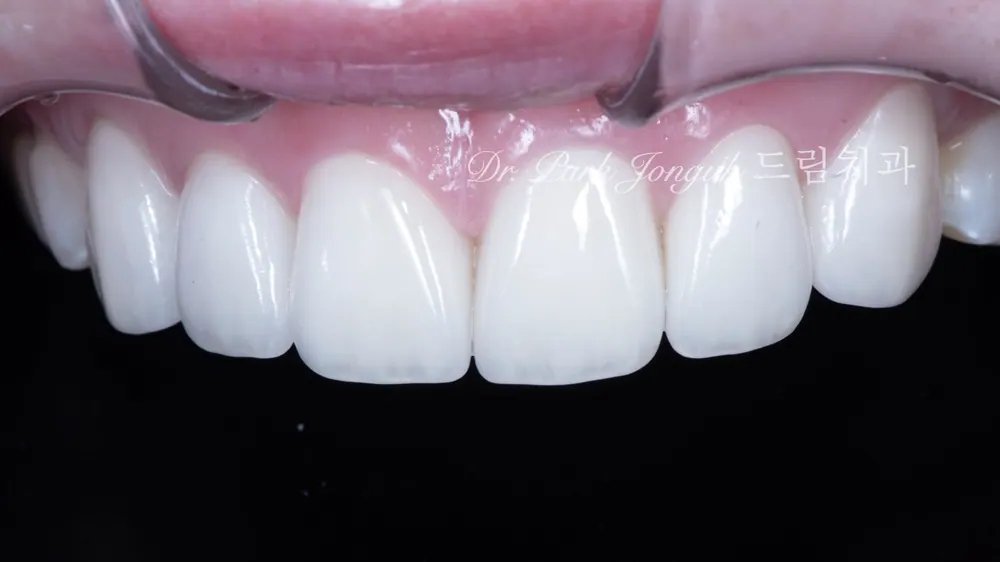
Photos 3, 4, and 5 show the result after treatment.
Compared with before treatment, it's like a completely different world.
A natural shape
The once-uniform, monotonous shape changed into something natural and three-dimensional.
There are subtle contours on the tooth surface.
The developmental lobes, fine depressions, and surface texture were all reproduced.
It's not flat — it's dynamic.
Each tooth has its own distinct character while still coming together in overall harmony.
A beautiful color
The once fluorescent-light-white color changed into a natural, vibrant color.
Near the root, it's a warm ivory tone.
In the middle of the tooth, it's a brighter shade.
Toward the tooth edge, it gradually becomes translucent.
This natural color variation is what makes it look like a real tooth.
Reproducing translucency at the tooth edge
The most important difference is that even the translucency at the tooth edge was reproduced.
In a natural tooth, the edge is translucent.
The younger the person, the more alive that translucency tends to be.
The new veneer reproduced this translucency perfectly.
As light passes through the tooth edge, it diffuses softly.
This is precisely the core of naturalness.
Vitality and life
Overall, there's a real sense of vitality and life.
The color subtly shifts depending on the angle of the light.
There's a sense of depth, so it looks three-dimensional.
It blends perfectly with the surrounding natural teeth.
There's no sign at all that she has veneers.
The patient's satisfaction
When the patient looked in the mirror, her eyes welled up with tears.
She said, "I finally found my own face again. Now I can smile with confidence."
Her words — "I regretted it when I first got veneers, but I'm truly satisfied after the redo" — proved the value of the redo.
Don't be afraid of a veneer redo
Many people worry, "What do I do now that my veneers turned out badly?"
But as this case shows, a veneer redo can give you a completely new smile.
Of course, if the tooth has already been reduced a great deal, the redo becomes more difficult.
But it's not impossible.
Combining safe removal with a laser, precise diagnosis, and hand-built layered fabrication can achieve a natural result.
The typical problems of a failed veneer
Why do veneers fail?
First, the limits of the single-block method.
A method where a computer mills a single block of ceramic cannot express translucency, color variation, or dimensionality.
Second, a focus on fast fabrication.
Emphasizing "finished the same day" or "finished in a week" means fine characterization gets skipped.
Third, the misconception that white is all that matters.
When patients say "make them white," some clinics simply make them uniformly bright.
But naturalness doesn't come from brightness alone — it comes from translucency and color variation.
Fourth, lack of experience.
A natural-looking veneer requires a high level of skill and experience, and problems arise when treatment is done somewhere with insufficient experience.
The conditions for a natural veneer
A natural veneer needs to meet the following conditions.
First, it needs translucency.
Translucency at the tooth edge in particular matters.
Second, it needs color variation.
There should be a natural color gradient from the root of the tooth to its edge.
Third, it needs dimensionality.
It shouldn't be flat — the surface should have subtle contours and character.
Fourth, it needs individuality.
It shouldn't be uniform — each tooth should have its own distinct character.
Fifth, it needs to be hand-crafted.
This kind of delicate expression is only possible with hand-built, multilayer construction.
For a veneer redo, get it done this way
If you're considering a veneer redo, follow these steps.
First, check whether laser removal is available.
Removal with a laser minimizes damage to the tooth.
Second, check whether it's a hand-built, layered method.
If a redo is also done with a single-block method, the same problem repeats.
Third, ask to see actual redo cases.
Look at before-and-after photos and check the naturalness for yourself.
Fourth, check the dentist's experience.
Choose a dentist with more than 20 years of clinical experience.
Fifth, allow enough time.
A properly done redo matters more than a fast one.
From regret to satisfaction
A veneer redo isn't simply about replacing a failed treatment — it's a process that restores a patient's natural smile and confidence.
To anyone stressed out because of teeth as white as a fluorescent light, I want to say this.
Don't blame yourself too much. It's a problem many people go through.
What matters is getting a proper redo, even now, and restoring a natural smile.
When precise diagnosis, laser removal, and hand-built layered fabrication come together, you can achieve a beautiful result indistinguishable from natural teeth.
Frequently Asked Questions (Q&A)
Q1. Is laser removal really safer than removal with an ordinary drill?
A. Yes, much safer. A laser can selectively remove only the bonding layer between the veneer and the tooth, minimizing damage to the tooth. This is especially essential for teeth that have already been reduced a great deal.
Q2. Is there a chance of failure again after a redo?
A. If precise diagnosis, hand-built layered fabrication, and proper care all come together, they can be used without problems for 10 years or more. A properly done redo actually has a higher long-term success rate than the initial treatment.
Q3. Is a redo possible even if the tooth has already been reduced a lot?
A. Yes, it's possible. Even if the tooth has been heavily reduced, it can be safely removed with a laser, and the redo can make the most of the remaining tooth structure. That said, choosing an experienced dentist is important.
This article is based on the real clinical experience of a dentist who has practiced esthetic dentistry in Apgujeong for 20 years. He teaches veneer redo techniques to other dentists every month at Lamista Academy, and has published Korea's first veneer textbook.
This article is a clinical note written by Dr. Park Jonguk of Dream Dental Clinic, Gangnam; the original was published on his blog. The photographs shown are real cases he treated. Results vary with each patient’s condition, and every procedure carries the possibility of individual variation and side effects.
Quick Consult
Request a Callback
Leave your number and we will call you back during clinic hours.
Request Received
We will contact you during clinic hours. For urgent matters, please call +82-2-3448-0028.