
Where to Find Good Veneers: The Secret to a Natural Look Is in How They're Made
Hello, I'm Park Jonguk, DDS, MS, director of Dream Dental Clinic, where I've provided esthetic dental care in Apgujeong for 20 years.
Today I'd like to explain how differences in veneer fabrication methods determine how natural the result looks,
and how, among the many veneer clinics in Gangnam, you can tell which ones truly do good work.
Awkward Veneers vs. Natural-Looking Veneers
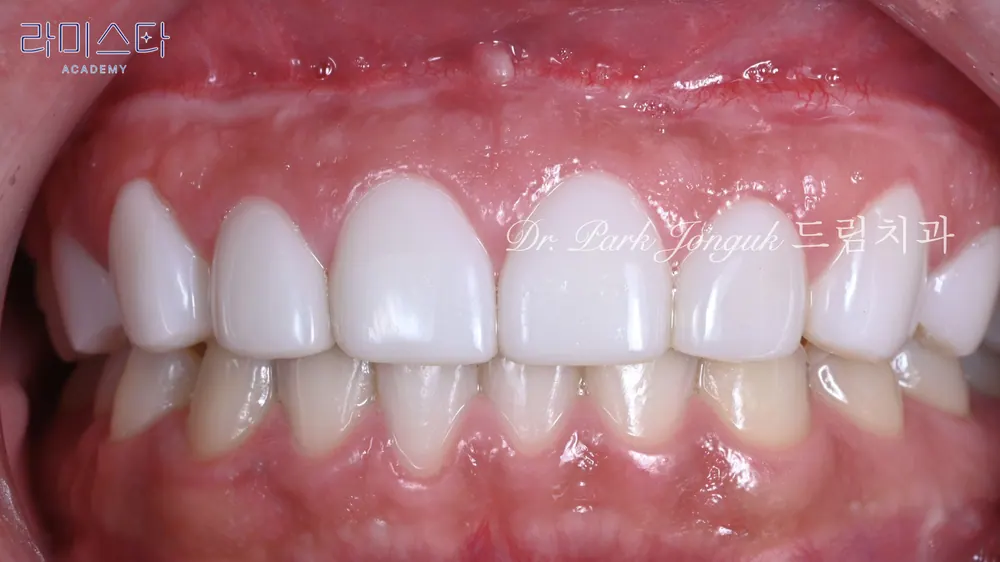
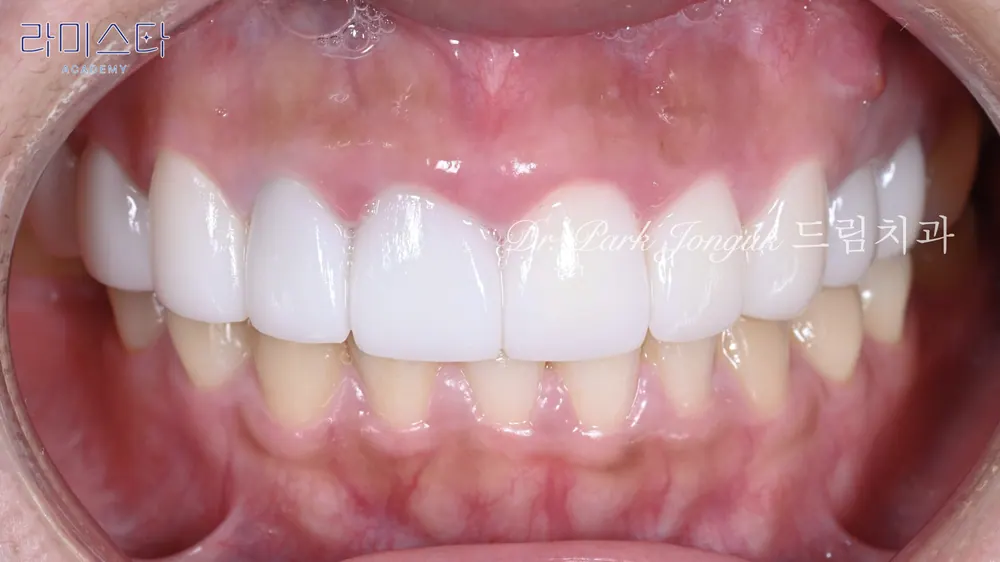
Photos 1 and 2 show awkward, artificial-looking veneers.
As you can see, the teeth look flat and monotonous.
There's no translucency at all — they look completely opaque.
With no dimensionality, they look like tiles glued onto the teeth.
The color is also uniform and simplistic.
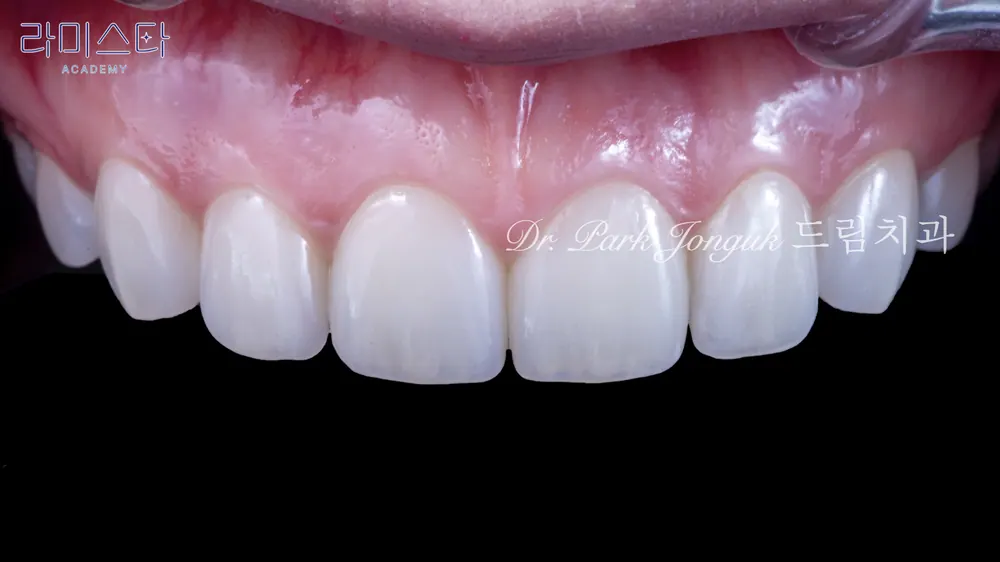
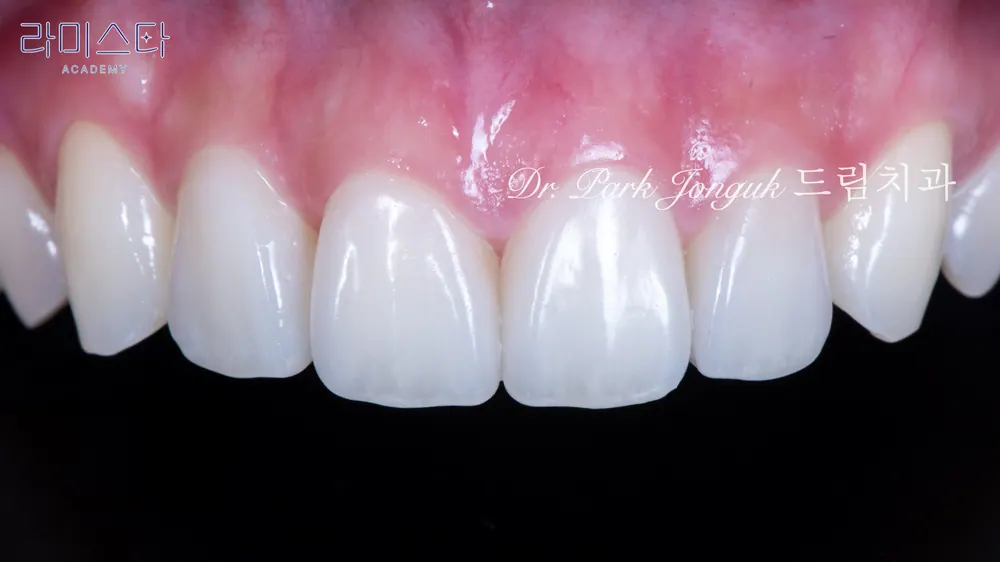
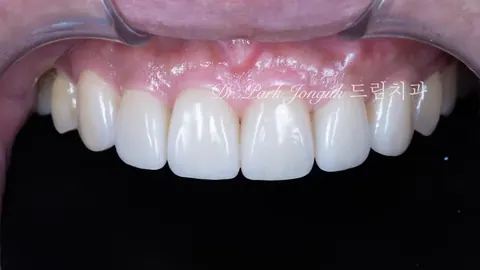
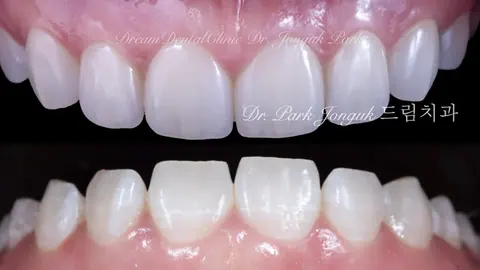
Photos 3 and 4 show veneers with a lot of natural expression.
They're translucent and three-dimensional, looking just like natural teeth.
The translucency at the tooth tip is alive, and you can see the subtle contours on the surface.
There's a depth to them, with the color shifting depending on the light.
They feel alive, just like real teeth.
Our clinic is one of the few that can make natural-looking veneers like the ones in Photos 3 and 4.
Why do most clinics make awkward-looking veneers these days?
Aren't you curious why?
These days, most clinics make awkward veneers like the ones in Photos 1 and 2.
It's not because that looks better — it's because they're easier and faster to make, can be produced in larger volumes, and cost less to fabricate.
Most are made automatically by computer.
A machine called CAD/CAM mills them from a single block of ceramic.
It's fast and convenient, but a natural look has to be sacrificed.
Veneers made by computer all look the same.
Since there's no way to differentiate between clinics, many advertise them under a different name instead of calling them veneers.
But they're all still just veneers — in fact, this is simply a mass-production method with a simpler fabrication process.
In fashion terms, it's like a fast-fashion brand.
Fast and cheap to mass-produce, but lacking in delicacy and refinement.
Our Clinic Makes Veneers Like Luxury Goods
The way our clinic works is handcrafted, the same way luxury goods are made.
Just as a tailor hand-sews a bespoke suit one piece at a time, we make each of our veneers by hand, one at a time.
We use a variety of ceramics to capture the tooth's rich, beautiful range of expression.
Translucent ceramic, opaque ceramic, bright ceramic, dark ceramic...
We stack several kinds of ceramic layer upon layer to reproduce the complex structure of a natural tooth.
The Secret of Young Teeth: Dimensionality and Translucency
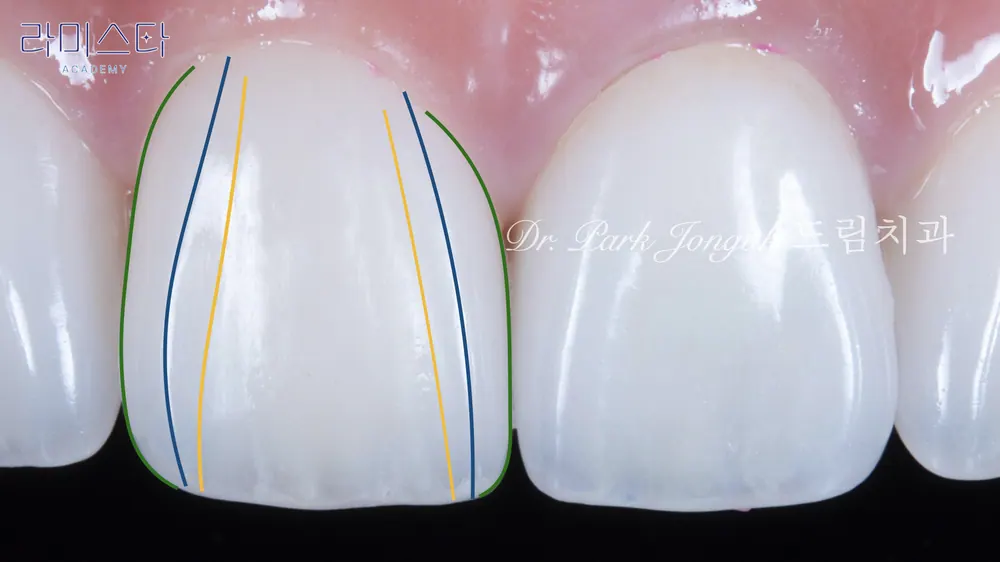
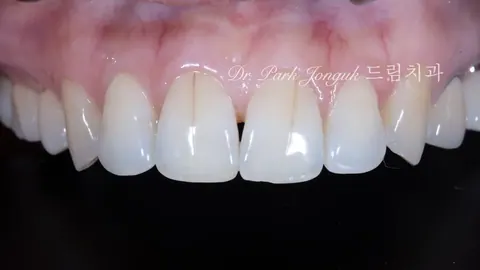
Take a look at Photo 5.
This is how a tooth's dimensionality should be expressed.
It's not flat — there are subtle contours on the surface.
It has natural features like developmental lobes, depressions, and ridges.
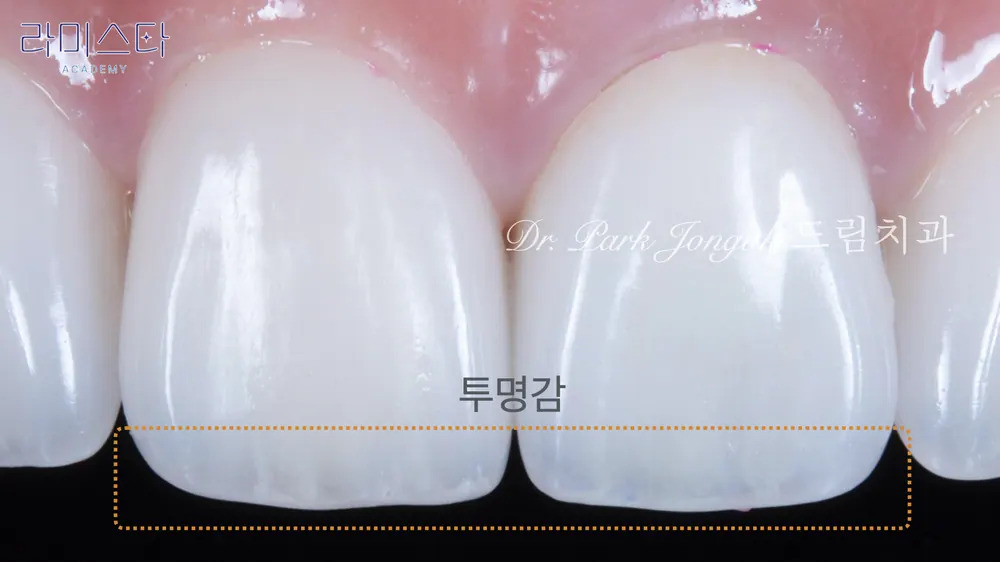
Take a look at Photo 6.
For a tooth to look young, the tip needs to have living translucency.
In young people, the tips of the teeth are translucent.
Light passes through and diffuses softly.
With age, teeth become more opaque and lose their dimensionality.
As teeth wear down and minerals deposit on them, translucency fades.
The surface also becomes smoother, which reduces dimensionality.
Dimensionality and translucency are essential for expressing young-looking teeth.
This is precisely the decisive difference between natural-looking veneers and awkward-looking ones.
Teeth Have Different Colors in Different Areas
There's a fact many people don't know.
A tooth's color varies by area.
Near the root (the cervical area), it's closer to yellow.
The middle of the tooth is a bright ivory color.
The tip of the tooth (the incisal edge) is translucent.
These subtle shifts in color are what make a tooth look natural.
A single block of ceramic can never express this kind of color variation.
The E-max Base + Buildup Method
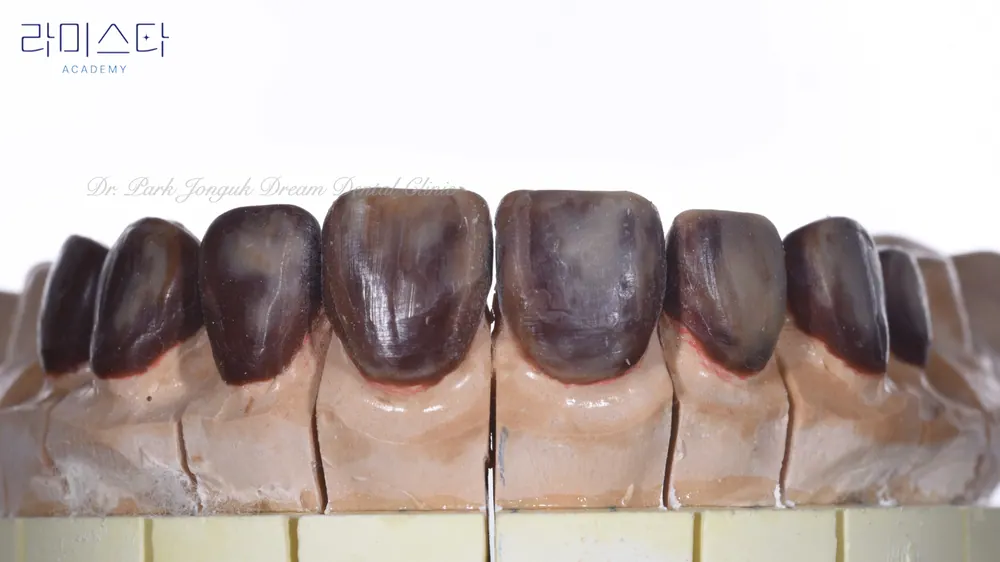
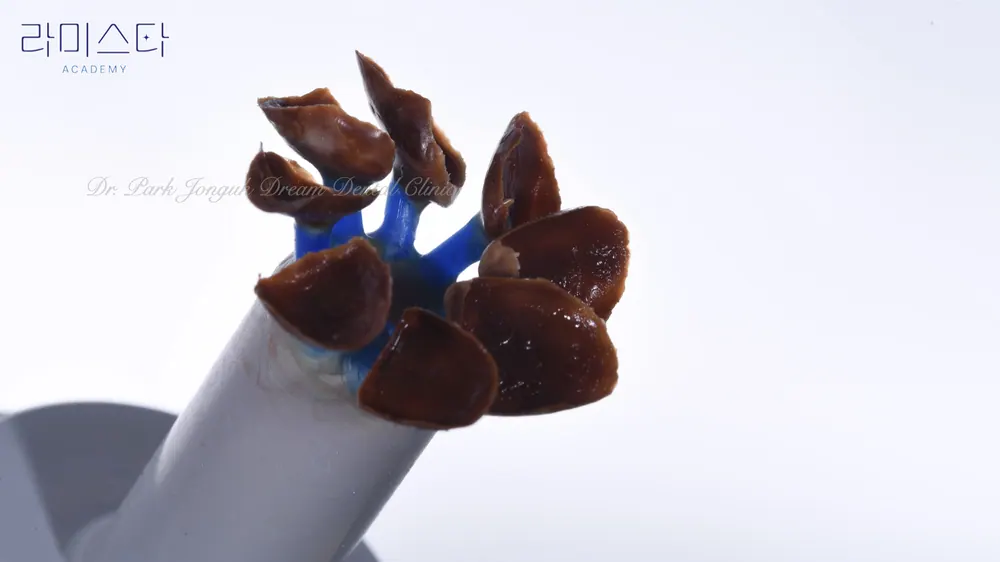
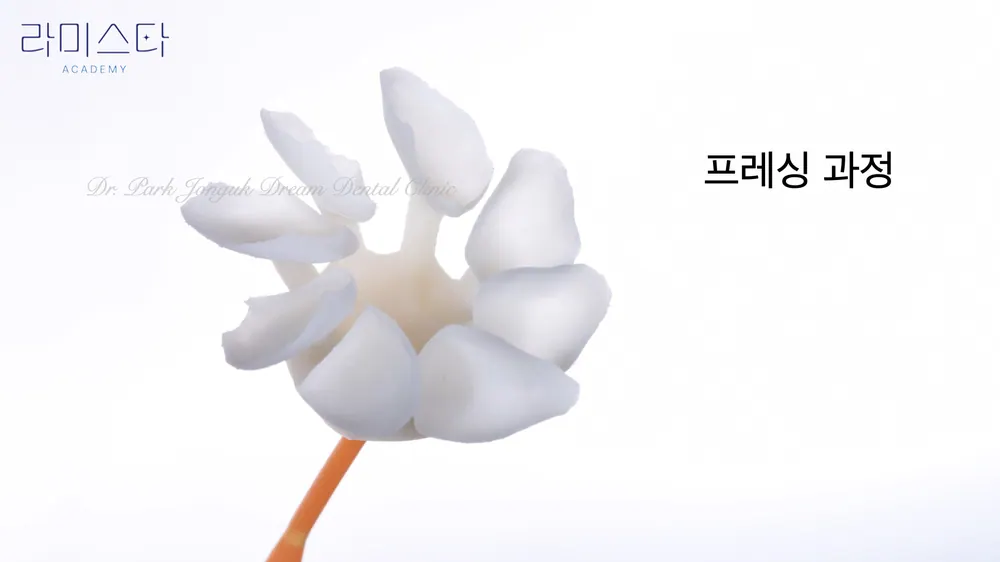
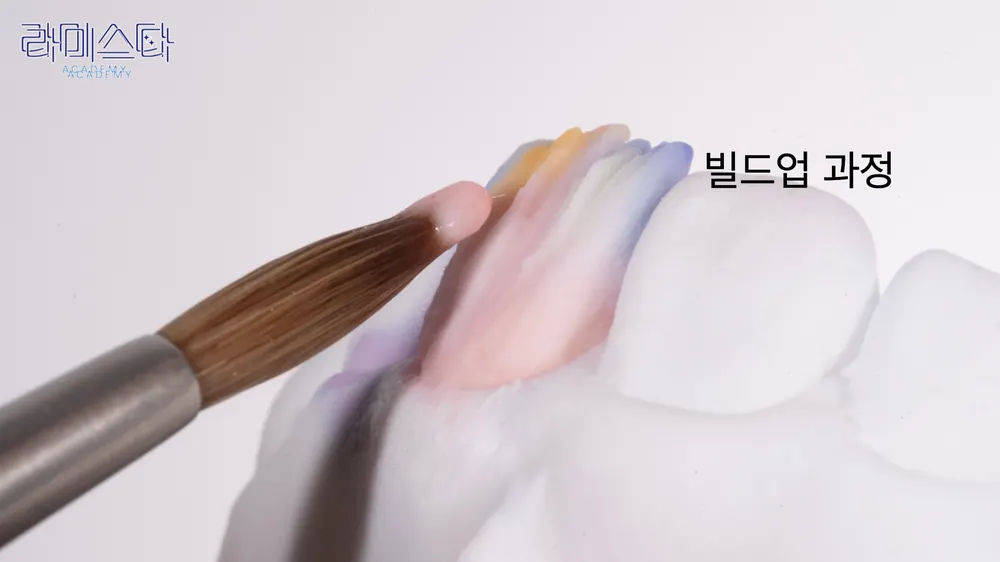
Take a look at Photos 8, 9, 10, and 11.
Our clinic fabricates veneers using a method called buildup on an E-max base.
E-max is a ceramic known for its excellent strength.
We use it as the basic framework, or base.
Several layers of ceramic are then stacked on top of it (buildup).
The first layer is an opaque, dentin-colored ceramic.
The second layer is a semi-translucent, enamel-colored ceramic.
The third layer is a translucent ceramic.
The fourth layer is a ceramic that expresses the surface characteristics.
Stacking multiple layers like this reproduces the complex structure of a natural tooth.
The Buildup Process Takes Time and Care
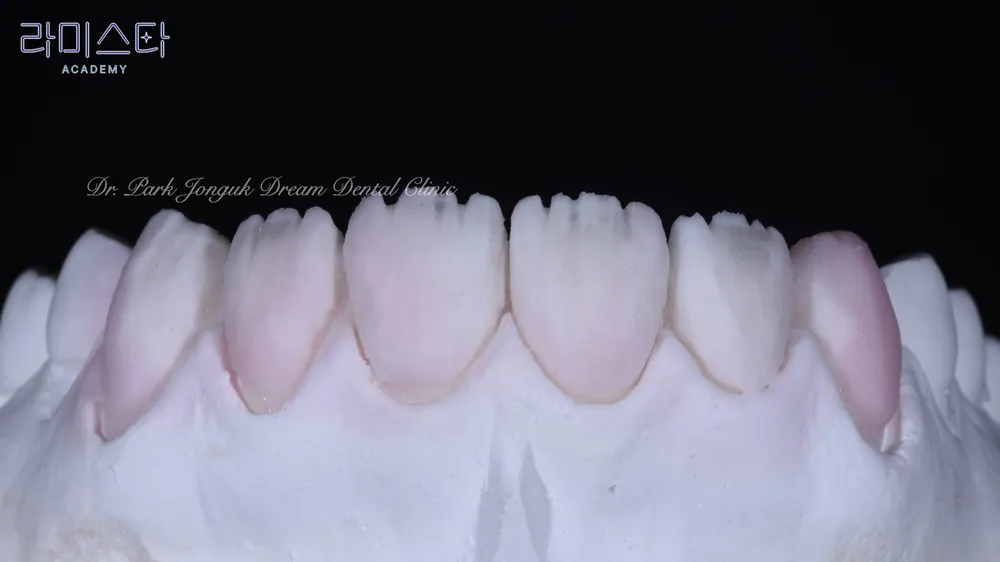
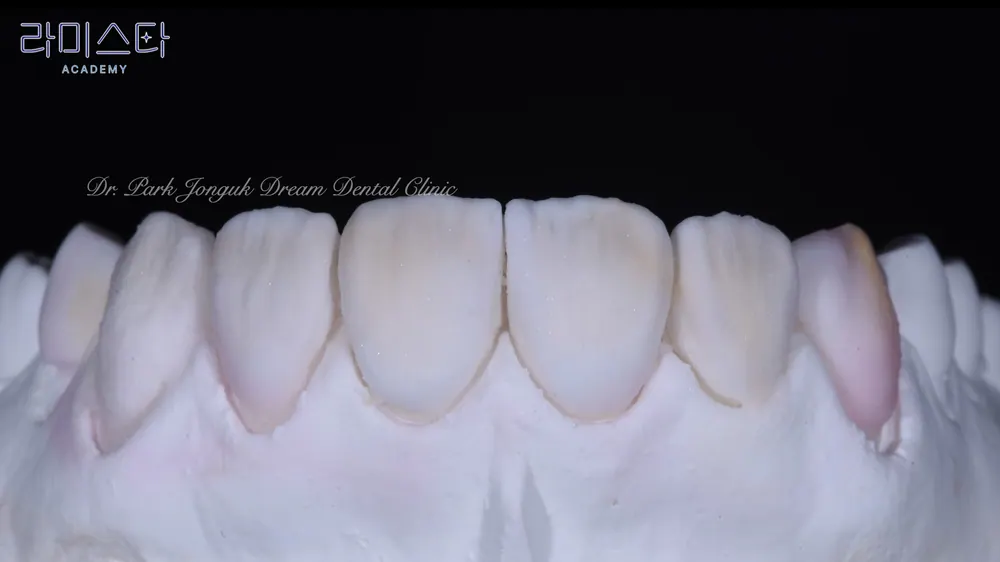
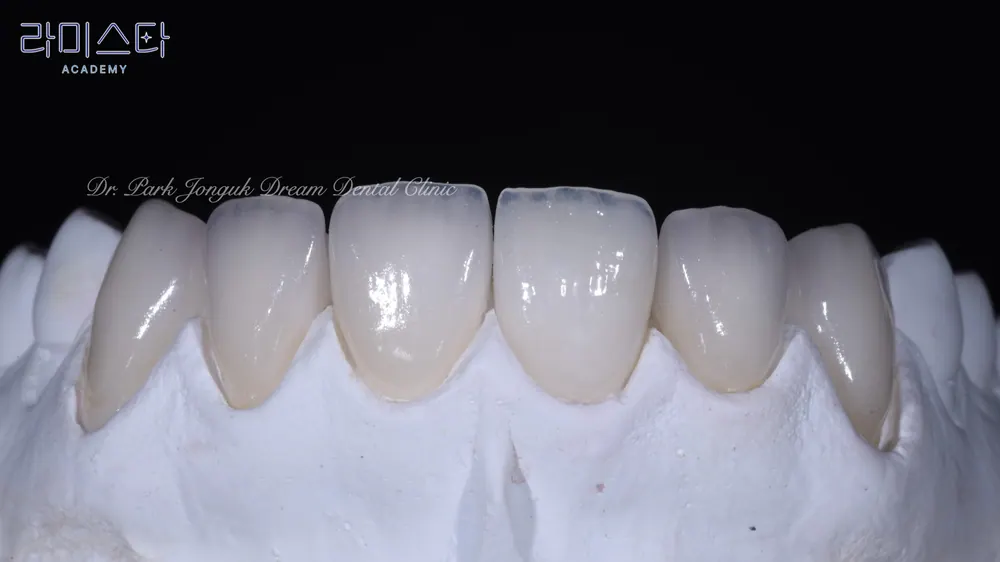
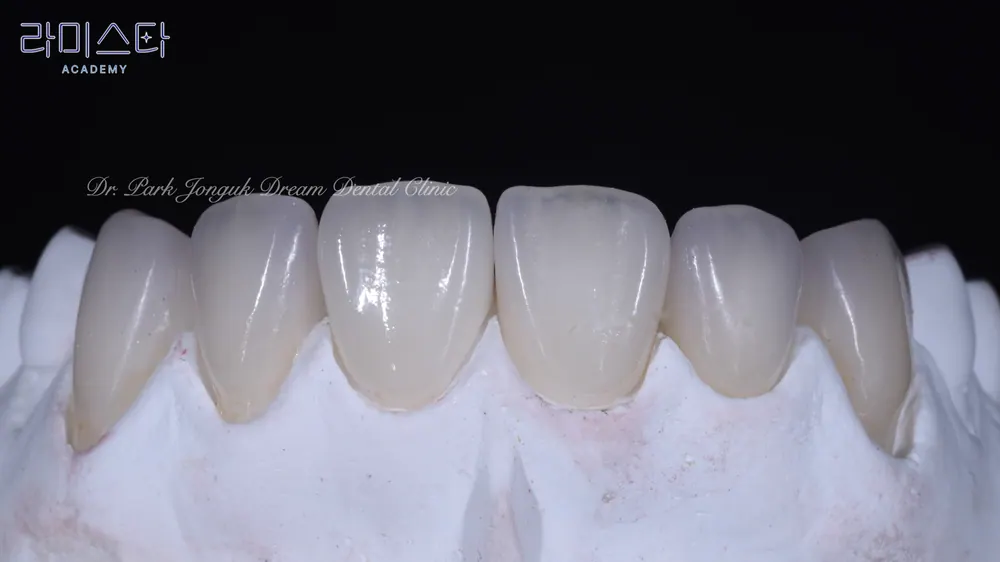
Photos 12, 13, 14, and 15 show the buildup process.
A ceramist (dental technician) stacks the ceramic by hand, one layer at a time.
The ceramic powder is picked up with a brush and applied.
Each layer is built up carefully, one at a time.
Every layer is fired in a kiln.
This takes time and care, and the skilled touch of a craftsman-like ceramist matters, too.
What a computer can make in an hour, we spend several days making.
That's because a natural look can only be achieved by investing time.
It takes the artistic sense of an experienced ceramist.
How to blend the colors, where to add translucency, what contours to create...
All of this is decided at the ceramist's fingertips.
The Difference at a Glance
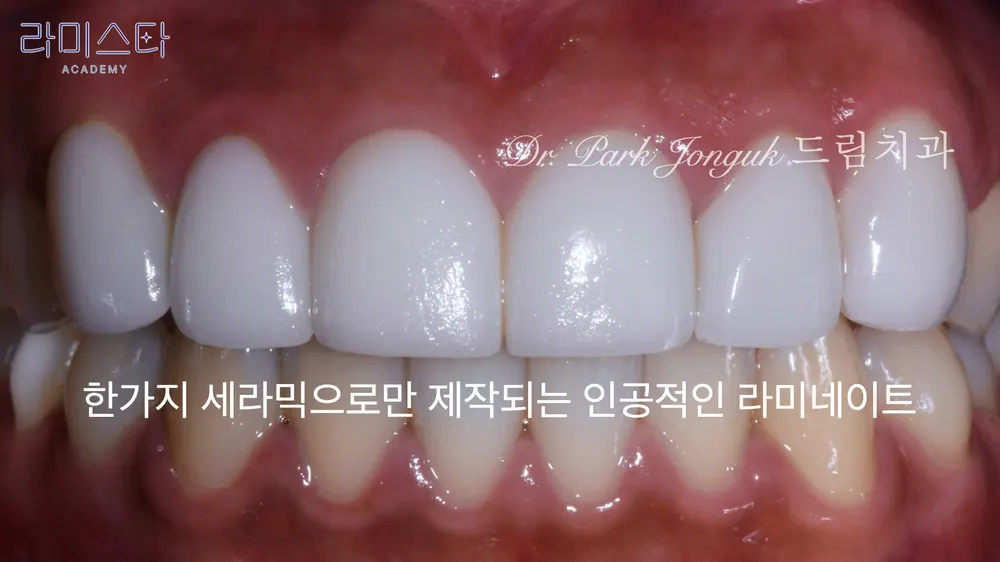
Take a look at Photo 16.
This is an artificial-looking veneer made from a single type of ceramic.
It's flat and monotonous.
It has no translucency and looks opaque.
The color is simple and uniform.
It has no sense of life to it.
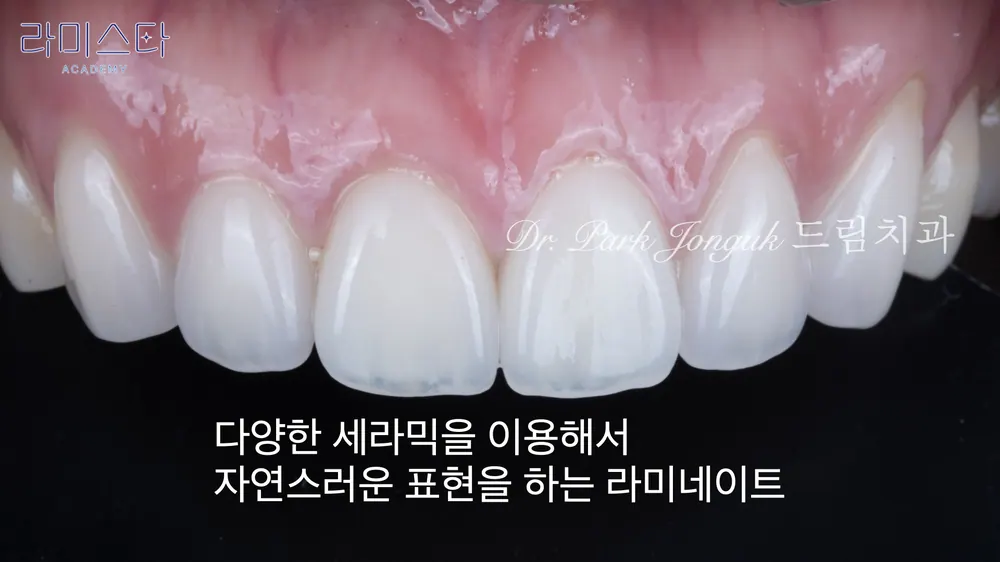
Take a look at Photo 17.
This is a natural-looking veneer, rich with the expression of a natural tooth.
It's three-dimensional and dynamic.
The translucency is alive.
The color is varied, with depth.
It feels alive, just like a real tooth.
This difference comes down to the fabrication method.
How to Find a Good Veneer Clinic
There really are a great many veneer clinics in Gangnam.
But finding one that truly does good work isn't easy.
Here's how to find one.
First, ask about the fabrication method.
"Is this a handcrafted buildup method, or CAD/CAM milling?"
Choose a clinic that answers with the buildup method.
Second, ask to see photos of actual cases.
Check whether the tooth tips have translucency and the surface has dimensionality.
If they look flat and opaque, it's an automated fabrication method.
Third, check the treatment timeline.
A clinic that emphasizes "finished the same day" or "finished in one week" is using a mass-production method.
A properly made buildup veneer takes a minimum of 2 to 3 weeks.
Fourth, check the dentist's experience.
Choose a dentist with more than 20 years of clinical experience.
Experience really matters when it comes to veneers.
Fifth, ask about the collaboration with the ceramist (dental technician).
Check whether the clinic has worked with the same ceramist for a long time.
Our clinic has worked with the same ceramist for more than 20 years.
Fast and Cheap vs. Natural and Beautiful
The choice is yours.
Do you want a fast, cheap, mass-produced veneer?
Or do you want a natural-looking veneer made with time and care?
For 20 years, I've walked the latter path.
I've made each patient's teeth like a work of art, one by one.
My philosophy is to do things properly and naturally, rather than quickly and in large volume.
That's why the veneers made at our clinic look so natural they can't be told apart from real teeth.
Frequently Asked Questions (Q&A)
Q1. Isn't the buildup method more expensive than the CAD/CAM method?
A. Yes, it's generally more expensive. It takes more time and care,
and it requires the manual work of a skilled ceramist.
But the natural look and beauty it achieves are incomparable.
Q2. Is a buildup veneer strong enough?
A. Yes, since it uses an E-max base, the strength is sufficient.
Q3. Why do most clinics use the CAD/CAM method these days?
A. Because it lets them make veneers quickly, cheaply, and in large numbers.
But a natural look is sacrificed in the process.
True esthetic treatment takes time and care.
This article is based on the real clinical experience of a dentist who has provided esthetic dental care in Apgujeong for 20 years. I teach hand-crafted buildup veneer techniques to dentists every month at Lamista Academy, and I have published Korea's first veneer textbook, 『최소 삭제를 위한 라미네이트 임상』 (Laminate Clinical Practice for Minimal Reduction).
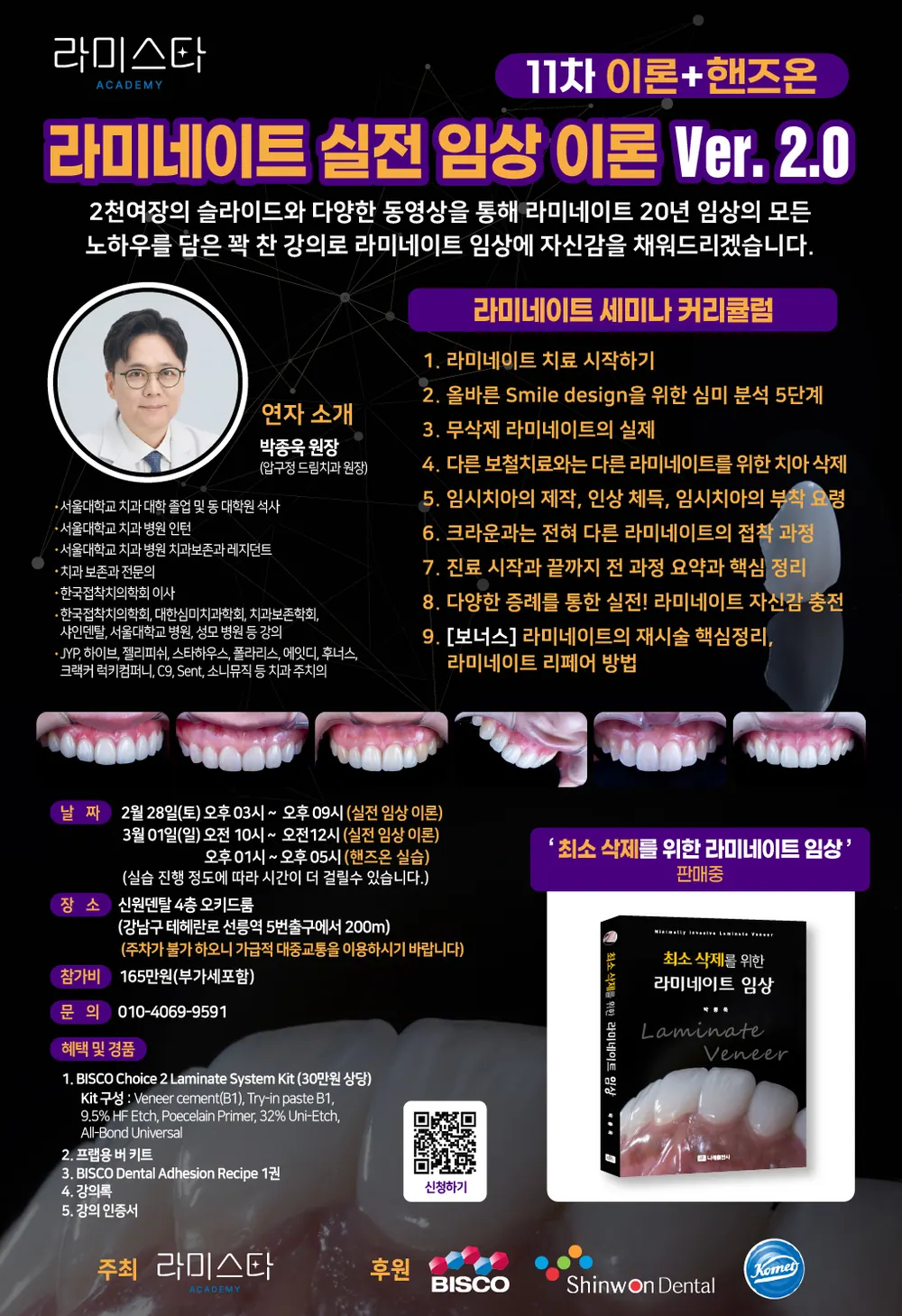
This article is a clinical note written by Dr. Park Jonguk of Dream Dental Clinic, Gangnam; the original was published on his blog. The photographs shown are real cases he treated. Results vary with each patient’s condition, and every procedure carries the possibility of individual variation and side effects.
Quick Consult
Request a Callback
Leave your number and we will call you back during clinic hours.
Request Received
We will contact you during clinic hours. For urgent matters, please call +82-2-3448-0028.