
Protruding Front Teeth or a Snaggletooth: Braces or Veneers? 20 Years of Clinical Experience Weighs In
Hello, I'm Dr. Park Jonguk, director of Dream Dental Clinic in Apgujeong.
This week alone, I've heard a similar question four times in consultations.
"My front teeth stick out a little—do I really need braces?"
"I have one snaggletooth—could veneers fix it instead?"
"The length of orthodontic treatment feels like a lot—is there another way?"
"I heard veneers might still be needed even after braces—is that true?"
Having devoted 20 years to veneer treatment, I've thought as much as anyone about where orthodontics ends and veneers begin.
Veneers aren't a cure-all.
Orthodontics alone isn't always the answer either.
The two treatments are different solutions with different goals and principles.
Even patients with the same complaint can have clear, distinct reasons why one should go with orthodontics and another with veneers.
Today I'll walk you through that decision-making framework in detail, using real clinical cases,
and lay out the questions you should always ask during a consultation.
Before we get into this, reading the linked article below will help a great deal.
1. The Two Treatments Are Fundamentally Different
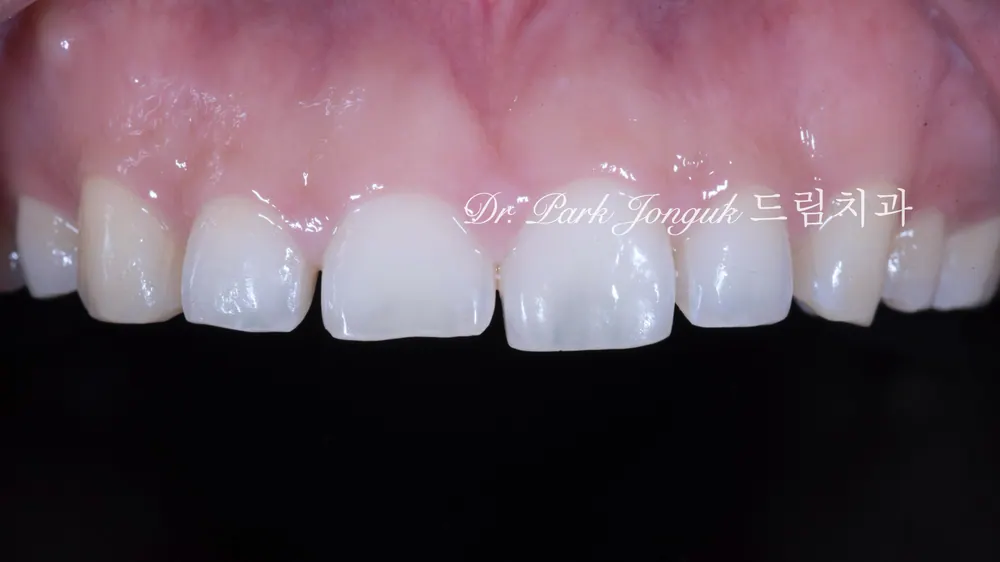
Let's start by clearly defining the terms.
Orthodontics moves teeth all the way to the root, repositioning the entire bite.
Veneers thinly cover just the front surface of the tooth to change its shape and color.
Here's an analogy using a building.
Orthodontics is like remodeling—tearing down walls and changing the structure of the space itself.
Veneers are like a finishing job—repapering the walls to change how the space feels.
Both treatments appear to improve the smile in the end, but the process and scope are completely different.
Understanding this difference is what finally reveals the right choice for you.
2. The Degree of Misalignment Is the First Fork in the Road
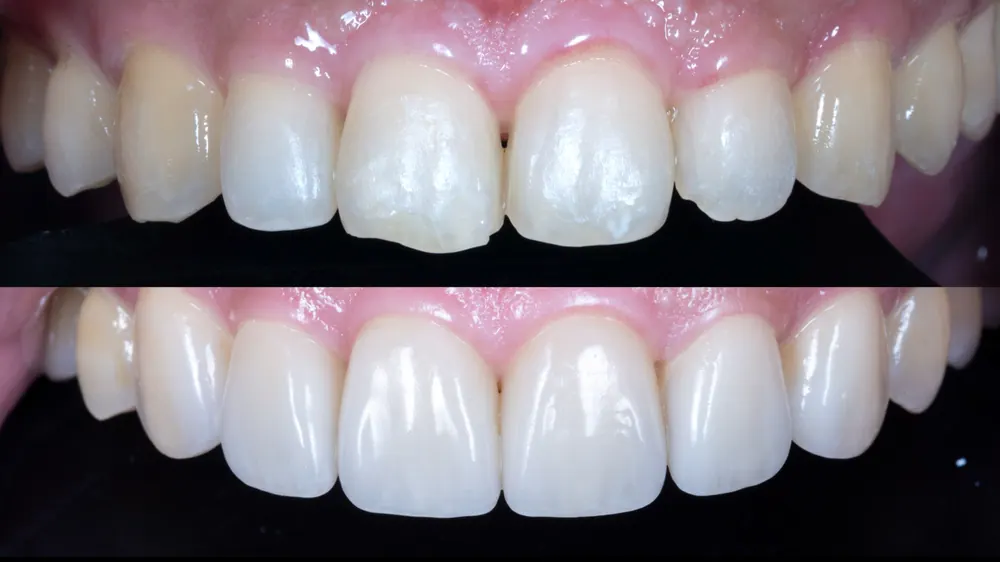
The degree of misalignment is measured in millimeters.
This number is the first criterion in choosing a treatment.
Misalignment under 1mm
A slight tilt of the tooth axis, or a minor protrusion at the tip.
This can be resolved with veneers.
The amount of reduction can also be kept to a minimum.
The 1–2mm borderline zone
Veneers are still possible, but more reduction is required.
It's often better to first align the teeth with simple partial orthodontics,
then finish with no-prep veneers—this actually preserves more natural tooth structure.
Misalignment of 2–3mm or more
From this range on, orthodontics is the standard approach.
Forcing veneers to cover this much misalignment makes the teeth look overly protruded or unnatural.
During a consultation, the director's first step is measuring the tooth axis, degree of protrusion, and degree of rotation.
A consultation that skips this numeric assessment and simply says "veneers can fix everything" is hard to trust.
3. The Difference in Time and Cost
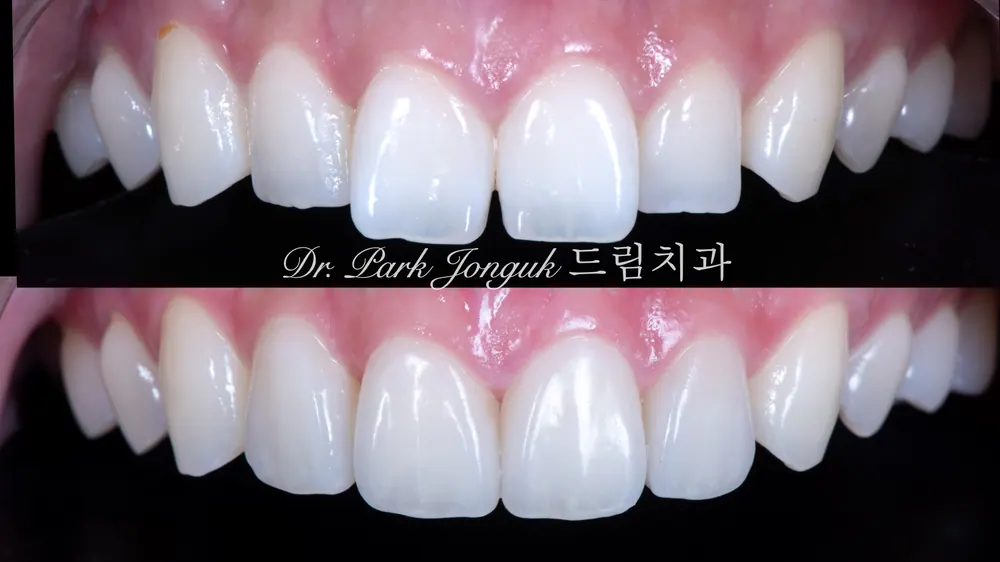
Time is the biggest variable.
Orthodontic treatment takes at least a year and a half, often two years or more.
Clear aligners like Invisalign require a similar or comparable amount of time.
Veneers take 2 to 4 weeks from diagnosis to completion.
Even cases requiring reduction are finished within a month.
Cost varies depending on the scope of treatment and the number of teeth involved.
Full adult orthodontics typically runs around ₩5,000,000–8,000,000.
Veneer cost varies depending on the number of teeth and the fabrication method.
When a wedding is six months away.
When a job change or interview is two months away.
When wedding photos are a month away.
In these kinds of time-constrained situations, orthodontics is essentially not an option.
On the other hand, if you have time to spare and want a fundamental improvement, orthodontics has the advantage.
The starting point is figuring out how important time is as a factor in your own situation.
4. Cases Where You Should Definitely Choose Orthodontics
In the following situations, the rule is to go with orthodontics rather than working around it with veneers.
Severe malocclusion
An open bite, where the front teeth don't meet at all.
A deep bite, where the upper front teeth cover the lower teeth too much.
A crossbite, where the upper and lower teeth meet in reverse.
These functional problems can't be solved with a surface treatment.
Severely uneven gum line
When a single tooth sits noticeably higher or lower than the rest.
When the gum position itself is asymmetric.
Even if veneers correct the tooth shape, the mismatch in the gum line will remain.
Adolescents who are still growing
Jaw growth is still ongoing before age 18.
Placing veneers during this period can leave tooth position mismatched after growth is complete, requiring redo treatment.
Orthodontics is the standard approach here.
When protruding lips are the primary concern
If the cause is protrusion of the entire alveolar bone, veneers won't solve it.
In fact, the added bulk can make the protrusion look even more pronounced.
In this case, orthodontics or orthognathic surgery is the right answer.
5. Cases Where Veneers Are Far More Efficient
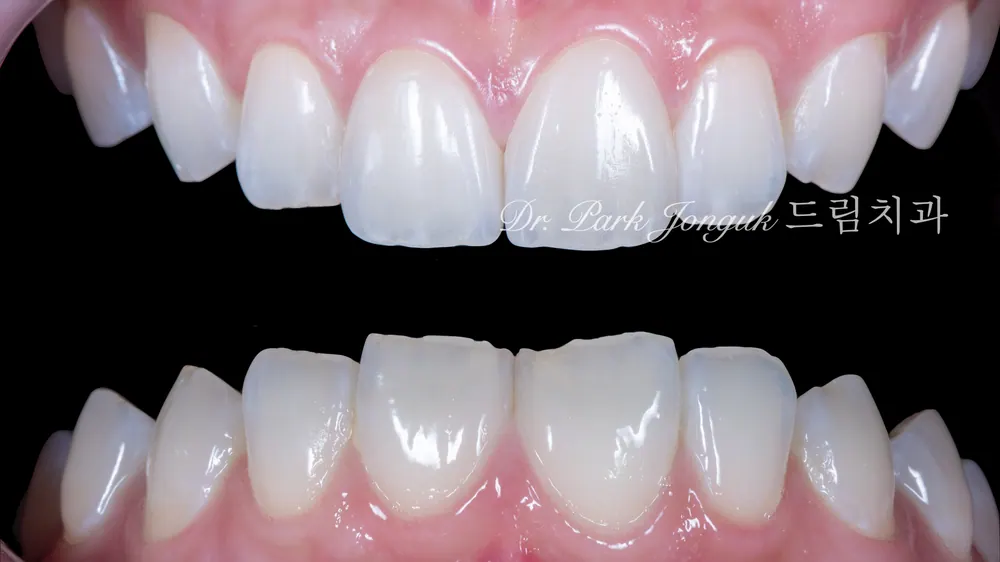
Conversely, in the following situations, veneers are the much faster and more effective choice.
When the alignment is fine and only the color and shape need improving
For patients whose main concerns are discoloration, staining, chipped teeth, or size mismatch between teeth.
These are areas orthodontics simply can't address.
When an important event—a wedding, an interview, a photo shoot—is coming up soon
If you need results within six months, orthodontics is realistically not an option.
Veneers can be completed within a month, making them the practical choice under time constraints.
Minor misalignment in the 1–2mm range
Build-up veneers can create visual alignment by adjusting thickness.
This can produce a naturally well-aligned look.
Adults with stable dental alignment
Patients past their 30s whose alignment has essentially stopped changing.
The long-term results of veneers stay stable in these cases.
Shape issues like undersized teeth or black triangles
For cases like this, veneers are precisely the right solution.
6. A Middle Ground: Combining Partial Orthodontics with Veneers
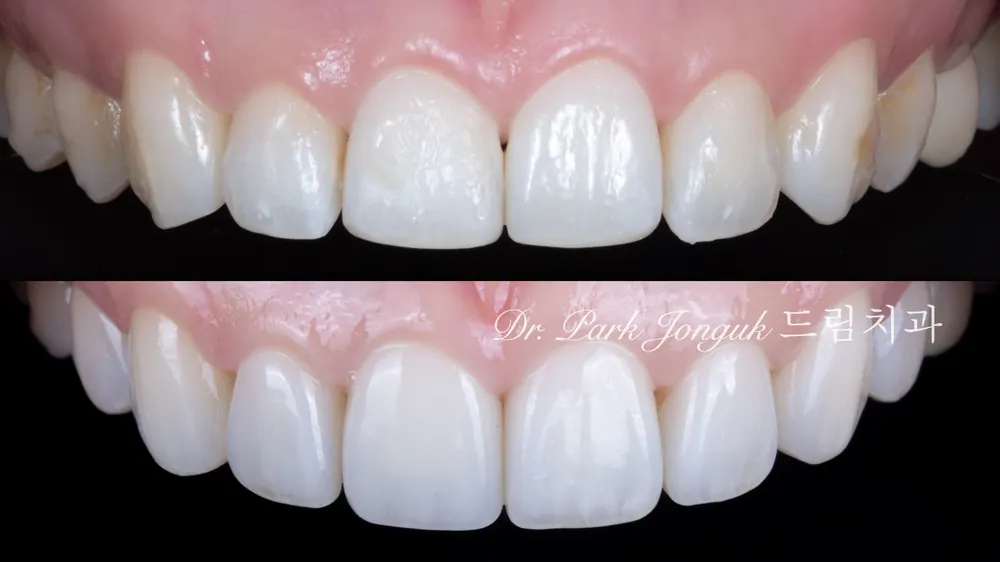
The approach getting the most attention in recent clinical practice is combining the two treatments.
Clear aligners like Invisalign are used for 6 to 9 months to lightly align the teeth.
Then the remaining issues of color, shape, and size are finished off with veneers.
This method is called the Align-First Approach.
Advantages of This Combination
First, it minimizes the amount of veneer reduction, or eliminates it entirely.
Because the alignment is already corrected beforehand, much less thickness needs to be covered.
Second, it addresses both functional bite issues and esthetic results at once.
Veneers make up for color and size issues that orthodontics alone can't solve.
Third, it preserves the tooth's original position while producing a more natural final result than veneers alone.
Drawbacks and Considerations
Total treatment time extends to 8–12 months.
It requires a clinical setting capable of integrating orthodontic and veneer planning.
Active patient cooperation is also key to success.
At Dream Dental Clinic, we work with patients during the consultation stage to determine whether this combination is applicable.
7. Questions You Should Always Ask During Consultation
Before deciding which direction to take, be sure to ask the following questions during your consultation.
- How many millimeters is my misalignment?
- If veneers alone can work, how many teeth and how much reduction would be needed?
- Is my case suitable for combining partial orthodontics with veneers?
- If I go with orthodontics, how long will it take and what method will be used?
- Can I see the expected result through a digital simulation before treatment?
- What is the policy if a redo procedure becomes necessary?
A provider who answers these questions with specific numbers and evidence has a solid diagnostic foundation.
If you only get vague answers, it's worth thinking twice.
FAQ
Q1. Is it really possible to still need veneers even after finishing orthodontic treatment?
A. Yes, it is. Orthodontics realigns the teeth—it doesn't change their color or shape. Even after orthodontics is complete, existing discoloration, size mismatches between teeth, undersized teeth, or gaps often remain. Finishing these with veneers makes the orthodontic result stand out even more. The wisest approach is to plan this together with your orthodontist from the start, asking, "Will orthodontics alone be enough, or will esthetic treatment be needed afterward?" At Dream Dental Clinic, we also see many patients who are currently in orthodontic treatment or nearing its finish, seeking a consultation about finishing veneers.
Q2. I only have one snaggletooth—can veneers fix that too?
A. It depends on the position and severity of the snaggletooth. If it sits only slightly outside the arch and doesn't deviate much from the overall flow of the bite, veneers can provide a good visual correction. On the other hand, if the tooth is positioned high up where the canine should be, or protrudes significantly outside the arch, veneers alone won't solve it. In the latter case, a practical approach is to use partial orthodontics to reposition the tooth first, then finish with veneers. An accurate assessment requires an in-person oral examination.
Q3. Can veneers alone fix protruding lips?
A. Only to a limited extent. What matters most is the underlying cause. If the protrusion is just a slight forward tilt of the front teeth, veneer thickness can provide some visual correction. But if the roots themselves are angled forward, or the jawbone itself protrudes, veneers won't solve it—in fact, the added bulk will make the protrusion more noticeable. If protruding lips are the main concern, orthodontics or orthognathic surgery is the standard solution. An accurate diagnosis always comes first.
Q4. I'm in my 20s—am I still a good age for orthodontic treatment?
A. Orthodontic treatment is possible not just in your 20s but in your 40s and 50s as well. There's no upper age limit. That said, adult orthodontics moves teeth more slowly than in adolescents, and periodontal care needs to go alongside it. Patients who find visible orthodontic appliances a burden for professional reasons often choose clear aligners like Invisalign. If you're considering adult orthodontics, a precise diagnosis from an orthodontic specialist is essential, and your periodontal health should be evaluated as well.
Q5. I want to see results quickly—is it okay to decide in a hurry?
A. Please don't rush the decision. Both orthodontics and veneers are difficult to reverse once started. Veneers in particular involve reshaping natural teeth, so extra caution is warranted. Get consultations at two or three clinics at minimum, and compare the diagnosis and treatment plan each one offers. It's common for different providers to suggest different approaches for the same teeth. Compare thoroughly, then choose what best fits your situation. Waiting a day or two won't change the outcome.
Q6. How long do veneers last?
A. According to the international literature, the 10-year survival rate for veneers is reported at around 91–95%, and the 20-year survival rate at around 64–83% (Beier et al., 2012). The variation is significant, depending on individual bite, nighttime teeth grinding, dietary habits, oral hygiene, and the material and fabrication method used. In cases fabricated with the build-up method and maintained with regular checkups, results close to the upper end of that range are seen. This should be approached as a treatment for teeth you'll use for a lifetime, not just for one day at a wedding.
In Closing
Orthodontics and veneers are not competitors.
They are different solutions, built for different purposes.
The condition of your teeth, your life schedule, your budget, your expected outcome.
Weighing these four factors together is what leads to the right choice.
And that choice always starts with an accurate diagnosis.
Speaking from my experience as a director who has practiced veneer dentistry for a long time,
the patients with the fewest regrets were the ones who didn't rush, got an accurate diagnosis,
and chose the treatment that truly fit their situation.
Don't rush your decision—get a good diagnosis first.
Park Jonguk, Director, Dream Dental Clinic, Apgujeong
Graduate of Seoul National University School of Dentistry / Master's Degree in Dentistry
Board-certified specialist in conservative dentistry
Director of Education, Korean Academy of Adhesive Dentistry
Author of 『최소 삭제를 위한 라미네이트 임상』 (Laminate Veneer Clinical Practice for Minimal Reduction)
Director, Lamista Academy
This article is a clinical note written by Dr. Park Jonguk of Dream Dental Clinic, Gangnam; the original was published on his blog. The photographs shown are real cases he treated. Results vary with each patient’s condition, and every procedure carries the possibility of individual variation and side effects.
![[Veneers for Protruding Teeth] Solving Protruding Teeth Without Braces? A Difficult Case in a Woman in Her 50s — 4-Year Follow-Up Revealed](/column-media/224094075985/thumb.webp)
Quick Consult
Request a Callback
Leave your number and we will call you back during clinic hours.
Request Received
We will contact you during clinic hours. For urgent matters, please call +82-2-3448-0028.