
[Veneers After Invisalign] Solving a Peg Lateral After Orthodontics! Designing 'No-Prep Veneers' to Preserve the Tooth (Dream Dental Clinic)
Hello. I'm Park Jonguk, lead director of Dream Dental Clinic in Apgujeong and a board-certified specialist in conservative dentistry.
I've worked exclusively on esthetic restoration of the front teeth for 20 years,
and as the author of a veneer-specialty textbook, I put the philosophy of minimal prep into practice.
Today, combining the benefits of orthodontic treatment with the esthetics of veneers,
I'm introducing a case that completed beauty without any damage to the tooth at all —
a no-prep veneer case after Invisalign.
This is the most ideal treatment approach for peg lateral veneers.
1. Veneers after Invisalign — why is this the optimal combination?
Veneers are an esthetic treatment that completes a tooth's shape, size, and color.
For these veneers to be safely done as no-prep or minimal-prep,
the position of the tooth needs to be perfect.
Why veneers after Invisalign are optimal:
Increased likelihood of minimal prep:
Through Invisalign orthodontic treatment, the space where the veneer will go can be secured in advance, precisely.
Especially for gapped teeth or a peg lateral, creating space makes no-prep veneer treatment possible.
Adjusting the tooth axis:
Once orthodontics perfectly and carefully aligns the angle (axis) of the tooth, adding the veneer on top
keeps the restoration's thickness even, making it more natural and stable.
2. Case study: precise orthodontics for no-prep veneers
[Photo 1] Presenting with Invisalign attachments still on
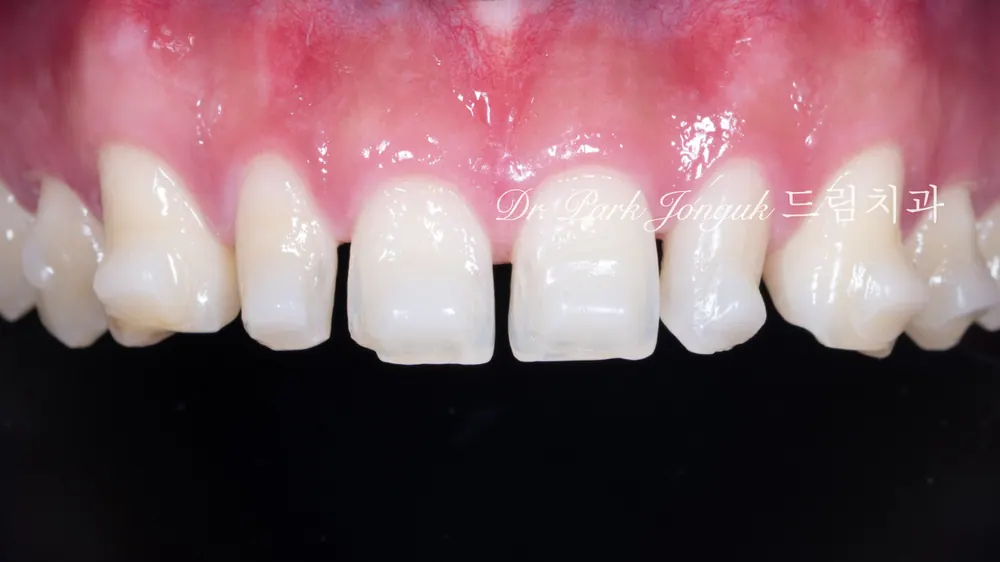
The patient was in her early 30s,
and was already undergoing Invisalign orthodontic treatment as "preparatory work" for veneers.
As shown in the photo, attachments for the Invisalign device
were still bonded onto the tooth surfaces.
Tooth condition: both the central and lateral incisors were peg laterals, smaller than average.
Treatment plan: since the patient had small teeth with gaps between them,
we decided to use orthodontics to deliberately create space for the veneer, and go with no-prep veneers.
3. Precise diagnosis and design for no-prep veneers
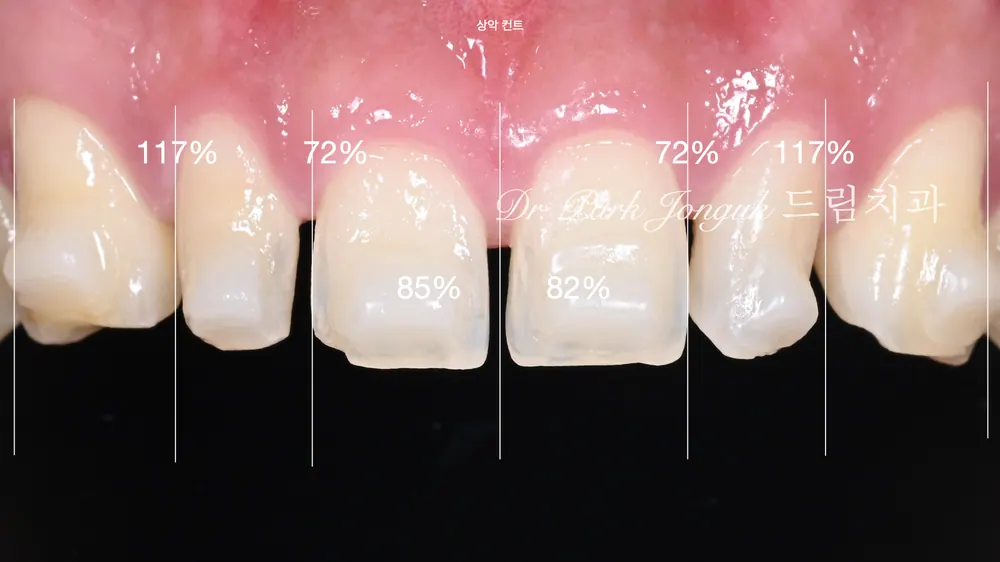
[Photo 2] the diagnostic process and [Photo 3] wax-up precision diagnosis
![[Veneers After Invisalign] Solving a Peg Lateral After Orthodontics! Designing 'No-Prep Veneers' to Preserve the Tooth (Dream Dental Clinic) — photo 3](/column-media/224107245498/03.webp)
The attachments still on the teeth got in the way,
but we carried out a precise wax-up diagnosis.
Design goals:
We matched the once-small peg lateral perfectly in proportion with the neighboring teeth,
and precisely aligned the tooth-edge line to design the smile.
The no-prep commitment:
Through the wax-up model, we made a final confirmation
that the desired shape could be achieved without any tooth reduction.
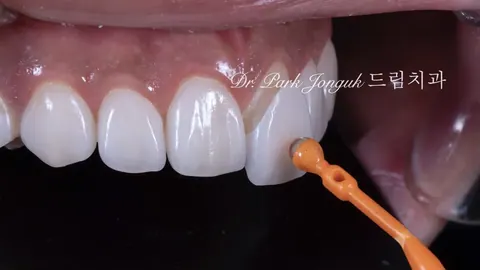
[Photo 4] after removing the attachments
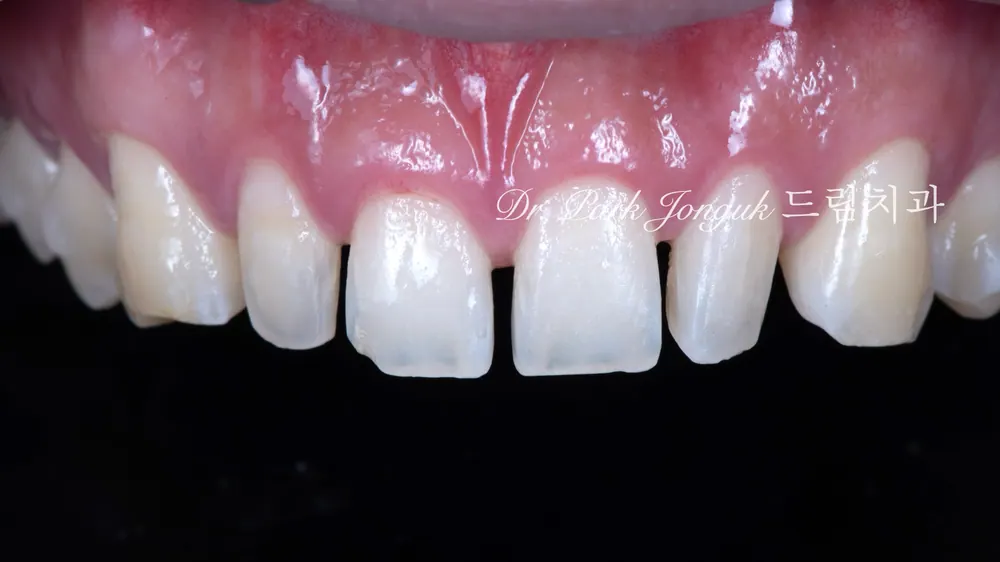
Right before the veneer procedure, all the Invisalign attachments were removed.
Now, through the no-prep veneers,
all that remained was to bond the newly designed shape directly onto the teeth.
4. The finished handmade build-up: a natural vitality
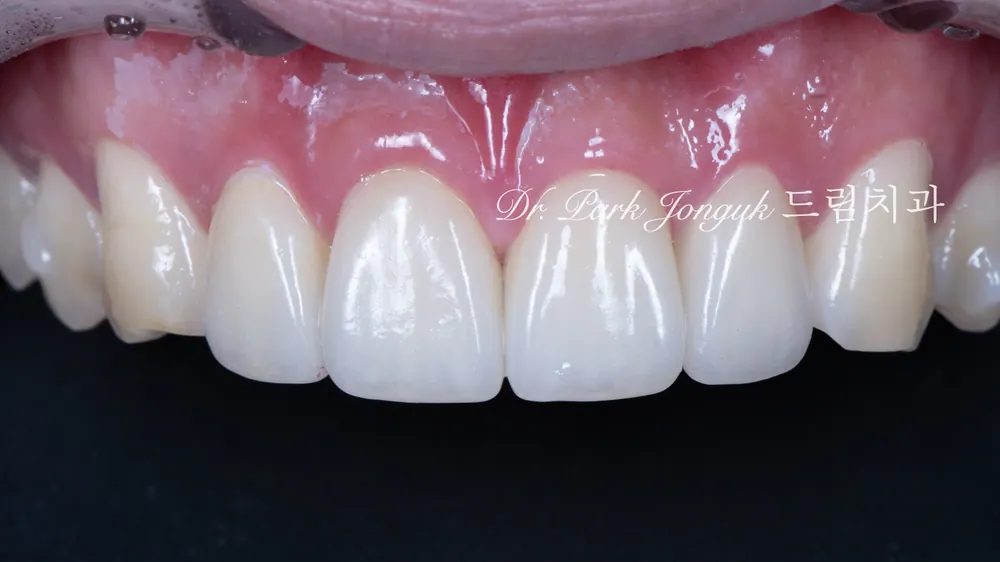
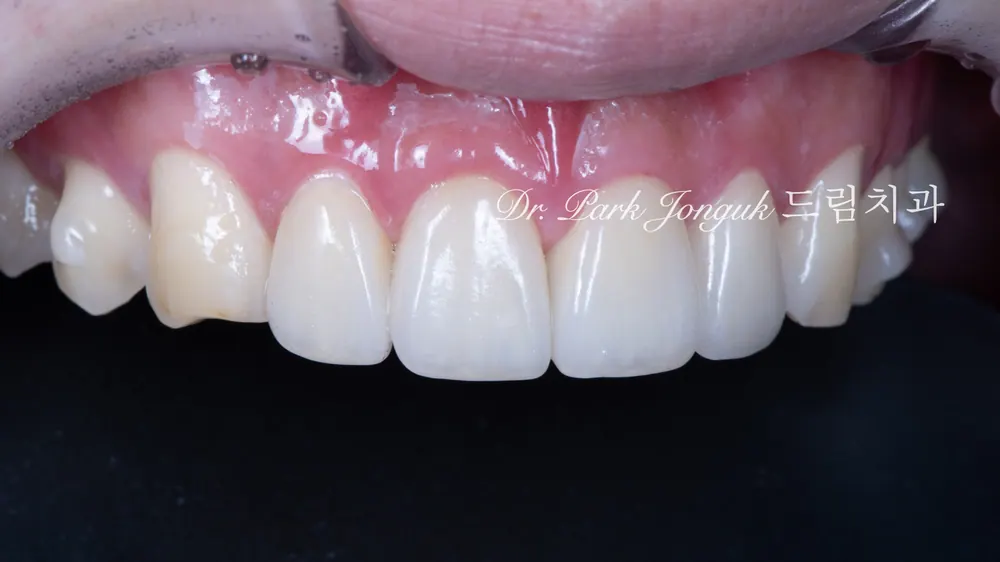
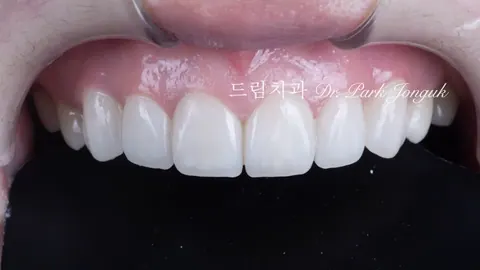
[Photos 5, 6] final appearance after treatment (front and side)
The no-prep veneer procedure was completed successfully.
The once-small, gapped teeth are gone, and a harmonious, beautiful smile has been achieved.
Tooth shape and coloring:
The tooth shape became larger in harmony with the face,
and the color, rather than an artificial white, blends perfectly with the surrounding natural teeth.
Translucency at the tooth edge: [detail from Photo 5] the most important thing is the translucency at the tooth edge.
Only our insisted-upon handmade build-up method
can reproduce a clear translucency that lets light pass through just like a natural tooth,
so the teeth still look full of life even after the procedure.
When Invisalign secures the exact position,
and our minimal-prep philosophy and handmade technique complete the details,
only then can perfect esthetics be achieved without touching the tooth at all.
5. Conclusion: preserving the tooth and completing esthetics at the same time
Veneers after Invisalign are
the most ideal treatment strategy for prioritizing tooth preservation above all else
when there's a structural issue with the tooth, such as a peg lateral or gapped teeth.
As a board-certified specialist in conservative dentistry with 20 years of experience,
on top of a position perfected through orthodontic treatment,
we perfectly restore every natural detail of the tooth through no-prep or minimal reduction alone.
6. Top 5 Q&A on veneers after Invisalign
Q1. Why get veneers after Invisalign orthodontic treatment?
A. Orthodontics corrects the tooth's position, while veneers complete its shape, size, and color. Veneers are used as the final finishing material to fill space created by orthodontics (as with a peg lateral) or to esthetically refine the shape of the tooth edge.
Q2. How does Invisalign create space for no-prep veneers?
A. When a tooth is small, as with a peg lateral, the Invisalign plan deliberately leaves a tiny gap (diastema) between the teeth instead of closing it. Since the veneer is bonded into this space, the procedure becomes possible without any tooth reduction.
Q3. Isn't there a greater risk of no-prep veneers coming off?
A. No. No-prep veneers bond by maximizing the bonding area on enamel, the hardest layer of the tooth, so the bond strength is actually strong. Using the latest bonding protocols makes it stable.
Q4. Can getting veneers after Invisalign shorten the orthodontic treatment period?
A. Yes, that's possible. Instead of resolving minor misalignment or a peg lateral issue 100% through orthodontics, the orthodontic treatment can be carried only far enough to allow the veneer to be placed, shortening the overall orthodontic period.
Q5. Why does translucency at the tooth edge matter for veneers?
A. Translucency represents the vitality of a young, healthy tooth. Without translucency, an opaque veneer reflects light in an artificial, dull way, which greatly reduces its esthetic quality.
This article is a clinical note written by Dr. Park Jonguk of Dream Dental Clinic, Gangnam; the original was published on his blog. The photographs shown are real cases he treated. Results vary with each patient’s condition, and every procedure carries the possibility of individual variation and side effects.
Quick Consult
Request a Callback
Leave your number and we will call you back during clinic hours.
Request Received
We will contact you during clinic hours. For urgent matters, please call +82-2-3448-0028.