
Front-Teeth Redo: Reviving an Awkward All-Ceramic Crown, Naturally
Hello. I'm the one who has practiced veneer and all-ceramic crown treatment in Apgujeong for 20 years —
Park Jonguk, director of Dream Dental Clinic.
Today I'd like to introduce a front-teeth redo case that many people struggle with —
specifically, an all-ceramic crown redo.
The Problem with an Old All-Ceramic Crown
This patient came to us having already received all-ceramic crown (All-ceramic crown) treatment on four front teeth long ago.
The moment we met, several problems were immediately obvious.
They didn't look anything like natural teeth. The shade was off, and the shape was unnatural.
In particular, as a female patient, her teeth were far too large,
and the proportions between the teeth hadn't been considered at all.
The patient herself said, "Every time I look in the mirror, my teeth are so big and awkward-looking that it stresses me out,"
and was upset that "people can tell right away that my teeth are fake whenever they look at them."
See the Condition Before Treatment
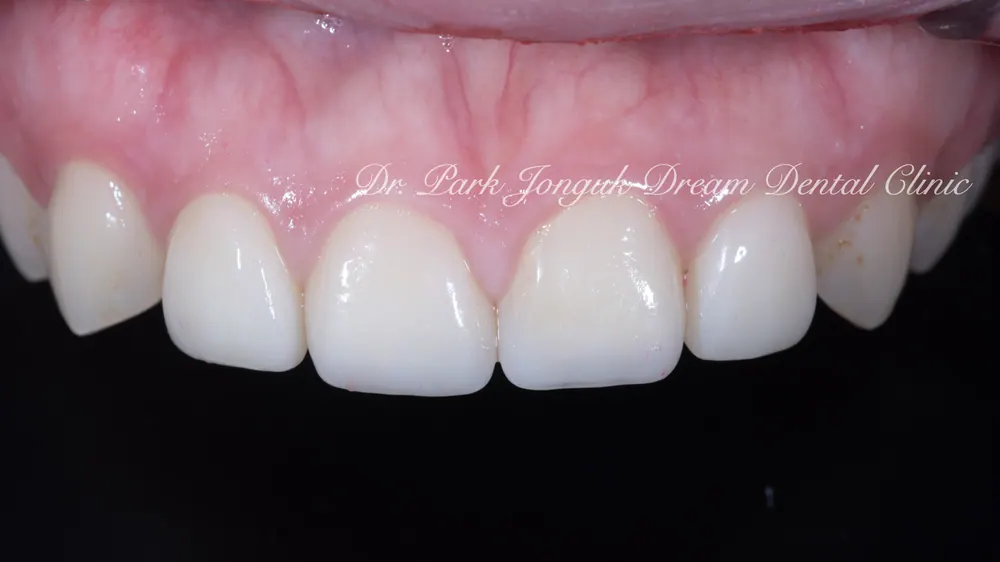
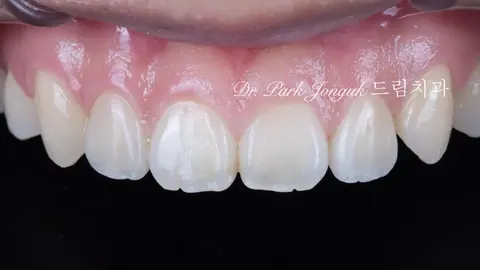
Photo 1 shows her condition before treatment.
All four front teeth had an awkward shade and shape, and above all, they were far too large.
Teeth that are excessively large relative to a woman's face disrupt the overall harmony
and instead give off a masculine, artificial impression.
All-ceramic crowns are certainly a good material.
But a good material doesn't automatically produce a good result.
Only when precise diagnosis, proper design, and the hands of a skilled dental technician all come together in harmony
is a truly natural-looking tooth finally completed.
Identifying the Problems Through Precise Diagnosis
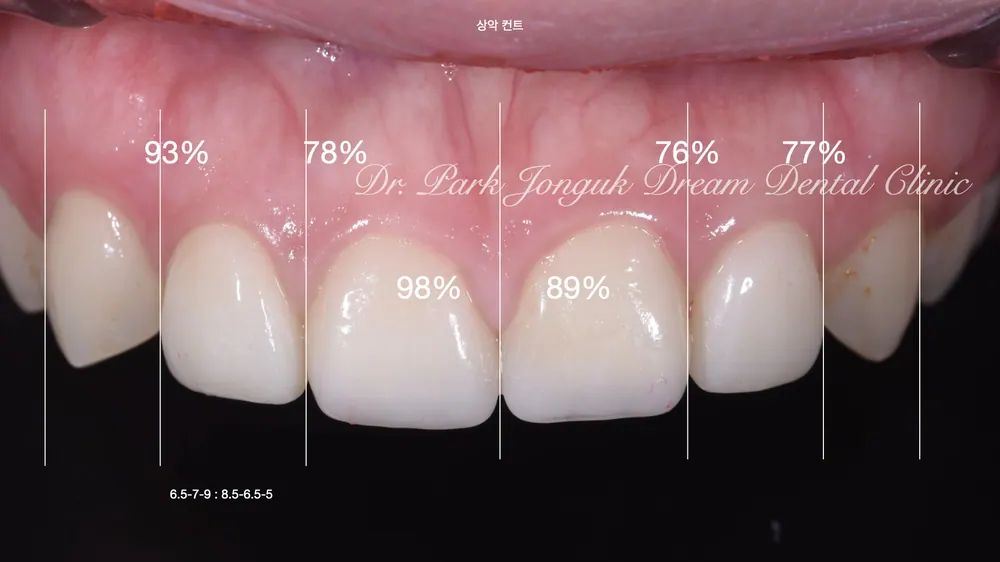
Photo 2 shows the diagnostic process.
A detailed analysis of her teeth showed that even the two central front teeth differed in size from each other.
Left-right symmetry was off, and the proportions between teeth hadn't been considered at all.
The central incisor naturally needs to be larger than the lateral incisor,
and that ratio needs to be appropriate for a natural look.
The ratio of a tooth's length to width matters as well.
In this case, every one of these basic principles had been ignored.
An even bigger problem was that because the teeth were so large,
they didn't suit her small face at all.
Teeth don't exist in isolation — their beauty is determined by their harmony with the whole face.
During the diagnosis, when I explained to her that "making the teeth smaller will make your face look smaller and more feminine,"
she said, "That's exactly what I wanted," and looked hopeful.
Designing the Ideal Shape with a Wax-Up
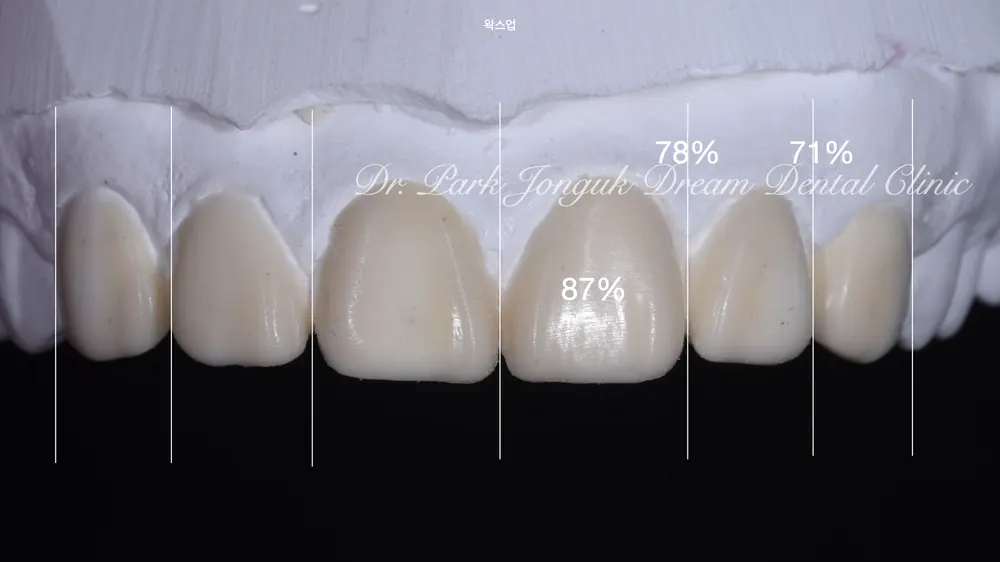
Photo 3 shows the result of the wax-up precision diagnosis.
Based on the diagnosis, we brought the size and proportions of the teeth as close as possible to average values.
The area we focused on most was making the front teeth look smaller.
Simply reducing the size isn't enough on its own.
The design needs to give enough three-dimensionality for the teeth to visually look smaller and more delicate.
We made the central part of the central incisor slightly convex,
and created a natural curve toward the edges to produce a shading effect.
This creates light and shadow, giving the teeth a sense of life and a natural, non-flat feel.
We also carefully adjusted the shape of the tooth edges.
Rather than looking like they'd been cut in a perfectly straight line,
we gave them a natural curve and a slight irregularity so they'd look like real teeth.
When the patient saw the wax-up model, she was moved and said, "It finally feels like I'm getting teeth that suit my face."
Creating a Natural Look with Handmade Build-Up
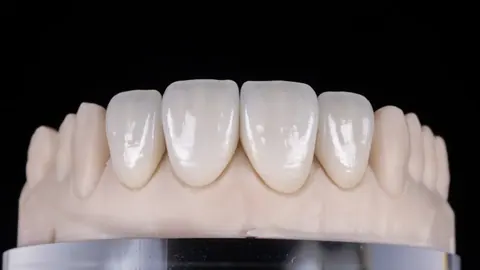
The video shows the build-up process of actually making the all-ceramic crowns.
Watching this process will help you understand why a natural result can be achieved.
The dental technician uses several types of ceramic powder and builds it up layer by layer.
The inner core starts with opaque ceramic,
and more translucent ceramic is used toward the outer layers.
The gum area is finished in a warm ivory tone,
the middle section in a bright, lively color, and the tooth edge with translucent ceramic.
Only by building this multi-layer structure
can you achieve the effect of light passing through and diffusing softly, just like a natural tooth.
A fine texture is also added to the surface to reproduce the surface characteristics of a natural tooth.
All these details come together to create a natural-looking tooth that doesn't give away the fact that "this is a crown."
None of this is possible with a method that mills the crown by computer.
This kind of delicate work is only possible in the hands of a skilled dental technician.
The Result After Treatment: A Complete Transformation
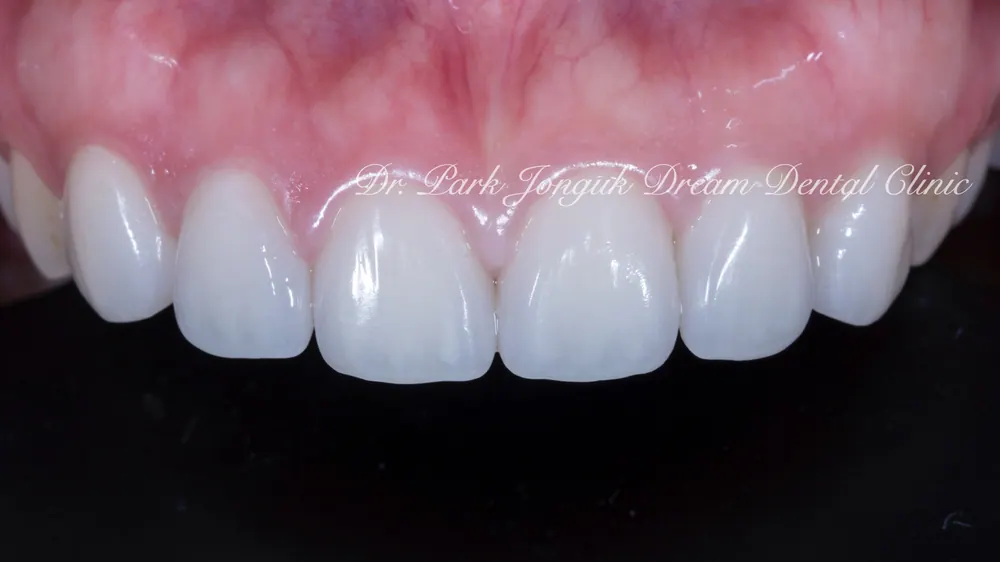
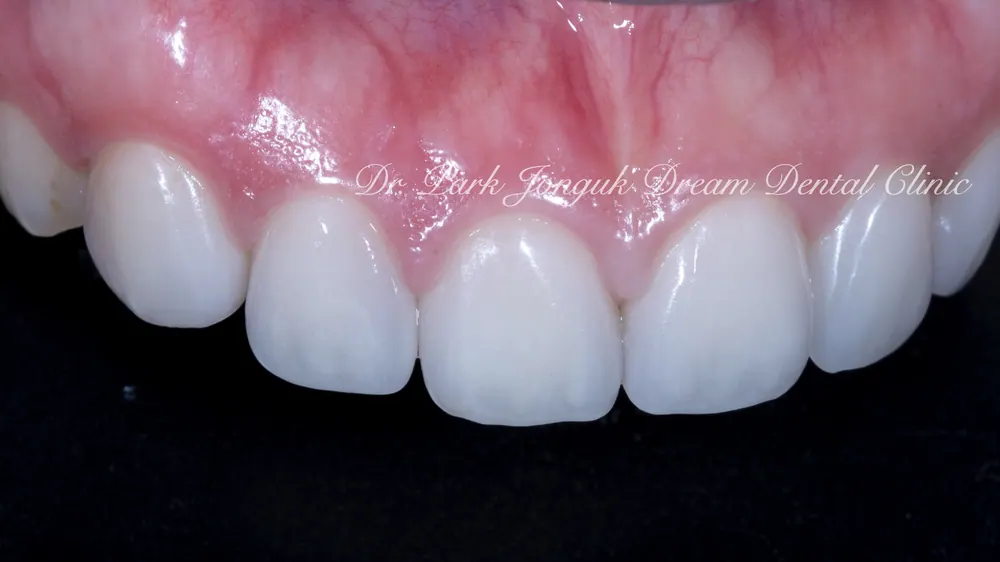
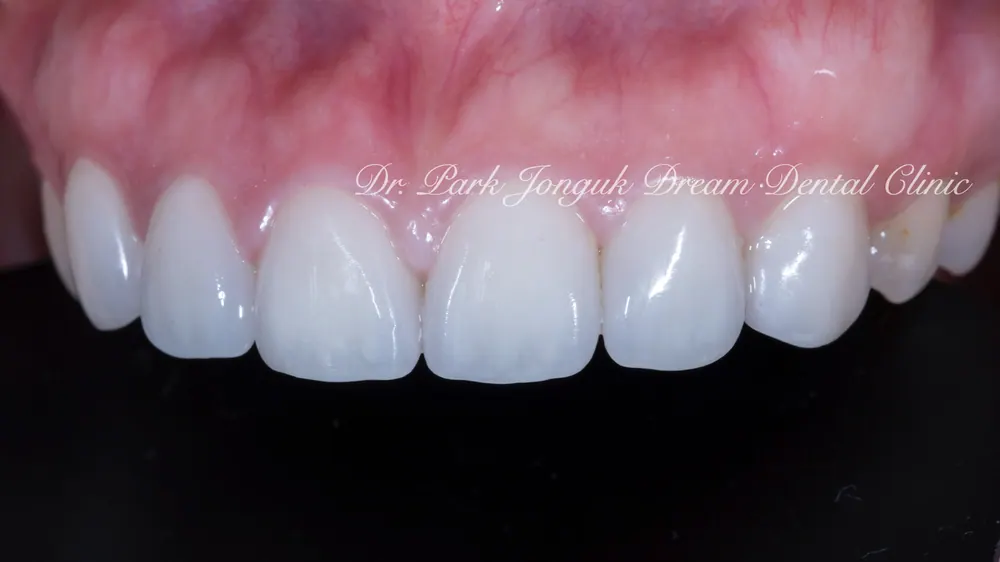
Photos 4, 5, and 6 show her condition after treatment.
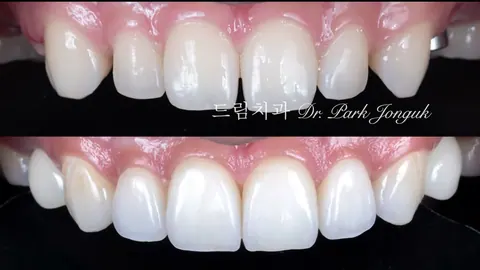
Isn't it remarkable? Compared to before, they look like a completely different person's teeth.
The teeth look much smaller, and natural.
With the size and proportions properly adjusted, they give off a feminine, delicate feel.
They also harmonize perfectly with her face.
Look closely at each individual tooth, and you'll see the three-dimensionality come alive.
They're not flat — subtle curves and shading give them the same sense of life as a natural tooth.
The shade has also changed completely.
Instead of the old dull, artificial color, it's now bright yet natural.
There's a natural color gradient from the gum area to the incisal edge,
and the translucency at the tooth edge was also beautifully expressed.
When the patient looked in the mirror, her eyes welled up with tears.
When she said, "It finally feels like I've gotten my face back. Thank you so much,"
the sense of fulfillment I felt as a dentist was truly immense.
Front-Teeth Redo: Why Is It Needed?
Many people are dissatisfied with all-ceramic crown or veneer treatment they received in the past and consider a redo.
The reasons are mostly as follows.
First, color problems. Many people struggle with teeth that are too white, dull, or artificial-looking.
Second, size and proportion problems. This includes teeth that are too large, left-right asymmetry, or odd proportions between teeth.
Third, shape problems. This includes teeth that are too angular, flat, or lacking three-dimensionality, giving a doll-teeth kind of feel.
Fourth, gum problems. This includes cases where the boundary line between the crown and gum is noticeable, or where the gum becomes inflamed.
These problems occur because the initial treatment lacked a precise diagnosis and plan.
Trying to get treatment done quickly and cheaply makes these problems more likely.
All-Ceramic Crown Redo: What to Look For
If you're considering a front-teeth redo, be sure to check the following.
First, check whether there's a precise diagnostic process.
It should include facial analysis, measurement of tooth proportions, and a wax-up diagnosis.
Avoid clinics that go straight into treatment without a diagnosis.
Second, ask whether they use a handmade build-up method.
The single-block method milled by computer is fast, but it has limits when it comes to a natural look.
Third, ask to see actual cases.
Looking at before-and-after photos of similar redo cases lets you gauge the clinic's skill and aesthetic sense.
Fourth, check whether they take sufficient time with the process.
A good all-ceramic crown takes 2-3 weeks.
Making it accurately matters more than finishing it in a single day.
Fifth, see whether there's good collaboration with the dental technician.
A system in which the dentist and technician communicate closely to custom-make the crown for each patient matters.
An all-ceramic crown redo is more demanding than the initial treatment.
This is because it requires removing the existing crown and re-evaluating the condition of the tooth.
But with a properly done redo, you can maintain a natural, beautiful smile for 10, even 20 years.
Don't Be Afraid of a Redo
Many people hesitate, thinking, "I've already had treatment once — do I really need to do it again?"
But feeling stressed every time you look in the mirror,
and being self-conscious every time you smile, is far worse for your quality of life than boldly deciding on a redo.
Patients who agonize for a long time before finally getting a redo, like this patient, mostly end up thinking, "Why didn't I do this sooner?"
Regaining confidence, and being able to smile freely in front of others —
that's the greatest value of a redo.
What I've come to feel after handling countless redo cases over 20 years is that
patient satisfaction is far higher with a redo than with the initial treatment.
Having already experienced a disappointing result, patients seem to feel even more grateful for a good outcome.
Frequently Asked Questions (Q&A)
Q1. When is an all-ceramic crown redo needed?
A. You should consider a redo if you're unhappy with the color, the size is excessive, the shape looks unnatural, or the boundary with the gum is noticeable. In particular, if people around you often point out that your teeth look fake, that's a sign it's time for a redo.
Q2. Doesn't the tooth get damaged when the existing crown is removed?
A. When a skilled dentist uses the right instruments and methods, tooth damage can be kept to a minimum. Ultrasonic instruments and diamond burs are used carefully to remove only the crown, selectively.
Q3. Is a redo more expensive than the initial treatment?
A. It depends on the complexity of the case. The cost can increase if removing the existing crown is difficult or additional treatment is needed, but in most cases it's similar to a standard crown treatment.
Q4. How long can it last after a redo?
A. With precise diagnosis and fabrication, plus proper care, it can last 10 years or more. A properly done redo can actually last even longer than the initial treatment.
Q5. If only the four front teeth are redone, will they match the surrounding teeth?
A. Yes, there's no problem at all if the color is matched harmoniously with the surrounding natural teeth. In fact, redoing just the front teeth often makes the overall smile even more beautiful.
Q6. How long does a redo take?
A. It generally takes about 2-3 weeks. It goes through stages such as removing the existing crown, making a temporary crown, and fabricating the final crown.
This article is based on the actual clinical experience of a dentist who has practiced aesthetic prosthodontic treatment in Apgujeong for 20 years. He lectures monthly at Lamista Academy to dentists on veneer and all-ceramic crown techniques, and has published Korea's first veneer textbook.
This article is a clinical note written by Dr. Park Jonguk of Dream Dental Clinic, Gangnam; the original was published on his blog. The photographs shown are real cases he treated. Results vary with each patient’s condition, and every procedure carries the possibility of individual variation and side effects.
Quick Consult
Request a Callback
Leave your number and we will call you back during clinic hours.
Request Received
We will contact you during clinic hours. For urgent matters, please call +82-2-3448-0028.