
No-Prep Veneers Naturally Correcting a Peg Lateral - A Real Post-Braces Veneer Case
Hello. I'm Park Jonguk, director of Dream Dental Clinic, who has been doing veneer treatment in Apgujeong for 20 years.
Today I'd like to introduce a peg lateral veneer case,
especially a special case that combines veneers after orthodontic treatment
with no-prep veneers.
A peg lateral — braces alone aren't enough
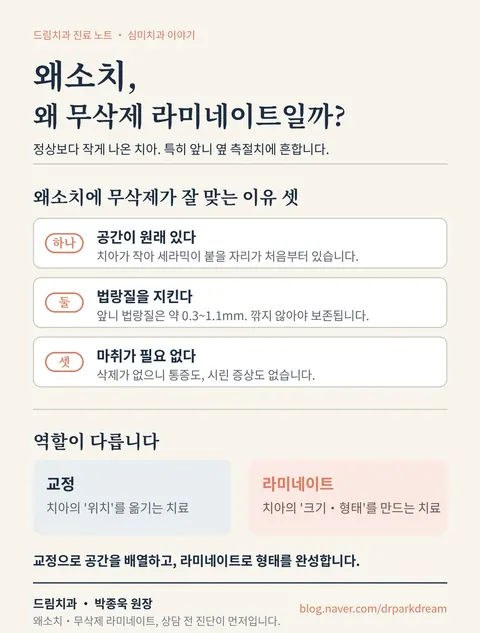
A peg lateral refers to a tooth that formed smaller than normal.
It occurs especially often in the lateral incisors (the teeth next to the front two),
and it's not just about being small — the shape is often pointed or cone-like too, which becomes a major esthetic concern.
This patient had both lateral incisors as peg laterals.
She said the small tooth size and odd shape always bothered her when she smiled.
So she decided to get orthodontic treatment first,
with a plan to complete it with veneers afterward.
A precise orthodontic plan for no-prep veneers
The most important thing considered when starting the orthodontic treatment was
securing space for no-prep veneers.
Regular veneers involve reducing the tooth a little and bonding the veneer in its place,
but no-prep veneers involve bonding a thin veneer directly onto the tooth without any reduction at all.
For no-prep to work, there needs to be enough space around the tooth.
If there isn't enough space, the tooth ends up looking too thick and unnatural once the veneer is bonded on.
So during the orthodontic treatment, we precisely designed and created space around the peg laterals.
Invisalign is used a lot these days for this kind of planned orthodontic treatment.
It's a clear aligner that's convenient,
and through digital simulation, it allows precise tooth movement that accounts for the eventual veneers.
The patient's return after finishing orthodontics
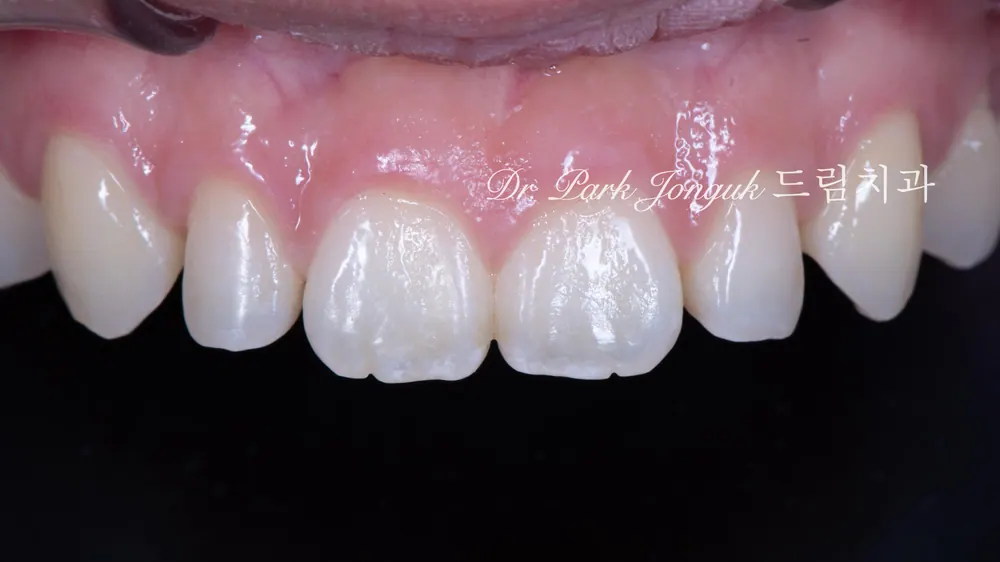
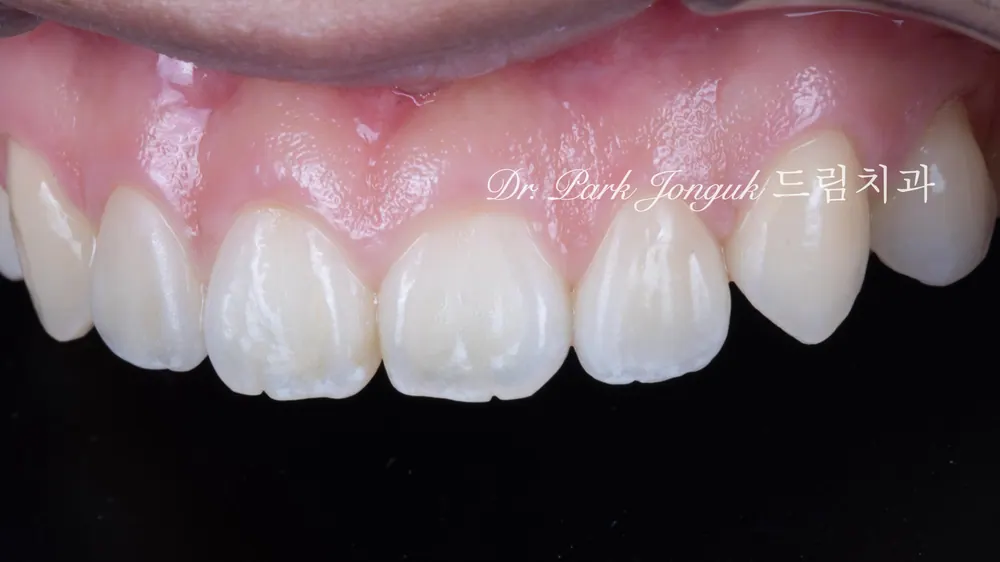
Photo 1 shows her condition when she came in after finishing orthodontics.
The braces had improved the alignment,
but the lateral incisors were still peg laterals — small in size and oddly shaped.
The space around them had been precisely secured for no-prep veneers.
There was one point of regret while consulting with the patient.
The color and shape of the central incisors (the two front teeth) weren't great either.
There was slight discoloration, some white spots were visible, and the shape was somewhat irregular.
From my perspective, treating the central incisors with veneers as well would have created a far more beautiful, harmonious result.
But the patient wanted to treat only the two peg laterals.
There was the cost to consider, and also the burden of having to reduce the central incisors.
So my task was clear.
Using only the two lateral incisors, make them look as natural as possible — as if they had always been there.
Designing the perfect shape with a wax-up
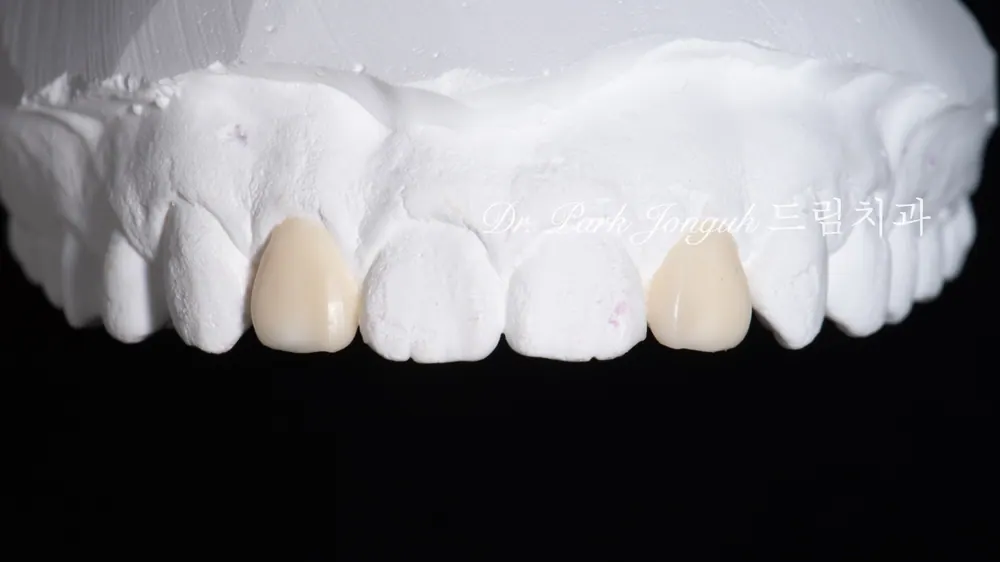
Photo 2 shows the result of the wax-up precision diagnosis.
This is the design process for turning the peg laterals into a normal size and shape.
The hardest part of peg lateral veneers is naturalness.
If you suddenly turn a small, pointed tooth into a large, normal-looking shape,
no matter how well it's made, it can end up looking like "something was obviously done."
So I reflected the irregular shape of the central incisors as much as possible.
Rather than a perfectly textbook, idealized shape,
I designed a natural shape similar in feel to the adjacent central incisor.
I even intentionally included slight irregularity and subtle asymmetry.
That's because a natural tooth is never perfect.
In fact, a bit of imperfection is what makes it look more real.
Checking in advance with temporary teeth
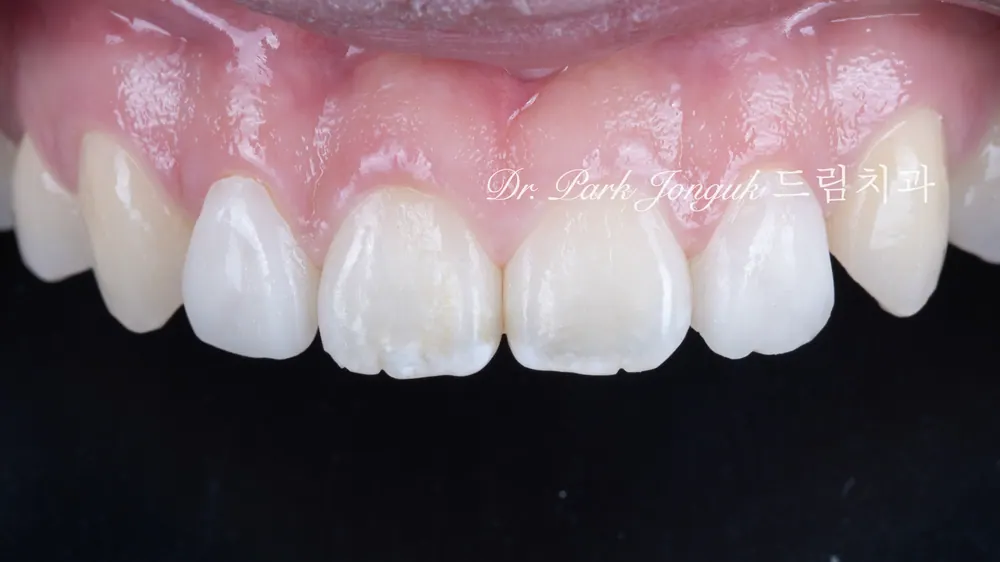
Photo 3 shows the temporary teeth.
This is the stage where the temporary teeth, made based on the wax-up design, are actually placed in the mouth.
Even just looking at the temporary teeth, the shape looks really good.
The irregular shape of the central incisors was reflected well, and the overall look is harmonious.
The patient, seeing the temporary teeth, said, "This looks really natural," and was satisfied.
The temporary-teeth stage isn't just about wearing something temporary until the final veneers are ready.
It's an important process for testing the final result in advance, making adjustments if needed, and incorporating the patient's opinion.
Two front-tooth veneers — color documentation is everything
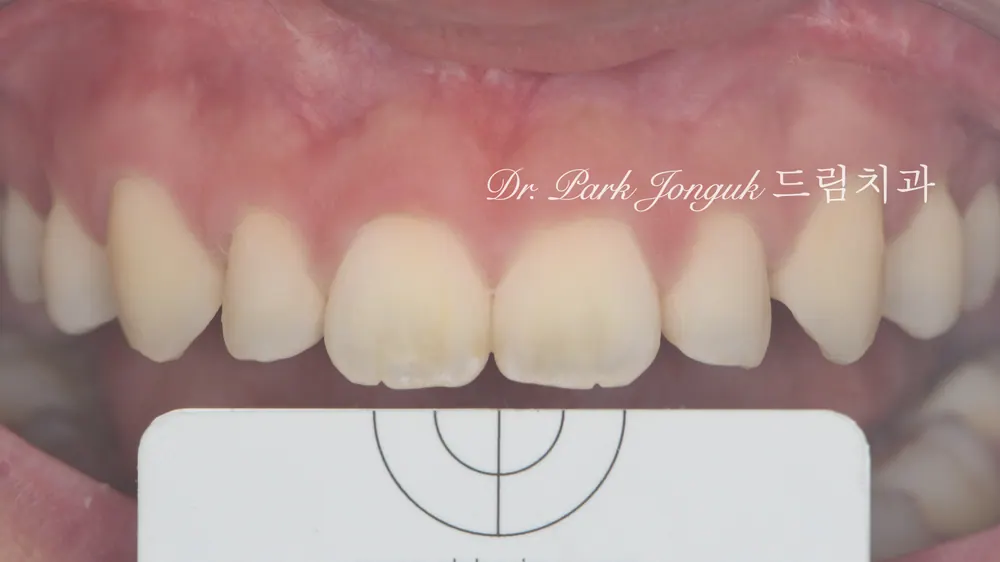
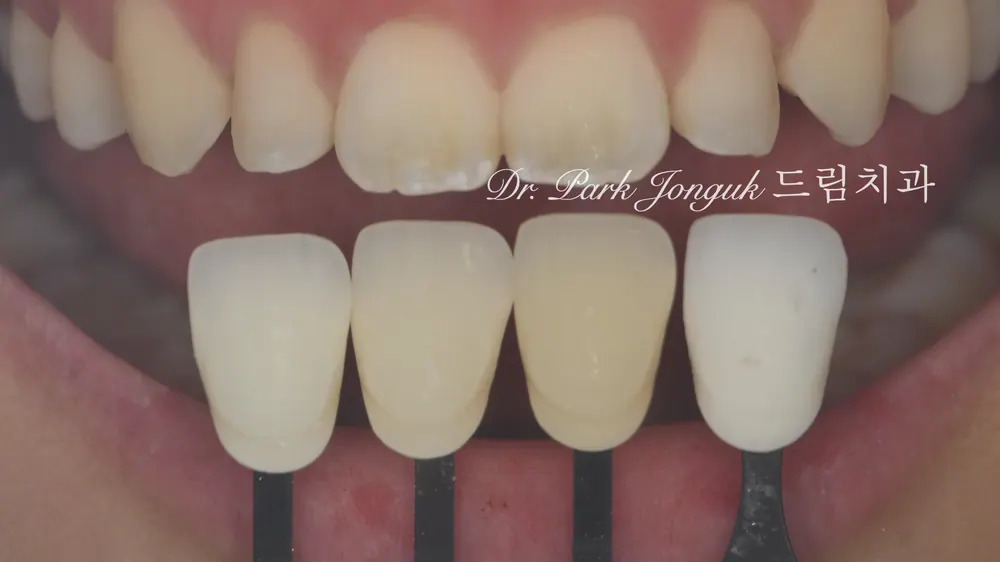
Photos 4 and 5 show that I used a special photography method.
When doing veneers on just two front teeth, the most important thing is color matching.
If you do four or six teeth at once, you can make the whole set a new color,
but when doing only two teeth, they have to be matched perfectly to the color of the adjacent central incisor.
Even a slight difference immediately gives away that "this is a veneer."
So I documented the photos using a polarizing filter.
With regular photos, it's difficult to accurately capture the true color of the tooth because of surface reflections.
But using a polarizing filter removes the reflected light and lets you accurately record the true internal color of the tooth.
I recorded not just the base color of the central incisors, but the location and size of the white spots,
and even the precise shade of the discolored areas.
I passed this information on to the technician so it could be reproduced exactly.
The platinum-foil feldspathic veneer fabrication process
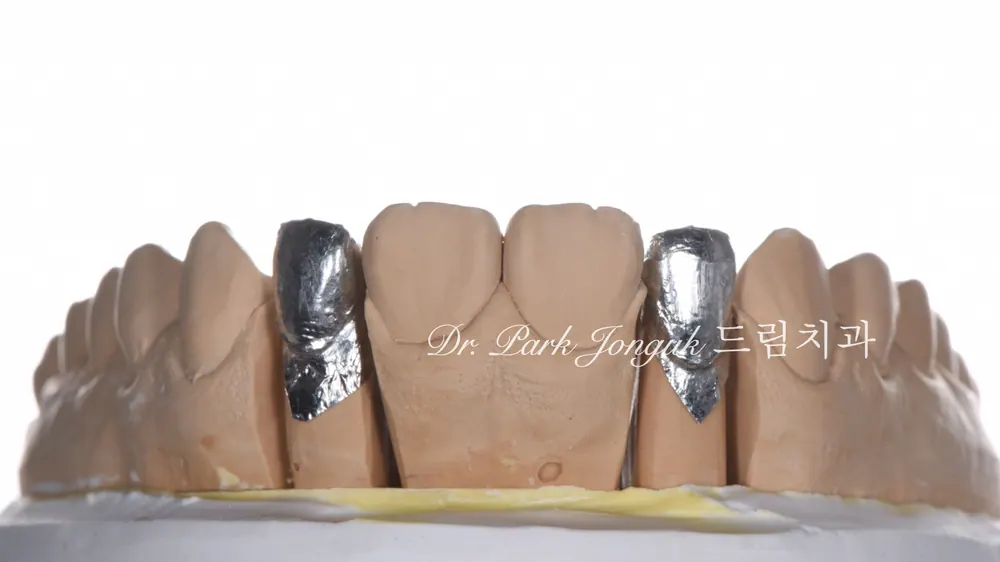
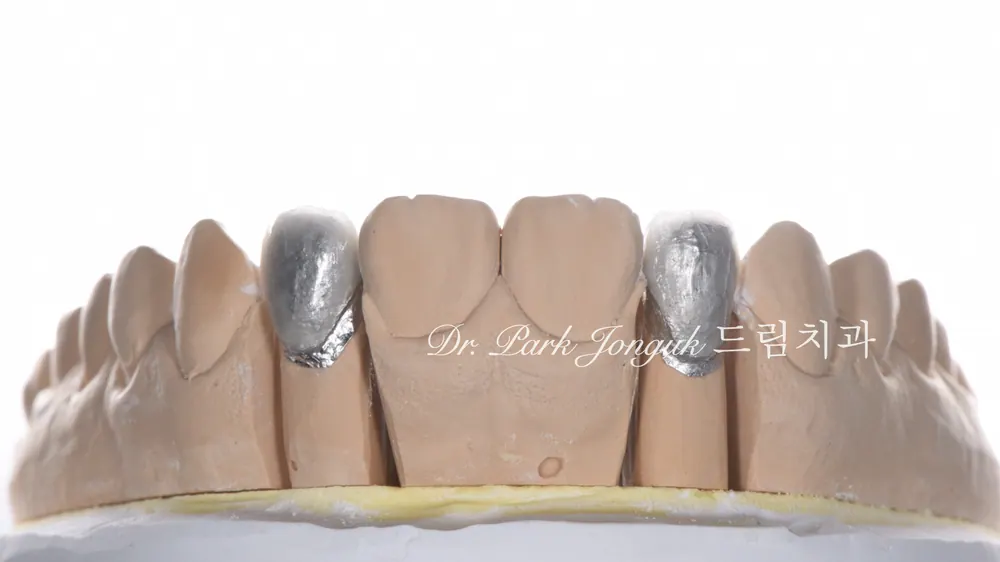
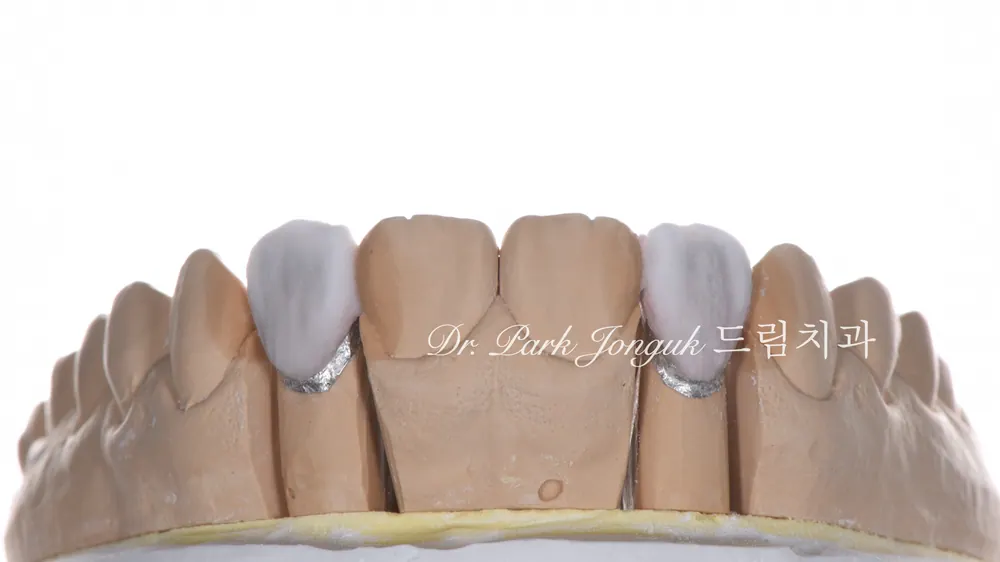
Photos 6, 7, and 8 show the veneer fabrication process.
For this case, I had platinum-foil feldspathic veneers fabricated.
The platinum-foil technique is the most traditional method of veneer fabrication,
and also the one that produces the most esthetic results.
It's a method where ceramic powder is stacked layer by layer on a thin platinum foil and then fired.
The biggest advantage of this method is its freedom to control translucency.
No-prep veneers need to be made extremely thin,
yet they still need to fully hide the color of the central incisor even while being thin.
The platinum-foil technique allows this kind of delicate control.
It also allows layering multiple shades of ceramic,
so it can reproduce the central incisor's white spots, discoloration, and color variation, all at once.
This is a level of detail that's simply impossible with a computer-milled method.
After communicating back and forth with the technician several times,
we made sure every characteristic of the central incisors was reproduced identically on the lateral incisor veneers.
Checking the completeness before setting
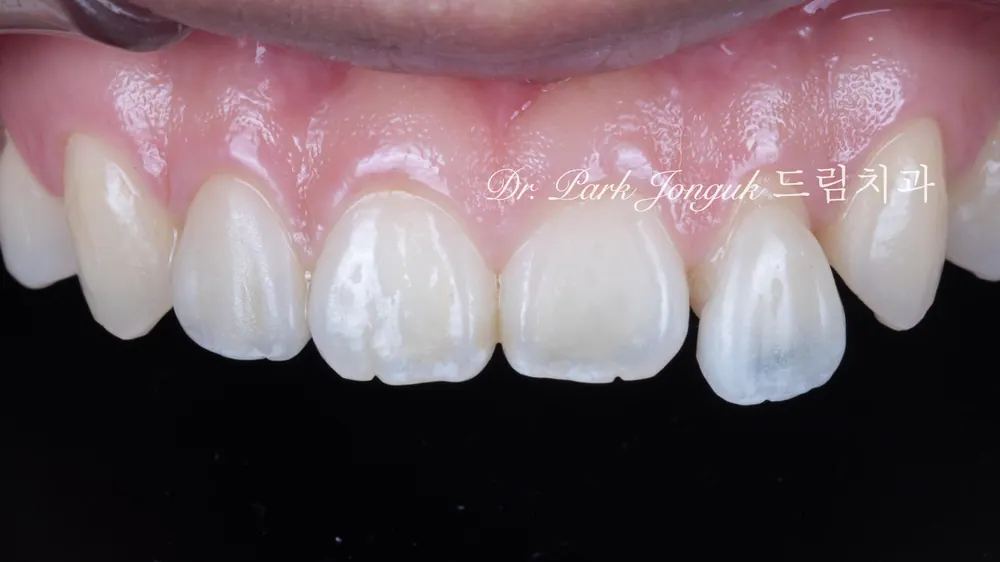
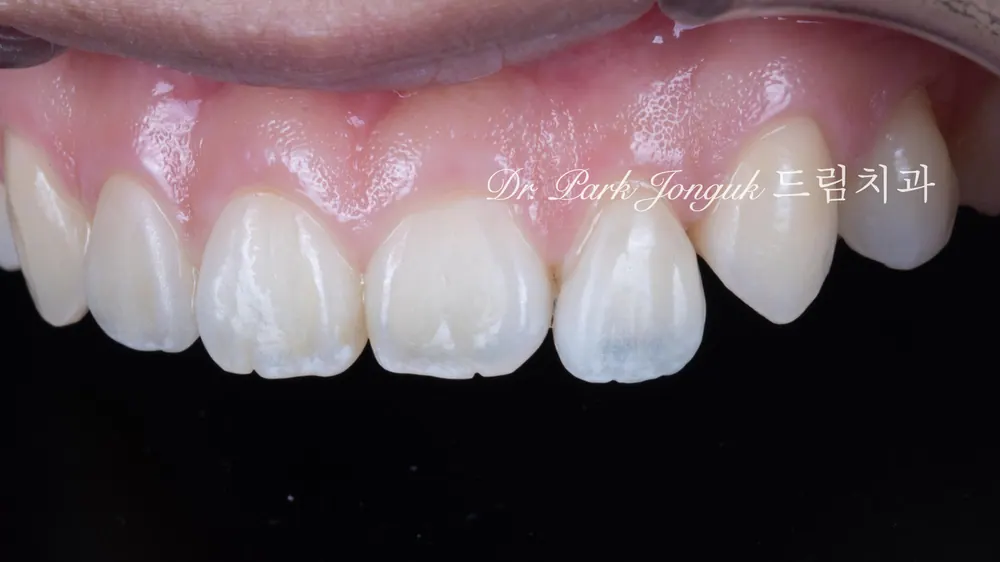
Photos 9 and 10 show the setting state before bonding the veneers.
This is the stage of placing the veneers on the teeth for a final check of the light, color, and shape.
Isn't it remarkable? The natural tooth expression has really come through.
The lateral incisor veneers are so similar to the central incisors that they're almost indistinguishable.
At this stage, we did a final check together with the patient in front of a mirror.
We carefully checked whether she liked the color and whether the shape looked natural.
The patient marveled, saying "This really looks like my original teeth."
Completion — the natural tooth itself
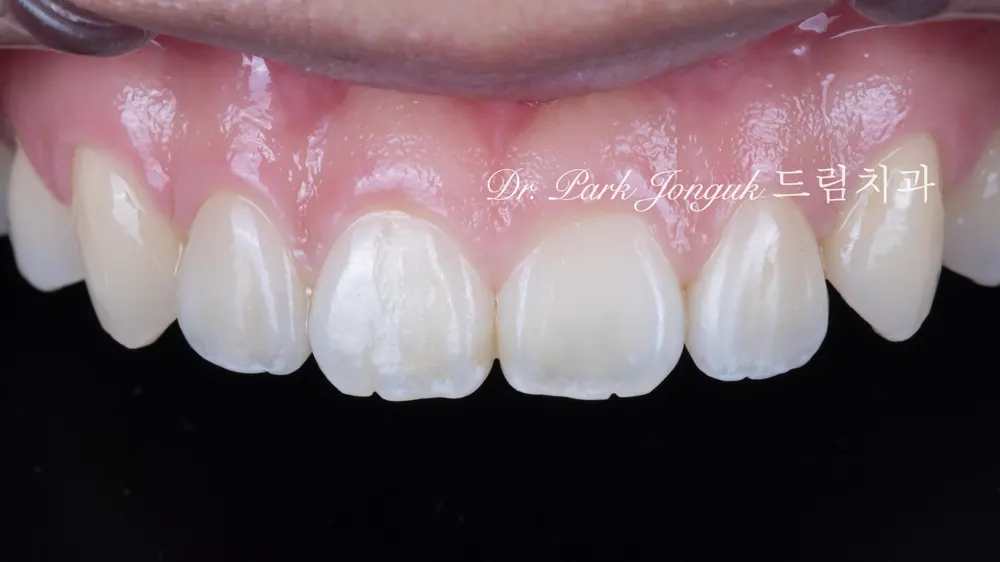
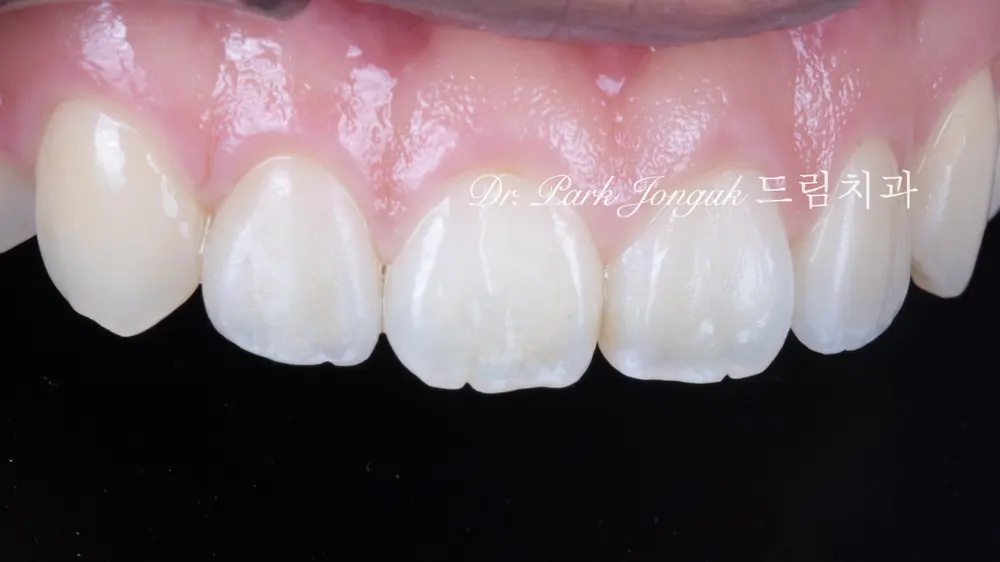
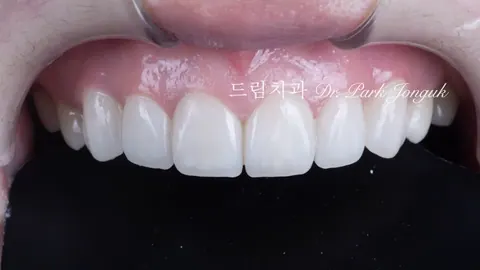
Photos 11, 12, and 13 show the final completed result.
It's really remarkable.
Even the white spots and discoloration of the central incisors were applied to and expressed on the lateral incisors.
Anyone looking at it would think it's simply a natural tooth.
It looks as though the lateral incisors had always looked like this.
Even the flaws of the central incisors were fully expressed.
This isn't simply matching a color — it's a complete integration.
Achieving this level of expression with no-prep is extremely difficult.
No-prep veneers are very thin, which makes color control difficult and limits how the shape can be expressed.
But when precise diagnosis, perfect color documentation, and a skilled technician's craft all come together, a remarkable result like this becomes possible.
It's so natural and so beautiful.
The patient was delighted, saying, "I only did two front teeth, but it feels like my whole face brightened up."
Are no-prep peg lateral veneers possible?
Many people ask, "Can peg laterals be done as no-prep too?"
The answer is, "it depends on the case."
If the peg lateral isn't too severe and enough surrounding space can be secured through orthodontics, no-prep is possible.
But if the peg lateral is too small, if there isn't enough space,
or if the tooth color is too dark, minimal reduction may be needed.
As in this case, it's important to plan with veneers in mind from the orthodontic stage onward.
The orthodontist and the restorative dentist need to work closely together, sharing the final goal, to achieve the best result.
The difficulty and reward of veneers on just two front teeth
Doing veneers on just two front teeth is actually harder than doing four or six.
It has to blend perfectly with the natural teeth right next to it,
and even a slight color difference immediately gives it away.
But the reward, when it succeeds, is far greater.
It's because the patient can get a beautiful result with minimal or no reduction of the tooth at all.
This case was especially satisfying among my 20 years of clinical experience.
It confirmed once again that no-prep veneers can achieve a result this natural.
For those troubled by a peg lateral
A peg lateral isn't just a matter of size — it causes a lot of psychological stress.
It's something you become self-conscious about every time you smile, and you end up keeping your mouth closed even in photos.
But it can be sufficiently improved with the right treatment plan and precise technique.
In particular, combining orthodontics with veneers can protect tooth health while still achieving a beautiful result.
Whether no-prep is possible or minimal reduction is needed is determined through precise diagnosis.
What matters is consulting thoroughly with an experienced dentist to find the best method suited to you.
Frequently asked questions (Q&A)
Q1. Does a peg lateral always need veneers?
A. No. If the peg lateral is mild and there's no functional problem, treatment isn't strictly necessary.
But if it's a major esthetic concern,
or if the gap between teeth is causing problems like food getting stuck, veneers can be a good solution.
Q2. Can peg lateral veneers be done as no-prep too?
A. It's possible depending on the case. If there's enough space around the peg lateral,
and the tooth color isn't too dark, it can be done without reduction.
Securing space in advance through orthodontics increases the likelihood of no-prep being possible.
Q3. Why get veneers after orthodontics?
A. Orthodontics alone can correct the tooth position,
but it can't improve the tooth's size, shape, or color.
Especially when a tooth is small or oddly shaped, like a peg lateral,
completing the process with veneers after orthodontics is what achieves a beautiful result.
Q4. Would veneers on just two front teeth still look natural?
A. With precise color matching and shape design, it can look completely natural.
In fact, as in this case, reproducing even the characteristics of the adjacent tooth can create perfect harmony.
Q5. Aren't no-prep veneers thick?
A. A properly made no-prep veneer is fabricated extremely thin, around 0.3mm.
If enough space has been secured, it isn't thick or unnatural at all.
Q6. Is Invisalign advantageous for veneers afterward?
A. Yes, Invisalign allows precise tooth movement,
planned through digital simulation with the eventual veneers in mind.
It's advantageous because it can precisely secure the space needed for the veneers.
Q7. What are platinum-foil feldspathic veneers?
A. It's a traditional method made by stacking ceramic powder onto a platinum foil.
It allows free control of translucency and delicate color expression, producing the most natural results.
This article is based on the actual clinical experience of a dentist who has practiced esthetic dentistry in Apgujeong for 20 years.
He lectures monthly to fellow dentists on veneer techniques at Lamista Academy,
and he published Korea's first veneer textbook.
This article is a clinical note written by Dr. Park Jonguk of Dream Dental Clinic, Gangnam; the original was published on his blog. The photographs shown are real cases he treated. Results vary with each patient’s condition, and every procedure carries the possibility of individual variation and side effects.
Quick Consult
Request a Callback
Leave your number and we will call you back during clinic hours.
Request Received
We will contact you during clinic hours. For urgent matters, please call +82-2-3448-0028.