
All-Ceramic Crown Redo Combined With No-Prep Veneers, Restored Perfectly
Hello, I am Park Jonguk, director of Dream Dental Clinic, who has practiced aesthetic dentistry in Apgujeong for 20 years.
Today I'd like to introduce a special case that many people struggle with —
an all-ceramic crown redo done together with veneers.
Old all-ceramic crowns: it may be time for a change
This patient came in with all-ceramic crown treatment on both central incisors, done a long time ago.
As a lot of time passed, various problems developed.
The biggest problem was that they didn't match the other natural teeth at all.
The color was different, and the size and shape also weren't harmonious with the surrounding teeth.
In particular, the lateral incisors on both sides were natural teeth,
and the mismatch with the central incisor crowns was so severe that it was uncomfortable every time she smiled, she said.
The patient said, "Every time I look in the mirror, only my two front teeth stand out, and it stresses me out,"
and pleaded, "I want to redo it, but I don't know what to do."
Expanding the scope of treatment, for a more beautiful result
While making the diagnosis, we discovered another problem.
The lateral incisors were positioned slightly inward.
If only the two central incisors were redone in this state,
it seemed it would be difficult to achieve perfect overall harmony.
I told the patient honestly:
"Rather than just redoing the central incisors, doing the lateral incisors together as well can create a much more beautiful and natural result.
And if we include the canines too and do all 6 front teeth together, the entire smile will become perfect."
After thinking it over for a moment, the patient said, "Since I'm redoing it anyway, I want it done properly,"
and decided to have all 6 teeth — the canines, lateral incisors, and central incisors — treated together.
But there was one more important decision to make here.
The central incisors already had crowns, so they had to be redone as crowns,
but the lateral incisors and canines were healthy natural teeth.
I didn't want to reduce these teeth much, and the patient felt the same way.
So we decided to proceed with no-prep veneers or minimal-prep veneers.
Check out the state before treatment
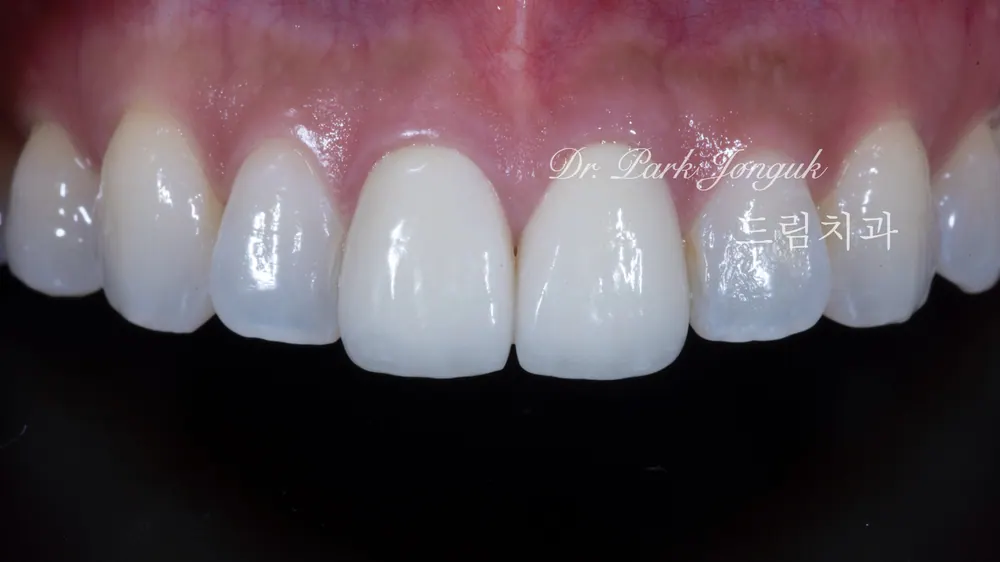
Photo 1 is from the first visit.
You can see at a glance that the all-ceramic crowns on the central incisors don't match the surrounding teeth.
The color is different, and the shape is unnatural too.
Also, the lateral incisors are positioned inward, so the overall tooth alignment isn't smooth.
In this state, no matter how prettily the central incisors alone are remade, achieving overall harmony is difficult.
The patient also said, "I thought only my two front teeth were the problem,
but now I finally realize you have to look at the whole picture."
Creating a perfect design with a wax-up
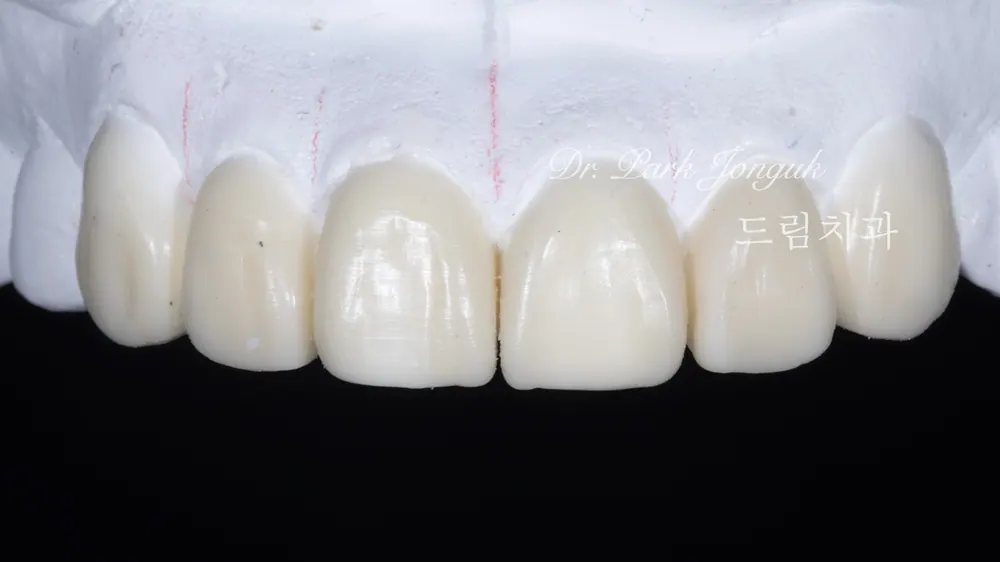
Photo 2 shows the result of the wax-up precision diagnosis.
This is the process of precisely designing the size, shape, and proportion of all 6 front teeth.
The central incisors were designed to be remade as all-ceramic crowns,
while the lateral incisors and canines were designed as no-prep or minimal-prep veneers.
The most important thing is for the 6 teeth to create one harmonious smile.
We made the lateral incisors come forward slightly to smooth out the tooth alignment,
and designed it so the overall smile curve, including the canines, flows beautifully.
We also carefully adjusted the size and shape of each individual tooth.
Upon seeing the wax-up model, the patient looked full of anticipation, saying "I can't believe I could have a smile like this."
A wax-up isn't just a simple model — it's a process of giving the patient hope.
Removing the all-ceramic crowns and preparing the teeth
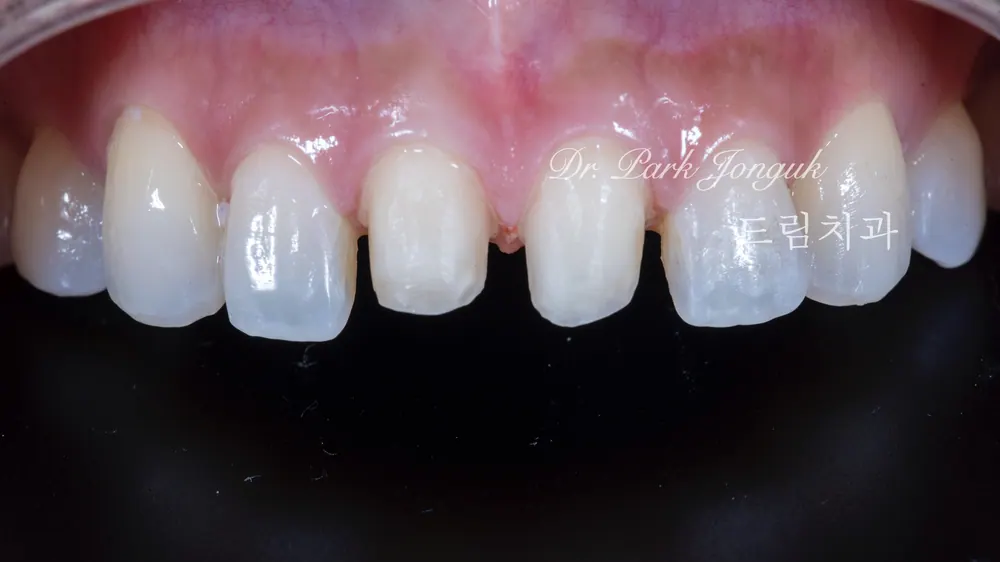
Photo 3 shows the state after the existing all-ceramic crowns were removed and the teeth prepared for the veneers.
After carefully removing the existing crowns, the central incisors were reshaped for the new crowns.
When removing old crowns, careful work is needed so the tooth isn't damaged.
And the lateral incisors and canines were barely reduced at all.
This is exactly the advantage of no-prep veneers.
You can preserve healthy natural teeth as much as possible while still achieving a beautiful result.
Since the lateral incisors were positioned inward,
the approach was actually to bond the veneer onto the front of the tooth so it comes forward.
In cases like this, there's almost no need to reduce the tooth at all.
Just slightly smoothing the tooth surface is enough.
The same goes for the canines.
Since it was just a matter of bonding a thin veneer to slightly refine the shape and harmonize the color,
only minimal reduction was carried out.
The patient was relieved, saying, "I'm so glad you barely have to reduce the teeth."
Since a tooth can never be restored once it's reduced, preserving as much as possible is best in the long run.
Result after treatment, a perfect transformation
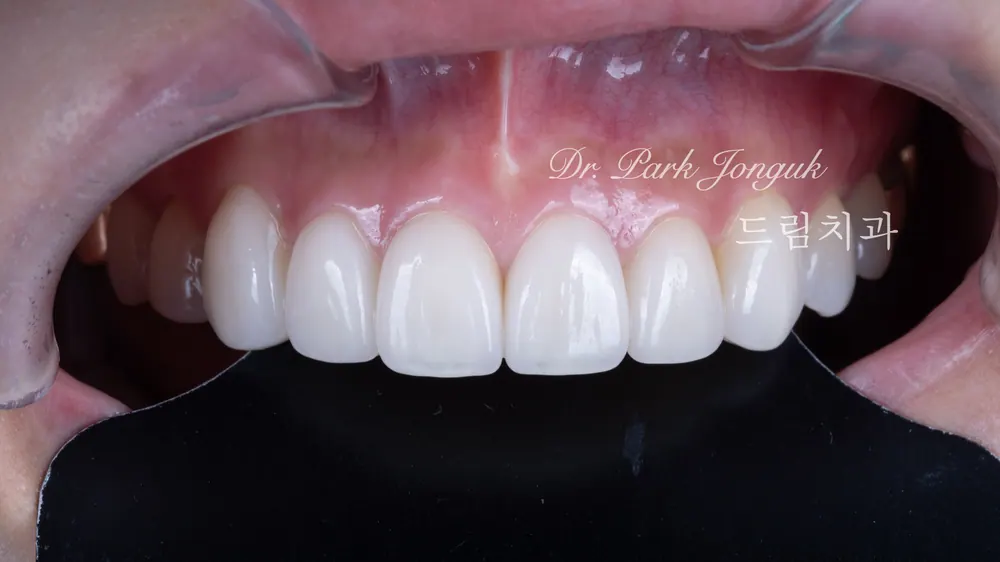
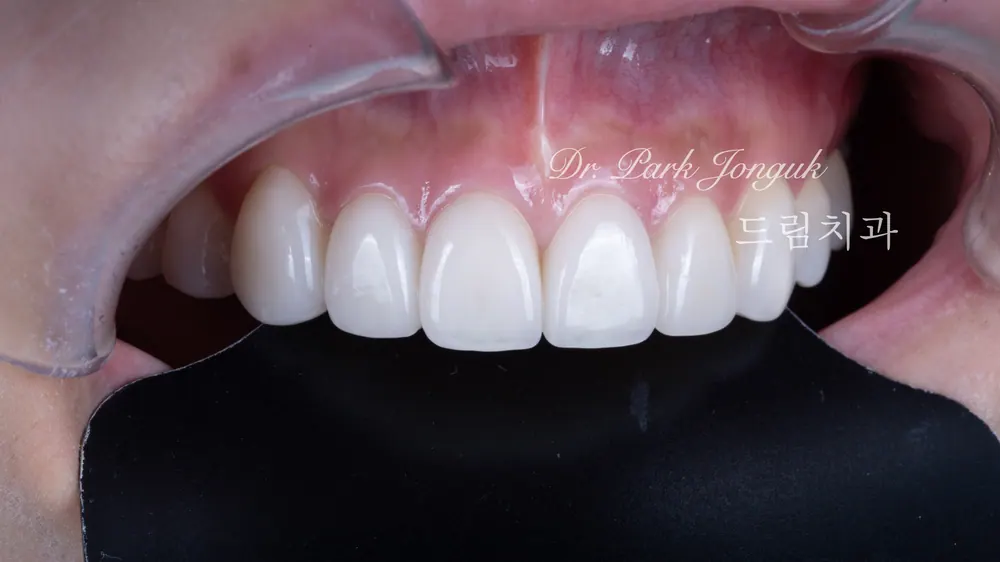
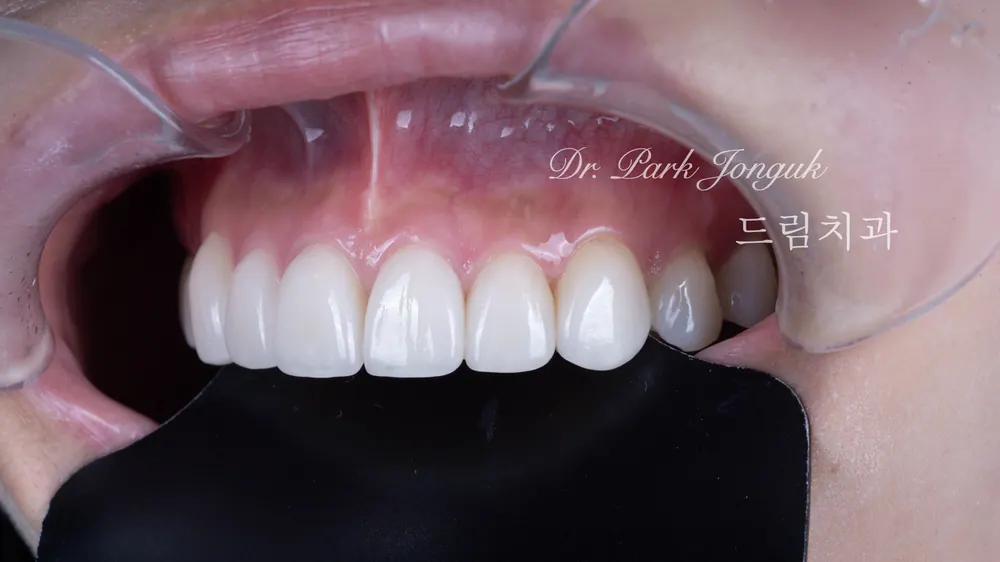
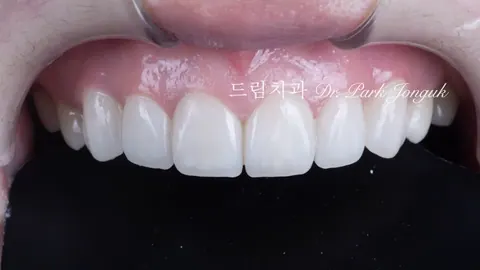
Photos 4, 5, and 6 show the state after treatment. Isn't this a truly remarkable change?
The all-ceramic crowns on the central incisors were completely remade and are as beautiful as natural teeth.
And the veneers on the lateral incisors and canines are in perfect harmony,
so the 6 teeth look as natural as if they had always been this way.
It's so natural that you can't tell at all which is the crown and which is the veneer.
This is exactly the standard for successful aesthetic treatment.
The color is also perfect. While all 6 teeth share the same tone,
there's a natural color change from the gum area to the incisal edge,
and the translucency has been beautifully expressed as well.
The shape is excellent too.
The problem of the lateral incisors being positioned inward was resolved,
so the tooth alignment now draws a smooth, beautiful curve.
The overall smile curve, including the canines, is truly perfect.
The patient looked in the mirror and her eyes welled up with tears.
"I never thought I'd have a smile like this. Thank you so much" — hearing that moved me deeply too.
Before-and-after comparison — the smile has changed
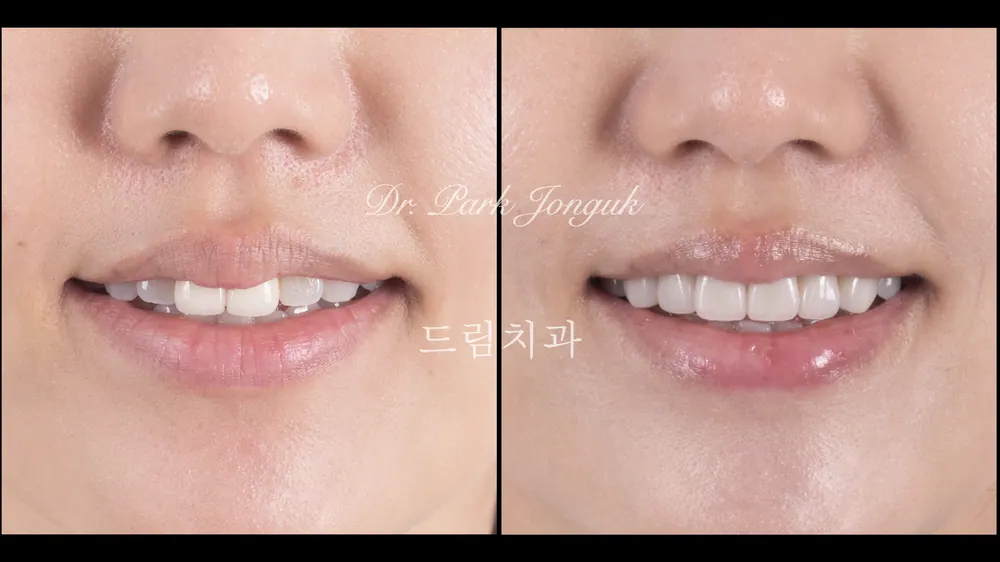
Photo 7 is a before-and-after smile photo.
Comparing them, the change is truly dramatic.
Before treatment, the central incisor crowns stood out awkwardly, and the overall smile wasn't harmonious.
She looked unconfident when smiling, and it seemed like a forced smile.
But after treatment, it was completely different.
The smile is bright and natural, and above all, the patient is smiling with confidence.
As the teeth became beautiful, her whole expression brightened.
The patient said, "Now I can smile confidently in front of people.
I can smile in photos now too," she said happily.
Why is an all-ceramic crown redo needed?
An all-ceramic crown isn't permanent either.
As time passes, a redo may become necessary for various reasons.
First, color change. An old crown may change color, or the color difference with the surrounding natural teeth may worsen severely.
Second, shape issues. A shape that was fine in the past may become aesthetically outdated over time, or
may look unnatural due to changes in the surrounding teeth.
Third, gum changes. As the gums recede, the border between the crown and the tooth may become visible, or the gum color may change.
Fourth, functional problems. The crown may become loose, chip, or issues may develop with the bite.
When these kinds of problems arise, it's a good idea to boldly consider a redo.
Rather than living with stress every day, properly redoing it and regaining confidence helps far more with quality of life.
Why the scope is expanded when redoing treatment
As in this case, there are cases where only the two central incisors were the problem, but all 6 teeth ended up being treated.
You might wonder, "Why treat even the healthy teeth?"
But in aesthetic treatment, overall harmony matters most.
No matter how prettily the central incisors alone are made,
if they don't match the neighboring teeth, it can actually look even stranger.
In particular, as in this case, when a lateral incisor is positioned inward,
redoing only the central incisors can't fully solve the problem.
The lateral incisors need to be treated together for the tooth alignment to become smooth and beautiful.
And by using no-prep or minimal-prep veneers,
the overall smile can be completed while hardly damaging the healthy teeth at all.
It's the best method for protecting both tooth health and aesthetics.
The advantages of no-prep veneers
No-prep veneers are one of the most attention-getting aesthetic treatment methods these days. There are really a lot of advantages.
First, they preserve the tooth.
Since healthy teeth aren't reduced, tooth health can be maintained as much as possible.
Second, there's almost no pain.
Since the tooth isn't reduced, anesthesia isn't needed, and there's almost no pain during or after the procedure.
Third, there's no tooth sensitivity issue.
Reducing a tooth can cause temporary sensitivity, but with no-prep there's no such issue.
Fourth, it's reversible.
If you don't like it, removing the veneer can return you to your original teeth.
If the tooth has been reduced, that can't be reversed.
However, no-prep veneers aren't possible in every case.
They're only possible when there's enough space, the tooth color isn't too dark, or the tooth shape is suitable.
Whether no-prep is possible needs to be judged through a precise diagnosis.
Don't be afraid of a redo
Many people hesitate to get a redo, thinking, "I already had it treated once, and now I have to do it again."
There's the cost burden, and also the fear of failing again.
But a properly done redo can change your life.
Like this patient, who used to feel stressed every time she looked in the mirror,
after a redo you can smile with confidence, take photos, and meet people.
If you're considering a redo, check the following points.
First, check whether there's a precise diagnosis. A systematic diagnostic process including a wax-up is essential.
Second, discuss the scope of treatment thoroughly. Sometimes treating the surrounding teeth together, not just the problem tooth, creates a better result.
Third, check whether a no-prep or minimal-prep option is possible. It's best to preserve healthy teeth as much as possible.
Fourth, ask to be shown actual cases. Looking at before-and-after photos of similar redo cases lets you predict the result.
What I've felt after doing countless redo cases over 20 years is that patient satisfaction is genuinely very high. It seems that because of their prior failed experience, gratitude for a successful result runs even deeper.
Frequently Asked Questions (Q&A)
Q1. When should an all-ceramic crown be redone?
A. There's no clear-cut standard, but if the color has changed, the shape looks unnatural, the border with the gum is noticeable, or it doesn't harmonize with the surrounding teeth, it's time to consider a redo. Generally, after about 10-15 years of use, many people start thinking about a redo.
Q2. Do even healthy teeth need to get veneers?
A. It can be necessary for overall harmony. In particular, with no-prep or minimal-prep veneers, a beautiful result can be achieved while barely damaging healthy teeth. However, the decision depends on the patient's situation and wishes.
Q3. Don't no-prep veneers come off easily?
A. With a properly done bonding process, they're just as strong as regular veneers. If the tooth surface is properly treated and the correct adhesive is used, they stay stable long-term.
Q4. Is a redo more expensive than the initial treatment?
A. Removing the existing crown or veneer requires an extra process, but the total cost varies by case. As the number of teeth treated increases, the total cost increases, but the cost per tooth is similar to a regular treatment.
Q5. How long does it take to treat all 6 teeth?
A. It generally takes about 2-3 weeks. It goes through stages such as removing the existing crown, preparing the teeth, making temporary teeth, and fabricating the final crown and veneers.
Q6. Could I need another redo after this one?
A. With a properly done redo, you can use it without problems for over 10 years. Regular checkups and proper care are the key to long-term success.
This article is based on the actual clinical experience of a dentist who has practiced aesthetic dentistry in Apgujeong for 20 years. He lectures monthly at Lamista Academy to dentists on veneer and all-ceramic crown techniques, and has published Korea's first veneer textbook.
This article is a clinical note written by Dr. Park Jonguk of Dream Dental Clinic, Gangnam; the original was published on his blog. The photographs shown are real cases he treated. Results vary with each patient’s condition, and every procedure carries the possibility of individual variation and side effects.

Quick Consult
Request a Callback
Leave your number and we will call you back during clinic hours.
Request Received
We will contact you during clinic hours. For urgent matters, please call +82-2-3448-0028.