
[No-Prep Veneers] Front-Tooth White Spots: Why No-Prep Was Still Possible Even Though the Teeth Weren't Small (Dr. Park Jonguk)
Hello. With 20 years in Apgujeong and 28 years as a dentist,
I'm Dr. Park Jonguk, a dentist focused on esthetic restoration of the front teeth.
My clinic is marking its 20th anniversary in Apgujeong.
Through all these years in one location, the single philosophy I've held onto is
"esthetic treatment that values the natural tooth above all else."
At the very peak of that philosophy is the no-prep veneer.
Today, through the case of a patient who had lost her smile because of severe white spots on her front teeth,
I'll take an in-depth look at what a doctor's precise diagnosis can achieve
in a situation that falls outside the usual conditions for no-prep.
1. The three principles of no-prep veneers, and this case's challenge
For a no-prep veneer to normally be performed safely, three essential conditions are needed.
The tooth size should be smaller than average (leaving volumetric room for the restoration to sit on)
The alignment should be even (the tooth axis isn't tilted)
The teeth should not be protruding forward (to prevent protrusion after the procedure)
But for this patient, condition 1 (tooth size) didn't apply.
She came in with extremely distinct, severe white spots on both central incisors,
and the teeth themselves were already on the larger side.
The usual approach would be to reduce the white-spot area and cover it,
but in order to protect the patient's precious enamel,
I chose the harder path of "no-prep based on precise diagnosis."
2. Every diagnosis starts not with the tooth, but with the face
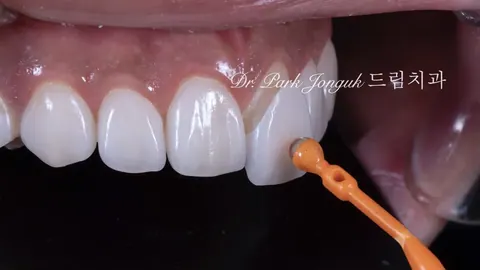
[Photo 1] Before treatment — severe white spots
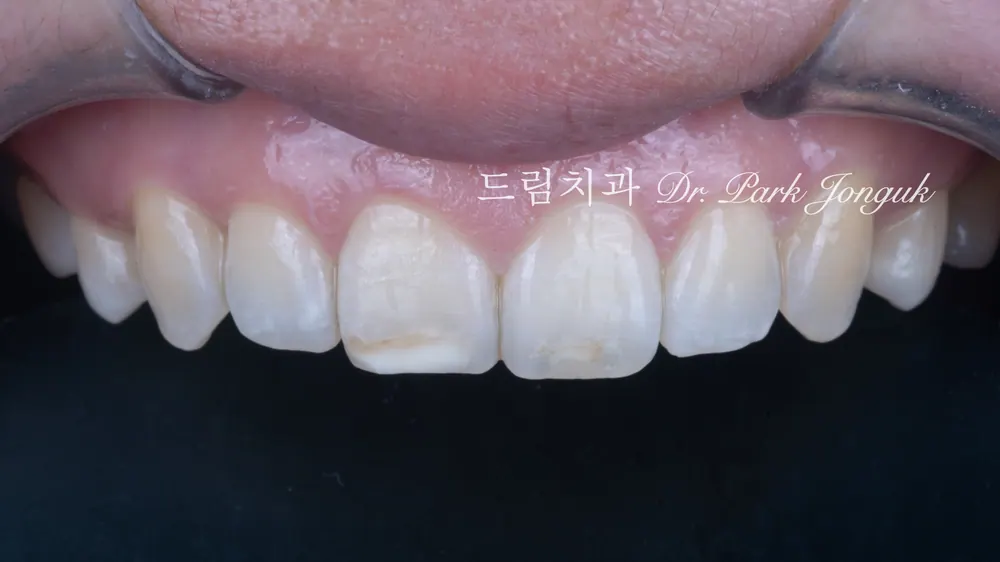
A horizontally stretched white patch stands out on the two central incisors.
White spots occur due to enamel formation defects or problems during the tooth's developmental stage,
and when they are this extensive and dense, resin treatment clearly has its limits, and whitening won't solve it either.
[Photo 2] The digital precision diagnostic process
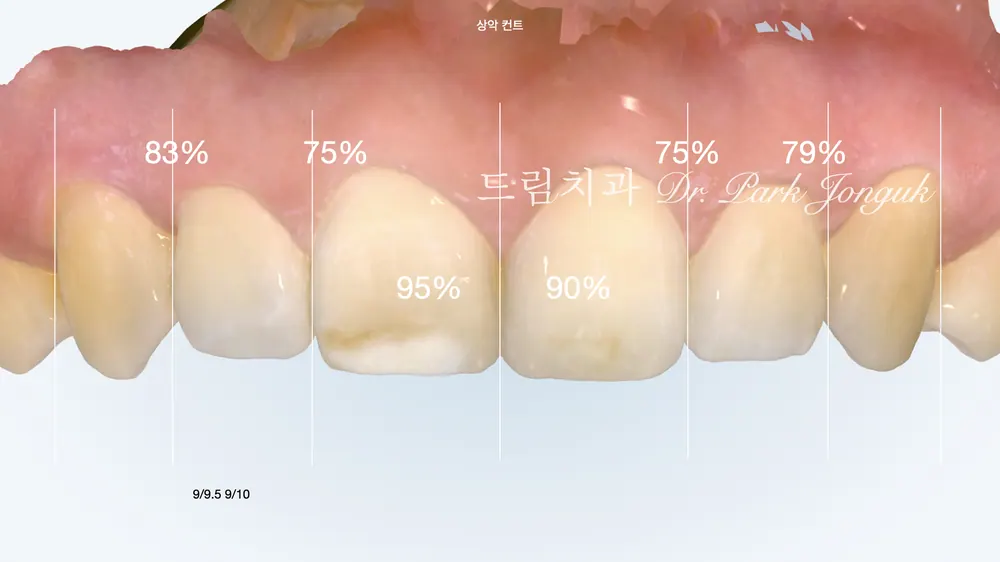
To do no-prep when the teeth aren't small,
a precise analysis that allows no margin of error greater than 0.1mm must come first.
Every diagnosis starts with facial analysis.
We calculate the limit within which the teeth can move, taking into account the patient's facial midline,
the lip line when smiling, and the harmony of the face as a whole.
Although I can't post all the facial photos here,
we measure not just the simple size of the tooth,
but the tooth's numerical proportions in harmony with the facial structure,
to calculate the optimal thickness that won't cause a bulging feel once the veneer is placed.
3. Simulating the final smile with a digital wax-up
[Photo 3] Digital wax-up (diagnostic wax-up) result
This is the final result, based on the analyzed measurements,
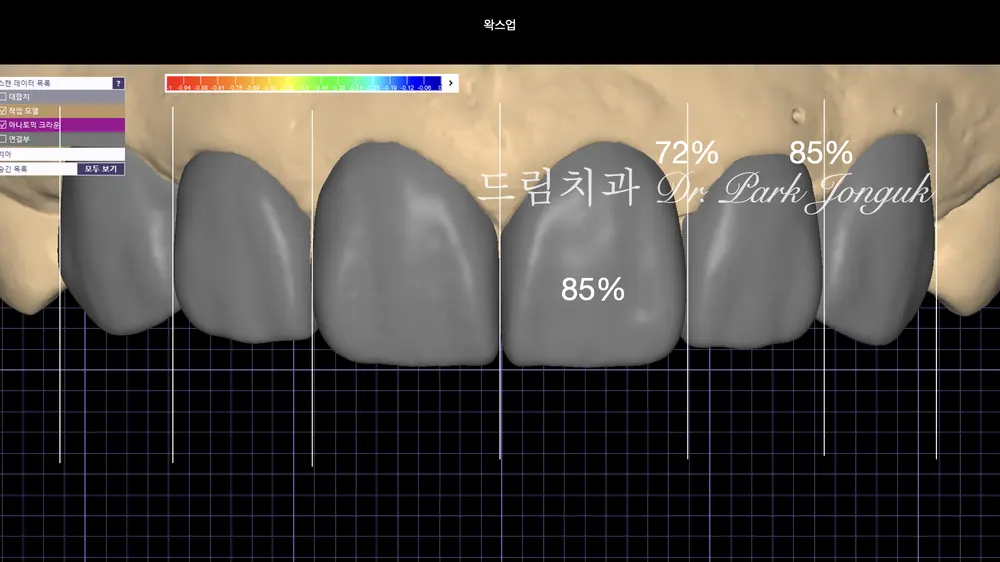
rendered digitally.
Redistributing the volume:
To do no-prep when the teeth aren't small,
the restoration can't simply be made thicker — the tooth's outer contour has to be redesigned.
Visual completeness:
This is the process of designing a thin, precise layer
that fully blocks the white spots while remaining indistinguishable from a natural tooth.
4. The near-miraculous change created by handmade build-up
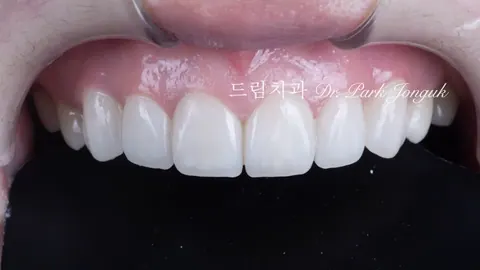
[Photos 4, 5, 6, 7] After treatment
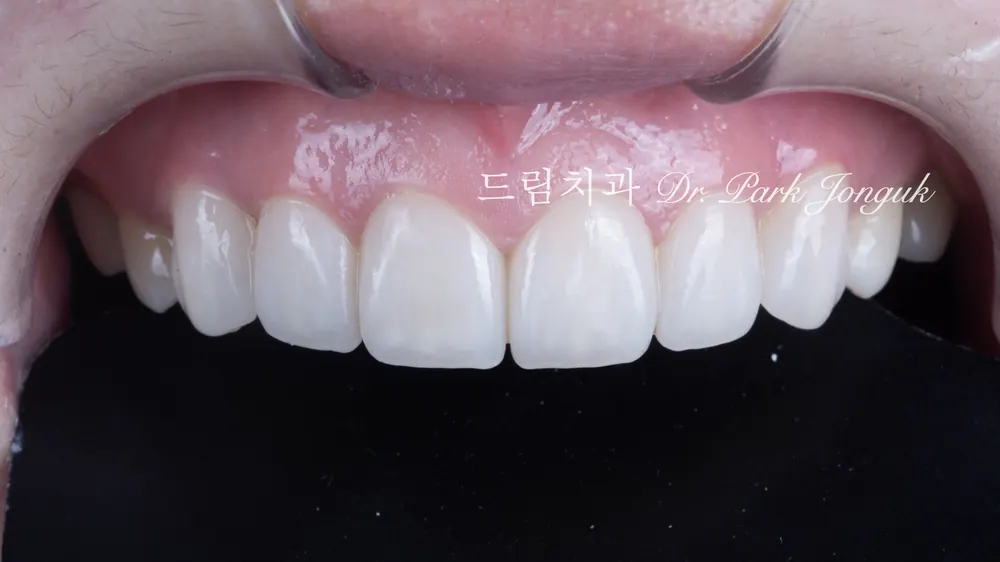
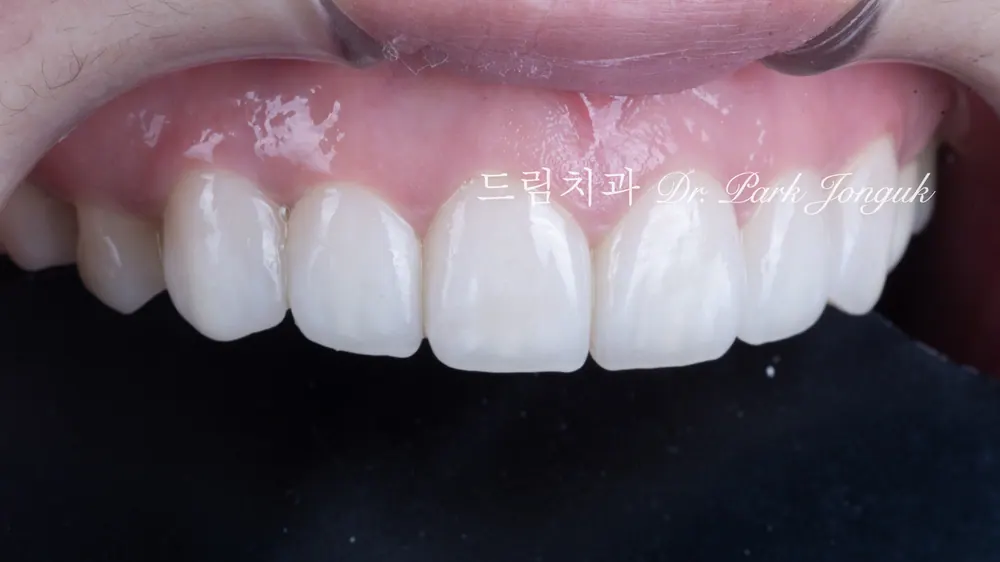
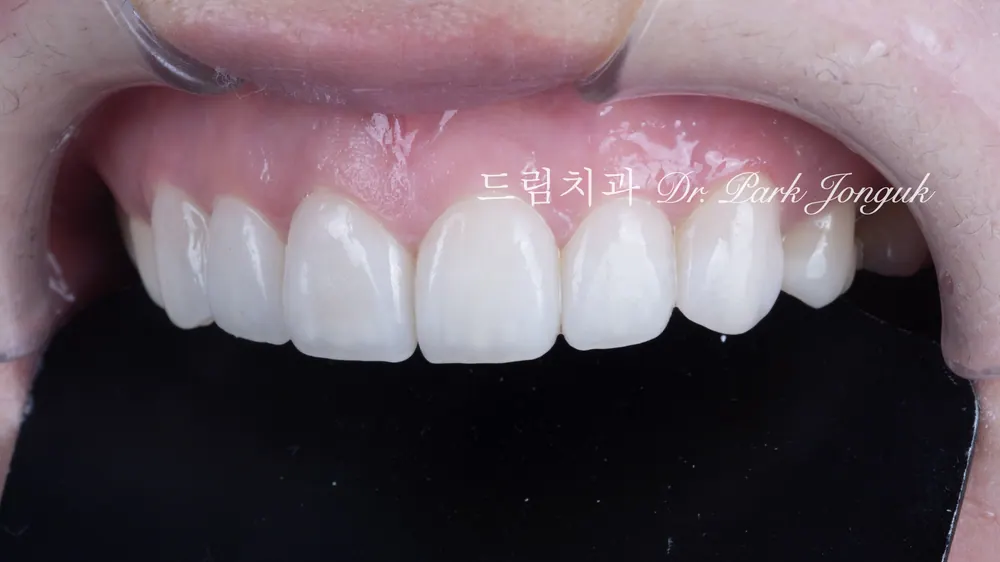
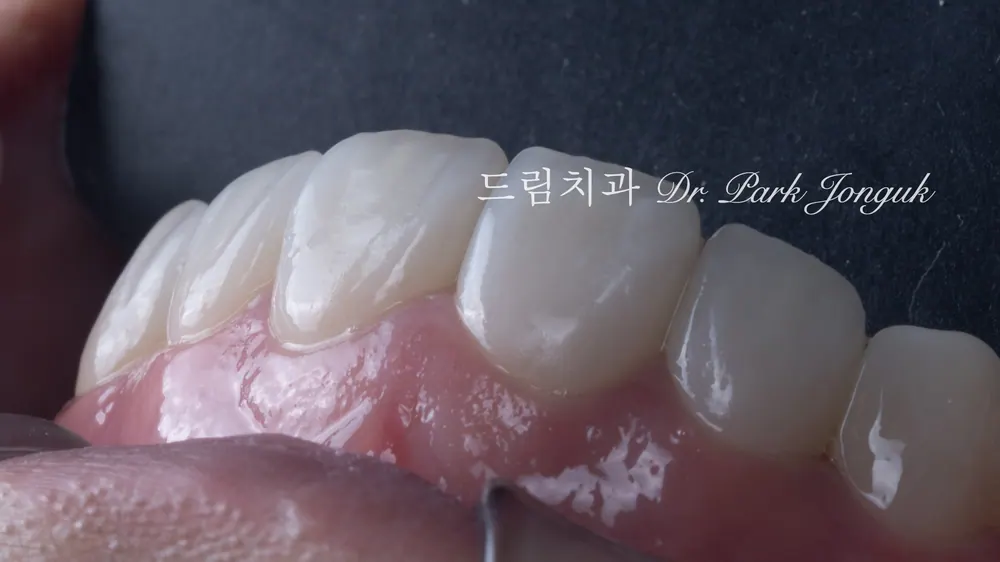
This is the appearance once the procedure was completed.
Even though the tooth wasn't reduced at all,
the result is remarkably natural and beautiful.
Complete coverage: the once-severe white spots have vanished without a trace.
A bright, open impression: rather than looking artificially painted white, it retains a translucency as if light were glowing from within.
A finish free of bulging: even though the teeth weren't small, thanks to the precise design, there's no sense of the lips looking pushed out or the teeth looking bulky at all.
This result was possible not through a machine-milled approach,
but because a skilled technician hand-stacked the powder layer by layer, using the handmade build-up method.
Looking at the clear translucency at the tip of the tooth shows why we insist on doing this by hand.
Conclusion: with precise diagnosis, the scope of no-prep expands
This case breaks the common assumption that "no-prep is only possible when the teeth are small."
If a doctor can accurately analyze and design the esthetic relationship running from the face all the way to the teeth,
it's possible to achieve the best esthetic result while maximizing preservation of the tooth.
With our 20th anniversary coming up next year, I will keep striving
to find the most beautiful smile for you without cutting your precious natural teeth.
Q&A on no-prep veneers
Q1. What's the difference between treating white spots with resin versus veneers?
Resin can discolor over time, and its border can become visible.
Especially when the spot covers a wide area, resin struggles to reproduce a natural translucency.
Veneers don't carry the risk of discoloration, and can evenly match the color tone and translucency across the whole tooth, making them far more esthetic and permanent.
Q2. If the teeth aren't small, won't no-prep make the mouth look like it's sticking out?
That's exactly where the doctor's skill comes in.
Through facial analysis, within the thickness the lips can accommodate,
by making very fine adjustments to the outer contour of the restoration,
even if the actual thickness is a bit greater, visually
a natural shape can be achieved without any sense of bulging.
Q3. Do no-prep veneers require any special care?
It's the same as caring for natural teeth.
That said, since they're bonded without any reduction, careful brushing and flossing are important
to prevent food from getting caught at the border between the tooth and the restoration.
With regular checkups to monitor the bonding condition, they can be used semi-permanently.
This article is a clinical note written by Dr. Park Jonguk of Dream Dental Clinic, Gangnam; the original was published on his blog. The photographs shown are real cases he treated. Results vary with each patient’s condition, and every procedure carries the possibility of individual variation and side effects.
Quick Consult
Request a Callback
Leave your number and we will call you back during clinic hours.
Request Received
We will contact you during clinic hours. For urgent matters, please call +82-2-3448-0028.