
Gapped Teeth + Gum Inflammation: Are Veneers Possible? | A Treatment Case Perfectly Maintained Two Years Later
Patients who once had their gapped teeth filled with resin — teeth that gapped again, with severe gum inflammation —
through veneers for gapped teeth, veneers for gum inflammation,
here's how they achieved a healthy, natural result, shown all the way through a 2-year follow-up.
This real case illustrates the importance of gum care before veneers and the principle of minimal reduction.
The teeth had gaps that were filled with resin,
"but they gapped again, and the gums swelled, became sensitive, and even started to smell" —
I really do see a lot of people struggling with this problem.
Resin is simple and inexpensive,
but it has many long-term drawbacks when used to fill gapped teeth or interproximal spaces.
The margin lifts easily, plaque collects, and inflammation keeps recurring.
This patient, too, was under a lot of stress for the same reasons,
and as the gaps between the teeth opened up again, the aesthetic problem grew as well,
so she came in for veneer treatment.
But the problem wasn't simply the degree to which the teeth were gapped.
👉 Inflammation across the gums
👉 Excessive tartar
👉 Discolored resin
All three of these were present at once.
Veneers aren't simply a "bonding treatment."
They're a precision cosmetic dental treatment that can only be designed by taking the gums, teeth, occlusion, and hygiene all into account.
In this article,
why gum inflammation makes veneers risky,
the criteria for choosing between no-prep and minimal-reduction veneers,
and why the result could stay stable, free of inflammation, even two years later —
I'll go through these three points in detail.
Main Content
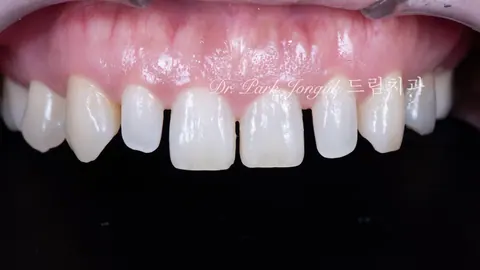
📸 Photo 1 — Before treatment: gapped teeth + severe gum inflammation
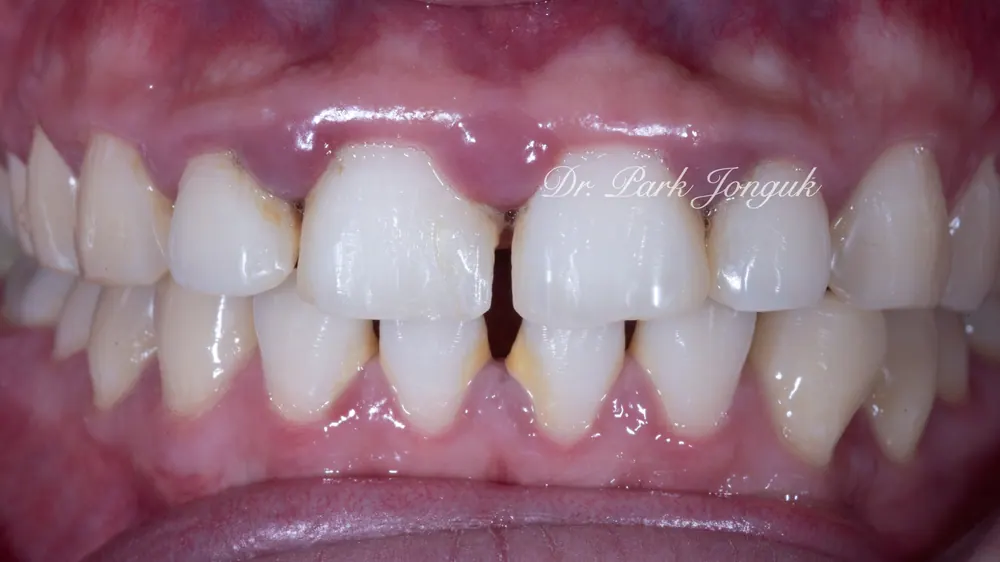
When she first came in, her condition was quite severe.
✔ Gaps had opened up between all the teeth
✔ Resin had been added on, but it was discolored
✔ The gums were red and swollen throughout
✔ There was an excessive amount of plaque and tartar
Even if a patient asks, "Please just do the veneers first" in a case like this,
we absolutely cannot go straight into treatment.
The lifeblood of a veneer is its "margin."
The margin has to be smooth, or inflammation will develop.
If veneers are placed right away while inflammation is present,
the inflammation will come back 100% of the time.
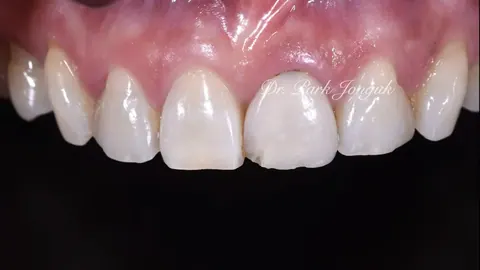
📸 Photo 2 — Discolored resin and an inaccurate margin
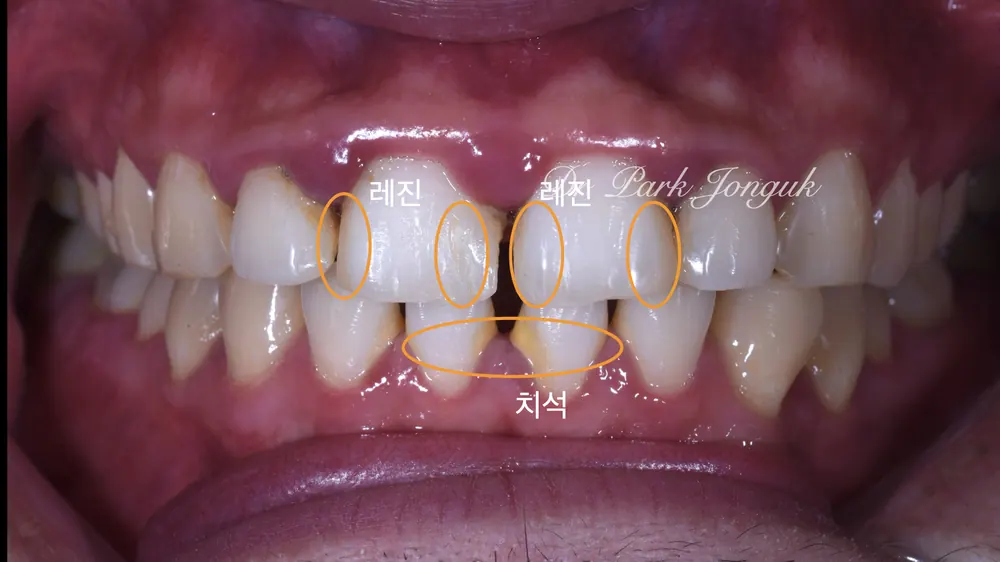
Over time, resin
✔ changes color,
✔ its margin lifts,
✔ tartar builds up along it,
✔ and it becomes a structure that's prone to inflammation.
In this case too, the resin was the main cause aggravating the inflammation.
Before even deciding whether to do veneers,
the priority was removing the resin and restoring the gums to health.
📸 Photo 3 — Two weeks after resin removal and scaling, healthy gums restored
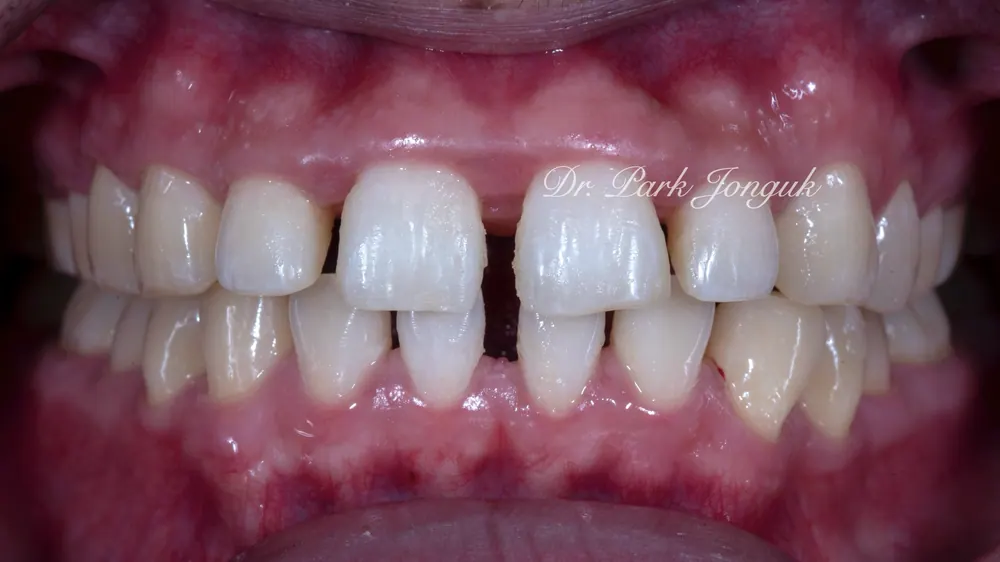
We removed all the resin and performed scaling.
Two weeks later, the gums had surprisingly recovered to a completely healthy state.
This stage is truly important.
Many people ask,
"If my gums are swollen, will they get better once I get veneers?"
and the answer
is an absolute no.
The gums need to be healthy for the veneers to stay healthy over time.
✦ Deciding the treatment direction: orthodontics vs. veneers
Two options remained at this point.
Close the gaps between the teeth with orthodontics,
or resolve the gaps aesthetically with veneers.
Orthodontics was recommended, but the patient said,
"It's just too hard to live with orthodontic appliances in my mouth."
That was her response.
If she were a patient today, I would have recommended Invisalign,
but at the time, Invisalign wasn't yet a widely used option,
so we decided on veneer treatment.
📸 Photos 4-5 — Minimal-reduction veneers on the upper arch
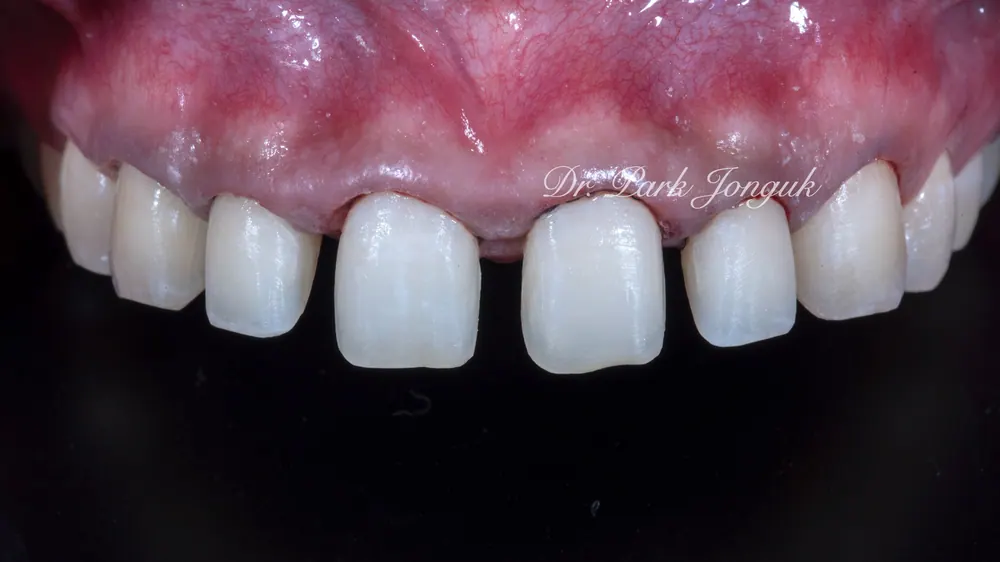
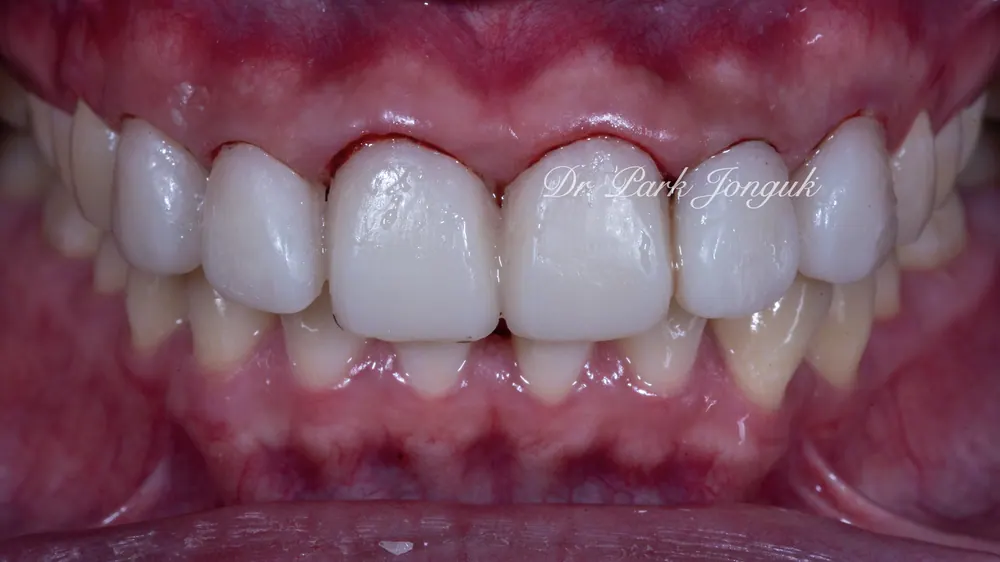
No-prep veneers were also an option,
but because the gaps were wide and the margin would have been difficult to finish cleanly,
going the no-prep route could actually have led to
👉 a risk of the inflammation returning,
👉 a rough margin,
👉 and lower long-term stability.
Since these problems could arise,
we performed minimal reduction, only where needed.
The amount reduced is at a level that has no effect at all on daily life,
and even if the veneers were removed later, there would be no problem with tooth function.
📸 Photos 6-7 — The temporary-teeth stage after reduction on the lower arch
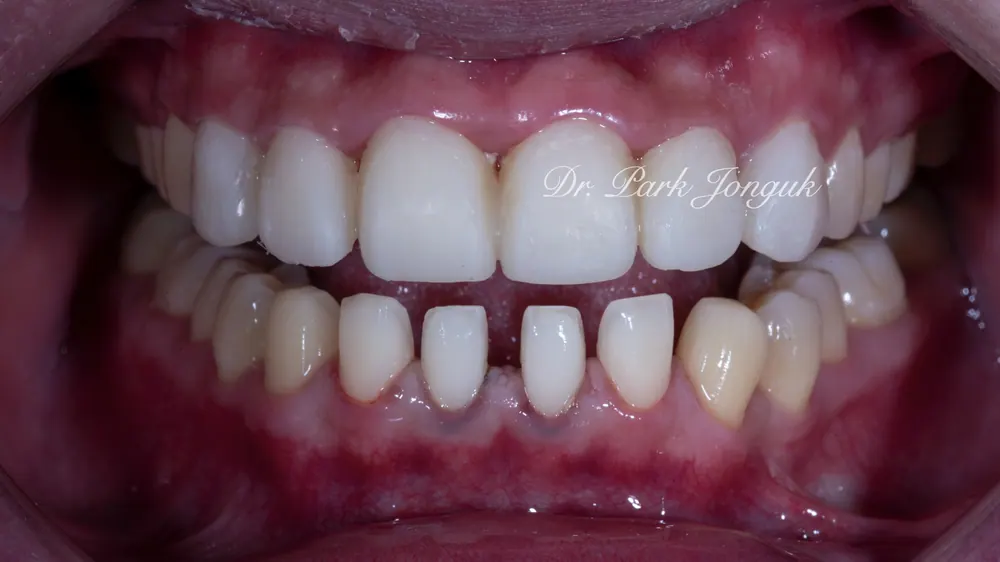
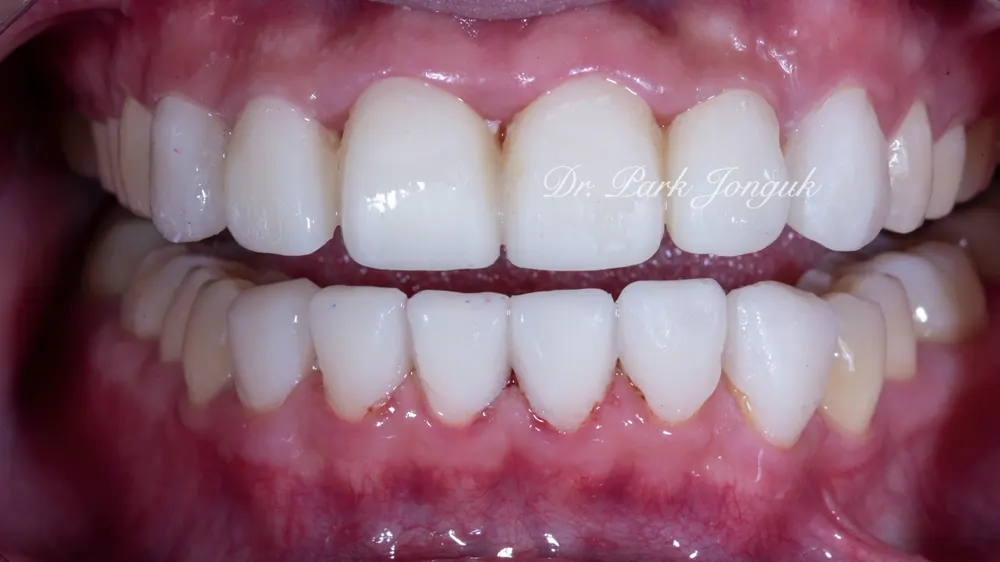
The lower teeth were treated the same way,
and through the temporary teeth,
✔ shape,
✔ length,
✔ symmetry,
✔ and the gum's response
were all thoroughly checked.
In veneer treatment, the temporary-teeth stage
is a very important process for previewing the final result in advance.
📸 Photo 8 — The finished veneers
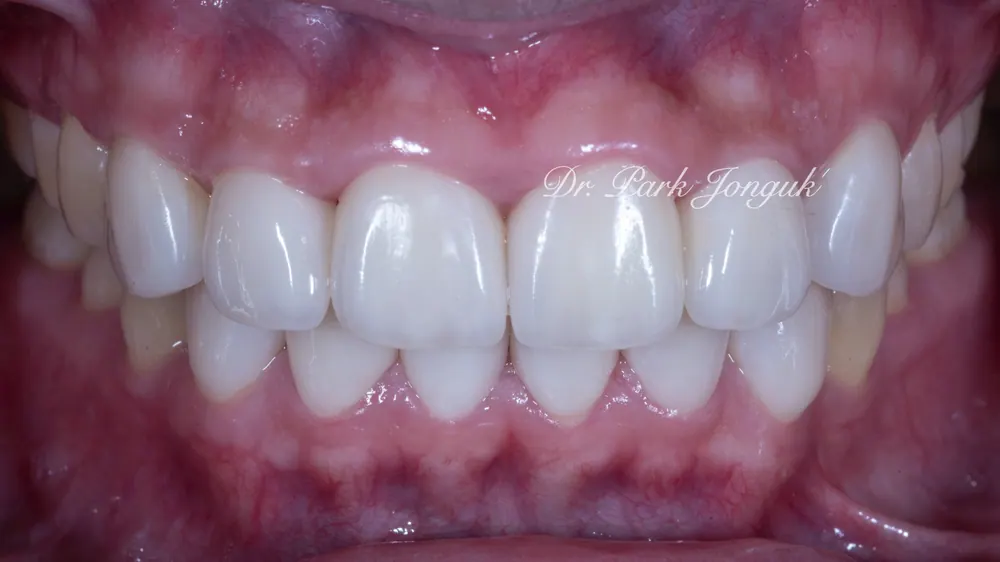
Both the upper and lower arches
✔ a natural brightness,
✔ a healthy margin,
✔ stable harmony with the gums,
✔ and a balanced shape
were achieved.
But the real key to this case isn't
the result "right after treatment" — it's the long-term result.
📸 Photos 9-10-11 — Two years later, the gums remain in a completely healthy state
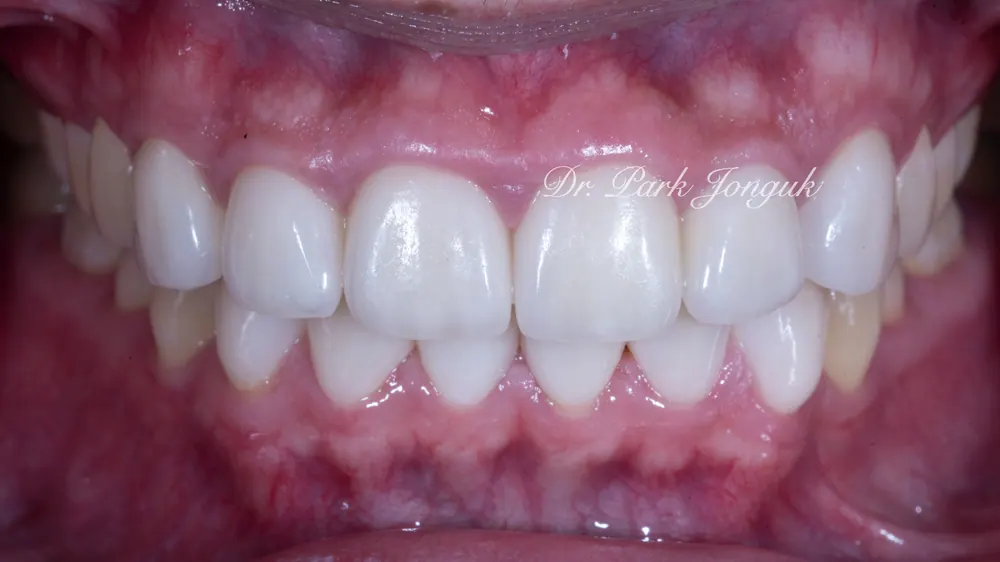
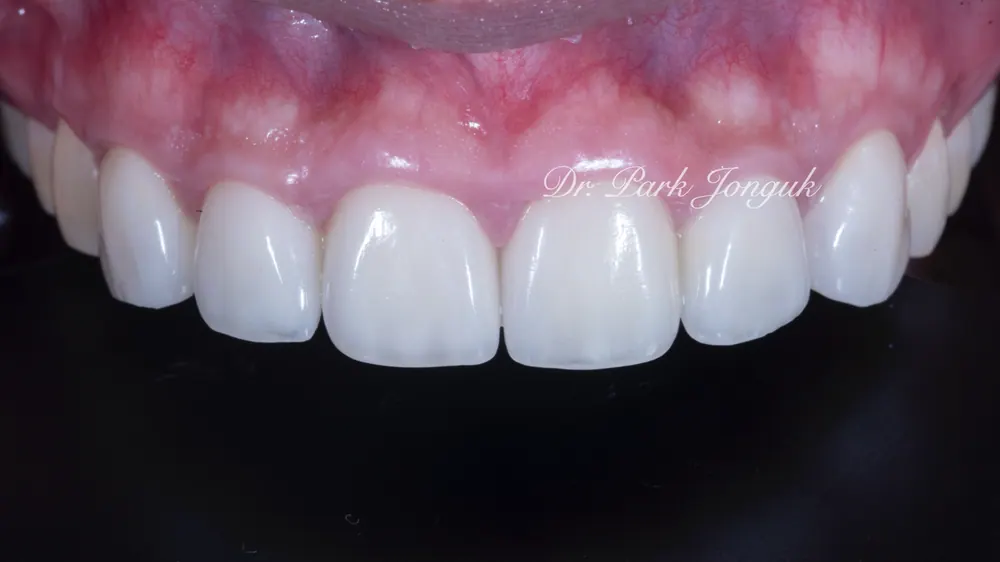
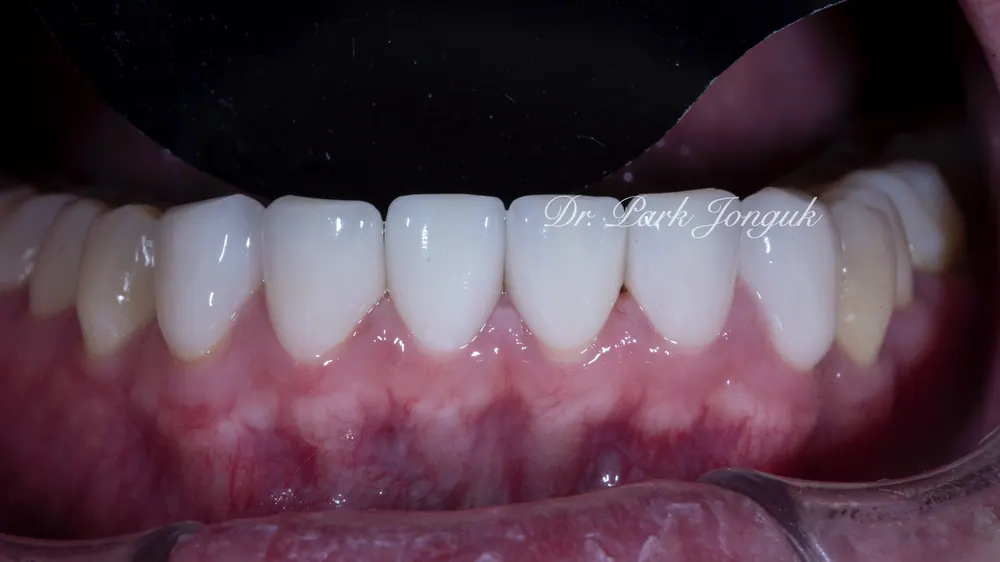
When she came in two years later,
her gums were genuinely, remarkably healthy.
✔ No inflammation
✔ No swelling either
✔ Stable margins
✔ Almost no tartar
✔ The space between the teeth was well maintained
✔ The veneers' color and translucency were unchanged
This is a level of long-term stability that resin could never achieve.
Conclusion
A case with both gapped teeth and gum inflammation together
isn't one where veneers can be decided on lightly.
But when the following three things are done well,
a truly stable, natural result can be achieved.
Starting treatment only after the inflammation has fully resolved.
Applying the principle of "minimal reduction where needed," rather than no-prep.
An accurate diagnosis and a carefully crafted fabrication process.
For anyone struggling to decide
between resin and veneers when their teeth are gapped,
I hope this case serves as a helpful reference.
Just like with this patient, even after two years,
veneers that keep the gums healthy —
this is the long-term, healthy cosmetic dentistry that Dream Dental Clinic strives for.
Q & A
Q1. Can gapped teeth be treated with no-prep veneers?
It's possible in some cases,
but considering issues with inflammation, margins, and shape, many cases require minimal reduction.
Q2. What's the biggest difference between filling with resin and veneers?
Resin is prone to repeated discoloration, gaps, and inflammation,
while veneers, being ceramic, don't discolor, and their smooth margins reduce gum inflammation.
Q3. Can veneers be done even if the gums are swollen?
Absolutely not.
It's only possible after the inflammation has completely subsided.
Q4. Is aftercare important following veneer treatment?
With good scaling and brushing, the result stays very stable.
Q5. I'm worried about tooth reduction. Is a lot cut away?
As in this case, only the minimum necessary amount is reduced, and only where needed.
It has no effect on daily life at all.
Q6. How many veneers do you need for a natural look?
It's decided by considering the shape, color, symmetry, and so on, of the teeth,
and it's not necessarily true that more teeth need to be done to look natural.
This article is a clinical note written by Dr. Park Jonguk of Dream Dental Clinic, Gangnam; the original was published on his blog. The photographs shown are real cases he treated. Results vary with each patient’s condition, and every procedure carries the possibility of individual variation and side effects.
Quick Consult
Request a Callback
Leave your number and we will call you back during clinic hours.
Request Received
We will contact you during clinic hours. For urgent matters, please call +82-2-3448-0028.