
Front Tooth All-Ceramic Crown Retreatment: Solving Discoloration and Gum Exposure
Hello, I am Park Jonguk, director of Dream Dental Clinic, who has practiced aesthetic dentistry in Apgujeong for 20 years.
Today I'd like to introduce a case where front tooth all-ceramic crown discoloration and gum exposure
were resolved through an all-ceramic crown retreatment.
I hope it helps those of you troubled by front tooth or crown discoloration.
The right front tooth crown is dark and gray
This patient came in with an all-ceramic crown on the right front tooth.
The problem was that this crown felt dark and gray compared to the other teeth.
The surrounding natural teeth are a bright color, while only the crown is unusually dark and dull.
It has a grayish tone, making it look almost like a dead tooth.
On top of that, as the gums receded, the tooth near the gum began to show.
The tooth color shows through below the gumline, making the border noticeable.
The patient said, "This tooth stands out every time I smile, and it stresses me out," and came in wanting to redo the all-ceramic crown on that one tooth.
Before treatment, the problem is clear
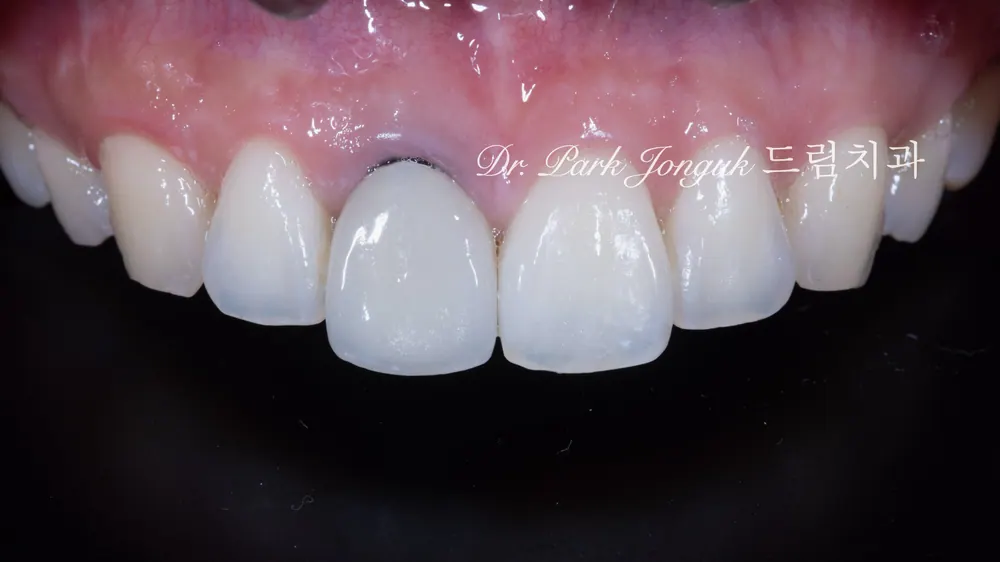
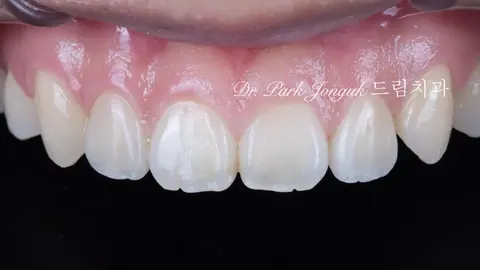
Photo 1 is from the first visit.
The all-ceramic crown on the right central incisor is noticeably different from the surrounding natural teeth.
Dark, grayish color
The crown's color is dark.
The surrounding teeth are a bright ivory color, while only the crown is dark and dull.
It has a grayish tone that makes it look lifeless.
It looks almost like a root-canal-treated tooth that has discolored.
Gum recession and tooth exposure
As the gums receded, the tooth beneath the crown began to show.
A dark tooth color shows through below the gumline.
The border between the crown and the tooth is noticeable.
This makes it look even more awkward and artificial.
Removing the crown, an unfortunate discovery
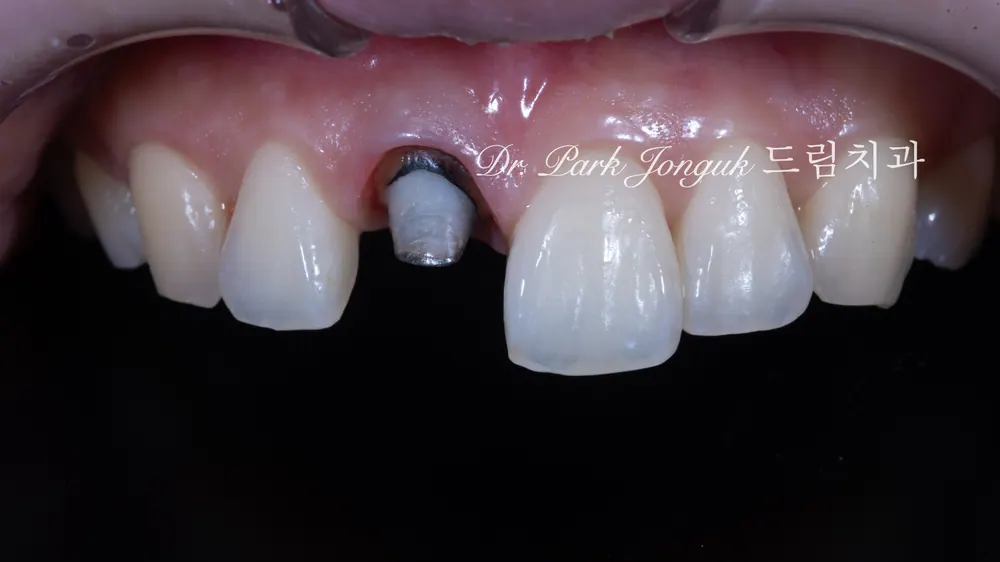
Photo 2 shows the state after the crown was removed.
We carefully removed the existing crown.
And there was an unfortunate discovery.
A tooth with a post inside
It turned out to be a tooth with a post placed inside.
After root canal treatment, a post (metal post) had been inserted inside the tooth.
Because of this post, the tooth had discolored to a dark shade.
The tooth discoloration can't be resolved
Unfortunately, the darkness of the tooth itself cannot be resolved.
A tooth with a post inside doesn't brighten with regular whitening.
This is because the post inside the tooth and the discoloration itself are the issue.
It's truly a shame.
But we can completely hide this dark tooth with a new crown.
Blocking the color with a zirconia crown
To hide a tooth discolored by a post, a zirconia crown is needed.
Zirconia has high opacity, so it effectively blocks the dark color of the underlying tooth.
The base cap try-in process
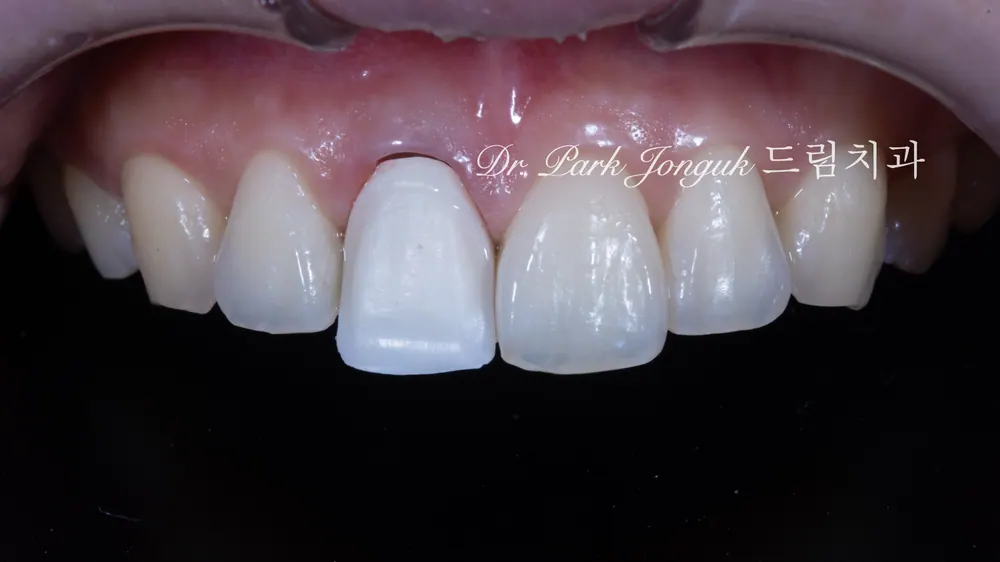
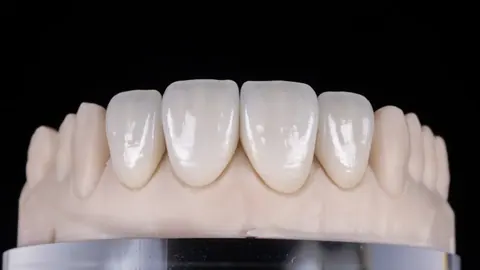
Photo 3 shows the intermediate process of trying in the base cap for the zirconia crown fabrication.
We first make a zirconia base cap and place it on the tooth.
In this process, we check two things.
First, we check whether the tooth color is effectively blocked.
We check whether the base cap properly hides the dark tooth color.
If any color shows through, we adjust the base to be more opaque.
Second, we check whether it fits the tooth well.
We check whether the cap fits the tooth precisely, and whether the margin matches the gumline well.
On top of this base cap, an aesthetic porcelain layer is applied to complete the final crown.
Final check before setting
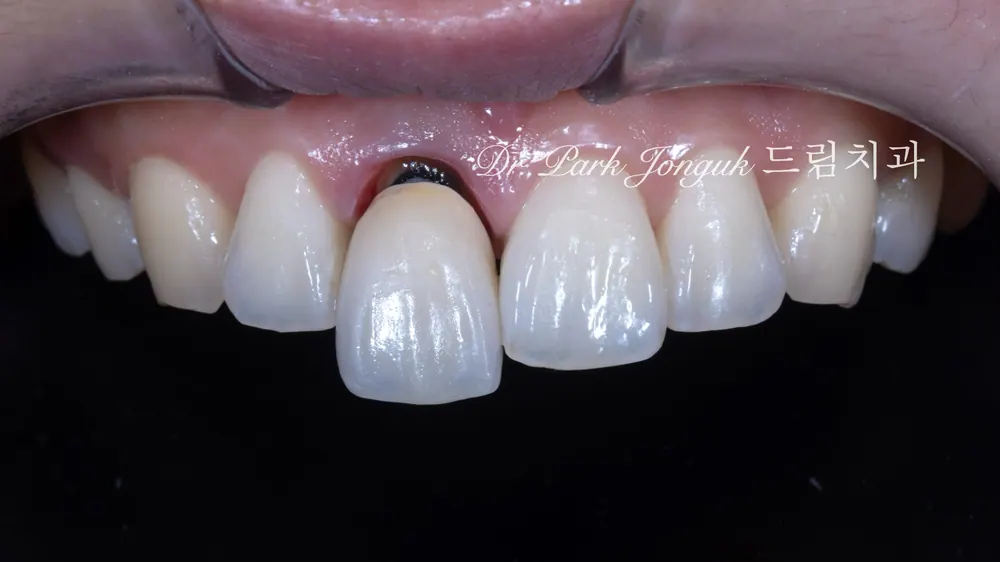
Photo 4 shows the crown lightly placed on before setting.
This is the final check before the completed all-ceramic crown is bonded.
We check whether the color harmonizes well with the surrounding natural teeth.
We check whether the shape is natural and appropriate.
We check whether the margin matches the gumline precisely.
The patient also looked in the mirror and was satisfied, saying "the color really looks natural."
Once everything is confirmed to be perfect, the final bonding proceeds.
Treatment complete, perfect harmony
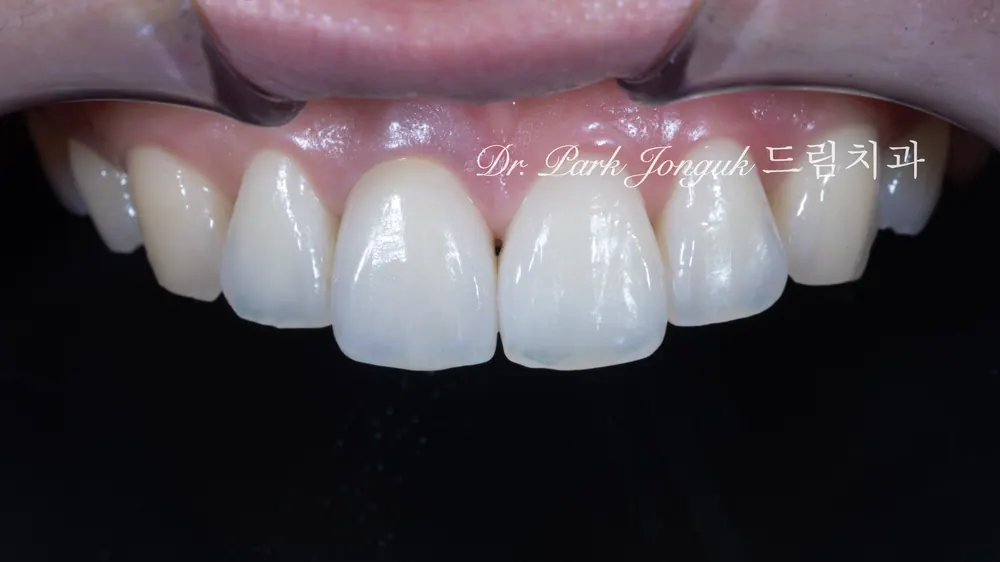
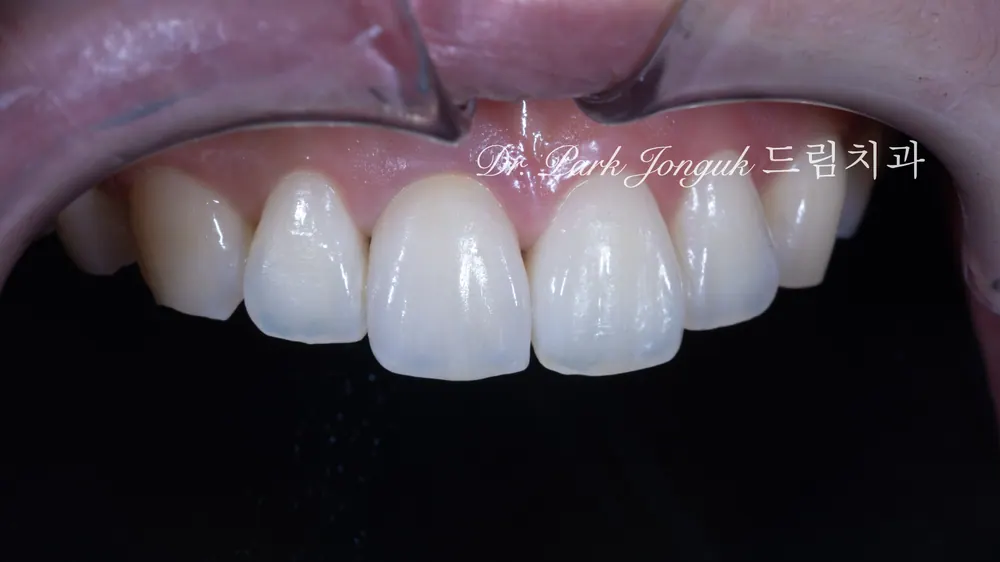
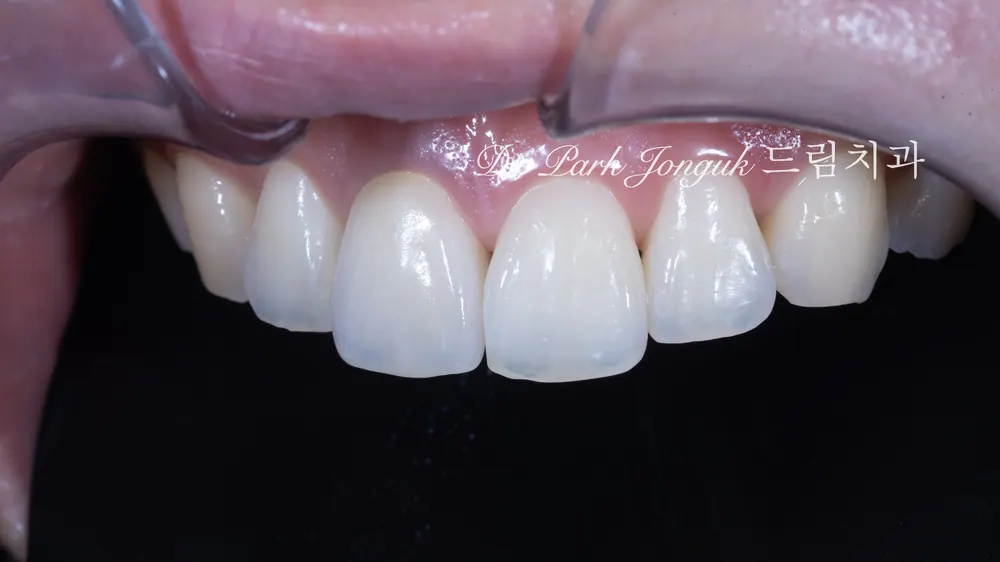
Photos 5, 6, and 7 show the state after treatment was completed.
It's a truly remarkable change.
Natural color
The crown that had been dark and grayish changed into a bright, natural color.
It harmonizes extremely well with the other natural teeth.
The color matches the surrounding teeth perfectly.
You can't tell at all which one is the crown.
Translucency at the tooth edge
The new crown also reproduced translucency at the tooth edge.
Like a natural tooth, the tip is slightly translucent.
It gives a natural feel as light passes through.
Perfect harmony with the gumline
The border between the gumline and the crown matches perfectly.
The dark tooth no longer shows through.
The gum area also looks natural and clean.
Dimension and shape
The new crown has subtle contours and characteristics on its surface.
It's not flat — it has three-dimensionality.
The developmental lobes and surface texture of a natural tooth were reproduced.
Before-and-after comparison, a dramatic difference
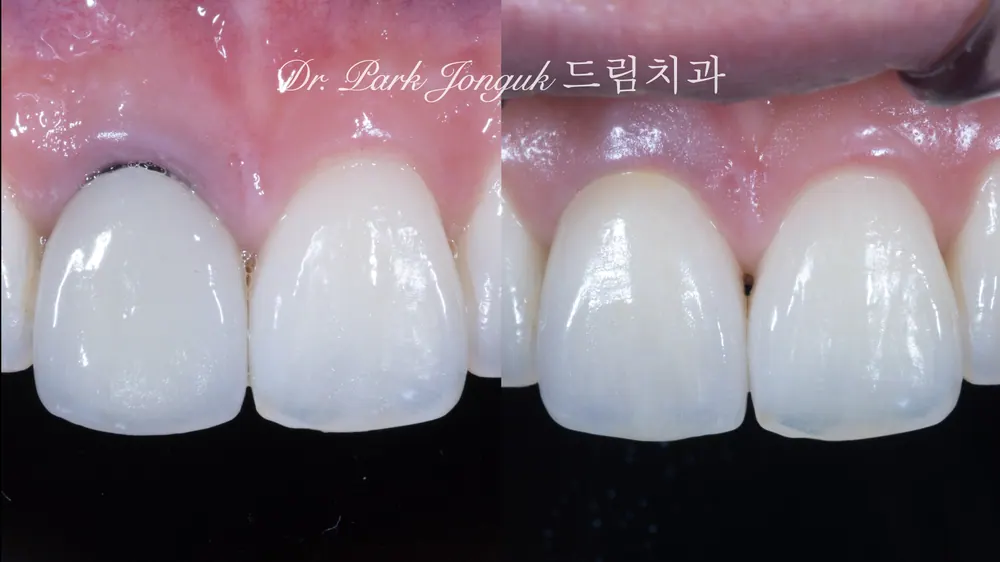
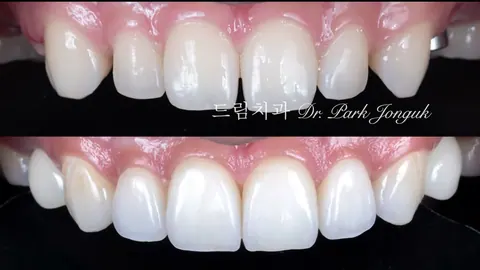
Photo 8 is a before-and-after comparison.
The difference is truly dramatic.
Before treatment, the dark, grayish crown stood out sharply.
As the gums receded, the dark tooth had been exposed.
It didn't harmonize at all with the surrounding natural teeth.
After treatment, it changed into a bright, natural-looking crown.
It harmonizes perfectly with the surrounding teeth.
You can't tell at all which one is the crown.
The gumline is clean and natural as well.
The patient was genuinely delighted, saying, "I'm satisfied every time I look in the mirror. Now I can smile with confidence."
Why does all-ceramic crown discoloration happen?
There are several causes for crown discoloration or front tooth discoloration issues.
Discoloration of the tooth itself
A root-canal-treated tooth discolors over time.
A tooth with a post inside darkens even more.
When this dark color shows through the crown, the crown looks dark.
Issues with the crown material
A crown with high translucency lets the underlying tooth color show through.
Using a translucent crown on a discolored tooth makes it look dark.
Gum recession
Gums can recede over time.
As the gums recede, the tooth or metal inside the crown becomes exposed.
This becomes a cause of the dark appearance.
Improper crown design
If the crown's opacity isn't sufficient, the discoloration isn't blocked.
If the color selection is wrong, it doesn't match the surrounding teeth.
It's fine to retreat just one tooth
"Won't the color be off if I only redo one tooth?"
Even retreating the all-ceramic crown of just one tooth, as in this case, can be made to look perfectly natural.
With precise color analysis and skilled technique, even a single tooth can be matched perfectly with the surrounding teeth.
Of course, if the other teeth are also unsatisfactory in color or shape, treating them together creates a better result.
But if only one tooth is the problem, retreating just that tooth alone can achieve a sufficiently natural result.
Frequently Asked Questions (Q&A)
Q1. Can a discolored tooth with a post inside still be made to look bright?
A. Yes, it's possible. The tooth itself can't be whitened, but
by blocking the dark color with a zirconia base
and applying a bright porcelain layer on top, it can be made perfectly bright and natural.
Q2. If the gums recede, won't the tooth become visible again?
A. By setting the crown margin position appropriately,
and managing gum health well, there's no problem.
Regular scaling and proper brushing are important.
Q3. If I retreat only one tooth, won't the color be off?
A. With precise color analysis and skilled technique,
even a single tooth can be matched perfectly.
As in this case, it can be made completely indistinguishable from the surrounding teeth.
This article is based on the actual clinical experience of a dentist who has practiced aesthetic dentistry in Apgujeong for 20 years. He lectures monthly at Lamista Academy to dentists on all-ceramic crown techniques, and has published Korea's first veneer textbook.
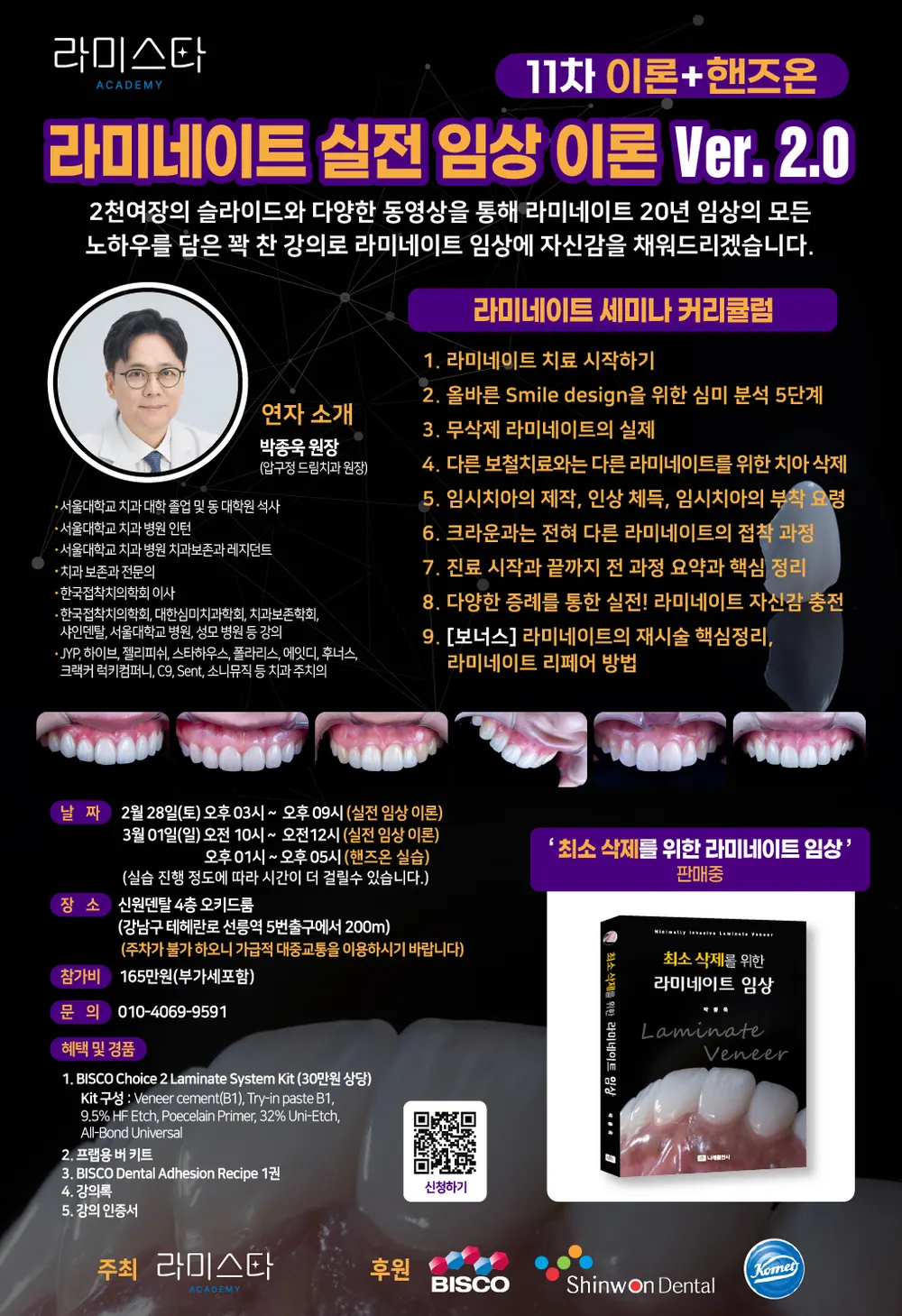
This article is a clinical note written by Dr. Park Jonguk of Dream Dental Clinic, Gangnam; the original was published on his blog. The photographs shown are real cases he treated. Results vary with each patient’s condition, and every procedure carries the possibility of individual variation and side effects.
Quick Consult
Request a Callback
Leave your number and we will call you back during clinic hours.
Request Received
We will contact you during clinic hours. For urgent matters, please call +82-2-3448-0028.