
All-Ceramic Crown Redo: A Perfect Transformation From PFM to Natural Teeth
Hello, I am Park Jonguk, director of Dream Dental Clinic, who has practiced aesthetic dentistry in Apgujeong for 20 years.
Today I'd like to introduce a special all-ceramic crown redo case.
This case was selected as "Masterpiece of the Month" by QDT (Quintessence of Dental Technology),
a renowned dental-technology journal in Japan.
It's dental treatment that could be called close to art.
A woman in her 30s and her struggle with old PFM crowns
This patient was a woman in her 30s,
who came in with crown treatment on four front teeth done a long time ago.
Because the treatment was done so long ago, they weren't all-ceramic crowns
but PFM (Porcelain Fused to Metal) crowns.
The patient earnestly requested, "I want it redone naturally,"
and "I want it to look like natural teeth to anyone who sees it."
She said that every time she looked in the mirror, and every time she talked with people,
she was self-conscious about her front teeth, causing her great stress.
What's the difference between PFM and an all-ceramic crown?
Many people aren't very clear on the difference between PFM and an all-ceramic crown.
Let me explain briefly.
PFM (Porcelain Fused to Metal) has a metal frame on the inside,
with porcelain (ceramic) covering it on top.
In the past it was widely used because of its good strength, but it has several critical drawbacks.
First, there's no translucency.
Because of the metal inside, light can't pass through, so there's no translucent feel like a natural tooth at all.
As a result, it looks stiff and artificial.
Second, there's the problem of gum discoloration.
Over time, metal ions can deposit in the gums, causing them to discolor to a dark bluish tone.
Third, the gumline looks dark.
If the gums recede even slightly, the metal frame becomes visible as a dark line.
Fourth, there are limits to color reproduction.
Because the metal frame has to be hidden, a thick layer of opaque porcelain must be used,
which makes it difficult to express natural color variation.
An all-ceramic crown, on the other hand, is made entirely of ceramic with no metal at all.
This gives it several advantages.
First, it has translucency just like a natural tooth.
As light passes through the crown, it transmits and reflects softly, just like a natural tooth.
Second, it's good for gum health.
With no metal, there's no worry about gum discoloration or allergic reactions.
Third, its aesthetics are far superior.
It can express a natural color gradient from the gum area to the incisal edge,
and it can reproduce translucency and three-dimensionality as well.
Fourth, its biocompatibility is excellent.
Ceramic is one of the safest materials for the human body.
For these reasons, PFM is barely used anymore these days,
and the all-ceramic crown has become the standard.
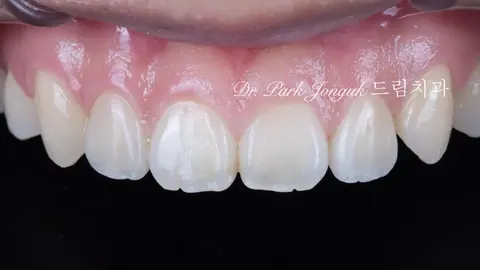
Before treatment, awkward-looking PFM crowns
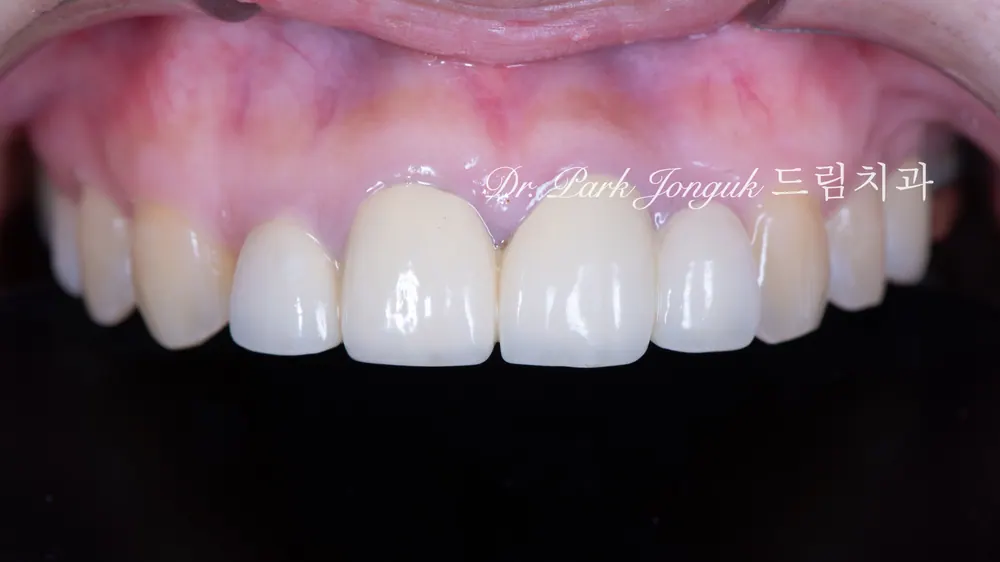
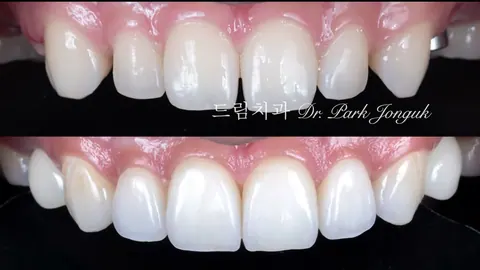
Photo 1 shows the state before treatment. The awkward PFM crowns are immediately visible.
The color is dull and opaque. Natural teeth have life to them as light passes through,
but the PFM looks stiff and lifeless, almost as if painted white.
The area around the gumline is a problem too.
As time passed, the gums receded slightly,
and the metal frame is faintly visible as a dark line.
This is one of the biggest problems with PFM.
The shape is unnatural too.
It's flat with no three-dimensionality, giving a doll's-teeth kind of feel.
Thinking that the patient had lived with this for more than 10 years was truly heartbreaking.
Wax-up precision diagnosis, designed for naturalness
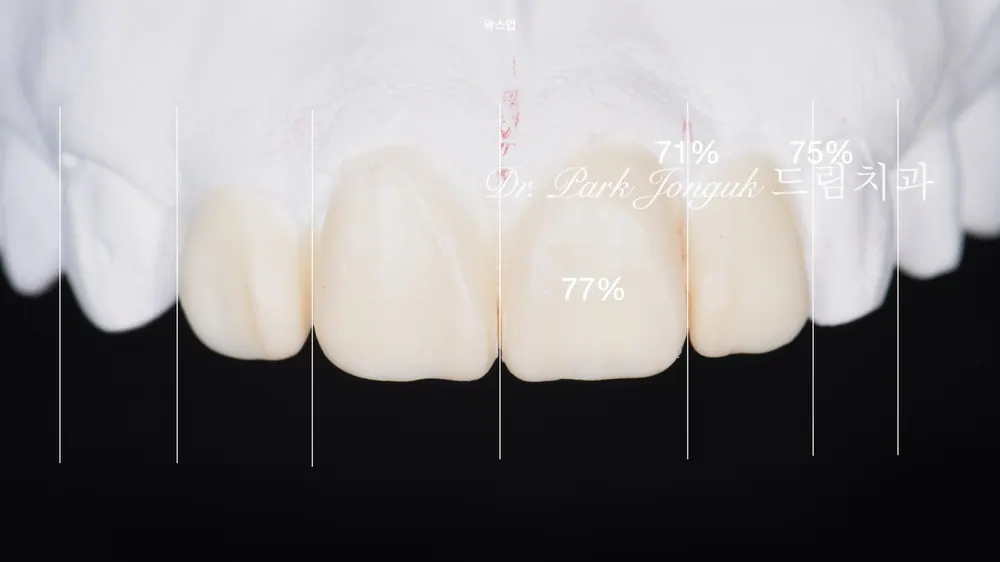
Photo 2 shows the wax-up precision diagnosis process.
It's the preparation stage for natural-looking treatment, and the most important step.
We analyzed the patient's facial shape, lip line, and smile curve.
We designed a tooth size and shape suited to a woman in her 30s.
Too large looks masculine, too small looks childish, so finding the right balance was important.
What we paid particular attention to was natural imperfection.
Natural teeth aren't perfectly symmetrical — they have slight irregularities.
We reflected these subtle characteristics in the wax-up.
Upon seeing the wax-up model, the patient expressed her anticipation, saying "this really does look like natural teeth."
Fabricating the all-ceramic crown — build-up is the key
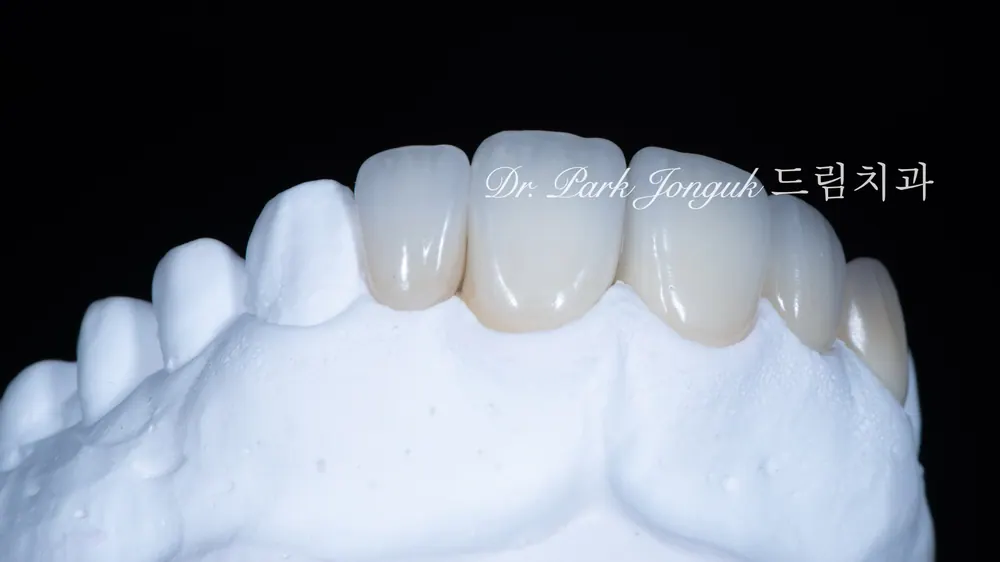
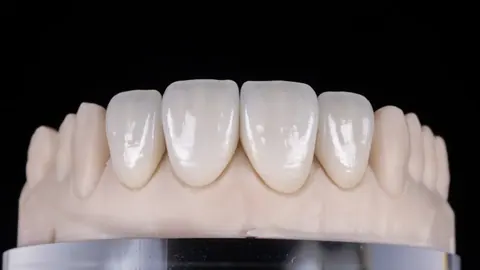
Photo 3 shows the fabricated all-ceramic crown.
Even from this photo alone, the difference from the PFM is clear.
Here I want to mention an important point.
Even an all-ceramic crown needs a build-up process.
Many people think all-ceramic crowns are all the same, but that's not true.
There are broadly two methods of making an all-ceramic crown.
First, the CAD/CAM milling method.
This is a method of milling a single ceramic block by computer.
It's fast and precise, but has limits in expressing natural color variation and translucency.
Second, the hand-layering build-up method.
This is a method where a dental technician stacks several kinds of ceramic powder layer by layer.
It takes a long time and requires skill,
but can perfectly reproduce the complex structure and color of a natural tooth.
This case was of course made using the hand-layering build-up method.
A dentin-colored core was formed on the inside,
an enamel layer was built up on top of it, and a translucent ceramic was applied on the outermost layer.
The gum area was finished in a slightly warm ivory tone, the middle section in a bright color,
and the tooth edge finished with translucent ceramic.
Only with this multi-layer structure does light scatter and reflect softly as it passes through the tooth, just like a natural tooth.
A single block simply bounces light off, which is why it looks stiff and artificial.
A fine surface texture was also given to reproduce the surface characteristics of a natural tooth.
These details all come together to make it look like "real teeth."
After the redo, the birth of a work of art
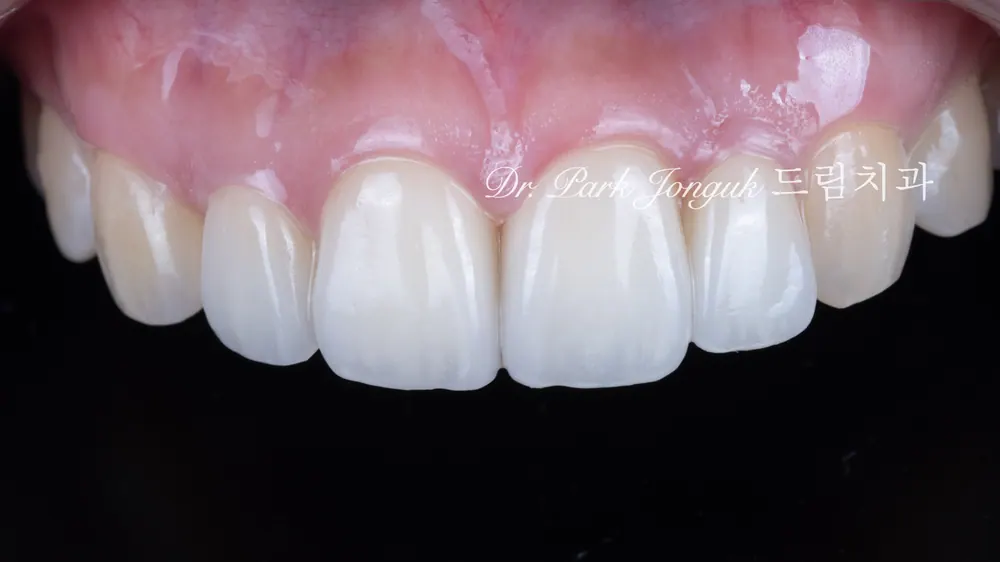
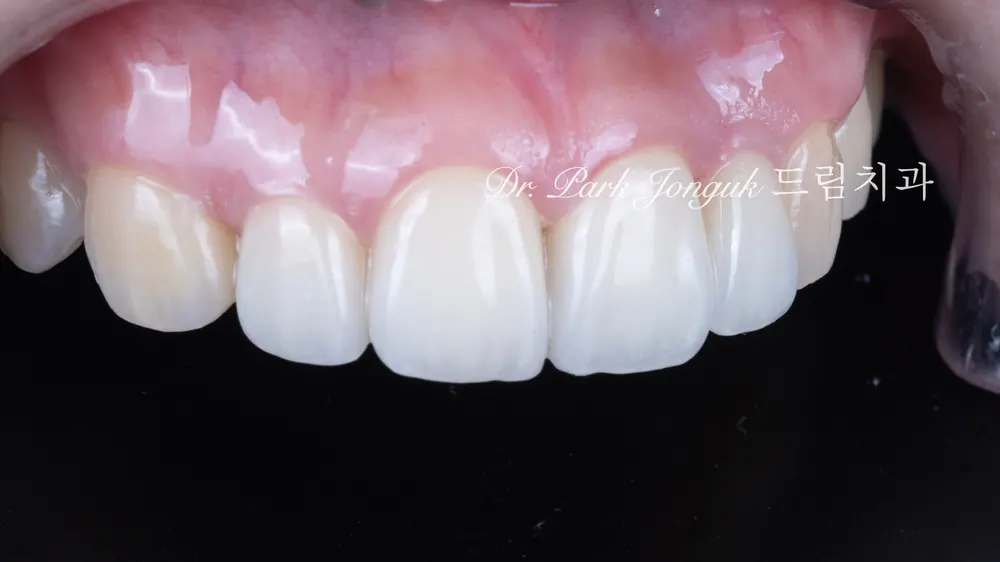
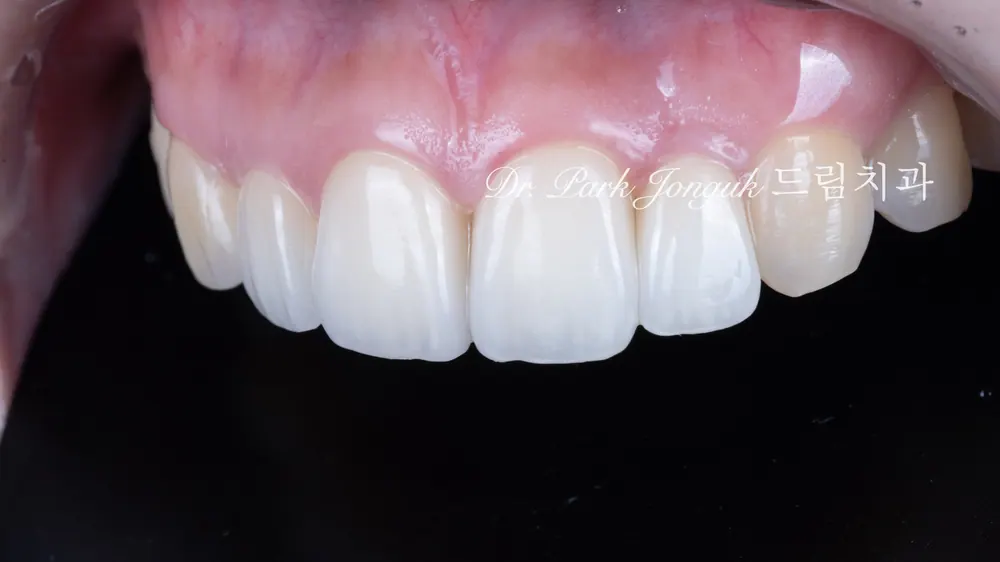
Photos 4, 5, and 6 show the state after the redo. It's remarkably natural.
The dull, opaque color of the PFM disappeared,
replaced by a color so translucent and vibrant it's indistinguishable from natural teeth.
The subtle reflection and transmission created as light passes through the tooth — this is exactly the characteristic of a natural tooth.
There's a natural color gradient from the gum area to the incisal edge.
Not a single flat color, but subtly shifting tones that create a sense of depth.
The shape is perfect too. It's not flat but three-dimensional, and each individual tooth feels dynamic, as if alive.
Even the fine surface texture is exactly like a natural tooth.
The patient looked in the mirror and was left speechless.
After a moment she said, moved, "Is this really my tooth? It really looks like a natural tooth."
QDT's Masterpiece of the Month, recognized as art
This case was selected by QDT (Quintessence of Dental Technology),
a prestigious dental-technology journal in Japan, as "Masterpiece of the Month."
QDT is a globally recognized top journal in the field of dental technology.
Each month, out of countless cases produced worldwide, it selects and introduces just a single outstanding work as its masterpiece.
The reason this case was selected wasn't simply because it was technically flawless,
but because its artistic value was recognized.
Dental treatment can also become art.
Precise diagnosis, perfect design, the skilled hands of a dental technician,
and sincerity toward the patient all come together to create a work of art.
This case also holds a very special meaning for me personally.
It's one of the proudest cases even among my 20 years of clinical career.
All-ceramic crown redo — please remember this
To those of you troubled by old PFM crowns, I want to say this.
First, PFM is now a material of the past.
With the advances in all-ceramic crowns, there is no longer any reason to use metal.
All-ceramic is superior in every respect — aesthetics, biocompatibility, and long-term stability.
Second, the fabrication method matters even for all-ceramic.
Rather than milling a single block, it must be made using the hand-layering build-up method to achieve a natural result.
Third, precision diagnosis is essential.
A satisfactory result requires systematic design through a wax-up.
Fourth, collaboration with a skilled dental technician is important.
The dentist and the technician need to communicate closely and fabricate the crown custom to the patient.
If you're considering a redo, don't be afraid.
A properly done redo can change your life.
Like this patient, you can regain your confidence, smile brightly, take photos, and meet people again.
Frequently Asked Questions (Q&A)
Q1. If PFM crowns are replaced with all-ceramic, does the gum discoloration also recover?
A. Gum discoloration caused by metal ions doesn't disappear immediately just from removing the crown. But it can gradually improve over time. With a new all-ceramic crown, further discoloration is prevented and there is also major aesthetic improvement.
Q2. Is there a big cost difference between the build-up method and the milling method for all-ceramic crowns?
A. The hand-layering build-up method requires more time and skill, so the cost can be higher. But considering the naturalness and long-term satisfaction, it's a worthwhile investment. The exact cost may vary by clinic, so please check through a consultation.
Q3. Will an all-ceramic crown also need to be redone again later?
A. With precise diagnosis and fabrication and proper care, it can be used without problems for more than 10 years, and in many cases more than 20 years. It has better biocompatibility than PFM, so gum health is also better maintained, and the risk of discoloration or fracture is lower. With regular checkups and proper oral care, it can last a long time.
This article is based on the actual clinical experience of a dentist who has practiced aesthetic dentistry in Apgujeong for 20 years. He lectures monthly at Lamista Academy to dentists on all-ceramic crown and veneer techniques, and has published Korea's first veneer textbook. This case was selected as "Masterpiece of the Month" by Japan's QDT journal.
This article is a clinical note written by Dr. Park Jonguk of Dream Dental Clinic, Gangnam; the original was published on his blog. The photographs shown are real cases he treated. Results vary with each patient’s condition, and every procedure carries the possibility of individual variation and side effects.
Quick Consult
Request a Callback
Leave your number and we will call you back during clinic hours.
Request Received
We will contact you during clinic hours. For urgent matters, please call +82-2-3448-0028.