
Resin Discoloration: It's Time to Put an End to It — A Case of Veneer Treatment for Discolored Front-Tooth Resin
You've had resin treatment repeatedly for cavities in your front teeth, but
if it keeps discoloring and you've been troubled by the aesthetics,
veneers are a far more stable and natural answer.
A great many patients with recurring front-tooth cavities struggle specifically with "resin discoloration."
Resin looks nice at first, but over time,
✔ the color turns yellow,
✔ the boundary with the tooth becomes messy, and
✔ it can even lead to a vicious cycle where cavities form more easily.
In particular, for patients who frequently develop cavities between the front teeth,
the amount of tooth reduction increases little by little each time resin is reapplied.
In the end, the tooth ends up moving in the direction of getting smaller and weaker.
This patient's case involved the same concern.
She'd had resin redone 4 to 5 times because of cavities between her front teeth, but it kept discoloring, and
the shape of her teeth didn't suit her face either, so she'd never felt confident about her smile.
The treatment goals for this case were clear.
1) Resolve the resin discoloration problem
2) Create a ceramic-covered structure to prevent cavities from recurring
3) Create natural, beautiful front teeth that harmonize with the face
Now let's take a closer look at the process.
Main content
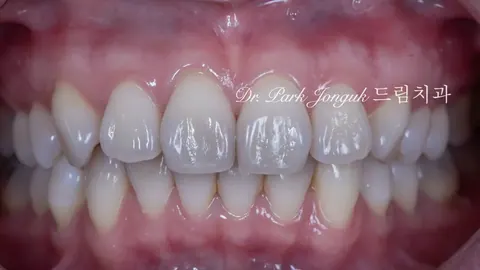
📸 Photo 1 — Before treatment
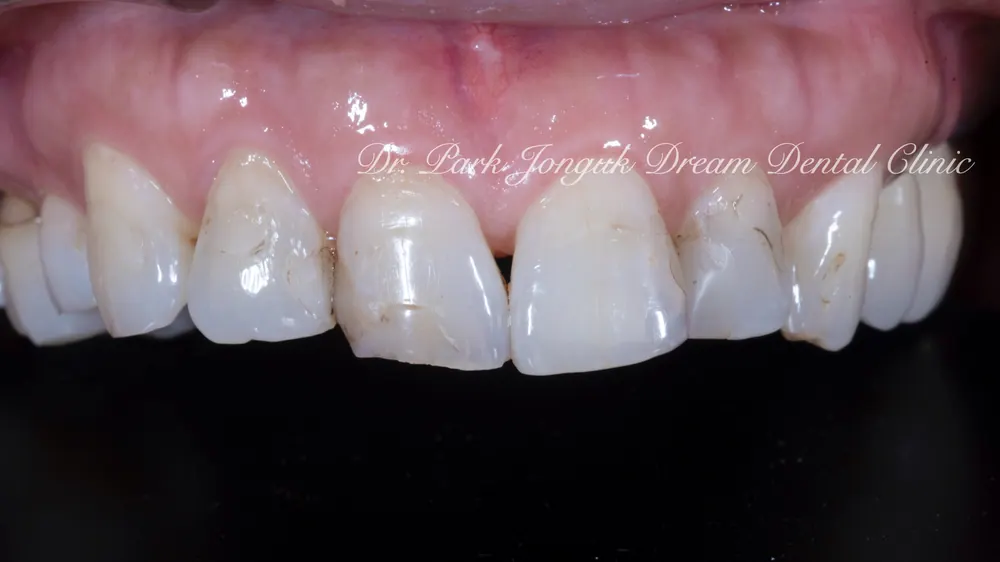
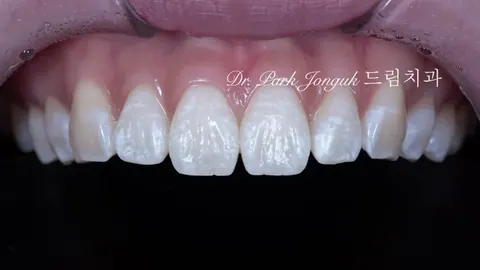
All the resin fillings between the front teeth had discolored.
Depending on the angle of the light, they looked yellow and dull, and
the proportions between the central and lateral incisors weren't natural either.
📸 Photo 2 — Marking the resin areas
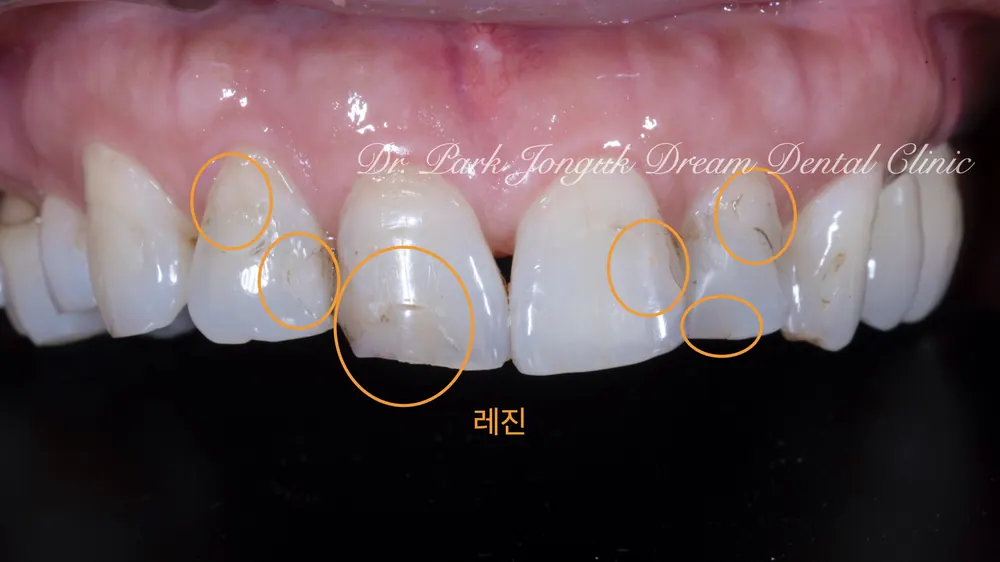
Resin had been layered on repeatedly over almost all of the front teeth.
Each patch had a different color, and the margins had become rough, so
the structure ended up staining and collecting tartar more easily.
Once this happens, cavities recur, and
inevitably, "having to do the resin all over again" comes around.
📸 Photo 3 — Diagnostic process (measuring size and proportions)
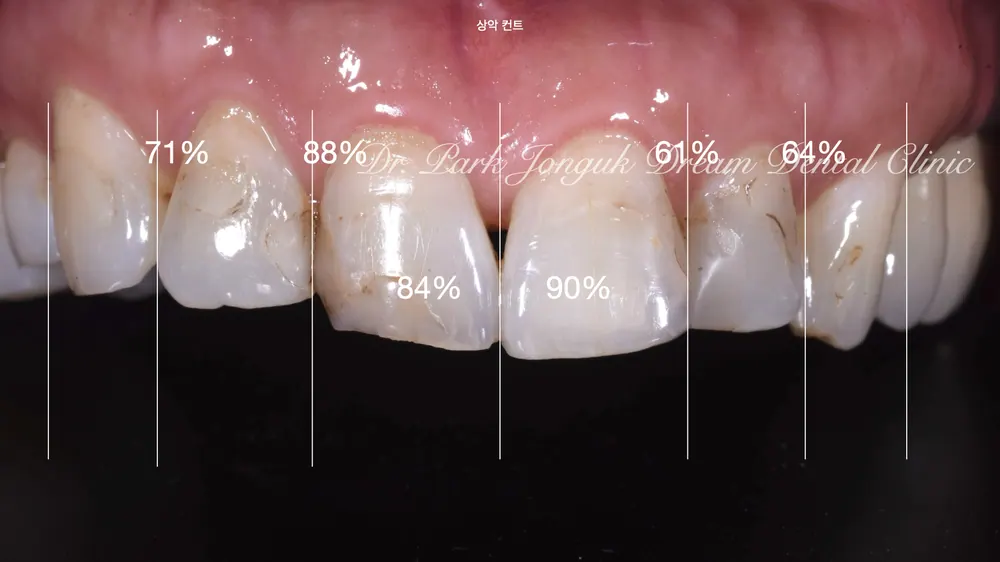
A veneer isn't simply a matter of "bonding something on."
First, the tooth ratio and symmetry,
and the length and width suited to the patient's face need to be precisely established.
This patient
✔ had large teeth,
✔ poor left-right proportions, and
✔ awkward protrusion, length, and symmetry all at once, so
diagnosis mattered more than anything else in this case.
📸 Photos 4 and 5 — Analyzing the occlusal plane and protrusion
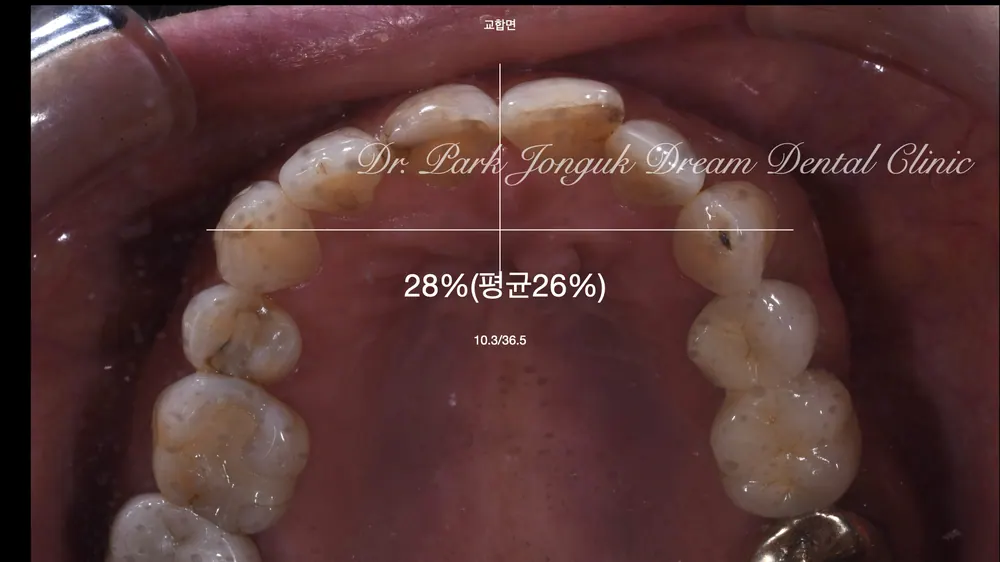
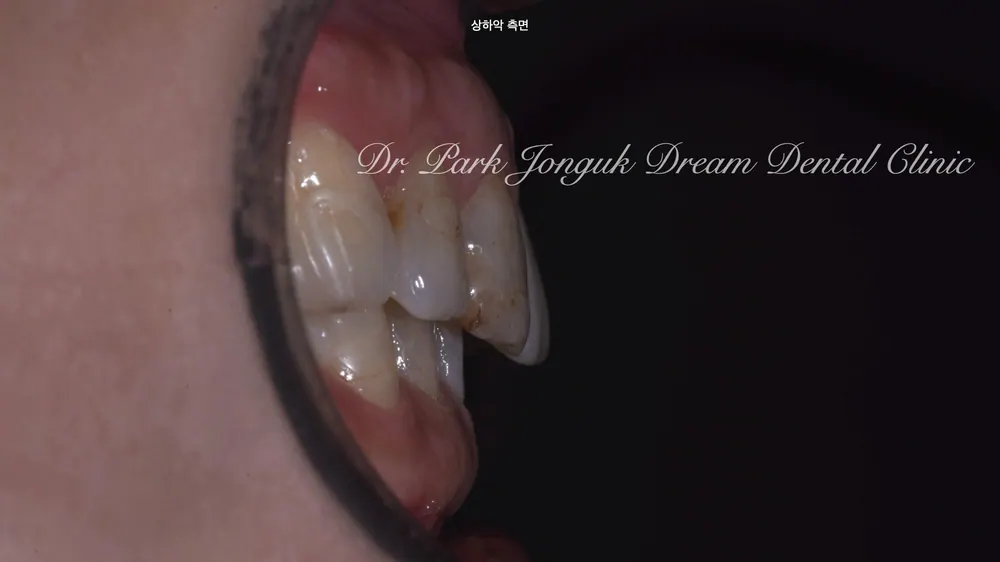
The degree of protrusion, and
even the angle of the teeth visible when smiling, were all analyzed.
The biggest reason veneer treatment fails is
because it's done by simply looking at the surface and bonding something on.
Only by calculating the occlusion, the profile, and the smile line as well,
does the final result end up looking natural.
📸 Photo 6 — Designing a model with a wax-up
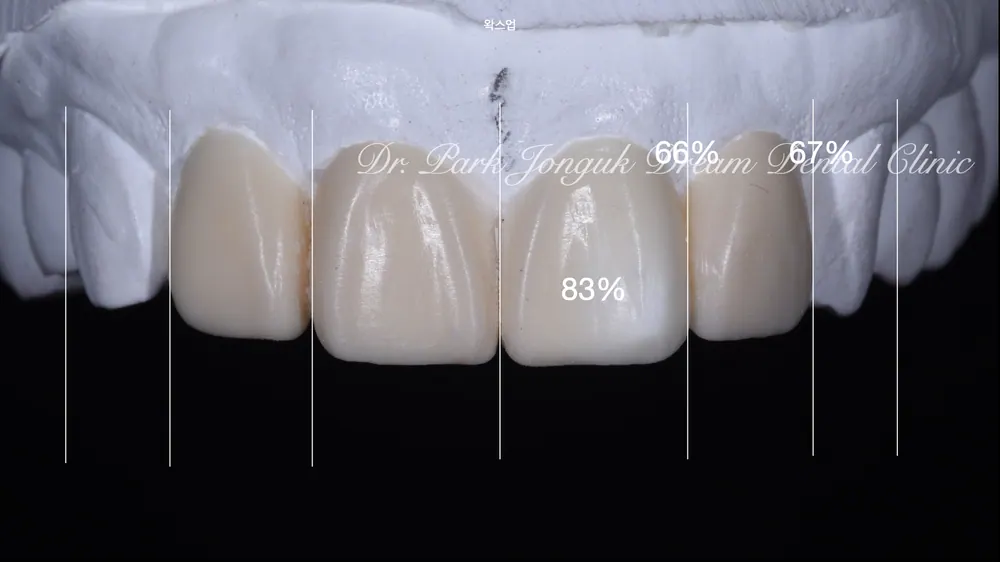
Based on the diagnostic findings,
we built the final shape of the 4 front teeth in wax.
A wax-up is
✔ the final tooth shape
✔ the amount of reduction
✔ the length and proportions
✔ occlusal stability
— a stage for predicting these in advance,
the single most important process in determining the treatment outcome.
📸 Photo 7 — Minimal reduction within the planned range, followed by resin refinement
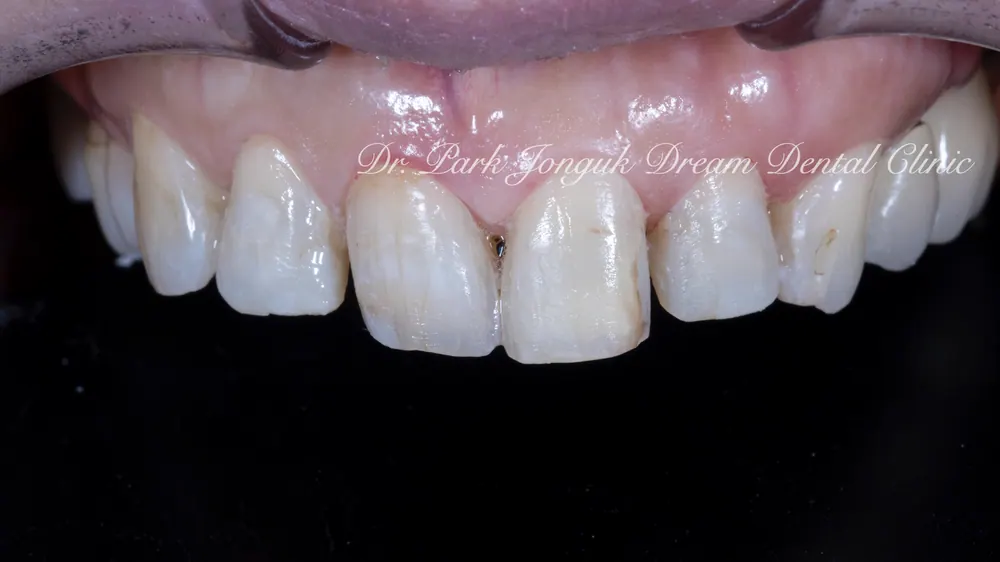
The cavity between the front teeth was completely removed, and
the surface was prepared so the veneer would seat stably.
The amount of reduction was
✔ minimal enough that anesthesia wasn't needed
✔ and as much of the enamel layer as possible was preserved.
This was the single most important step for preventing the cavity from recurring.
📸 Photo 8 — Final appearance after treatment
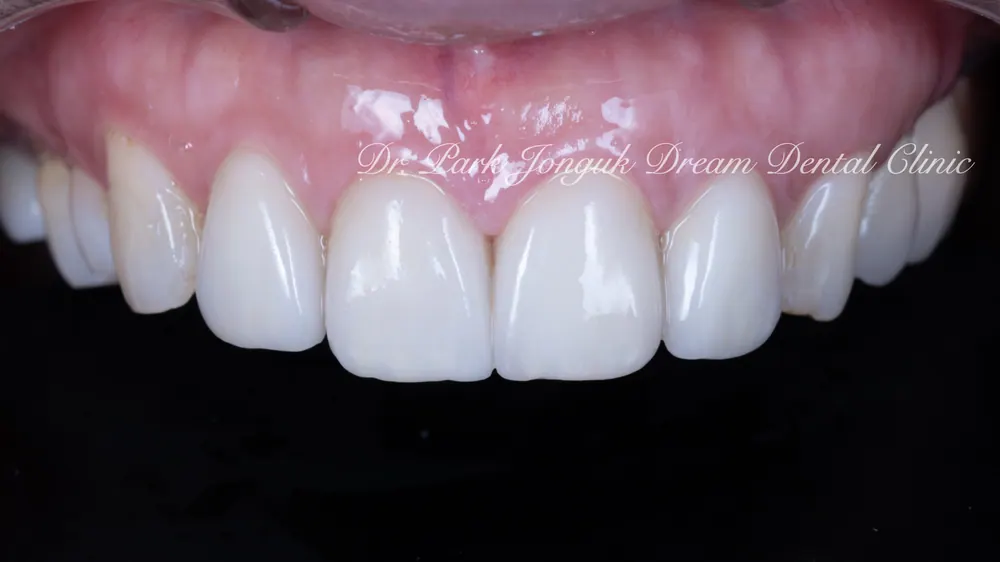
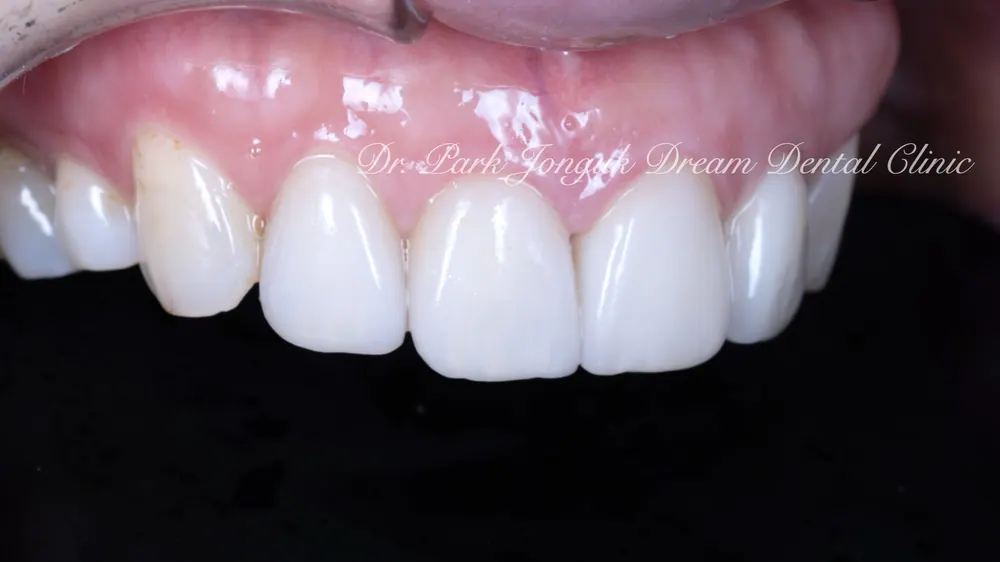
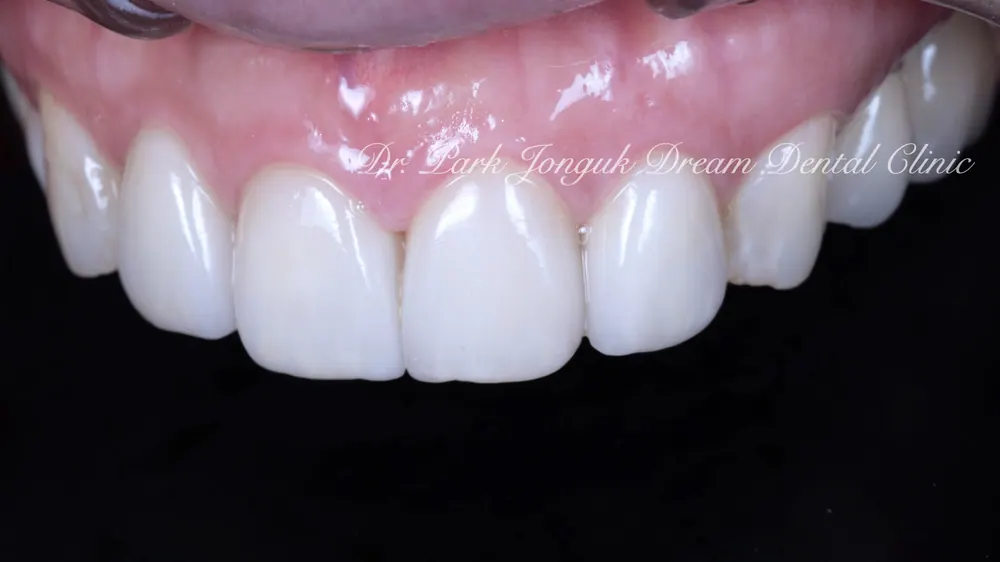
The front teeth have visibly transformed!
A bright, natural color
Stains and discoloration completely removed
The symmetry and proportions of the teeth harmonize with the face
A structure where ceramic evenly covers the whole tooth to prevent cavities from recurring
A far softer, more polished impression when smiling
The patient was genuinely delighted, saying, "The stress I had over my front teeth is finally gone."
Conclusion
The more front-tooth resin is repeated, the worse the discoloration and the more often cavities recur.
So at some point,
stabilizing things with a veneer, rather than continuing to patch up resin,
becomes far more advantageous, both for tooth health and for aesthetics.
In particular,
✔ when resin discoloration keeps recurring,
✔ when cavities form frequently, or
✔ when the shape of the teeth doesn't suit the face,
a veneer is far more stable over the long term, and
it's an overwhelmingly superior treatment aesthetically as well.
Q&A
Q1. Why does discoloration get worse the more resin is repeated?
Because resin has a rough surface and is a material that absorbs moisture,
staining and discoloration keep recurring.
Q2. If I get veneers, will cavities not come back?
Ceramic has a smooth surface, so tartar sticks to it less, and
the recurrence of cavities is greatly reduced.
Q3. I'm worried about tooth reduction.
Only the necessary areas are reduced, and only minimally.
In this case, it was even possible without anesthesia.
Q4. Can the veneer color be made to look natural?
With the handmade build-up method,
the translucency and dimensionality of a natural tooth are faithfully reproduced.
Q5. Would no-prep veneers be possible for my teeth too?
That's determined by looking at the tooth shape, presence of cavities, and bite condition.
We'll let you know the exact amount of reduction needed through diagnosis.
This article is a clinical note written by Dr. Park Jonguk of Dream Dental Clinic, Gangnam; the original was published on his blog. The photographs shown are real cases he treated. Results vary with each patient’s condition, and every procedure carries the possibility of individual variation and side effects.
Quick Consult
Request a Callback
Leave your number and we will call you back during clinic hours.
Request Received
We will contact you during clinic hours. For urgent matters, please call +82-2-3448-0028.