
Veneer Redo: Do You Know the Pitfalls of One-Day Veneers?
Hello, I'm the one who has specialized in veneer treatment in Apgujeong for 20 years —
Park Jonguk, director of Dream Dental Clinic.
Today, I want to go into detail, through a real case,
about something many people ask about: veneer redo treatment.
One-day veneers — being fast doesn't mean they're always good.
These days you've probably seen a lot of ads for 'veneers finished in a single day,' or 'one-day veneers.'
Because of the appeal of being fast and convenient, many people are interested,
but unfortunately, more and more patients are coming to our clinic after being treated this way.
The patient I'll introduce this time was one of those cases.
She had received one-day veneer treatment at another clinic,
but it looked so awkward and artificial that she came to our clinic wanting a natural-looking redo.
The first meeting, and the shock
When I first saw this patient, I was honestly taken aback.
In more than 20 years of doing veneer treatment, I've seen countless cases,
but a result this awkward and unnatural was truly rare.
The patient herself was quite upset, saying, "People around me keep telling me it looks so strange."
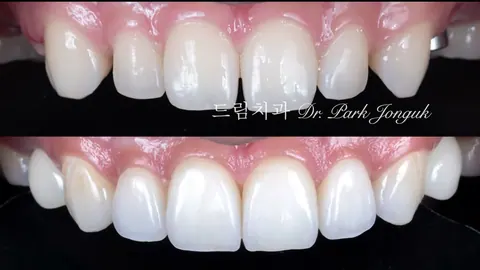
You can see what she looked like when she first came in, in photos 1, 2, and 3.
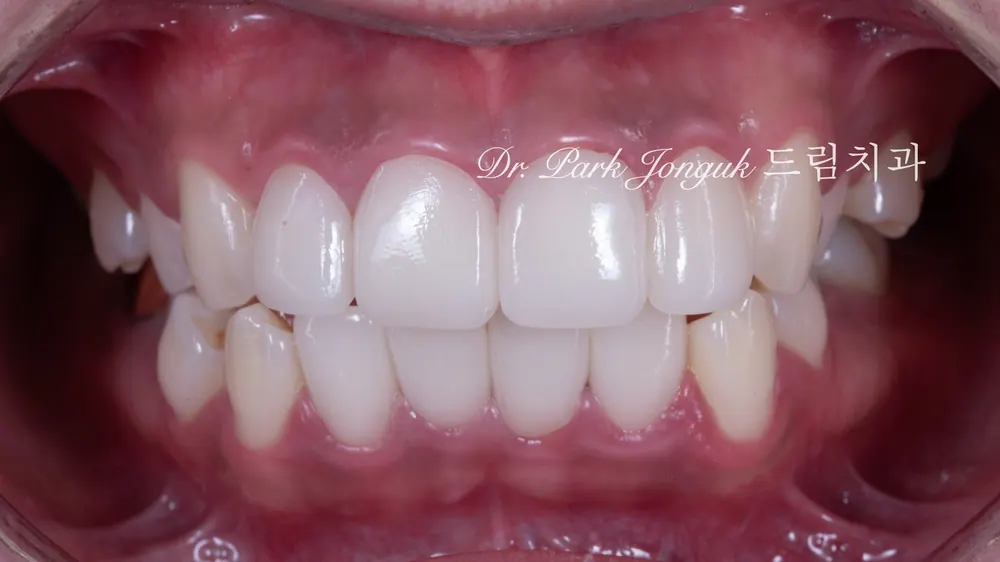
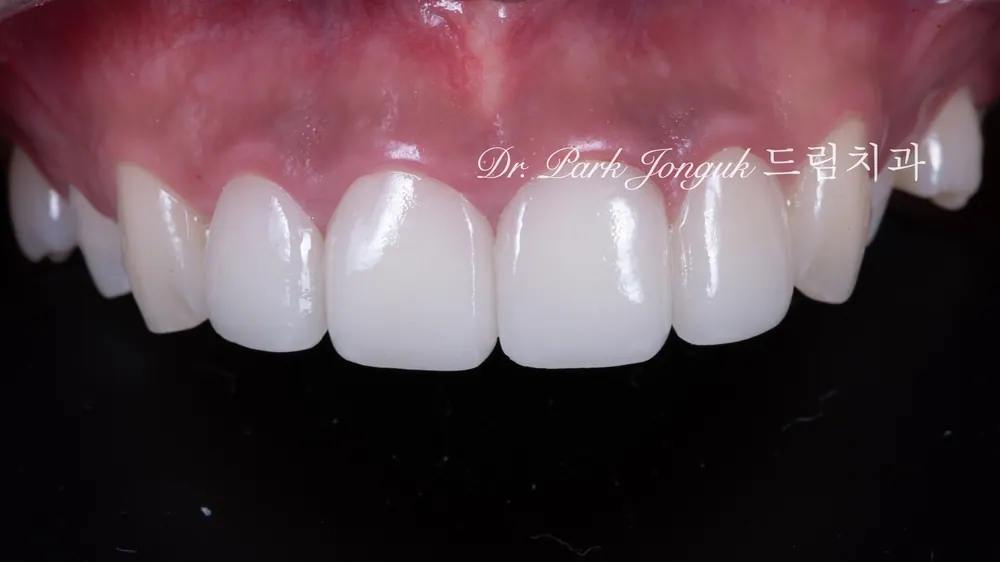
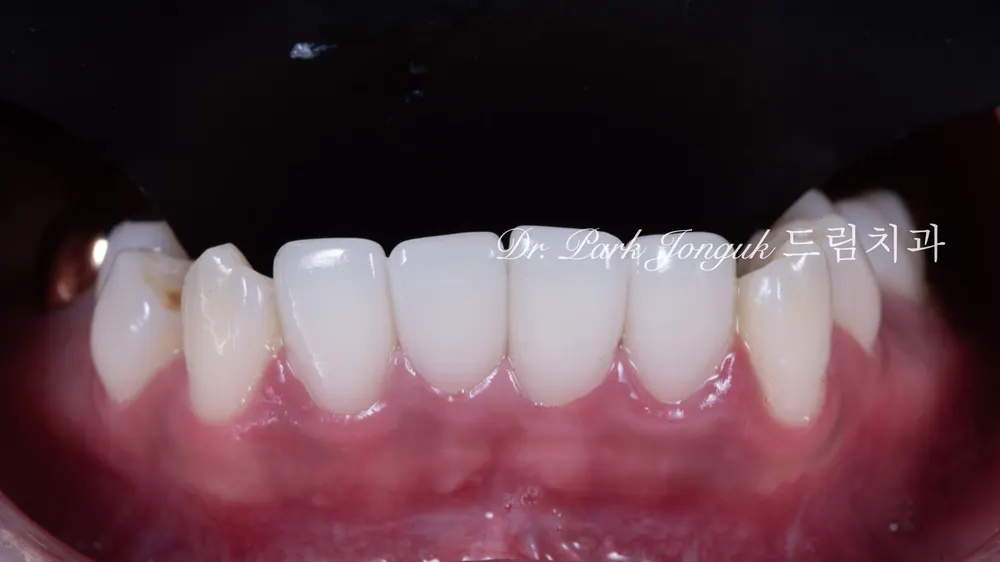
These are photos of the upper and lower jaws in a bite position where all the teeth are visible —
really awkward and odd-looking, isn't it?
It felt as if doll's teeth had been glued on.
Why does it look so unnatural?
The biggest problem with one-day veneers
is that they're made from a single block of ceramic.
To speed up fabrication, most use a CAD/CAM method where a computer mills the veneer,
and this method lacks the delicate consideration needed for tooth shape and proportion.
Natural teeth aren't made up of a single color and texture.
Near the gumline there's a slight yellowish tint, and toward the tooth's edge it becomes more translucent,
showing a variety of colors depending on the light.
To express this kind of naturalness,
a build-up technique — layering several different kinds of ceramic — is essential.
But the one-day method skips this process to save time and cost.
The result is an artificial look, almost as if the tooth had been coated in white paint.
We started over from precise diagnosis
A veneer redo is more demanding than the initial treatment.
Since it involves working again on a tooth that's already been treated once, even more care is required.
I always consider the diagnostic stage to be the most important part.
As you can see in photo 4, I first carefully checked the relationship between the face and the teeth.
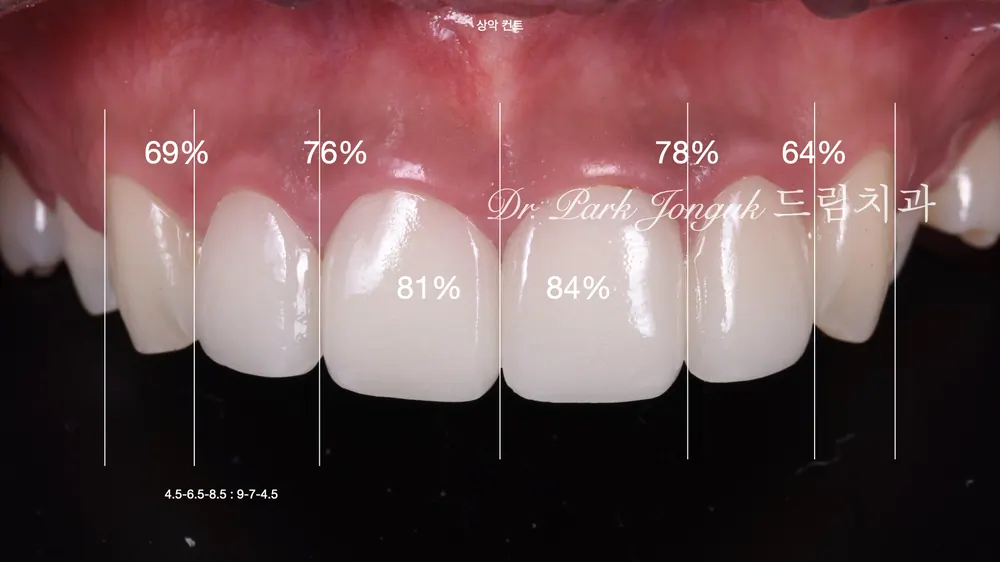
Then I precisely measured the tooth proportions,
and it was clear at a glance that the two front teeth in the existing veneers were even different sizes from each other,
and that the proportions between the teeth hadn't been considered at all when they were made.
Teeth have proportions that work well too.
The proportions among the central incisor, lateral incisor, and canine need to be in harmony to create a natural, beautiful smile.
But the previous treatment had ignored even this basic principle.
We planned everything precisely with a wax-up diagnostic
Photo 5 shows the wax-up diagnostic process.
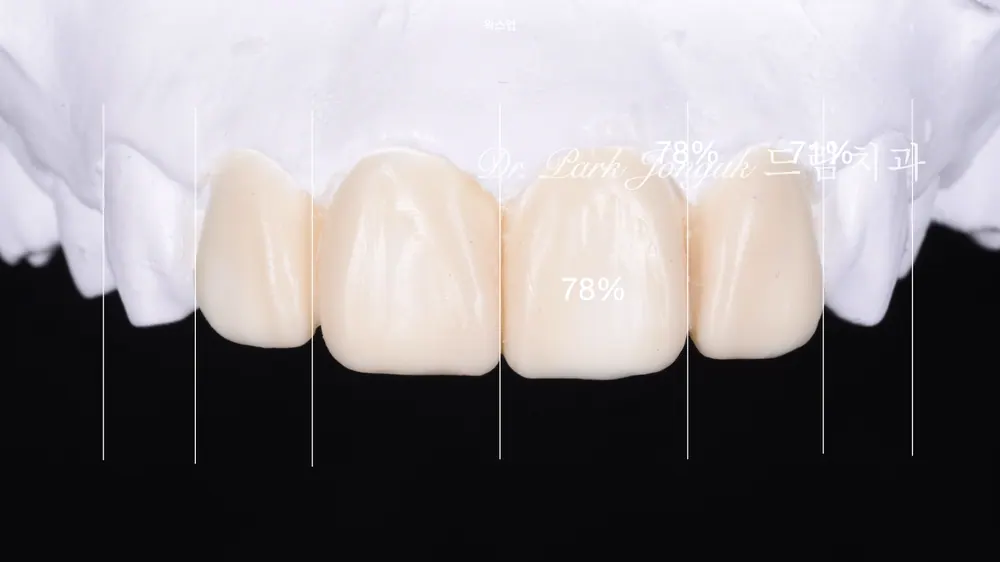
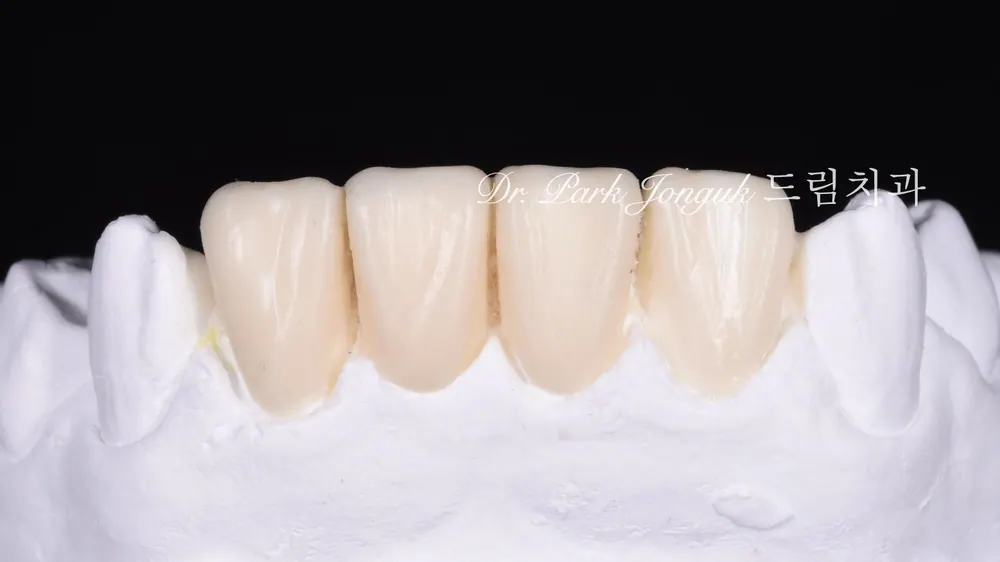
This is the stage where the size and proportions of the teeth are carefully adjusted to preview the ideal shape beforehand.
Through this process, I can show the patient the final result in advance, and the treatment plan becomes far more accurate.
I believe doing veneer treatment without a wax-up is like building a house without blueprints.
This is especially essential for a redo. When the patient saw the wax-up model, she felt reassured, saying,
"It finally feels like I'm getting proper treatment."
Hand-built layering: the secret to naturalness
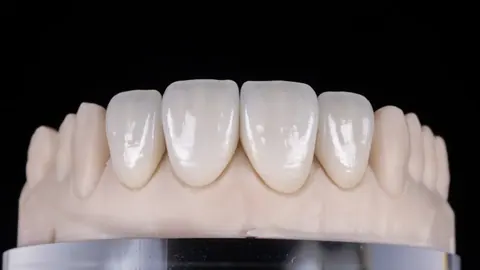
Photos 6 and 7 show the process of fabricating the veneers.
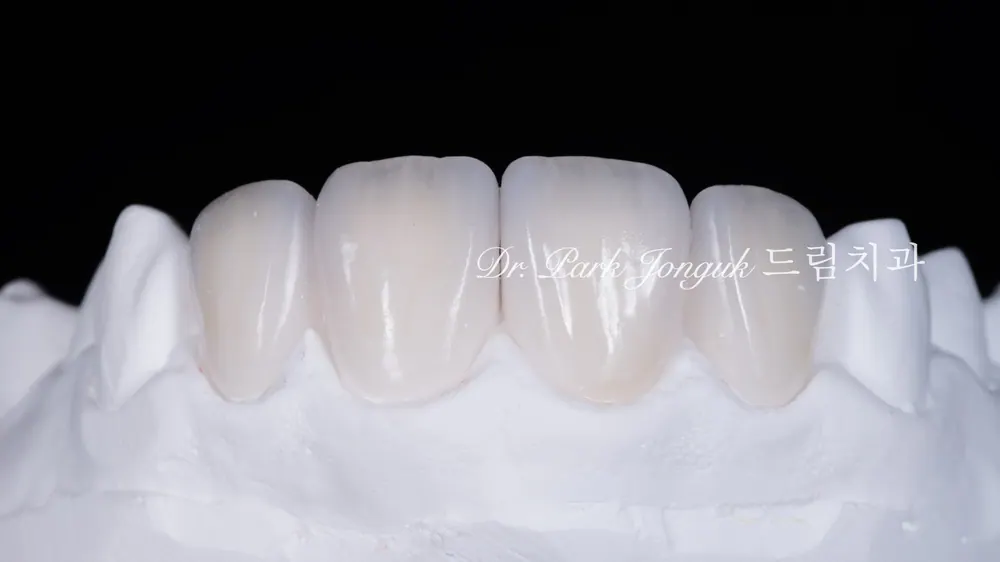
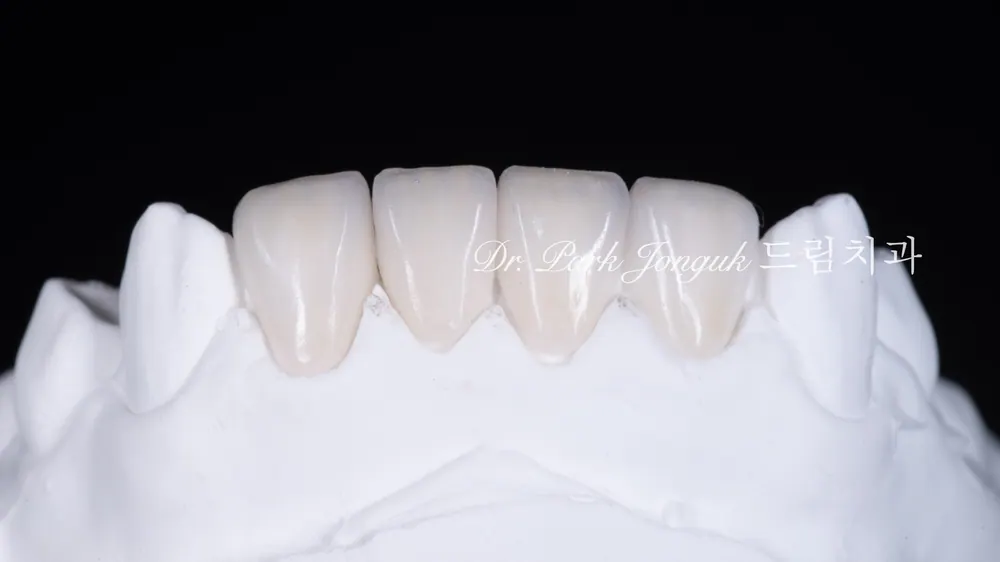
Doesn't it look clearly different from the previous veneers, even just from the photos?
Only by using this build-up method — layering different kinds of ceramic one layer at a time —
can you achieve a natural color, shape, and translucency.
We work closely with the dental technician, taking into account the patient's skin tone, lip color, and the shade of the surrounding teeth.
Near the gumline we start with a slightly deeper ivory-toned ceramic, move to a brighter shade in the middle,
and finish with a translucent ceramic at the tooth's edge.
This layered structure reproduces the texture of a natural tooth as it truly is.
As light passes through the tooth, it's transmitted and reflected softly, just like with a natural tooth.
That's a completely different result from the single-layer ceramic of the one-day method, which simply bounces light off, looking hard and artificial.
The try-in process: checked together with the patient
Photo 8 shows the try-in stage.
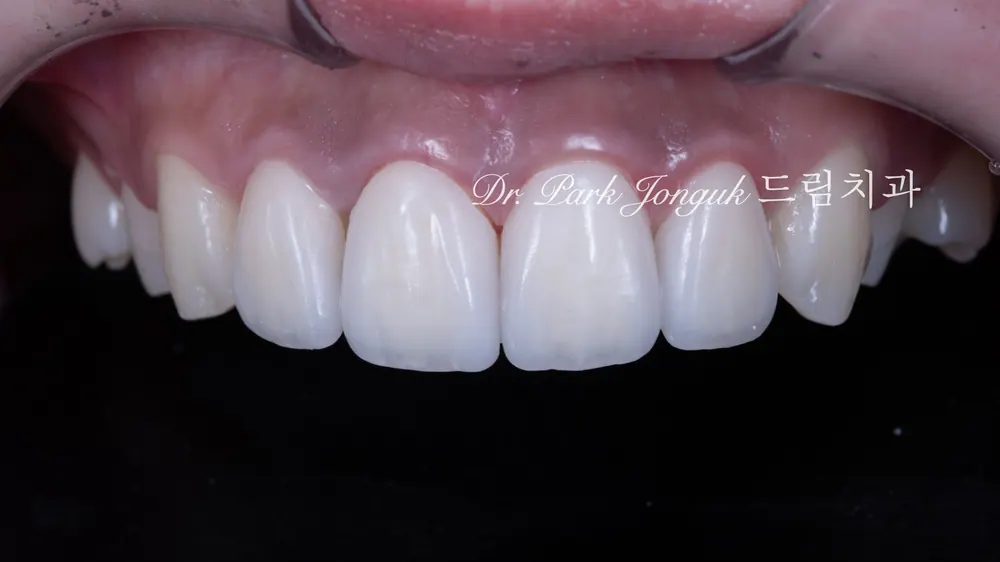
This is the stage where the veneer is placed on the tooth for a final check of shape and color before it's permanently bonded.
At this point, I discuss things thoroughly with the patient to confirm her satisfaction.
We carefully check things like "is it not too bright," "does she like the shape," and "does it look natural when she smiles."
If needed, we send it back to the dental lab for adjustment.
Even if it takes a bit more time, it's our clinic's principle to proceed carefully until the patient is completely satisfied.
When the patient looked in the mirror, her eyes welled up as she said, "I finally feel like I've found my own face again."
I could only imagine how much stress she must have gone through up to that point.
One year later, it still looks natural
Photos 9 and 10 show her a year after treatment.
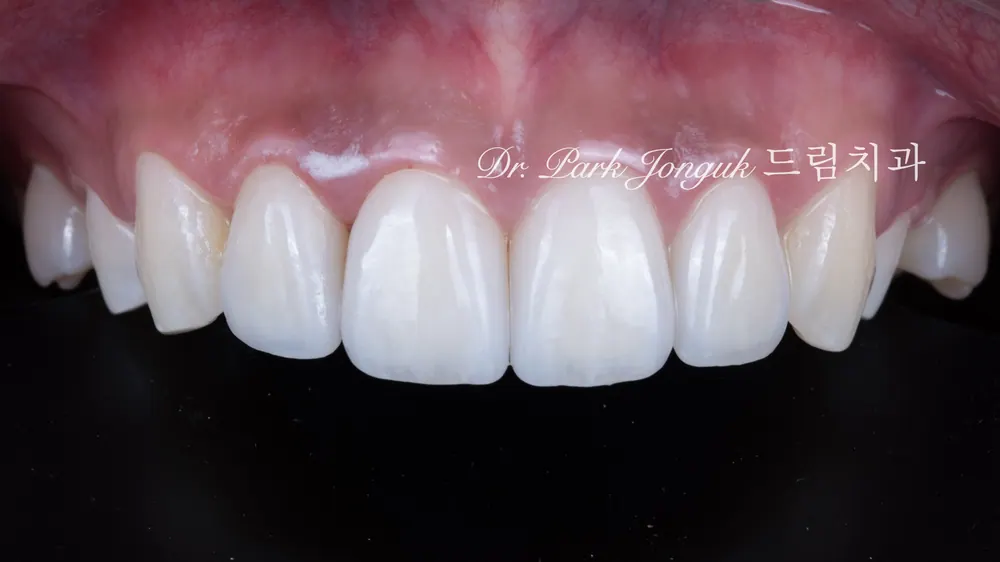
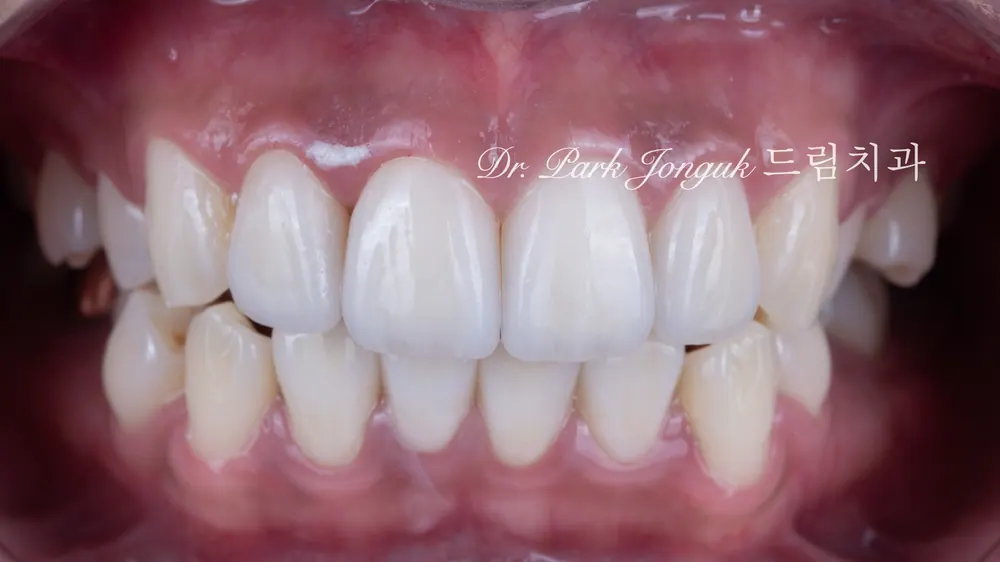
It's still holding up naturally and well, isn't it?
Success in a veneer redo isn't simply about making the teeth look pretty —
it also includes staying healthy and natural over the long term.
At every regular checkup, the patient happily tells me, "People compliment my smile now."
She said she now confidently tells her friends she got veneer treatment.
As a dentist, there's no greater reward than that.
Veneer redo — a few things to remember
If you're considering a veneer redo, be sure to check the following.
First, check whether there's a precise diagnostic process.
This should include facial analysis, measurement of tooth proportions, and a wax-up diagnostic.
Second, ask about the fabrication method.
Find out whether it's a hand-built, layered method using multiple kinds of ceramic,
or a method where a single block of ceramic is milled by computer.
Third, see whether enough time is allowed for the process.
A truly good veneer cannot be made in a single day.
You should expect it to take at least 2-3 weeks.
Fourth, check the collaboration system between the dentist and the dental technician.
It matters whether the dentist and technician communicate closely to make each veneer custom-fit to the patient.
A veneer, once done properly, is a treatment meant to last 10, even 20 years.
So that you don't end up choosing based on speed and low price alone, only to be considering a redo again within a few months,
I hope you'll get proper treatment from the very start.
Frequently Asked Questions (Q&A)
Q1. When is a veneer redo needed?
A. It's needed when the color has discolored, the shape looks unnatural, the border with the gum looks off, or the teeth are too large or too small. Redo is especially often needed for patients who received one-day or low-cost veneers.
Q2. What happens to the existing veneer during a redo?
A. The existing veneer is carefully removed, and the condition of the tooth is reassessed. The work is done carefully so the tooth isn't damaged, and if needed, the tooth surface is reshaped again.
Q3. Is a redo more expensive than the first treatment? A
. It depends on the case. If removing the existing veneer is particularly difficult, there can be an added cost, but in most cases it's similar to the cost of regular veneer treatment.
Q4. Are one-day veneers always bad?
A. The one-day method itself isn't inherently bad, but it does have limits in terms of naturalness and precision. It can work for simple cases, but if you want an esthetically flawless result, a hand-built, layered method is recommended.
Q5. How should I care for my teeth after a redo?
A. The same as with regular veneers. If you take care of the basics — being careful with hard foods, getting regular checkups, and brushing properly — you can expect them to last a long time.
Q6. How long can they last?
A. With a properly done redo, they can often be used for 10 years or more. Many of our patients have used theirs without problems for 15, even 20 years.
This article is based on the real clinical experience of a dentist who has specialized in veneer treatment in Apgujeong for 20 years. He teaches veneer treatment techniques to other dentists every month at Lamista Academy, and has published Korea's first veneer-specialized textbook.
This article is a clinical note written by Dr. Park Jonguk of Dream Dental Clinic, Gangnam; the original was published on his blog. The photographs shown are real cases he treated. Results vary with each patient’s condition, and every procedure carries the possibility of individual variation and side effects.
Quick Consult
Request a Callback
Leave your number and we will call you back during clinic hours.
Request Received
We will contact you during clinic hours. For urgent matters, please call +82-2-3448-0028.