
Veneers for Discolored Teeth in Your 50s: Making Large Front Teeth Look Naturally Smaller
Hello, this is Dream Dental Clinic, Apgujeong.
"My teeth look so big that I lose confidence when I smile." "My teeth have turned so yellow as I've gotten older."
These are concerns many people face after their 50s.
Today I'm sharing the case of a woman in her 50s who had struggled for a long time with large front teeth and overall discoloration —
her front-tooth veneer treatment.
In particular, I'll explain in detail how we naturally solved both large-tooth veneers and discolored-tooth veneers,
and the secret to how well they've held up even six years later.
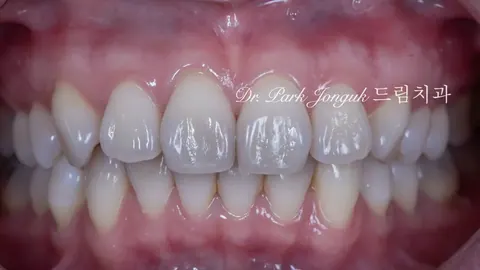
Before treatment: what brought her in?
[Photo 1 - Before treatment]
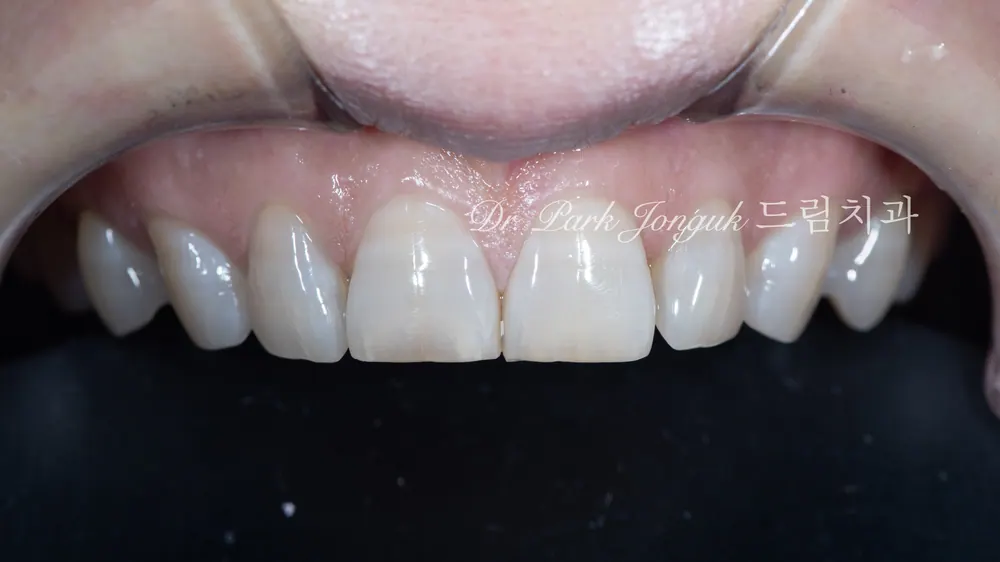
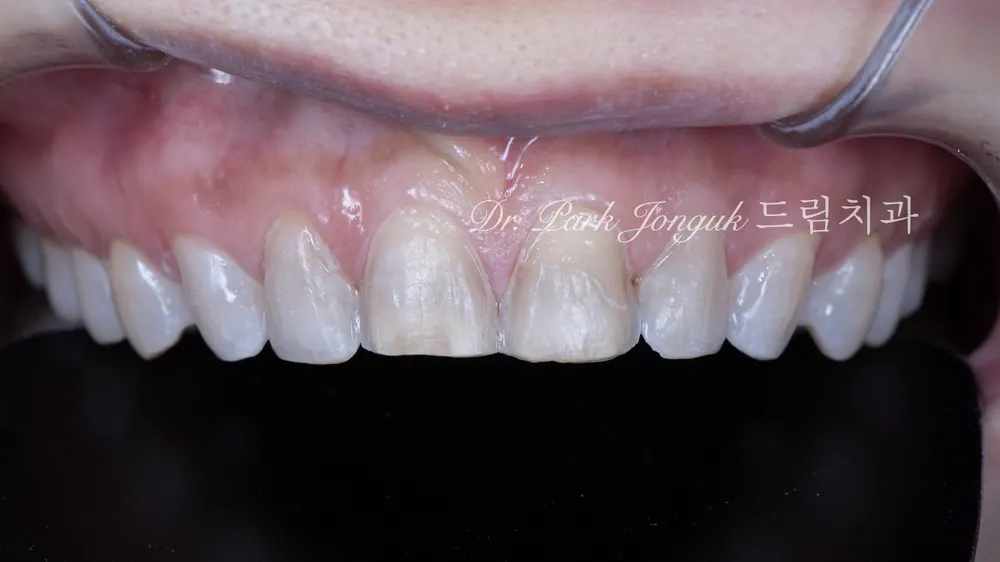
This is why the patient in her 50s came to us.
Main problems:
❌ The two front teeth looked noticeably larger than the other teeth
❌ Severe overall tooth discoloration (yellow)
❌ Age-related shortening made the teeth look even wider
❌ The front teeth stood out too much when smiling, lowering her confidence
❌ Teeth that made her look older overall
In fact, this patient also had some negative feelings about veneers.
"Wouldn't it be obvious I got veneers?" "Wouldn't they end up looking white and unnatural?"
But she said she'd heard about Dream Dental Clinic from people around her.
"I heard Dream Dental Clinic uses a precise diagnosis to create the best results."
Trusting that, she gathered the courage to come in for a consultation.
Precision diagnosis, stage 1: starting with harmony with the face
Dream Dental Clinic's own systematic diagnostic process
The most important thing in large-tooth veneers is not just looking at the teeth alone,
but looking at their harmony with the entire face.
We diagnose in the following order:
Stage 1: Facial analysis
The ratio of face width to tooth size
The lip line and how much of the teeth show
The degree of tooth exposure when smiling
The appropriate size for the patient's age and sex
This process can't all be shown on a blog, but it's a truly important first step.
Precision diagnosis, stage 2: measuring tooth size and proportion
[Photo 2 - Basic diagnostic process]
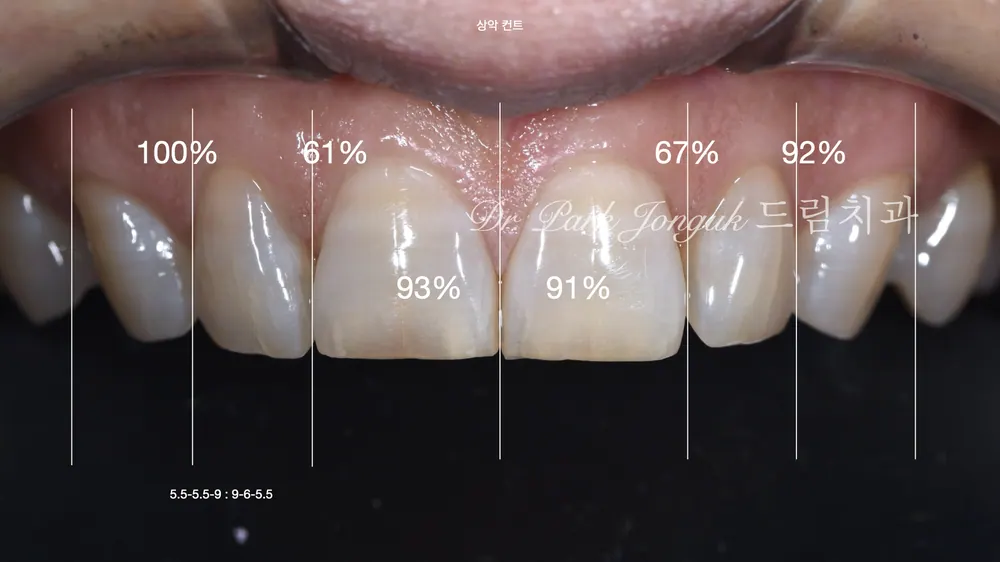
Now we analyze the teeth themselves.
What's measured: ✓ Width and length of the central incisors (front teeth) ✓ Proportion relative to the lateral incisors ✓ Left-right symmetry ✓ Spacing between teeth
For this patient, the two front teeth looked about 1.5-1.6 times larger than the lateral incisors.
The generally ideal ratio is around 1.4 times, so her front teeth were clearly, noticeably large.
On top of that, as the teeth had gotten shorter, they had the effect of looking even wider by comparison.
Precision diagnosis, stage 3: analyzing the dental arch and protrusion
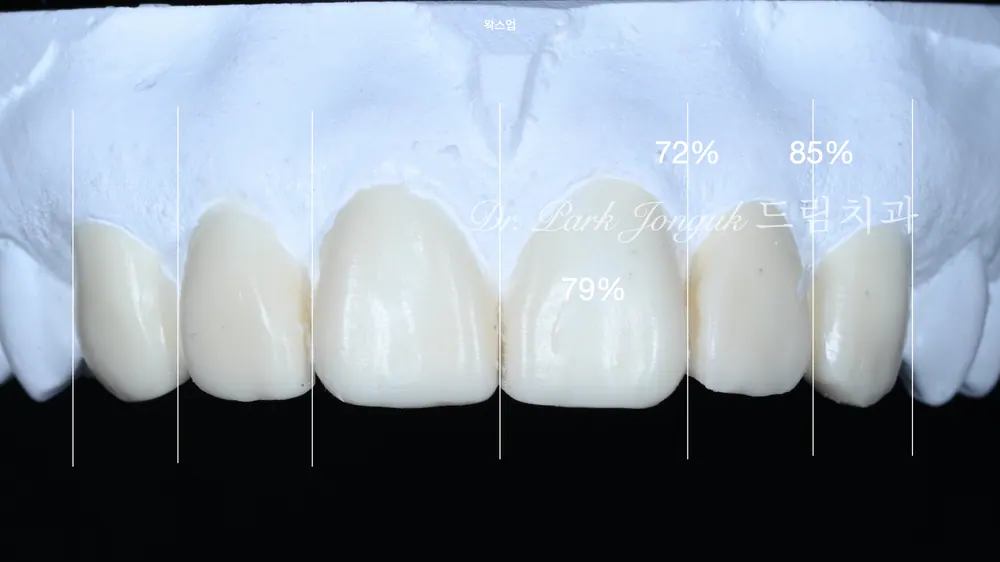
[Photos 3, 4, 5 - Precision wax-up diagnosis]
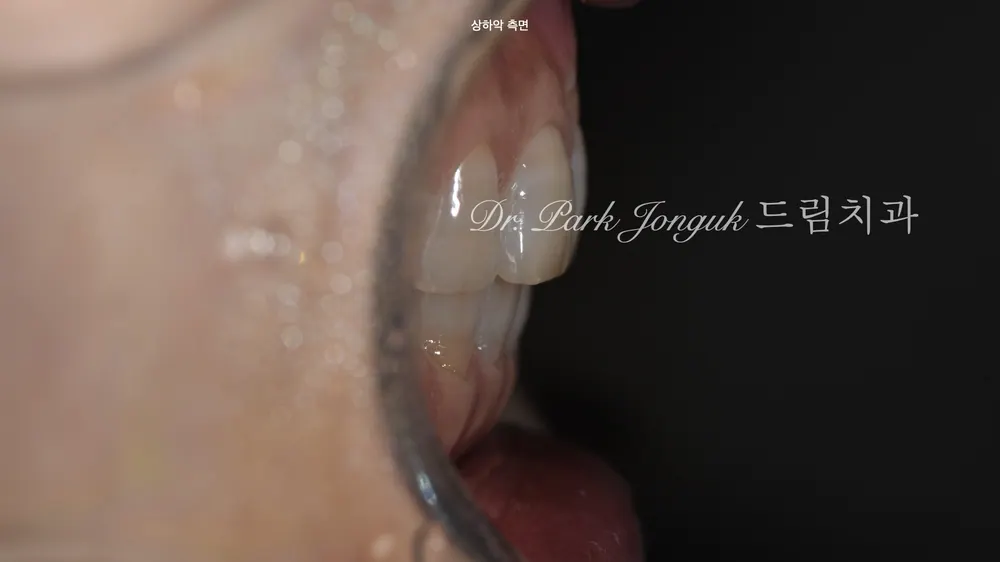
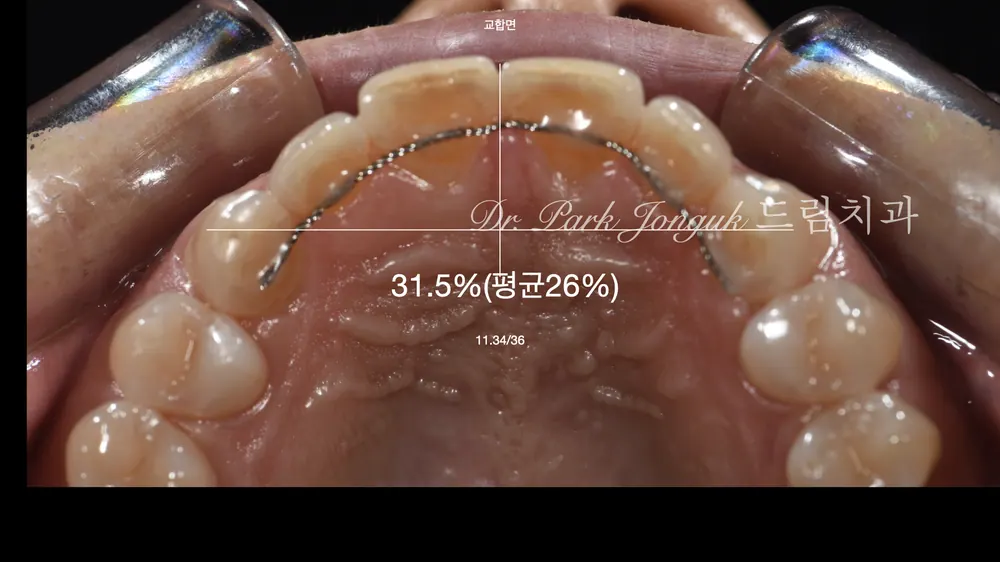
This isn't the end.
Additional analysis items: ✓ Shape of the dental arch: the curve of the tooth row ✓ Degree of protrusion: how far forward the teeth sit ✓ Occlusal relationship: how the upper and lower teeth meet ✓ Gingival line height: harmony of the gum line
We combine all of this data and carry out a precision wax-up diagnosis.
This is the most important step — previewing the final tooth shape in wax beforehand.
The secret to deciding the amount of tooth reduction
This process determines the entire amount of tooth reduction. This patient's case was special:
The two front teeth: since their original size was large, some degree of reduction was unavoidable to bring them into proportion.
We planned a typical amount of veneer reduction for these.
The other teeth: since their size wasn't large, almost no reduction was needed. We were able to proceed with almost no-prep treatment.
In other words, this is a customized, differentiated reduction strategy — only the teeth that need it, only as much as needed!
This is the power of precision diagnosis.
Rather than blindly grinding down every tooth the same amount, a different reduction plan is set for each individual tooth.
Tooth reduction: exactly as planned
[Photo 6 - Tooth reduction complete]
Tooth reduction was carried out exactly as planned in the wax-up diagnosis.
Result: ✅ The two front teeth: standard reduction
✅ Lateral incisors and canines: almost no reduction
✅ Maximum preservation of healthy enamel
✅ Only the areas that needed it were precisely reduced
As you can see, the amount of reduction on the front teeth is clearly different from the other teeth.
The reason for this kind of differentiated reduction is to protect the healthy natural teeth as much as possible while still achieving a perfectly balanced proportion.
Veneer fabrication: the miracle of handmade work
Designing large teeth to look smaller
Solving discolored-tooth veneers and large-tooth veneers at the same time makes the fabrication process truly important.
Color design: a brightness natural for someone in their 50s, a color that's translucent rather than too white, a warm tone suited to her age
Size design: adjusting the front-tooth-to-lateral-incisor ratio to 1.4:1, making the front teeth look relatively smaller, an overall harmonious size
Shape design: lengthening the teeth to prevent them from looking wider, a slim impression through proper vertical proportion, naturalness through a three-dimensional form
We bring all of this together at once through our hand-layered build-up at Dream Dental Clinic.
Treatment complete: a remarkable transformation
[Photos 7, 8, 9 - After treatment]
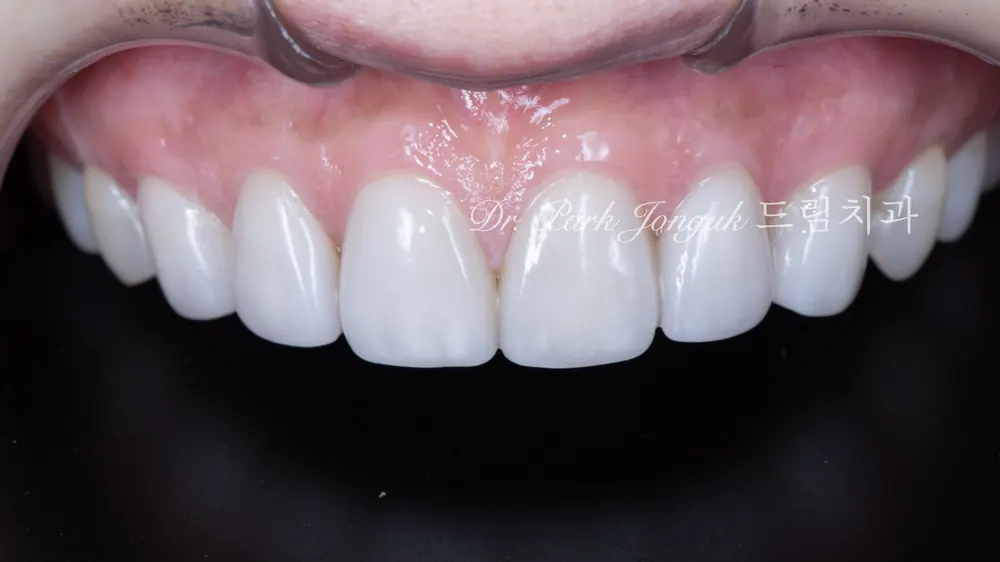
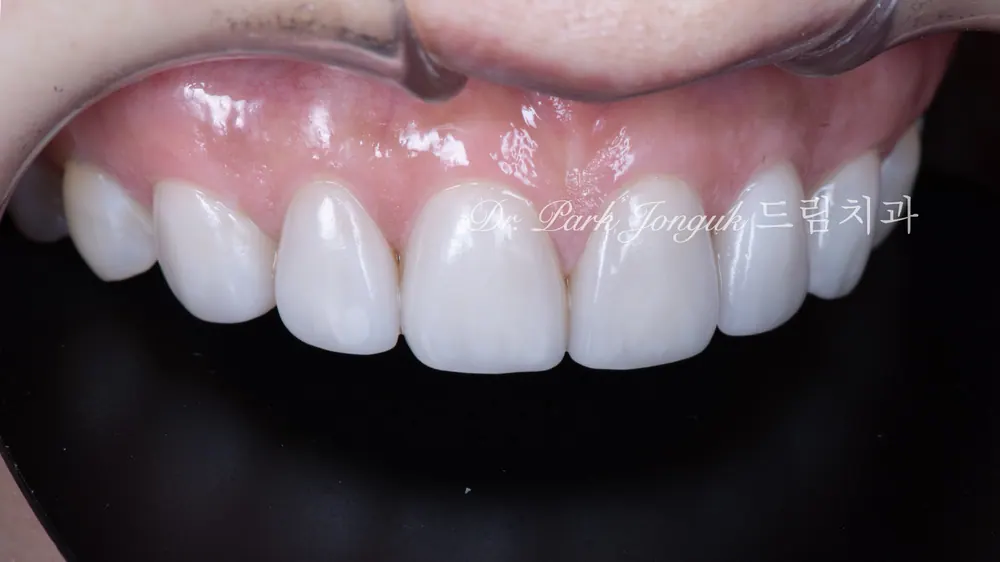
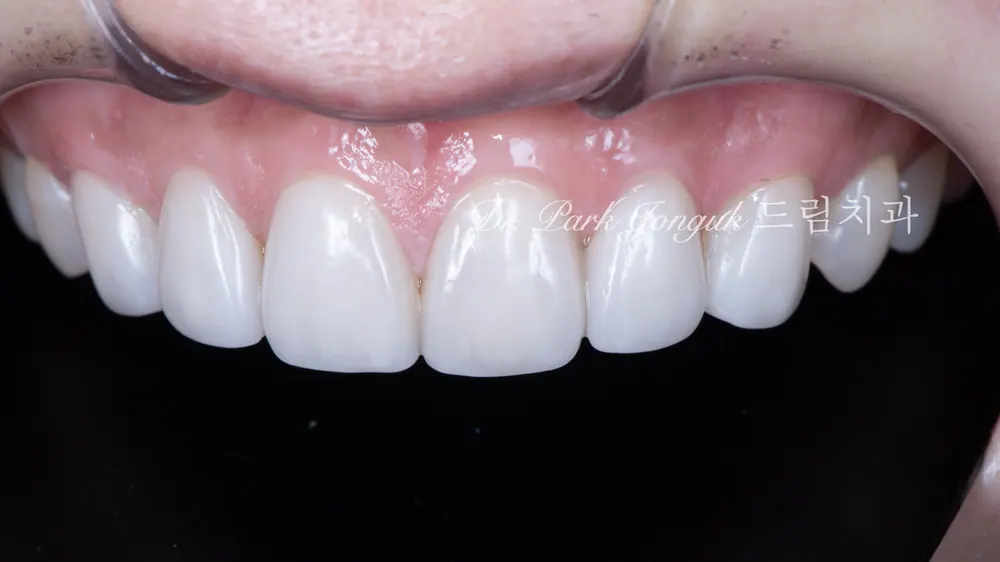
The front-tooth veneer treatment
was finally complete!
Remarkable changes:
✅ The front teeth look smaller — once brought into proportion with the other teeth, the front teeth no longer feel large.
✅ Color dramatically improved — the yellow, discolored teeth turned a natural, bright color.
✅ Overall harmony — the front teeth no longer stand out, and all the teeth look harmonious together.
✅ A younger-looking impression — with the tooth length restored and the color brightened, she looks younger overall.
✅ Naturalness — there's no telling at all that she got veneers.
What made the patient happiest was that "people around me have no idea I got veneers — they just say my teeth got prettier." This is what truly natural veneers look like.
Six years later: quality proven by time
[Photo 10 - Six years later]
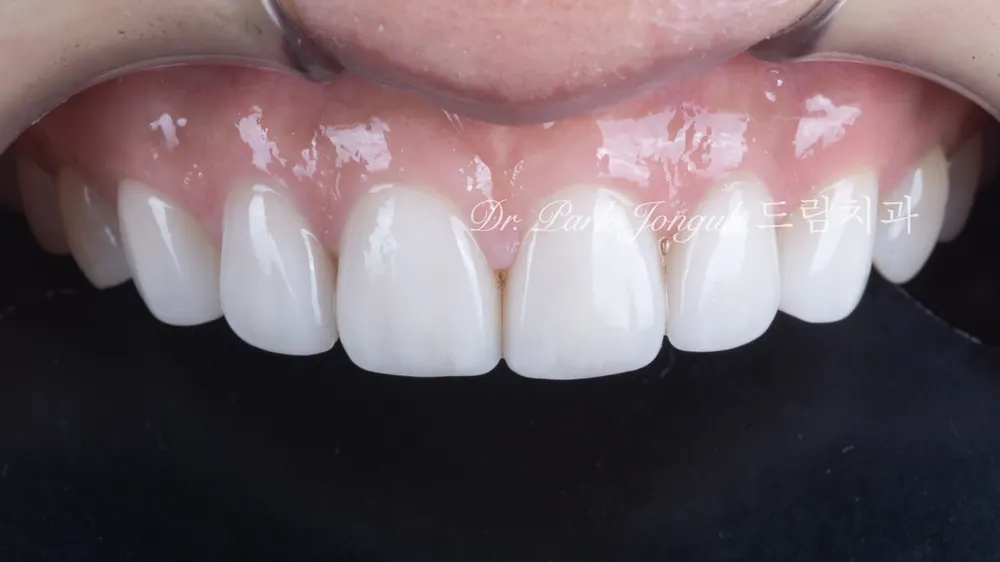
And this is the most important part. Even six years later, the veneers remain perfectly intact.
Condition after six years: ✅ No fractures or cracks at all ✅ No change in color, held exactly the same ✅ Good gum health ✅ Patient satisfaction still at its best
A properly made veneer can last 15-20 years or more. Six years have already passed, and she still has more than 10 years of use ahead of her. This is the difference precision diagnosis and handmade fabrication make.
Conclusion: Dream Dental Clinic's two promises
1. Minimizing tooth reduction through precision diagnosis
Whether it's large-tooth veneers or discolored-tooth veneers, the most important thing is a precision diagnosis.
✓ Analyzing harmony with the face ✓ Measuring tooth size and proportion ✓ Assessing dental arch shape and protrusion ✓ Building the final shape beforehand with a wax-up ✓ A customized reduction plan for each tooth
Only by going through all of these steps can only the teeth that need it be reduced, only as much as needed, while preserving healthy natural teeth as much as possible.
This is why, as with this patient, standard reduction on the front teeth and almost no reduction on the other teeth — this kind of differentiated reduction — is possible.
2. Creating a natural result
The hardest part of front-tooth veneers is naturalness.
In particular, making large front teeth look smaller while leaving no trace of the work is truly a highly advanced skill.
Dream Dental Clinic's secret to naturalness:
✓ A color suited to someone in their 50s (not too white) ✓ A translucent, multi-layer build-up ✓ An optical illusion created through proportion ✓ A three-dimensional, delicate shape ✓ Perfect harmony with the gums
This is exactly why I've specialized in veneers alone for 20 years, written the textbook 『최소 삭제를 위한 라미네이트 임상』 (Laminate Veneer Clinical Practice for Minimal Reduction), and teach dentists from across the country every month at Lamista Academy.
"Precision diagnosis and a natural result" — these two things are Dream Dental Clinic's promise.
Q&A: Questions about large-tooth and discolored-tooth veneers
Q1. If the front teeth are large, do they always have to be reduced a lot?
A. No. Through precision diagnosis, once the proportion is calculated, minimal reduction is possible.
For this patient too, only about 0.7mm was reduced from the front teeth, and the other teeth were barely reduced at all.
What matters isn't the absolute amount of reduction, but the visual balance achieved through proportion.
Q2. Can discolored teeth in someone's 50s also be improved naturally?
A. Of course. In fact, making them too white in your 50s actually looks unnatural.
They need to be made with a brightness and translucency suited to the patient's age, so she looks younger without it being obvious.
Handmade build-up can express a wide range of tones, making it ideal for discolored teeth in someone's 50s.
Q3. What's the principle behind making large front teeth look smaller?
A. Three methods are used.
First, the front teeth are moderately reduced to shrink their actual size.
Second, the other teeth are left almost unreduced to preserve their relative size.
Third, the tooth length is extended to prevent the width from looking wide.
Combining these three creates a visually balanced proportion.
Q4. Is a precision wax-up diagnosis really necessary?
A. It's essential — especially for cases like large-tooth veneers, where adjusting proportion matters so much.
Without a wax-up:
The final size can't be predicted
The amount of reduction can't be calculated accurately
The risk of over-reduction is high
There's no patient agreement on the result. A wax-up takes time and costs money, but it's an essential step for a successful result.
Q5. What's the secret to veneers still holding up perfectly six years later?
A. There are three reasons:
Precise margin finishing: the boundary with the gum fits perfectly, leaving no gap
Handmade fabrication: made without internal stress, so the risk of fracture is low
Proper occlusion: designed so excessive force isn't applied. In addition, the patient's own consistent care (regular checkups, correct brushing) also matters.
Q6. At another clinic, I was told all my teeth would be reduced the same amount — is that normal?
A. Without a precision diagnosis, that's the only way it can be done.
Reducing every tooth uniformly is technically easier.
But at Dream Dental Clinic, we set a different reduction plan for each individual tooth.
As with this patient, reducing only the front teeth more while leaving the other teeth almost untouched is what true minimal-reduction veneers really means.
Q7. Where's a good clinic in Gangnam for large-tooth and discolored-tooth veneers?
A. Check the following:
✓ Whether a precision wax-up diagnosis is performed (essential) ✓ Whether differentiated reduction is offered (a different plan for each tooth) ✓ Experience with cases in patients' 50s (a different approach by age) ✓ Long-term follow-up photos (cases followed for 5+ years) ✓ Verified expertise such as authoring a textbook or academic activity
I'm the author of 『최소 삭제를 위한 라미네이트 임상』 (Laminate Veneer Clinical Practice for Minimal Reduction), and every month at Lamista Academy I teach dentists from across the country how to handle difficult cases like large teeth and discolored teeth. My 20 years of specialized experience is what leads these complex cases to success.
This article is a clinical note written by Dr. Park Jonguk of Dream Dental Clinic, Gangnam; the original was published on his blog. The photographs shown are real cases he treated. Results vary with each patient’s condition, and every procedure carries the possibility of individual variation and side effects.
Quick Consult
Request a Callback
Leave your number and we will call you back during clinic hours.
Request Received
We will contact you during clinic hours. For urgent matters, please call +82-2-3448-0028.