
Matching an All-Ceramic Crown Redo with No-Prep Veneers | One of the Hardest Front-Tooth Esthetic Cases
This is a highly challenging esthetic treatment case that combined redoing an old all-ceramic crown with placing no-prep veneers on the front teeth at the same time.
It describes in detail the real clinical process of matching the color, translucency, and shape of the crown, the veneer, and the natural teeth all at once.
Introduction
If you ask me what the most difficult esthetic case in dentistry is,
I'll say this without hesitation:
"It's when you have to do a crown and a veneer at the same time, while also matching the natural teeth right next to them."
Treating 6 or 8 teeth all with the same method can actually be easier.
But when one side is a crown, the other side is a no-prep veneer,
and the rest are natural teeth, the story is completely different.
This case involved
redoing an old all-ceramic crown,
placing a no-prep veneer on a very small front tooth,
and the natural tooth and the space existing between them —
a case where all three of these had to be matched at once.
In truth, a case like this
is one that even clinics known for doing a lot of veneers
are likely to turn down, saying "it's too risky" or "we can't guarantee the result."
The reason is clear.
Because no-prep veneers use extremely thin ceramic,
they have to express the color, translucency, and even the surface texture of a natural tooth.
They also need to match the crown right next to them,
and beyond that, look just like a natural tooth.
In this article,
I'll explain, from a dentist's perspective, why this case was so difficult,
and how it was resolved — with a focus on the fabrication process.
Main Content
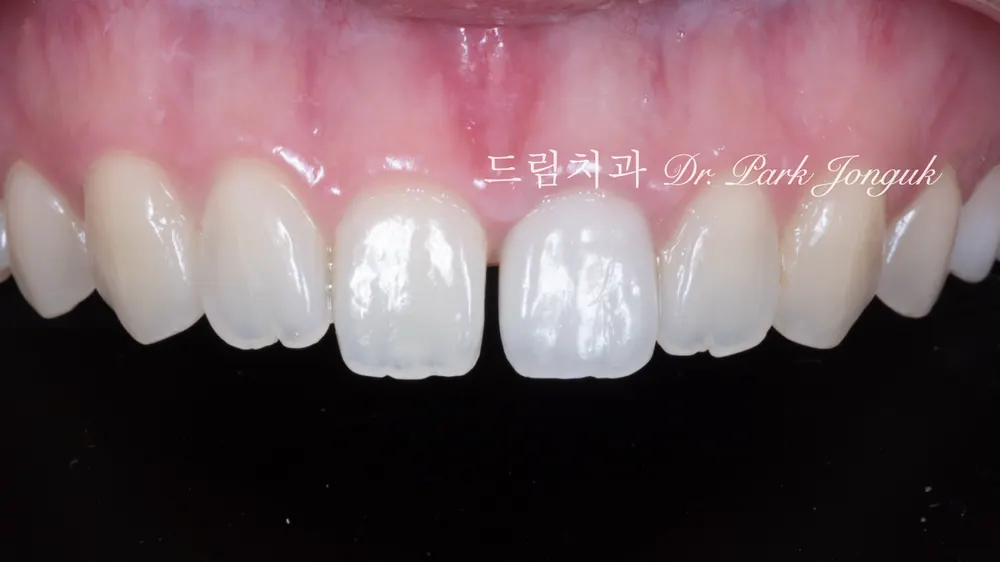
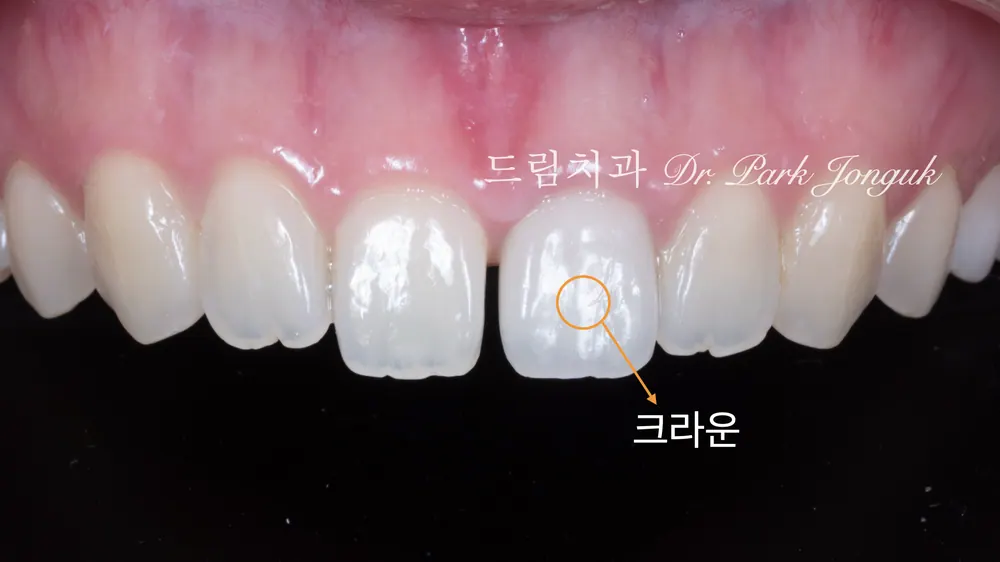
Photos 1, 2 | Condition at the First Visit
The left front tooth already had an all-ceramic crown.
It was an old crown, and its color and shape didn't match the natural teeth at all.
The right front tooth, meanwhile,
was very small and underdeveloped.
There was also a space between the two teeth,
and the left-right balance had already broken down.
In Photo 2,
I've marked with an arrow which tooth is the crown.
Even at this stage, it was already clear this case wouldn't be easy.
Photo 3 | Removing the Existing All-Ceramic Crown
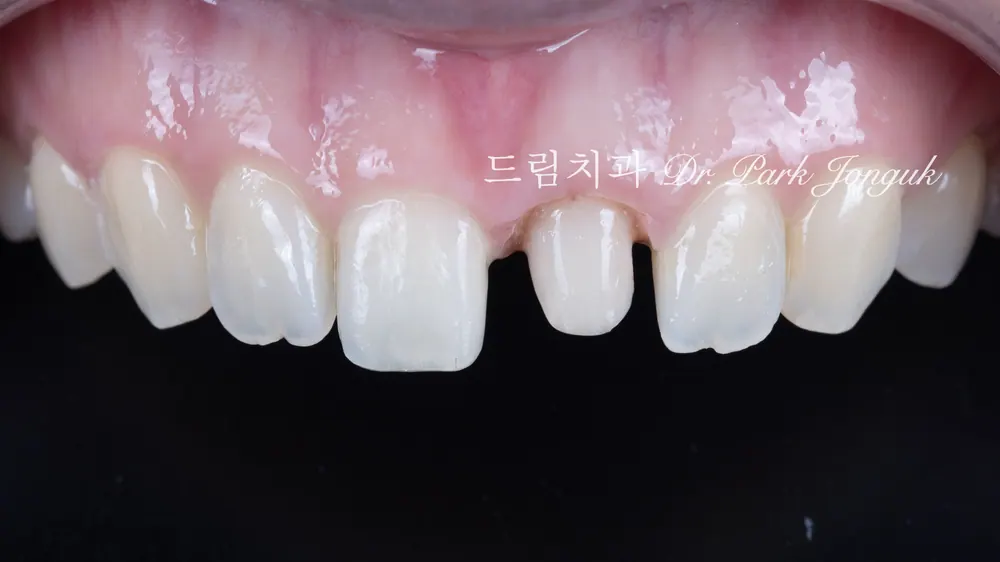
We removed the existing crown.
We needed to check the exact condition of the tooth under the old crown,
since that's what determines the direction of the redo.
What matters at this stage
isn't how much more to remove,
but how much can still be preserved.
Photos 4-9 | Fabricating the No-Prep Veneer and All-Ceramic Crown
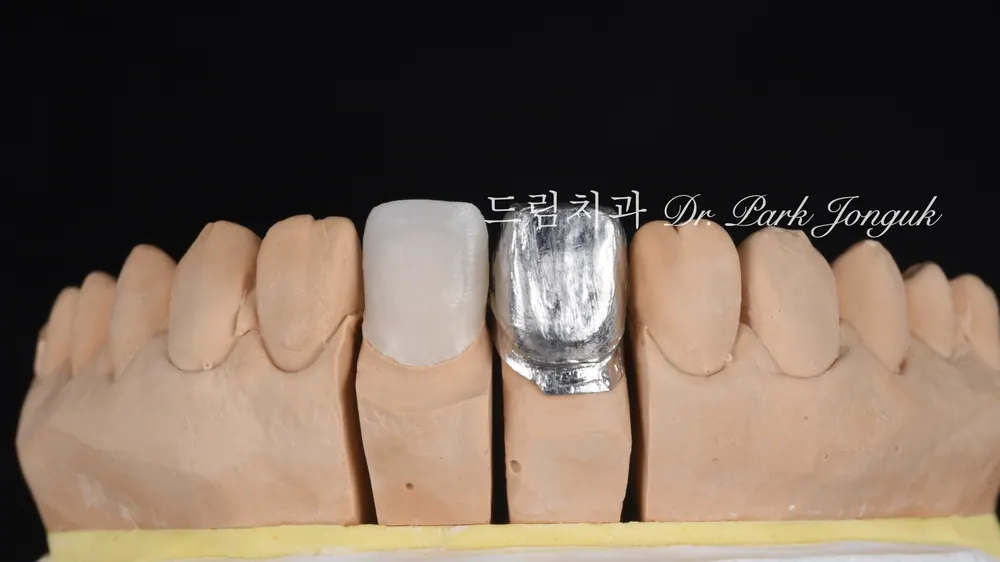
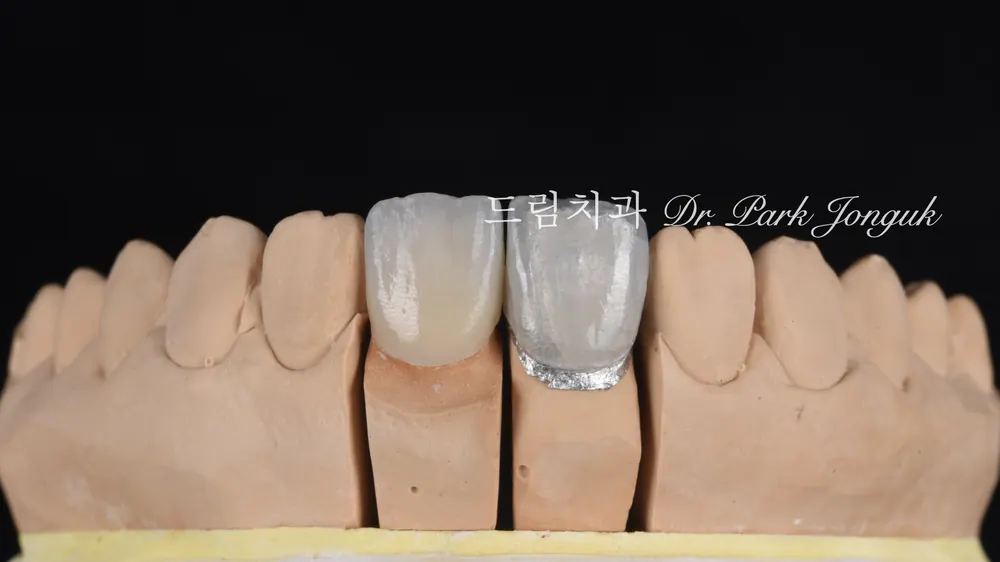
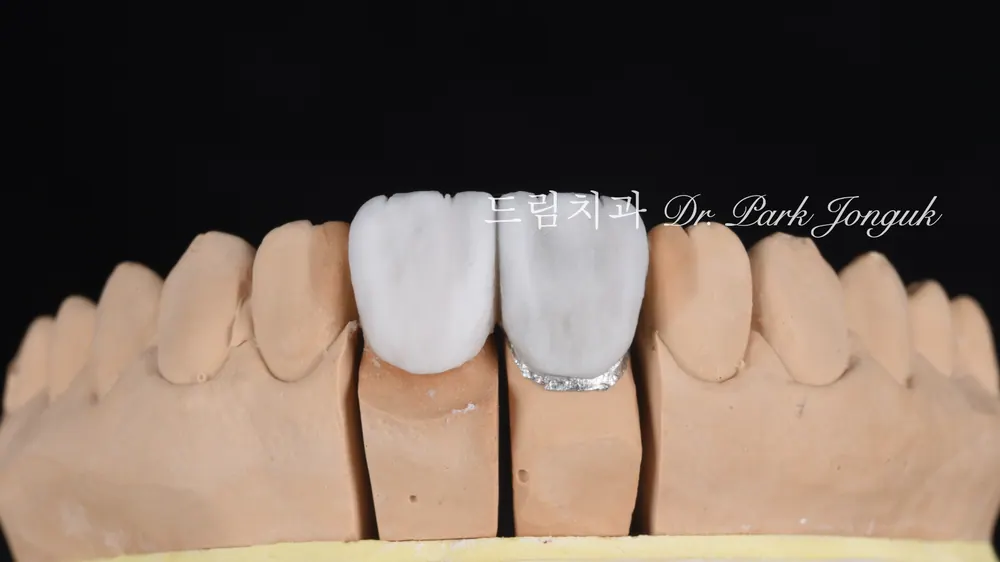
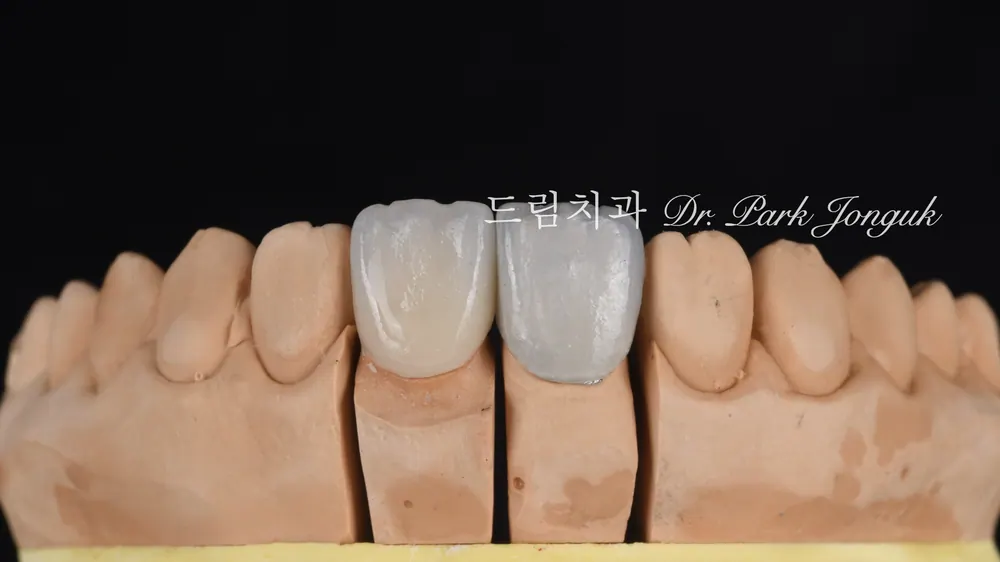
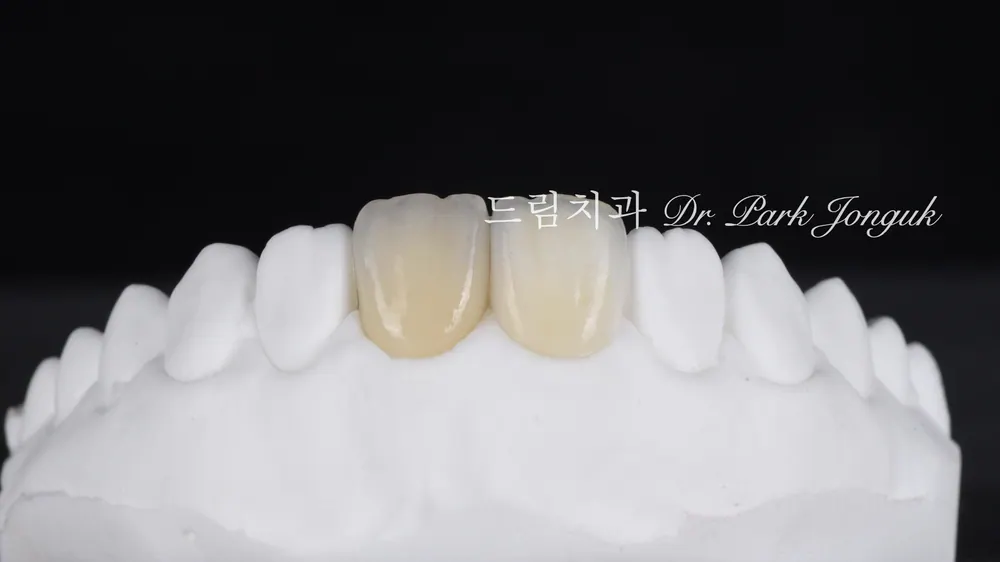
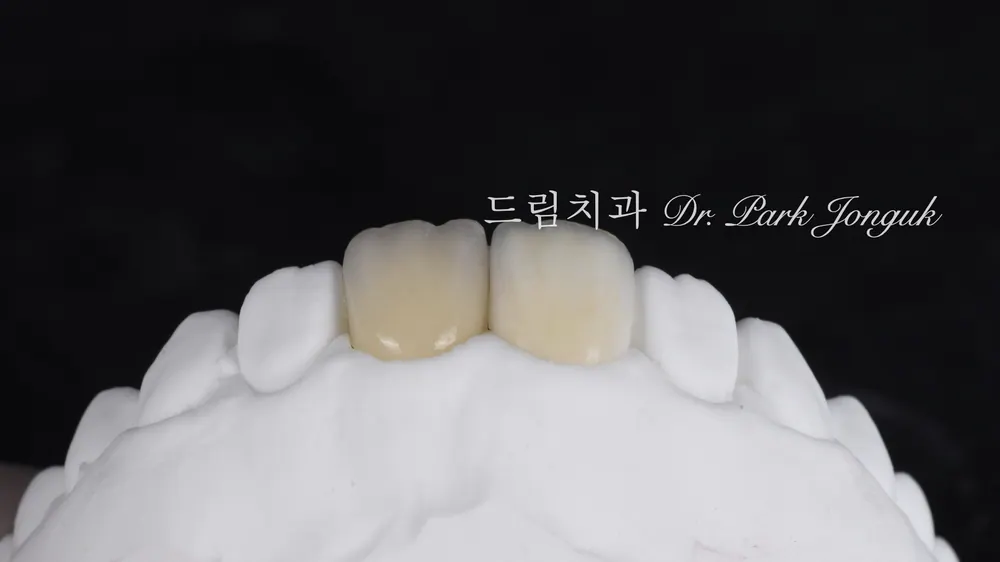
This is the heart of the case.
On one side, an all-ceramic crown.
On the other, a no-prep veneer.
And the harmony with the natural tooth in between.
If you look at the later photos,
you can see that the veneer and the crown appear different colors when placed on the white model.
This isn't a mistake —
it's an intentional difference.
Because no-prep veneers
are so thin, the natural tooth's color shows straight through them.
So starting from the fabrication stage,
the crown has to be made to match the natural tooth,
while the veneer has to be made a bit brighter —
calculated deliberately,
so that the final color matches once everything is in the mouth.
If this calculation is off,
the veneer alone can look gray,
the crown alone can stand out,
or both can end up looking artificial.
This process
isn't something a machine can solve.
It's a stage where the maker's experience and sense show up directly in the result.
Photo 10 | After Setting the Crown, Testing the Veneer
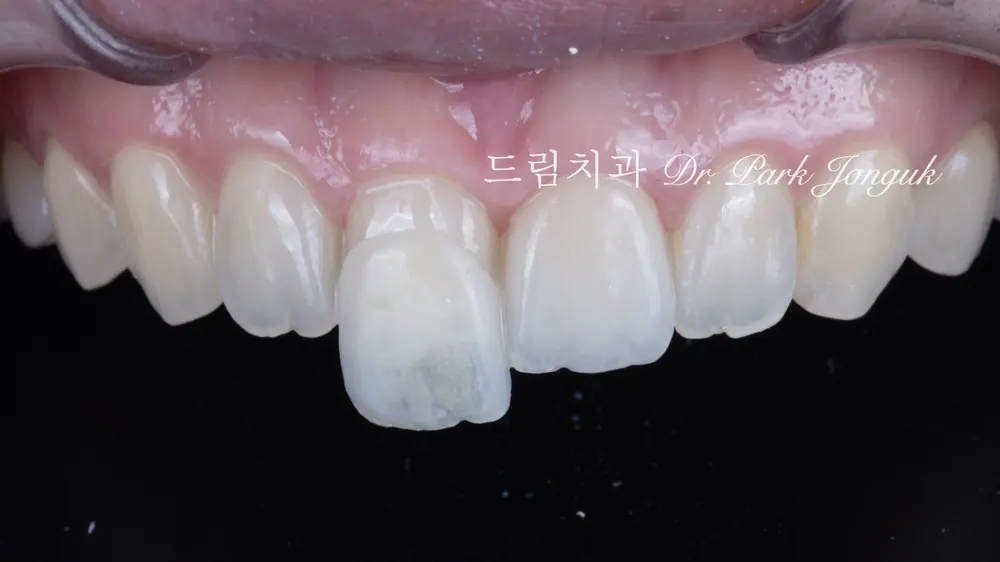
After setting the crown first,
we placed the veneer against it at an angle.
There are two points to notice in this photo.
The thickness of the veneer
The translucency of the veneer
You can see just how thin the no-prep veneer is,
and how much expression is packed into it.
Photos 11, 12, 13 | After Final Treatment
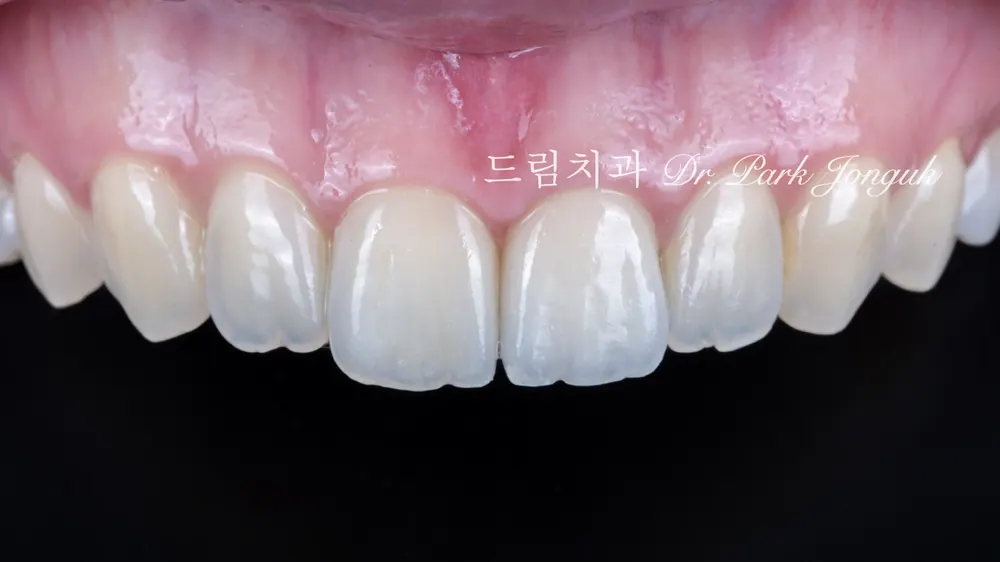
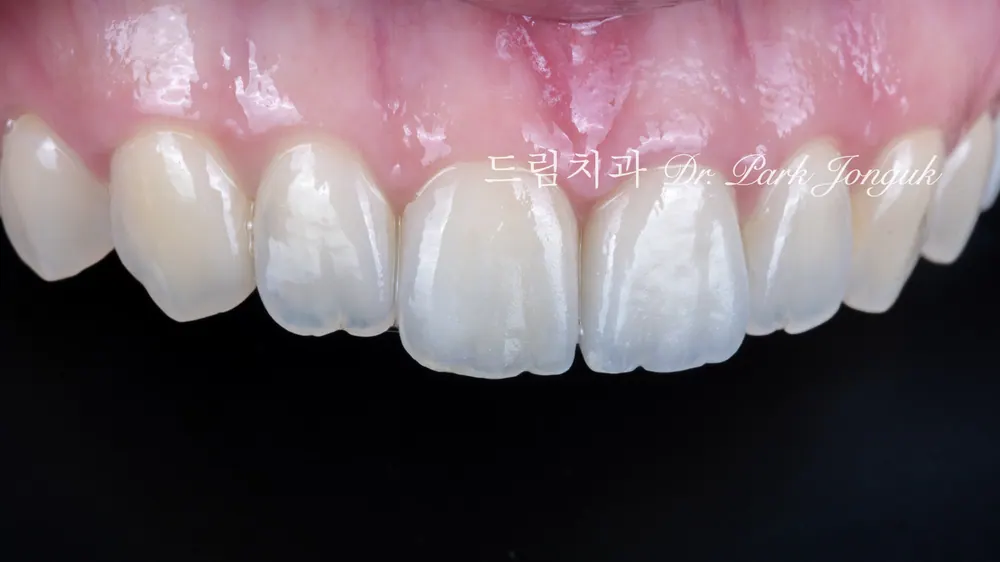
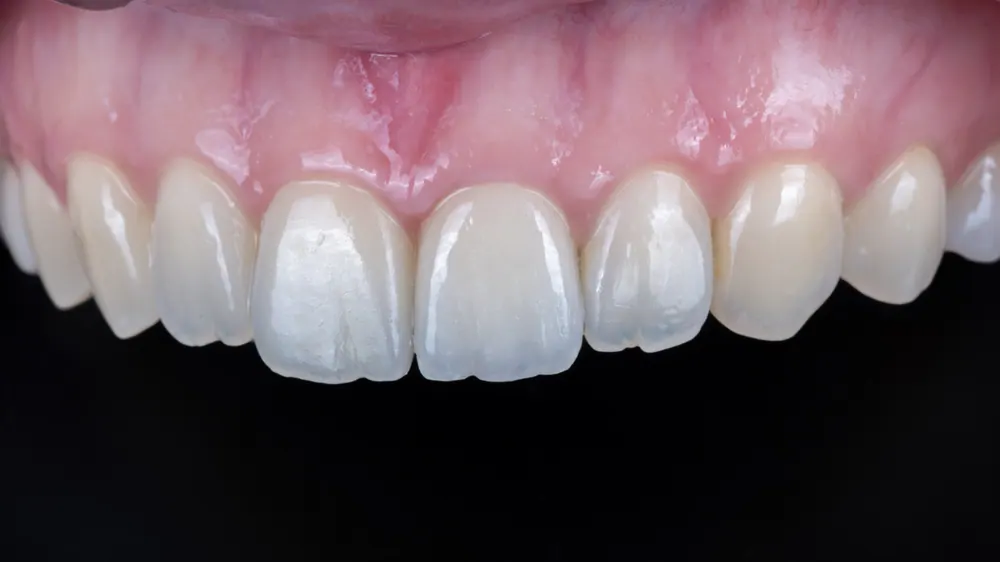
Treatment is now fully complete.
If you compare the translucency of the natural tooth,
the subtle color shift at the tooth tip,
and even the surface texture,
it's genuinely hard to tell
which tooth is the crown
and which is the veneer.
This was the goal of this treatment,
and also the most difficult part of it.
Conclusion
This case
isn't one that can be summed up simply as "we made it pretty."
An all-ceramic crown redo,
a no-prep veneer,
and perfect harmony with the natural teeth —
this was a case where all three
had to be satisfied at once, making it one of the most challenging esthetic cases there is.
Not every veneer case is this difficult.
But I believe it's only by building up the experience to solve cases like this
that you can truly master veneer treatment.
Q&A (Simple Version)
Q1. Why is it so difficult to do a crown and a veneer together?
A. Because the two treatments differ completely in thickness and in how they express color, coordinating the color — including that of the natural teeth — is extremely difficult.
Q2. Why are no-prep veneers so demanding?
A. Because they're so thin that the natural tooth's color shows straight through, even a small error in the color calculation during fabrication becomes immediately noticeable.
Q3. Is a case like this possible at every clinic?
A. Without enough experience and a solid fabrication system, predicting the outcome is difficult, which is why most clinics find a case like this daunting.
This article is a clinical note written by Dr. Park Jonguk of Dream Dental Clinic, Gangnam; the original was published on his blog. The photographs shown are real cases he treated. Results vary with each patient’s condition, and every procedure carries the possibility of individual variation and side effects.

Quick Consult
Request a Callback
Leave your number and we will call you back during clinic hours.
Request Received
We will contact you during clinic hours. For urgent matters, please call +82-2-3448-0028.