
[All-Ceramic Redo] A Front-Tooth Bridge Ruined by Excessive Reduction, Restored by a 28-Year Specialist's Precision Design
Hello.
I'm Park Jonguk, an esthetic and conservative dentistry specialist with 20 years in Apgujeong and 28 years of clinical experience as a dentist.
We often assume that "esthetic treatment" simply means making teeth white and even.
But after 28 years and tens of thousands of patients, the conclusion I've reached is different.
True esthetic treatment is "finding the best possible harmony within the limits of preserving the tooth's vitality."
The case I'll share today is truly unfortunate, but it carries an important lesson for anyone considering a redo.
The patient came in because of a mismatch between an old all-ceramic crown and bridge, but the truth we found once we removed the restoration came as a real shock, even to me as a dentist.
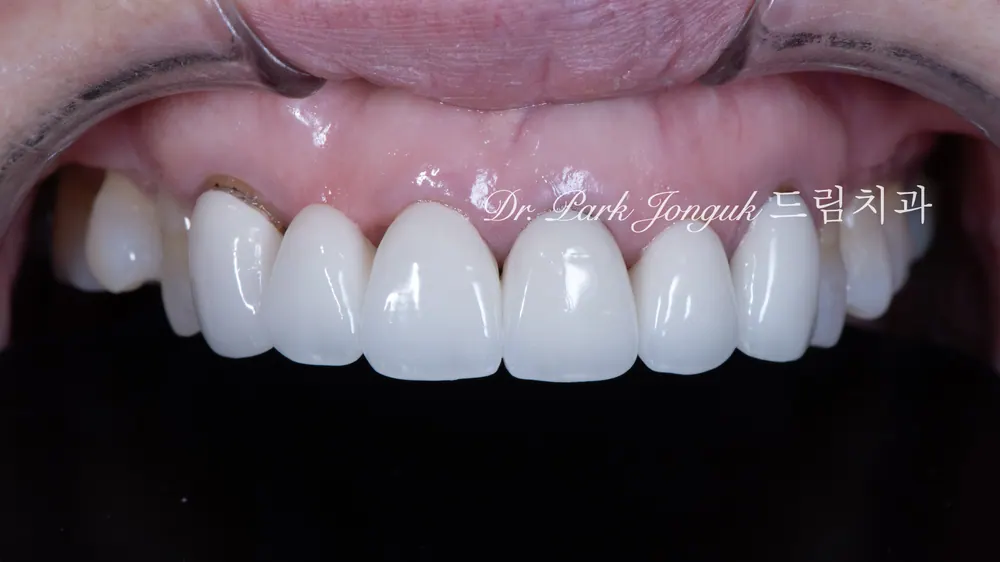
1. First Visit: Unnaturalness Hidden Beneath a Flashy Restoration
The patient had been living with a front-tooth bridge and crowns for quite a long time.
But as time passed, the gum line had receded, and the margin between the restoration and the gums had turned black.
Above all, the color of the teeth was a "dull, murky white" that didn't blend with the surrounding teeth at all,
and the shape was also disrupting the harmony of the entire face.
The patient earnestly told me, "I just want a natural, bright smile like everyone else."
But what concerned me more than the visible esthetic problems was the condition the tooth underneath might be in.
When a restoration doesn't fit well, food particles get trapped in the gaps and secondary decay develops,
which ultimately shortens the tooth's lifespan dramatically.
2. Precise Diagnosis: Dr. Park Jonguk's "Prescription"
I don't finish a consultation by simply sending the lab a note that says "please make it pretty."
As the author of a textbook specializing in veneers, I apply every piece of academic data I have to the patient's actual face.
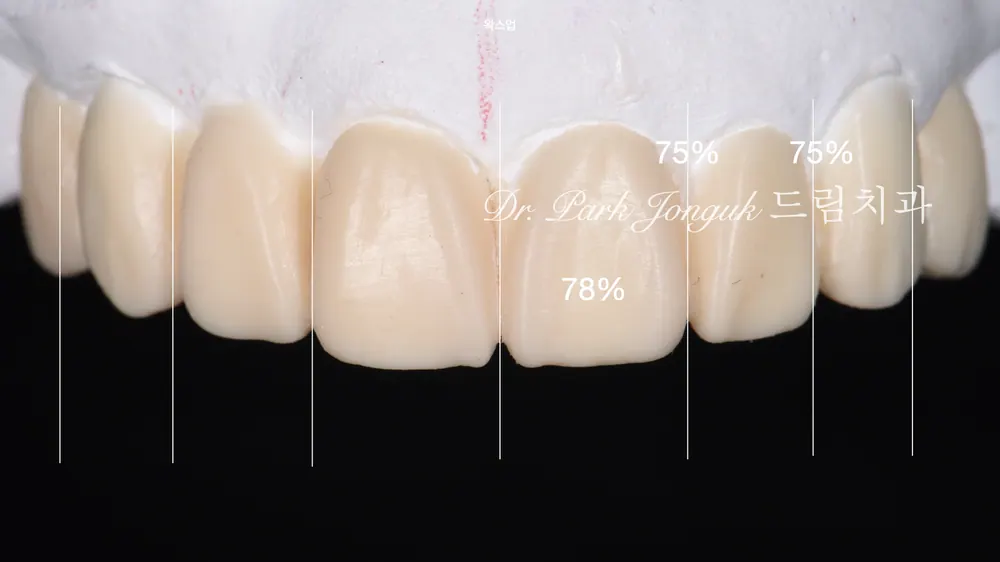
[Photo 2] Wax-Up Diagnostic Mock-Up
As I'll also emphasize on our redesigned website, the core of Dream Dental Clinic is "design led by the dentist."
Facial analysis: We quantify the face's midline, lip movement, and the proportions of the nose and chin.
Digital and analog wax-up: Based on this quantified data, we build a preview model of the final result in advance.
Through this process, we determine how much to even out the gum height and how to distribute the load across the bridge.
Only when the Prescription I set at this design stage is flawless can the later fabrication produce a restoration with no margin of error.
3. The Truth We Found: Scars Left by Excessive Reduction
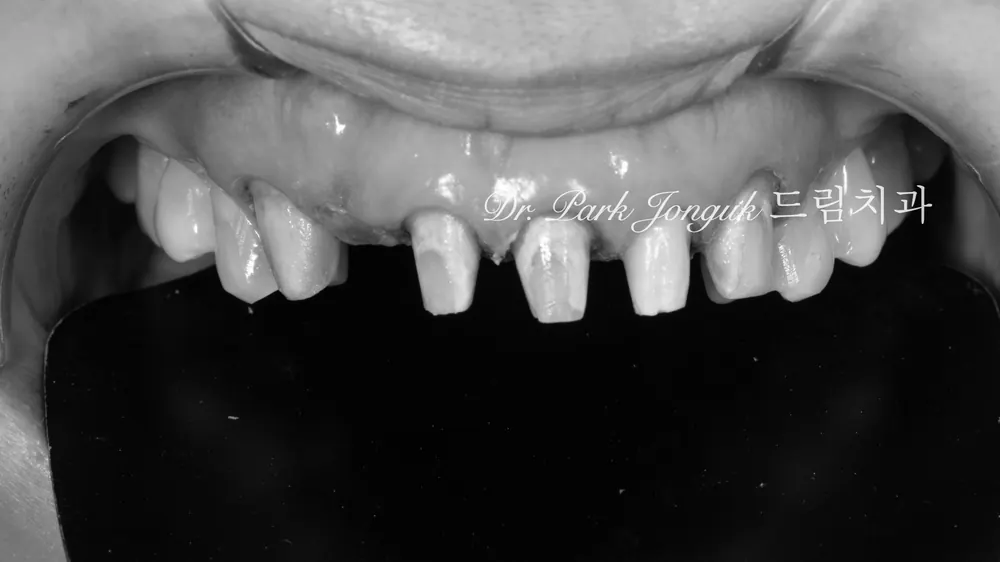
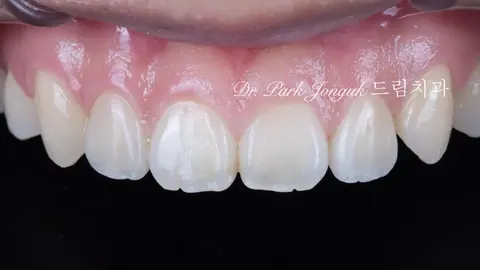
[Photo 3] After Removing the Existing Restoration
The moment I carefully removed the existing restoration, I was at a loss for words for a while, out of sheer regret.
The tooth had been reduced to an extremely severe degree.
As a board-certified specialist in conservative dentistry, this was a level of destruction I simply cannot condone.
Whoever treated this patient before had likely, in order to make the alignment look even as quickly as possible,
ground down the teeth indiscriminately.
But this isn't really treatment — it's closer to destruction.
With malocclusion this severe, the position of the teeth should have been corrected with orthodontic treatment before any reduction was ever done.
If the tooth axis had been shifted through orthodontics, the amount of reduction could have been dramatically reduced,
and veneers might not even have been necessary at all.
The patient may have gotten a quick result at the time, but the price was borrowing against the tooth's future lifespan.
Because so much had already been removed, the abutment teeth were left weak, so this redo had to go beyond simply making things look pretty —
everything had to be staked on the question of how to perfectly seal and protect the tooth structure that remained.
4. The Essence of the Treatment: Hand-Layered Buildup and Inspection
This is exactly where the limits of the "same-day method" churned out by factory-style clinics become clear.
With a monolithic method that mills a single block, it's impossible to both block out the discoloration of an abutment tooth that's been reduced this much
and still achieve a natural sense of translucency.
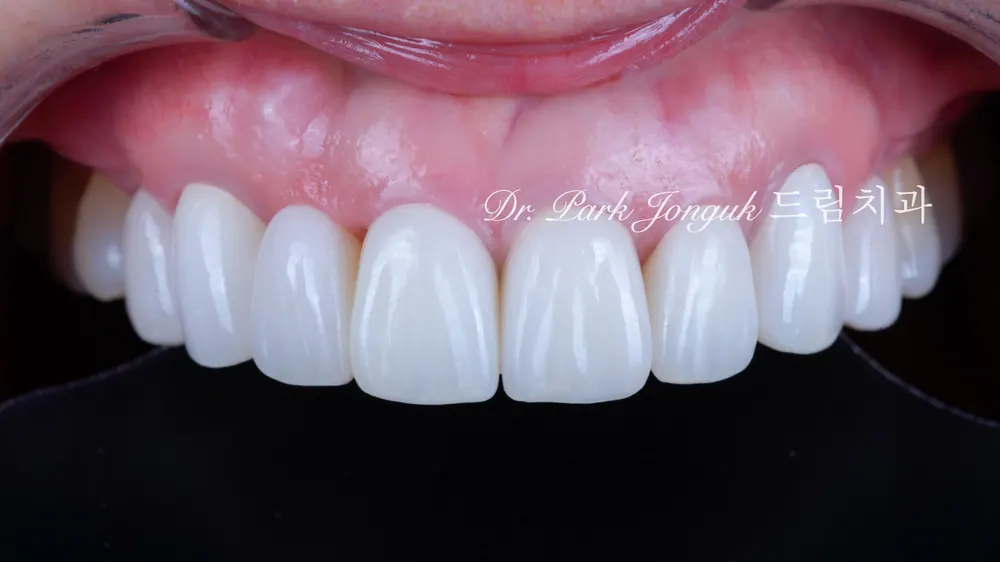
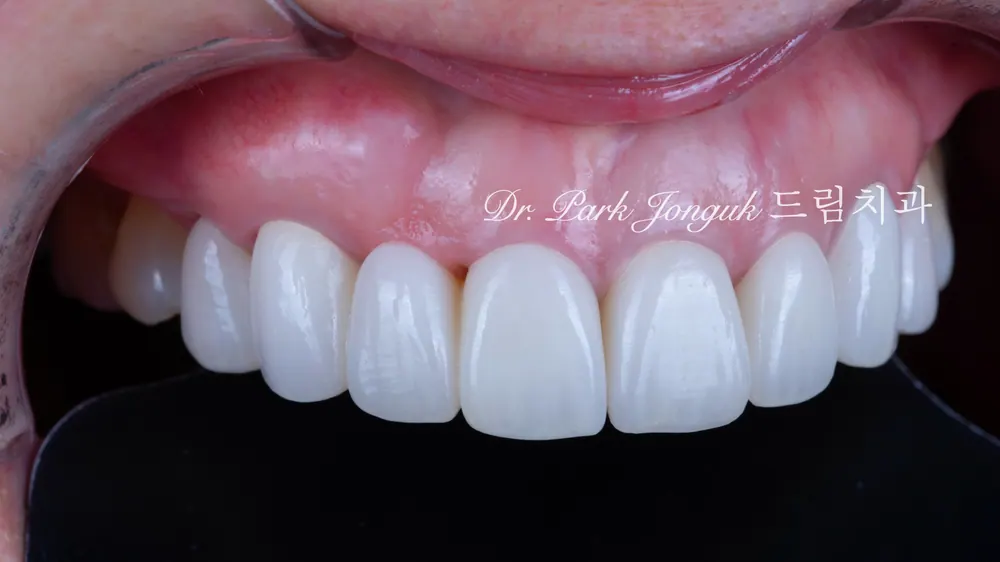
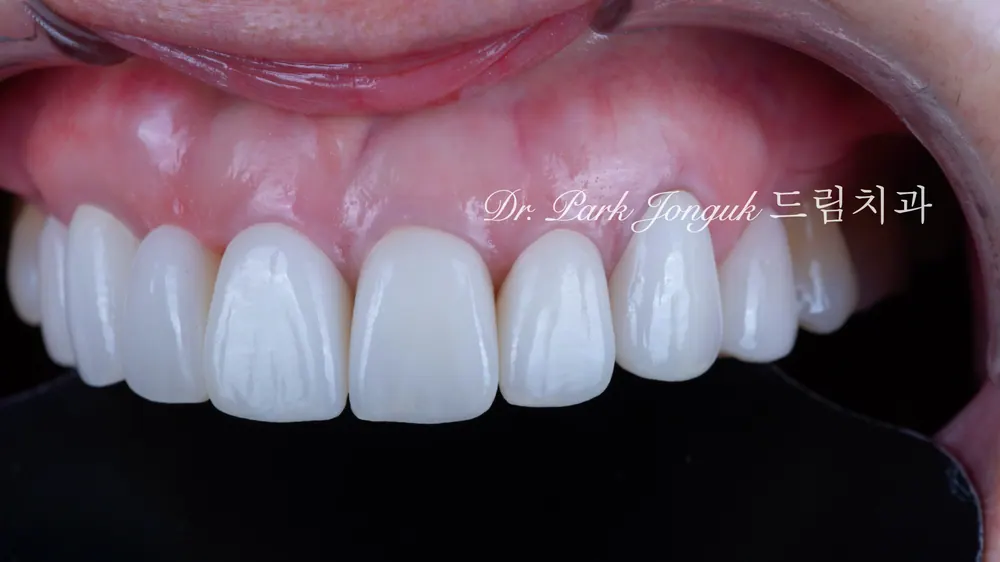
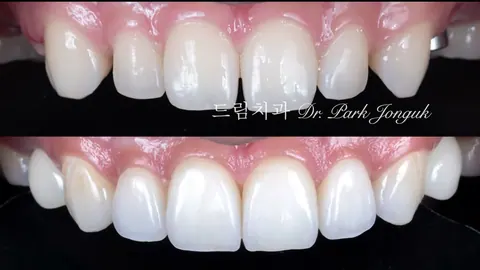
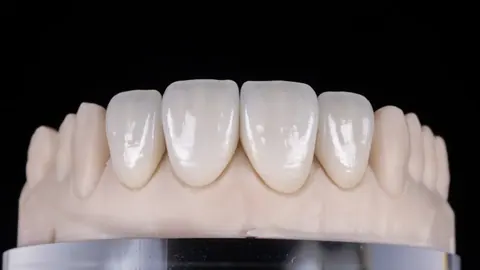
[Photos 4, 5, 6] After Treatment
The result was remarkable.
The patient looked in the mirror and was so moved she asked, "Are these really my teeth?"
1. Multi-layered buildup: A skilled dental technician stacked dozens of kinds of ceramic powder, layer by layer.
The opaque areas inside the tooth were masked, while the clear, enamel-like feel of the surface was preserved.
This is exactly the power of handcrafted work.
2. Strict Inspection: If the fabricated restoration differs from the design I prescribed
by even 0.1mm, I simply won't set it.
The final inspection stage — checking the fit against the gums and how the surface scatters light under a microscope — is what creates this level of precision.
3. Recovery of Gum Health: Thanks to the precisely fitted restoration, the gums, which had been under constant pressure, began to regain their vitality and take on a healthy, rosy color.
5. Conclusion: Choose a Treatment You Can Still Smile With 20 Years From Now
We're living in an age of "name-branding marketing."
The names sound grand, but underneath, the substance is often just "ceramic milled by a machine."
But teeth are not a product stamped out at a factory.
If you skip the process where a textbook author does the design personally, a skilled craftsman shapes it by hand, and the dentist inspects it under a microscope,
it's hard to call that genuine medical care.
If you're suffering from past excessive tooth reduction, as in this case,
you need to find a specialist who can protect what's left of your teeth without any further reduction.
Through the "art of preservation" proven by 28 years of experience and Dream Dental Clinic's 20-year history,
I'll bring the vitality back to your smile.
💡 In-Depth Expert Q&A
Q1. My teeth have already been reduced a lot — is a redo still possible?
A. Yes, it's possible. In fact, the more a tooth has been reduced, the more precisely fitted the restoration needs to be.
If the restoration covering the tooth lifts even 0.01mm, bacteria can get in through that gap, which can eventually lead to the tooth being extracted.
We eliminate this risk at the source through microscope-based inspection.
Q2. Does an all-ceramic bridge have a shorter lifespan than veneers?
A. A bridge is structured so that the teeth on either side share the load of the missing tooth.
So if the mechanical design is done incorrectly, the abutment teeth can fracture.
But with textbook-level load calculations and a precise fit, a bridge can last just as long as a natural tooth.
Q3. Why did other clinics recommend reduction instead of orthodontics?
A. Patients usually prefer whatever finishes "quickly."
Orthodontic treatment takes one to two years, while reduction followed by a crown can be finished in one to two weeks.
But a dentist should prioritize the patient's lifelong oral health over immediate satisfaction.
Even now, I recommend orthodontic treatment first for any case where excessive reduction seems likely.
Q4. Is a handmade restoration more resistant to discoloration?
A. The material itself has similar resistance to discoloration, but there's a difference in surface texture and density.
Ceramic that's carefully fired using the handmade method has a very dense surface, so plaque doesn't adhere to it as easily,
and it keeps a natural luster even after many years.
Q5. How much pain or time is involved in a redo?
A. There's very little pain, since we use a precision microscope to remove the existing restoration and minimize damage to the tooth.
The process can take one to two weeks longer than at a typical clinic, since it includes precise diagnosis and handcrafted fabrication,
but that extra time is proven worthwhile by the result.
![[All-Ceramic Redo] A Front-Tooth Bridge Ruined by Excessive Reduction, Restored by a 28-Year Specialist's Precision Design — photo 7](/column-media/224178494655/07.webp)
This article is a clinical note written by Dr. Park Jonguk of Dream Dental Clinic, Gangnam; the original was published on his blog. The photographs shown are real cases he treated. Results vary with each patient’s condition, and every procedure carries the possibility of individual variation and side effects.
Quick Consult
Request a Callback
Leave your number and we will call you back during clinic hours.
Request Received
We will contact you during clinic hours. For urgent matters, please call +82-2-3448-0028.