
No-Prep Veneers Beautify Inward-Tilted and Short Teeth — No Tooth Reduction
Hello, I'm Park Jonguk, director of Dream Dental Clinic, who has practiced cosmetic dentistry in Apgujeong for 20 years.
Today I'd like to introduce a case where no-prep veneers resolved inward-tilted teeth, short and small teeth,
and a gap between the front teeth all at once.
Inward-tilted teeth, short teeth, gapped front teeth... so many concerns
This patient came in with several concerns.
First, inward-tilted teeth.
Her teeth angled inward, so she lacked confidence when smiling.
Second, short, small teeth.
Her concern was that small teeth made her look childlike.
Third, a gap between the front teeth.
There was a space between the central incisors that stood out when she smiled.
The patient said, "I considered orthodontics, but it takes a long time and can't improve tooth size or color, so I looked into veneers instead."
Before treatment, several issues are visible
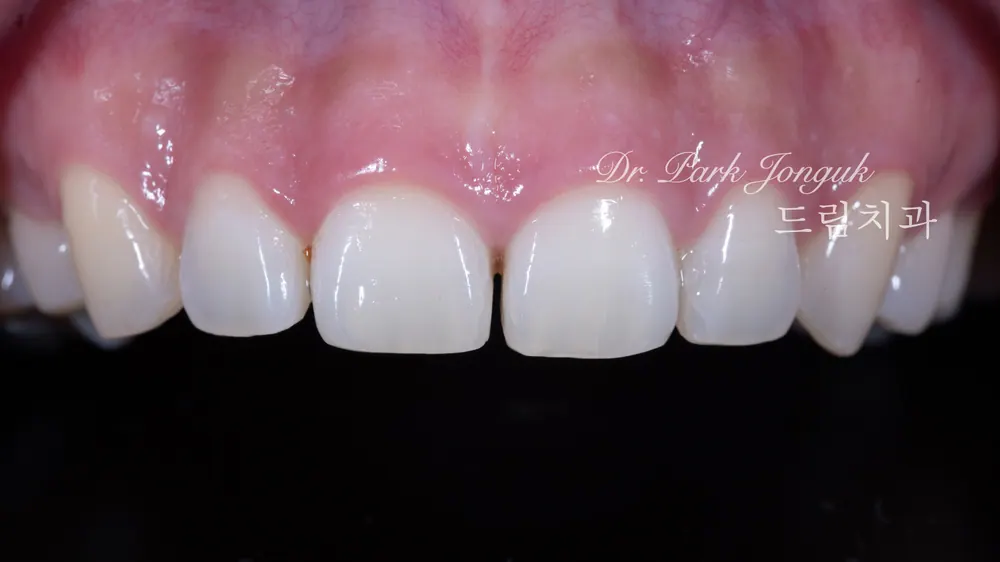
Photo 1 is the initial examination photo.
Several aesthetic issues can be observed.
Her teeth were angled inward — inward-tilted teeth.
The teeth were short and small overall.
The central incisors in particular were short, making the smile look cramped.
There was a gap between the central incisors.
This made the center of the smile look awkward.
The tooth color was somewhat yellow, and the shape was monotonous.
But there was good news.
This patient had the ideal conditions for no-prep veneers.
Her teeth were small, inward-tilted, and relatively even.
In such cases, veneers can be done with almost no tooth reduction.
Designed perfectly with a wax-up
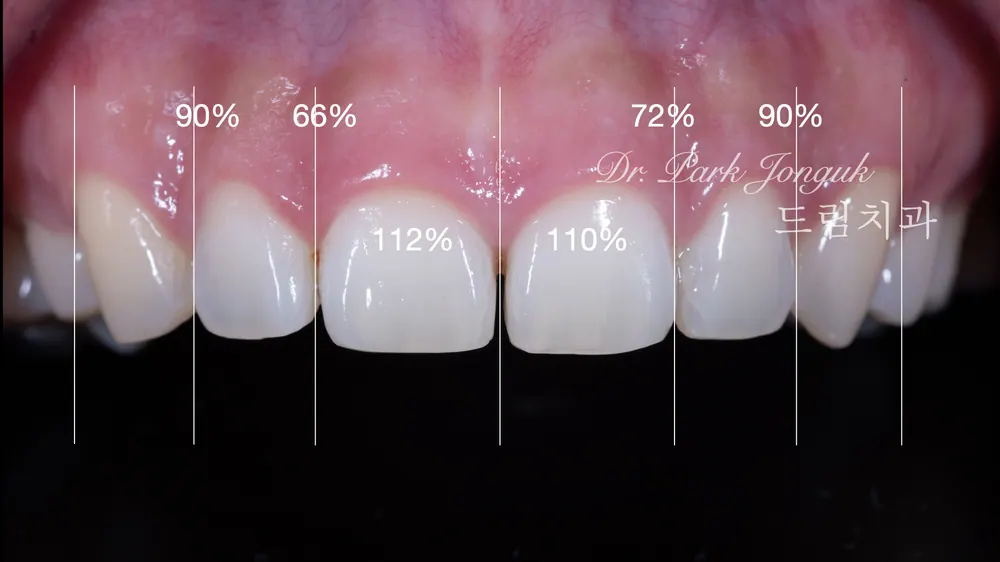
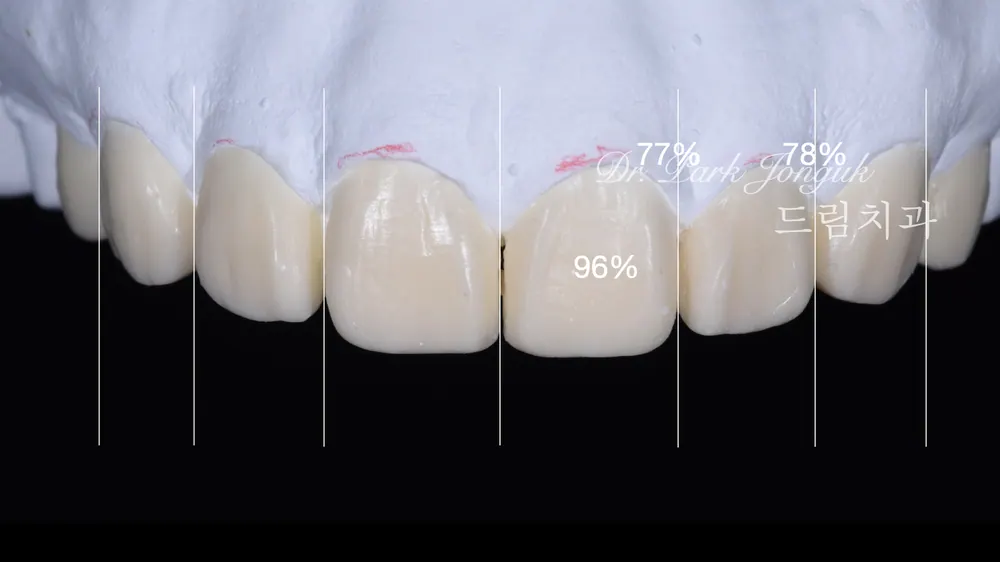
Photos 2 and 3 show the results of the precision wax-up diagnosis.
This is the process of previewing the post-treatment appearance.
We brought the teeth forward to resolve the inward tilt.
We lengthened the teeth to improve the short, small tooth problem.
We completely closed the gap between the central incisors.
The shape of the teeth was also designed to look natural and beautiful.
We created feminine, elegant curves.
Seeing the wax-up model, the patient was delighted, saying, "I can't wait to have a smile like this."
Gum contouring, for an even more beautiful smile
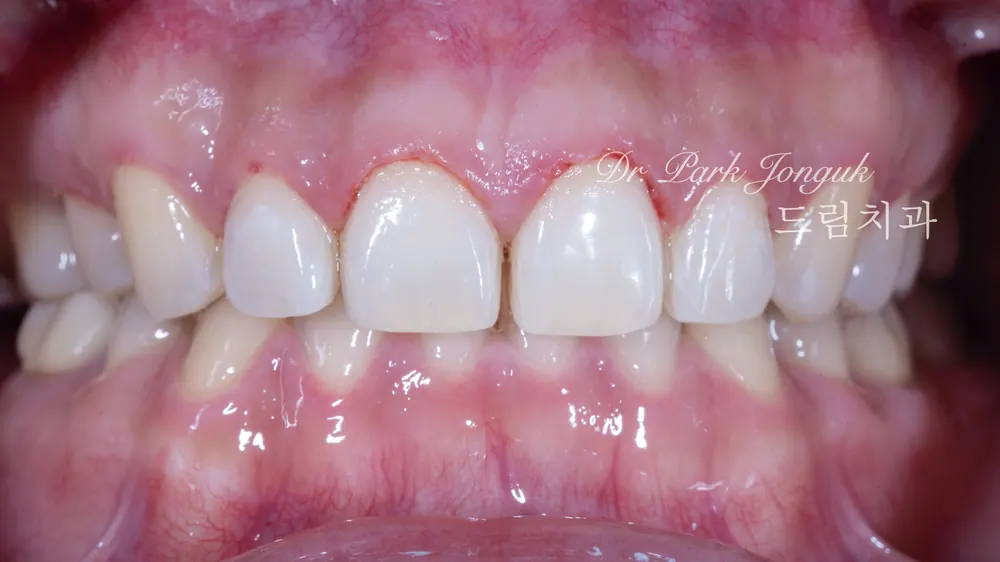
Photo 4 shows the appearance after gum contouring.
To make the teeth look longer, the gumline needs to be raised slightly.
Especially with short teeth, combining gum contouring (gingivoplasty) can achieve a much more beautiful result.
We used a laser to precisely trim the gums.
There is almost no pain, and bleeding is minimized.
We shaped the gumline to look natural and beautiful.
We also matched left-right symmetry perfectly.
One week later, the gums have healed
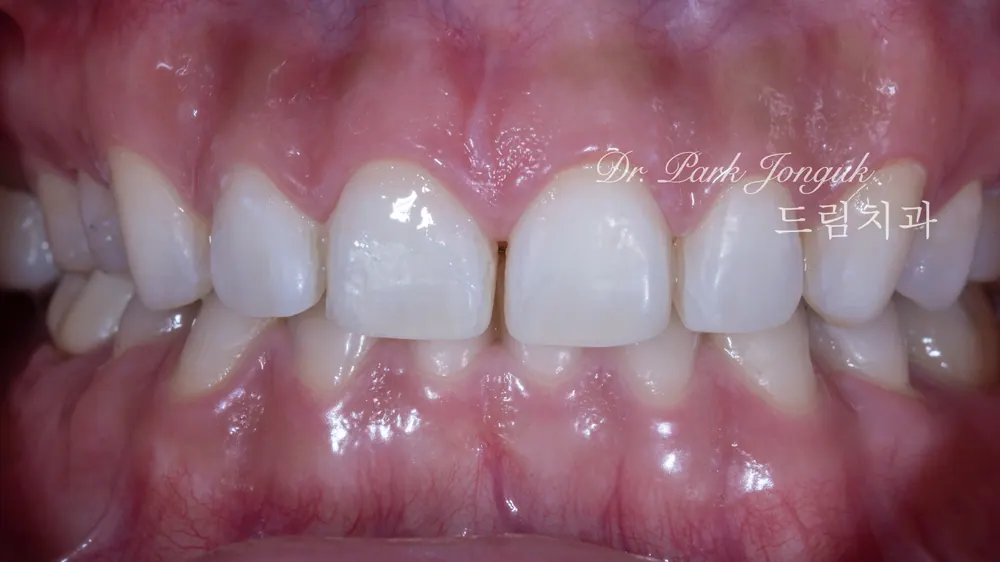
Photo 5 shows the appearance one week after gum contouring.
The gums have healed cleanly.
There is no swelling, no bleeding, and the color is a healthy pink.
The gumline has finished looking natural and beautiful.
Now it's ready for the veneers to be bonded.
It's important to place the veneers only after the gums have fully recovered from contouring.
The gums must be stable for the border between the veneer and the gum to stay natural and healthy.
Checking with a half try-in
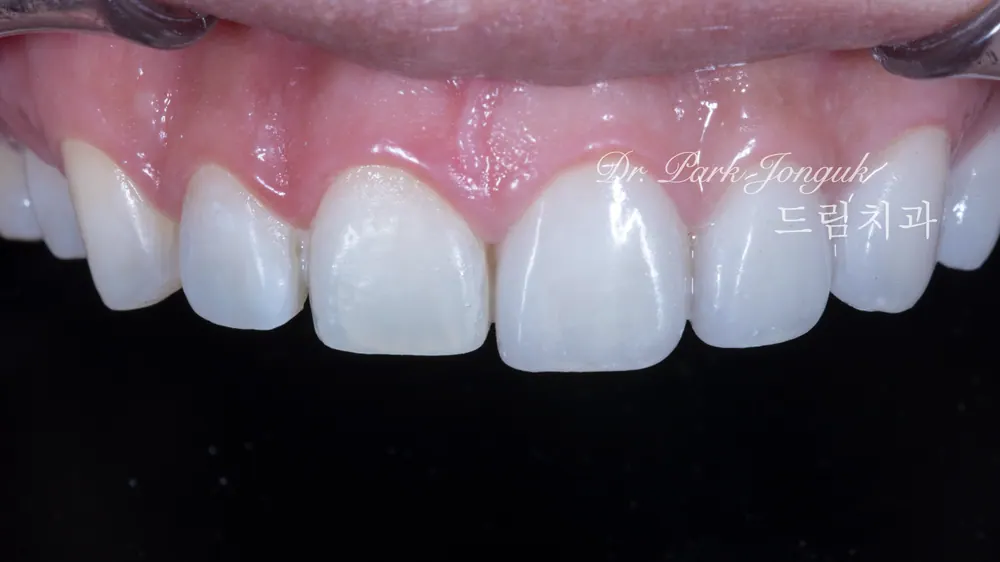
Photo 6 shows the veneers placed on only one half.
This is the try-in process.
The left side has the veneers placed, the right side does not yet.
The difference is striking.
On the side with veneers, the teeth come forward, lengthen, and the gap is closed.
The side without veneers is still inward-tilted, short, and gapped.
This process lets the patient see the change for herself.
"It's really different. I can't believe it," she said in amazement.
Wrapping the sides perfectly as well
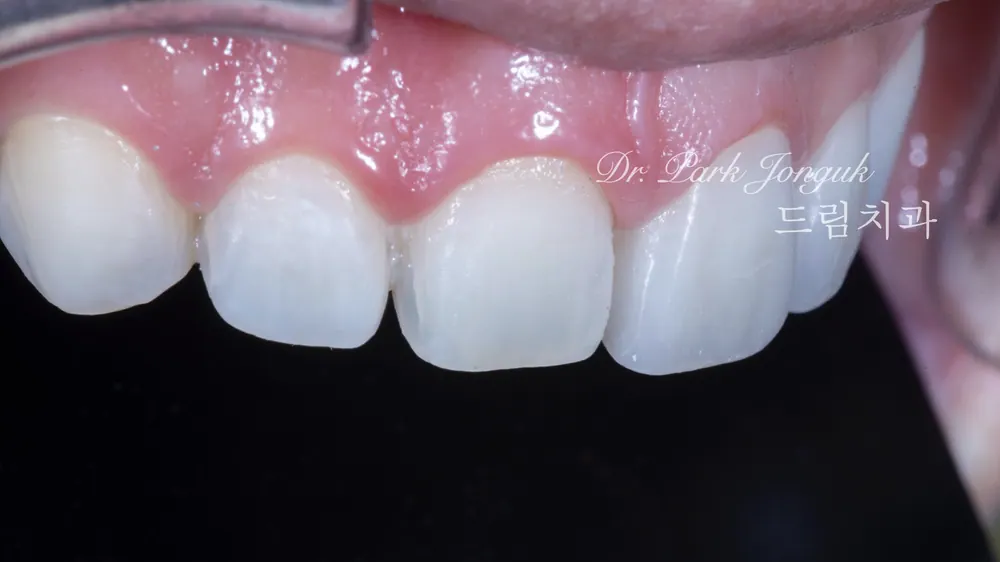
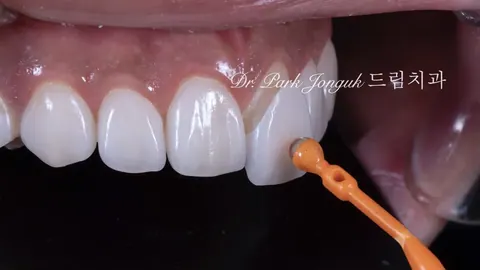
Photo 7 is a side view of the veneer placed on tooth #21 (the left central incisor).
You can see the veneer wraps well around the side of the tooth.
No-prep veneers naturally wrap not only the front surface but also the sides of the tooth.
Because the tooth was inward-tilted, the veneer could bring the tooth forward while naturally covering the sides as well.
This is possible only because almost no tooth structure was removed.
If a lot of the tooth had been reduced, there would have been no room to wrap the sides.
No-prep veneers complete — so beautiful
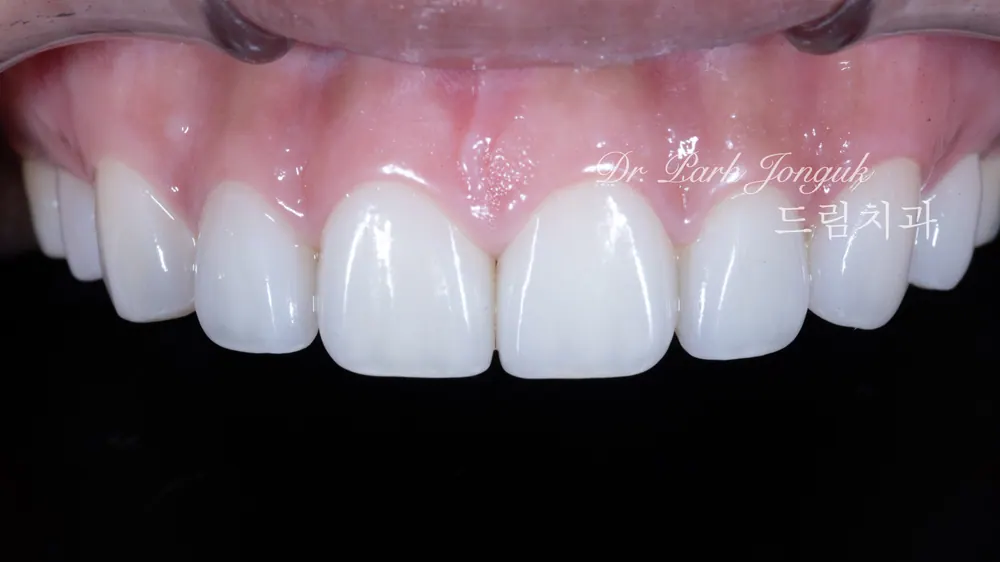
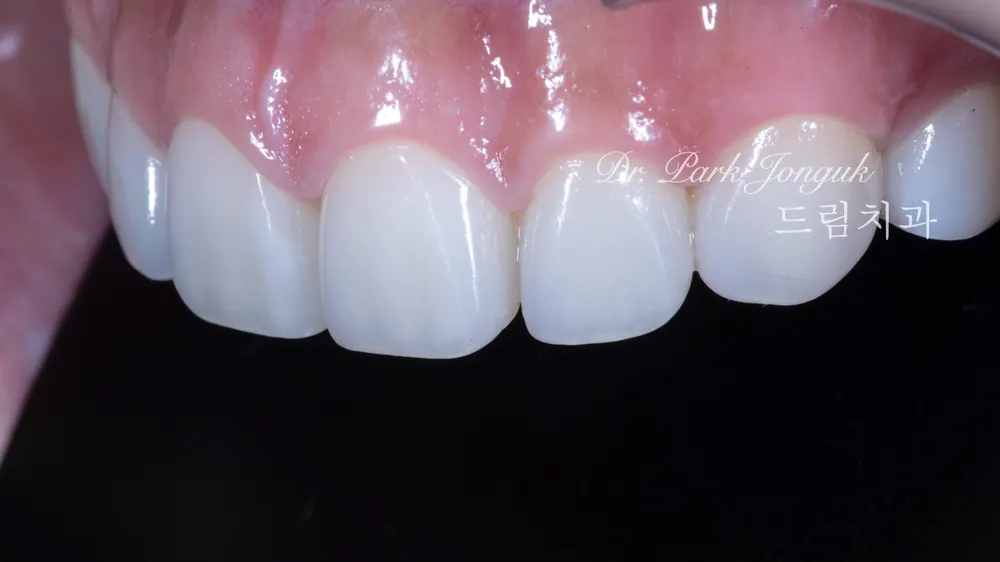
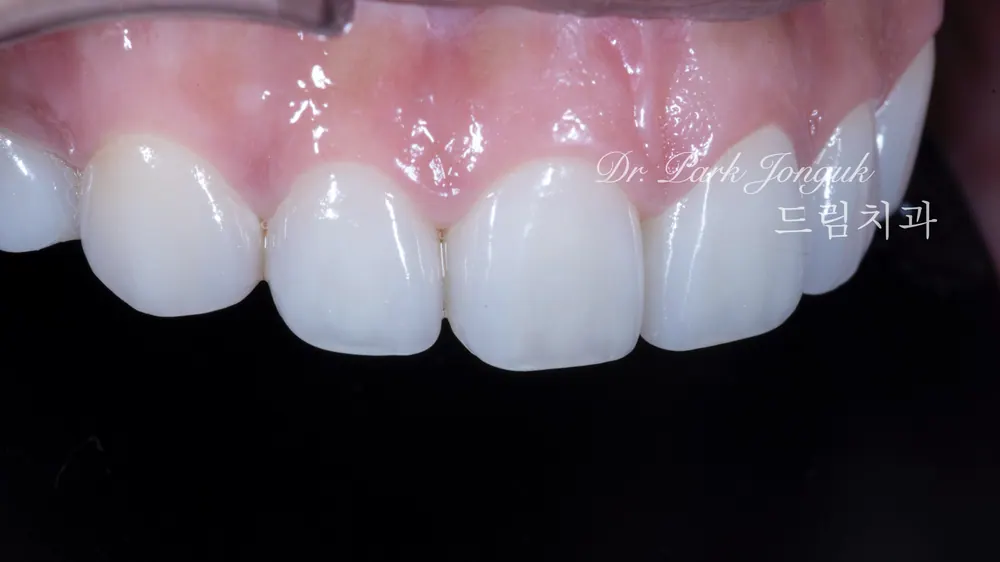
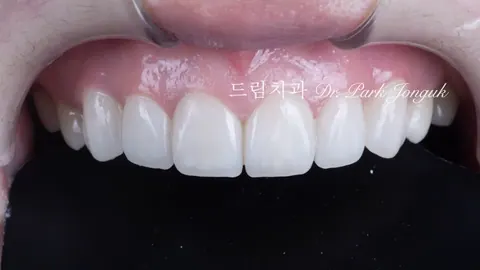
Photos 8, 9, and 10 show the appearance after the no-prep veneer treatment was completed.
It's truly a remarkable change.
The inward tilt is completely resolved
The teeth now come forward naturally, so the inward tilt is no longer visible at all.
The tooth alignment is even and forms a beautiful curve.
The teeth are longer and more beautiful
The short, small teeth changed to an ideal length and size.
Gum contouring and the veneers worked together to create a perfect proportion.
The gap between the front teeth is gone
The space that once separated the central incisors is completely closed, so the teeth now look naturally connected.
The color is bright and natural
The yellowish tooth color changed to a bright, radiant shade.
But it's not simply white — it has translucency and dimension, so it looks natural.
The translucency at the tooth edges, the subtle surface curvature, and the way the color shifts with light are all alive.
This is exactly the natural look created by hand-layered, no-prep veneers.
The smile is completely different
The overall smile became bright and confident.
The patient was delighted, saying, "I'm happy every time I look in the mirror. Smiling is a joy now."
No-prep veneers — good for these people
No-prep veneers are especially suitable for the following people.
First, those with inward-tilted teeth.
If the teeth are angled inward, veneers move them forward, so almost no reduction is needed.
Second, those with small teeth.
Since the goal is to enlarge the teeth, there's no reason to reduce them.
Third, those with gaps between the front teeth.
Since the goal is to fill the space, no reduction is needed.
Fourth, those who want to preserve as much tooth structure as possible.
This is the best option for those who don't want to reduce healthy teeth.
Fifth, those who want to finish treatment quickly.
Orthodontics takes 1-2 years, but no-prep veneers can be completed in 2-3 weeks.
Advantages of no-prep veneers
No-prep veneers have truly many advantages.
First, they preserve the teeth.
Since healthy teeth are barely reduced, tooth health can be maintained as much as possible.
Second, there is almost no pain.
Since the teeth aren't reduced, no anesthesia is needed, and there is almost no pain during or after the procedure.
Third, there is no tooth sensitivity issue.
Reducing teeth can cause temporary sensitivity, but no-prep avoids that problem.
Fourth, it's reversible.
If you're not satisfied, removing the veneers lets you return to your original teeth.
This isn't possible when the teeth have been reduced.
Fifth, natural results.
Because the teeth aren't reduced, the veneers are thin, making them look even more natural.
Frequently Asked Questions (Q&A)
Q1. Don't no-prep veneers come off easily?
A. With a proper bonding process, they're just as strong as regular veneers. Bonding to enamel is very strong and stable.
Q2. I have inward-tilted teeth — can I just get veneers without orthodontics?
A. It depends on the degree of the inward tilt. Mild cases can be resolved with veneers alone, but severe cases may need orthodontics. The decision is made after a precise diagnosis.
Q3. Doesn't gum contouring hurt?
A. Since a laser is used, there is almost no pain and bleeding is minimized. Anesthetic cream alone is usually enough, and recovery is quick, about a week.
This article is based on the real clinical experience of a dentist who has practiced cosmetic dentistry in Apgujeong for 20 years. He teaches no-prep veneer techniques to fellow dentists every month at Lamista Academy and has published Korea's first laminate veneer textbook.
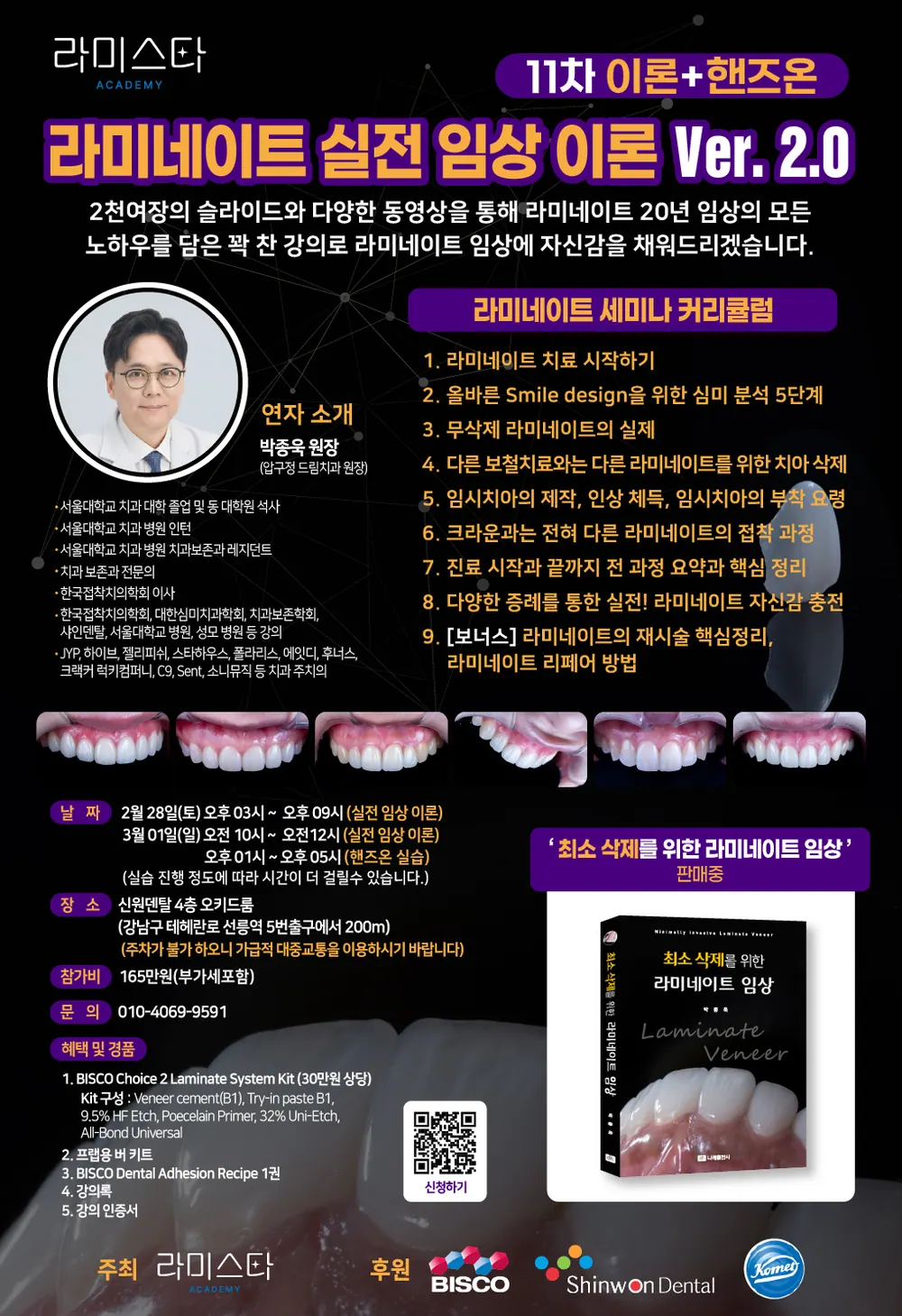
This article is a clinical note written by Dr. Park Jonguk of Dream Dental Clinic, Gangnam; the original was published on his blog. The photographs shown are real cases he treated. Results vary with each patient’s condition, and every procedure carries the possibility of individual variation and side effects.
Quick Consult
Request a Callback
Leave your number and we will call you back during clinic hours.
Request Received
We will contact you during clinic hours. For urgent matters, please call +82-2-3448-0028.