
Laser Veneer Removal: Why Veneers Can Be Removed Without Tooth Damage
In veneer redo treatment, the most important first step is removing the old veneer.
Grinding it off with a high-speed handpiece can raise the risk of tooth damage.
Dream Dental Clinic uses laser veneer removal to weaken the resin cement and safely separate the veneer.
During consultations for veneer redo treatment,
there's a question patients ask more than any other.
"When you remove this... doesn't a lot of tooth get ground away?"
"Once you get veneers, aren't they impossible to remove?"
Let me give you the conclusion first:
the result of veneer removal is completely different depending on how it's done.
Typically, veneers are removed by grinding away the ceramic with a high-speed handpiece,
but with this method, the boundaries between the ceramic, the resin cement, and the tooth (enamel/dentin) can't be distinguished visually,
so the chance of tooth damage increases.
This is especially true for cases like no-prep veneers, where the tooth was preserved as much as possible from the start —
if the tooth gets damaged during removal, it can turn into "a bigger treatment than it started as."
That's why, for veneer removal,
the safest approach, whenever possible, is to first weaken the "adhesive layer" using a specialized laser.
1) The Core Principle Behind Laser Veneer Removal
The core idea behind laser veneer removal is simple.
The ceramic lets the laser energy pass through it relatively easily,
and as the resin cement bonding the tooth and the ceramic together reacts to the laser and degrades (chars/weakens),
its bond strength drops sharply, and the veneer "separates" from the tooth.
In other words, it's not a matter of "grinding the tooth to remove it,"
but closer to "lifting it off" by breaking down the adhesive layer.
The remaining resin cement is then
safely cleaned up under a microscope.
This process determines the success or failure of veneer redo treatment.
Even for the same redo case, if the removal step is done roughly, the tooth gets damaged,
and in the end, the amount of reduction can increase to the point where a crown becomes necessary instead.
Case 1 | Discoloration Around a Veneer → Veneer Redo
Photo 1. At the Time of the Visit
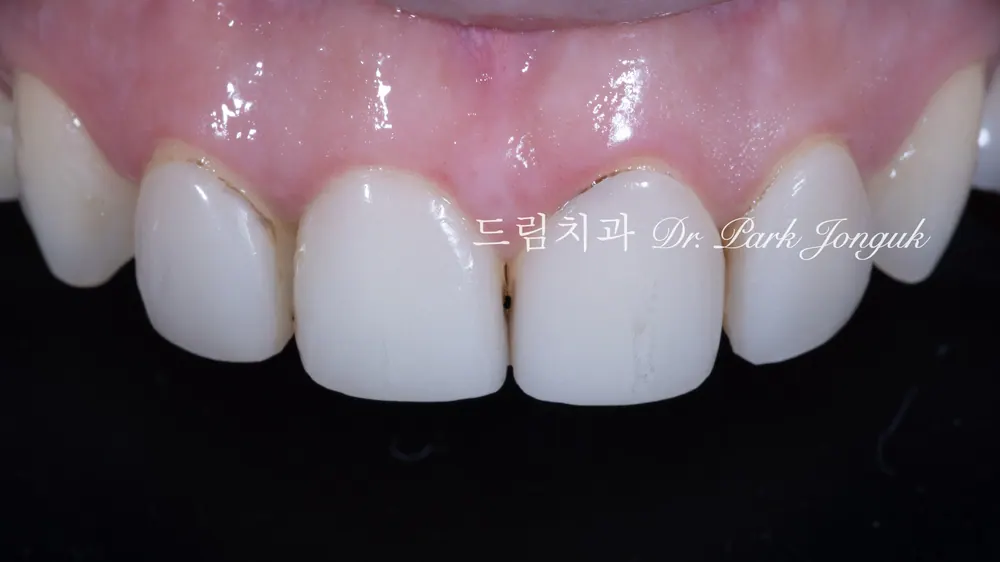
Discoloration was visible around the edges of the veneer,
and the patient came in for redo treatment.
More than the veneer itself,
discoloration around the margin and fine gaps at the contact area are often the real problem.
Video: Removing a Veneer with a Laser
As shown in the video, removing it with a laser
allows the veneer to be separated without forcibly grinding it off.
Photo 2. Right After Removal (Resin Cement Still Remaining)
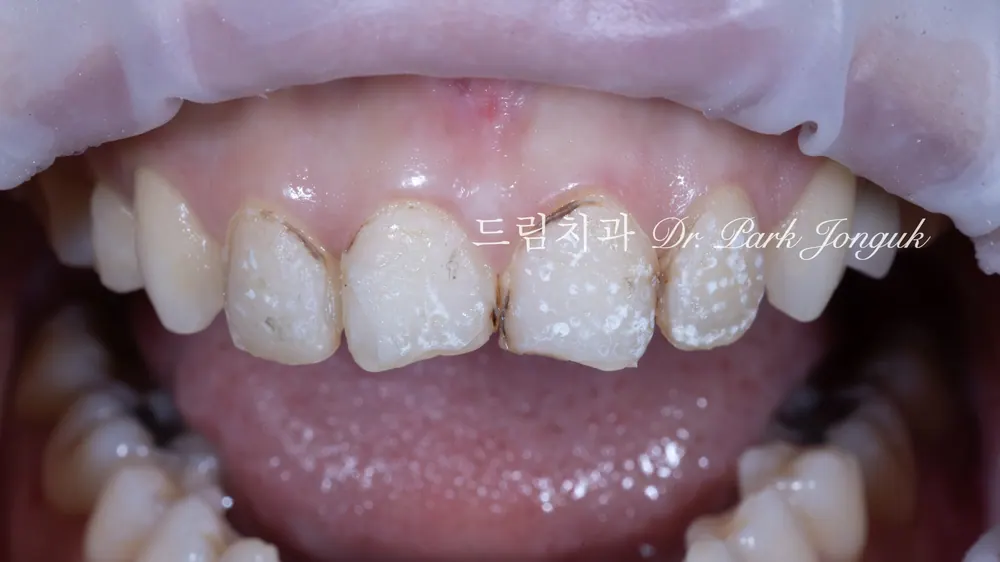
After laser removal,
you can see the resin cement remaining on the tooth surface, now discolored.
This is actually an advantage.
Because the boundary is now visible,
we can clean up "only the resin, without touching the tooth," while viewing it under a microscope.
Photo 3. After Removing the Resin Cement (Tooth's Original State)
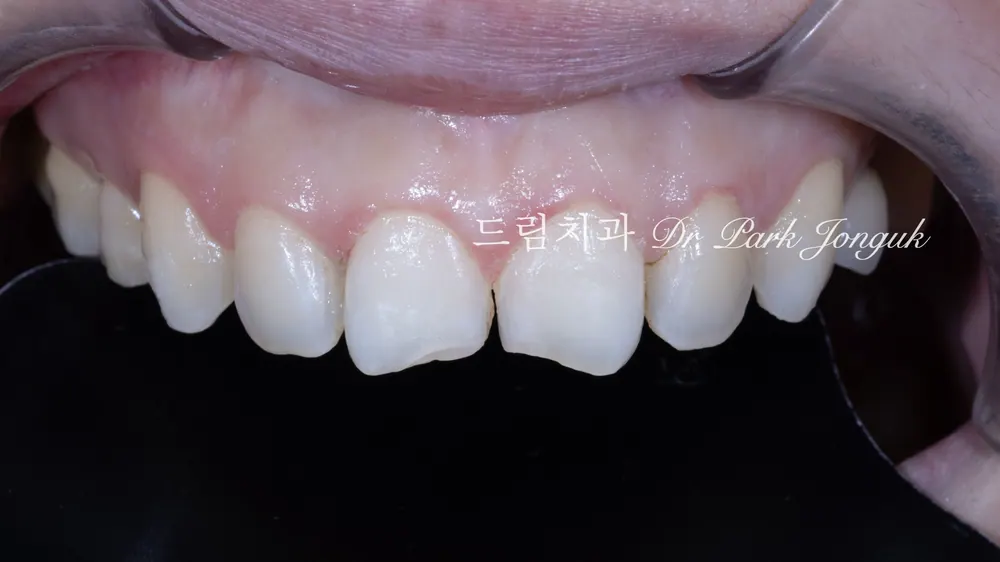
Once the resin has been cleaned up,
this is the stage where patients are most surprised.
"Wait, this is my own tooth?"
That's right.
The goal of removal is to "return the tooth to its original state without grinding it down."
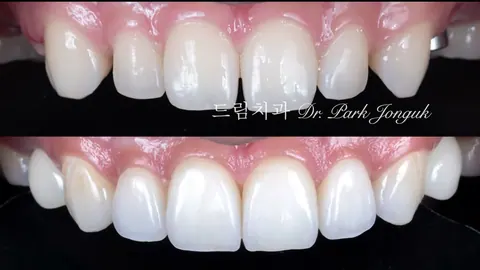
Photo 4. After Redo Treatment
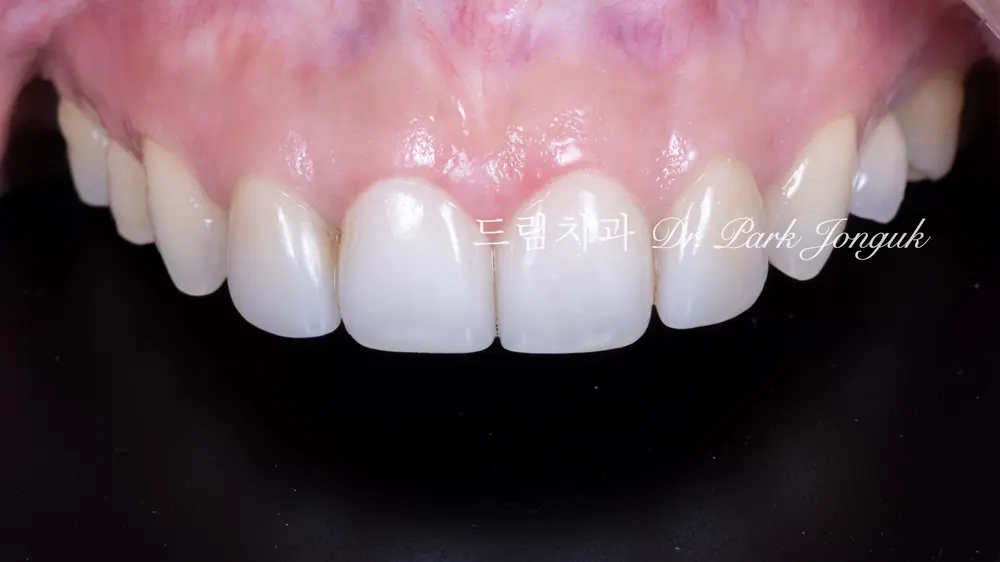
After redo treatment,
you can see that not only the color and shape, but also a natural sense of translucency, have been restored.
In veneer redo treatment, the "skill of remaking the veneer" matters, but
how safely the old veneer was removed beforehand is often the more important part.
Case 2 | No-Prep Veneers That Looked Too Artificial → A Patient Who Wanted Only Removal
Photo 5. Reason for the Visit
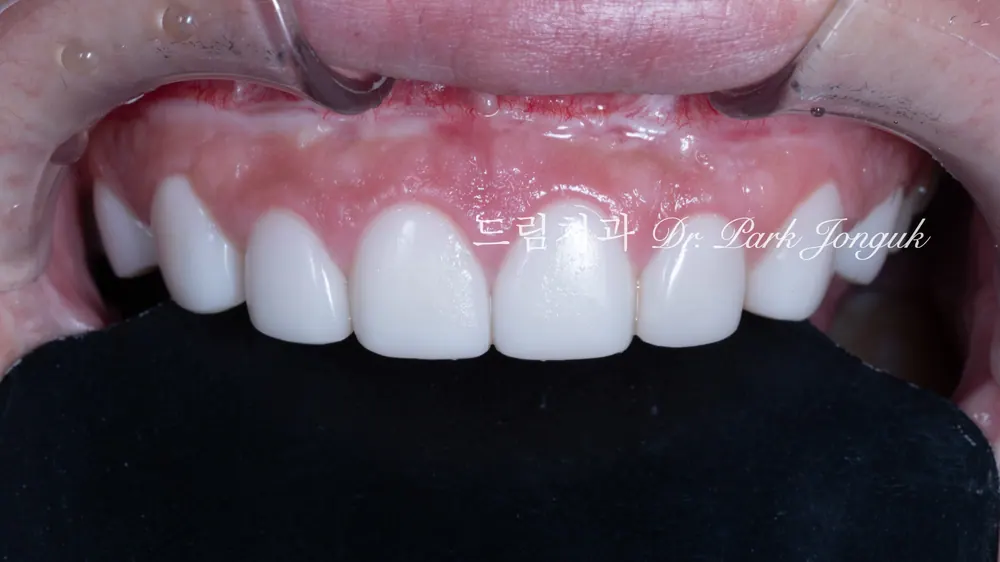
The patient had no-prep veneers done, but
after hearing comments from people around her like "it's too white," "it's too obvious," and even "it looks like donkey teeth,"
she came in wanting only to have them removed.
What shocked her was something she'd been told.
"Veneers can't be removed."
That's simply not true.
There's removal done with the right method, and there's removal that damages the tooth — that's the only real distinction.
Photo 6. After Laser Removal (Resin Cement Remaining)
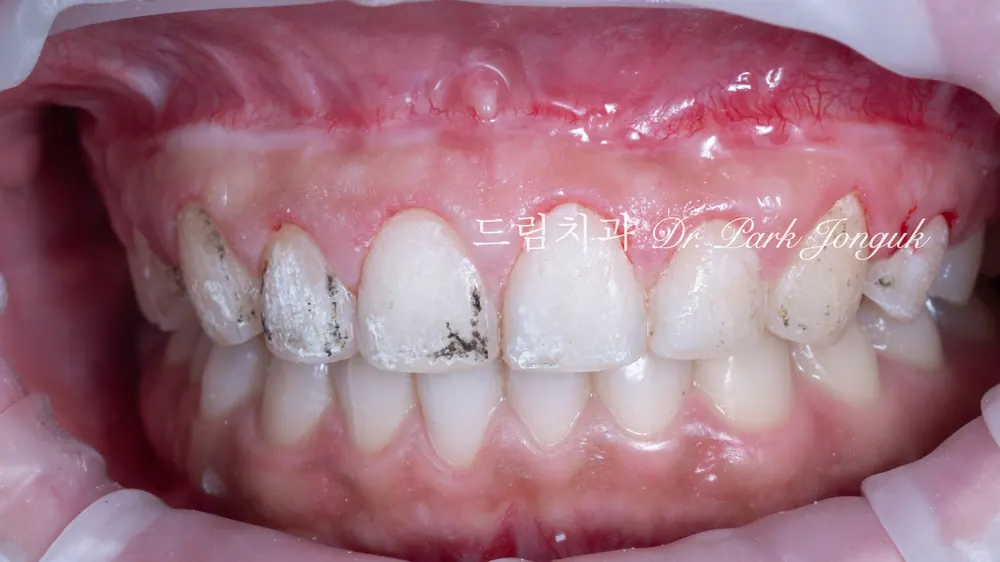
Just as in the previous case,
after separating the veneer with the laser, resin cement remains behind.
The important point at this stage is
not simply cleaning up "as much as is visible,"
but clearing it away without damaging the tooth while confirming everything clearly under a microscope.
Photo 7. Complete Removal of the Resin Cement Under a Microscope
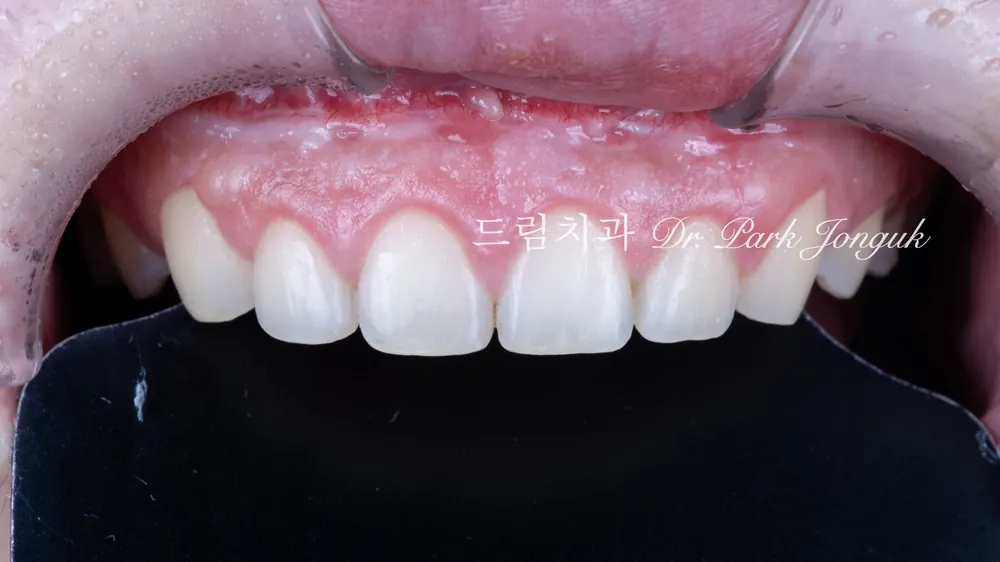
When the resin is cleaned up under a microscope,
the result is clean enough that even the patient herself says, "this is so clean."
And many patients say the same thing at this point.
"My natural tooth is prettier... I don't know why I even got veneers."
Veneer removal
should be approached, if only to reduce regrets like this,
with a clear understanding from the start of which methods allow for safe removal.
Conclusion | Veneer Removal Is "Separation," Not "Grinding"
For those considering veneer redo treatment,
here's the first thing I want to emphasize.
Only when veneer removal is done safely
can redo treatment be done with minimal additional reduction
and lead to a natural-looking result.
Removal by grinding with a high-speed handpiece
makes the boundaries between the ceramic, resin cement, and tooth unclear,
which can increase the risk of tooth damage.
Laser veneer removal, on the other hand,
doesn't force the ceramic off by grinding,
but instead separates it by weakening the resin cement layer,
which is far more favorable for preserving the tooth.
It's not that "veneers can't be removed" —
veneer removal simply needs to be done "properly."
Q&A (3 Questions)
Q1. Is laser veneer removal possible in every case?
A. It's advantageous in most veneer redo cases,
but the approach can vary depending on the type and thickness of the ceramic, the bonding condition, and other factors.
What matters is choosing the removal method that best serves the goal of "minimizing tooth damage."
Q2. When removing with a laser, doesn't the tooth get burned or damaged?
A. The principle is that the energy passing through the ceramic reacts with the adhesive layer (resin cement),
reducing its bond strength.
The remaining resin is then cleared away while being checked under a microscope,
so the risk of tooth damage can be reduced compared to simply grinding it off.
Q3. Can redo treatment be done right after veneer removal?
A. It depends on the case.
Depending on gum condition, the position of the existing margin, and the degree of tooth damage, a period with a temporary tooth may be needed.
In particular, if the gums were unstable or inflamed, allowing a stabilization period leads to a better result.
This article is a clinical note written by Dr. Park Jonguk of Dream Dental Clinic, Gangnam; the original was published on his blog. The photographs shown are real cases he treated. Results vary with each patient’s condition, and every procedure carries the possibility of individual variation and side effects.
Quick Consult
Request a Callback
Leave your number and we will call you back during clinic hours.
Request Received
We will contact you during clinic hours. For urgent matters, please call +82-2-3448-0028.